Giloy Care Guide: Light, Water & Growing Tips
Tinospora cordifolia
Giloy needs bright sun, a trellis, and well-draining soil that dries slightly between waterings. Learn how to grow this Ayurvedic climbing vine in pots and gardens across India.
Giloy Care Guide: Light, Water & Growing Tips
Start with wateringThe most common care mistake for GiloyWatering guide →Giloy care essentials
Light
at least 4–6 hours of direct sun or very bright light daily
Water
Water when the top 2–3 cm of soil is dry. Keep soil lightly moist in active growth, but never waterlogged — giloy is sensitive to soggy roots.
Soil
Light sandy loam rich in organic matter with good drainage. pH 6.0–7.5.
Humidity
moderate (40–70%); naturally suited to tropical Indian climates
Temperature
20°C to 38°C (68–100°F)
Fertilizer
About Giloy
Giloy is native to Indian subcontinent; tropical and subtropical India, Myanmar, and Sri Lanka, typically reaches 3–15 m on a trellis; 60–120 cm in a supported container indoors, with fast in warm, bright conditions with support growth. Giloy has a climbing growth habit and part of the Menispermaceae family. It is also known as Guduchi, Amrita, Tinospora, Heart-leaved Moonseed, Gulancha, Gulvel, and Gurcha.
| Detail | Information |
|---|---|
| Also known as | Guduchi, Amrita, Tinospora, Heart-leaved Moonseed, Gulancha, Gulvel, Gurcha |
| Native region | Indian subcontinent; tropical and subtropical India, Myanmar, and Sri Lanka |
| Mature size | 3–15 m on a trellis; 60–120 cm in a supported container |
| Growth rate | Fast in warm, bright conditions with support |
| Growth habit | Climbing |
| Scientific name | Tinospora cordifolia |
| Family | Menispermaceae |
Giloy Care Guide: Light, Water & Growing Tips
Giloy care starts with an honest framing: Tinospora cordifolia is a fast-climbing medicinal vine, not a low-light windowsill foliage plant. Get three things right—bright sun or very strong light, a trellis from week one, and soil that never stays waterlogged—and watering, feeding, and pruning become predictable. Skip the support, park it in shade, or keep the pot soggy through monsoon weeks, and you will see pale thin shoots, yellow leaves, and stalled nodes long before fertilizer can help.
This overview is the starting map for home growers in India and similar warm climates: how to recognize the plant, what mature size looks like in a pot versus the ground, the care rhythm that fits a balcony trellis, the warning signs that matter first, and when to open the deeper Giloy light, watering, and soil guides. For species profile fields and hub notes, start at the Giloy plant page.
What Is Giloy?
Giloy is a large deciduous climbing shrub in the moonseed family that twines for support and can send down long, thread-like aerial roots. Kew’s Plants of the World Online accepts Tinospora cordifolia (Willd.) Hook.f. & Thomson as a liana of the wet tropical biome with a native range from the Indian Subcontinent to Indo-China. Plants For A Future describes it as a deciduous climber growing to about 15 m at a fast rate in warm conditions, suited to USDA hardiness zones 10–12.
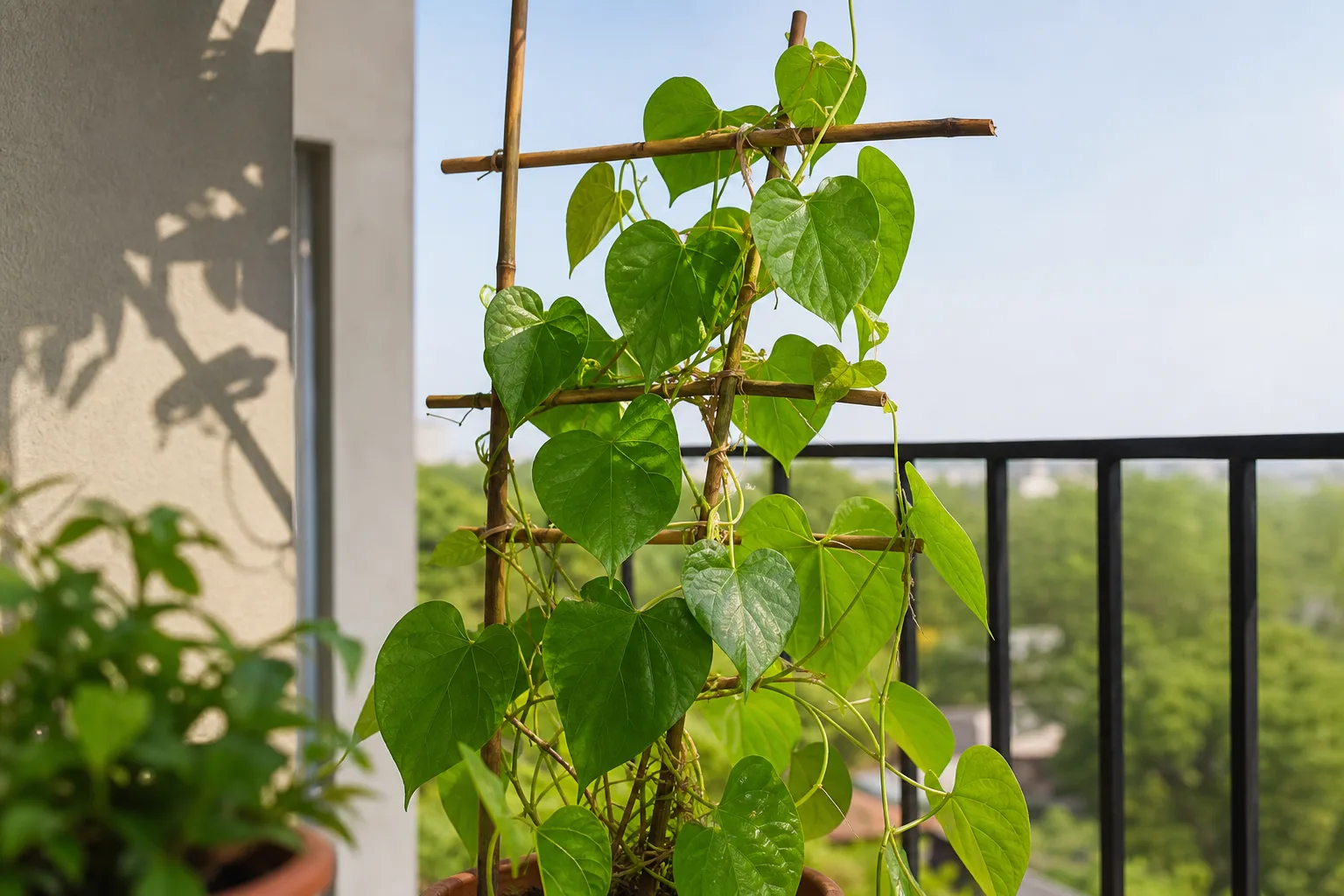
In home culture, think of Giloy as a sun-loving vine with succulent stems, heart-shaped leaves, and visible lenticels. Fresh nodes and aerial-root bumps along the stem are better success signals than any marketing name on the nursery tag.
Botanical Identity and Common Names
The accepted botanical name is Tinospora cordifolia in the family Menispermaceae. Kew lists common names including giloe and gulancha; Indian growers also know it as guduchi, amrita, gulvel, gurcha, and heart-leaved moonseed. Those labels usually mean the same species for care purposes, but buyers should still confirm the botanical tag.
Useful Tropical Plants notes the species climbs by twining around other plants and can reach the tops of tall trees while sending down aerial roots that root when they touch the ground. Habitat notes place it in dry districts at low elevations and deciduous or dry forests across East Asia—India, Sri Lanka, and Myanmar in classic range summaries, with Kew expanding distribution through Bangladesh, Myanmar, Vietnam, and island floras.
Do not confuse Giloy with unrelated “immunity vines” sold only by Hindi market names. Related Tinospora species such as T. crispa or T. sinensis appear in trade and research; if the leaf shape, stem texture, or label looks off, ask for Tinospora cordifolia specifically before copying this care map.
Growth Habit, Size, and Support Needs
In open ground with a host tree or strong frame, Giloy can climb several metres—PFAF’s 15 m figure is a landscape ceiling, not a balcony promise. In a supported container, expect roughly 60–120 cm of manageable vine if you prune and train regularly, with longer runs if you give a tall railing or freestanding trellis.
Support is not optional décor. Without a stake, trellis, or railing, stems sprawl, nodes stretch, and aerial roots search for contact points that never arrive. Tie the main stem loosely within the first weeks after bringing a plant home, then guide new shoots as they lengthen. Judge success by firm green stems, short internodes in bright light, and new aerial-root bumps—not by how many old woody canes you keep.
Best Growing Conditions at a Glance
If you only remember four rules for Giloy care, use these:
- Light: at least 4–6 hours of direct sun or equivalent very bright light daily.
- Water: water when the top 2–3 cm of mix feels dry; never leave the pot chronically soggy.
- Soil: light sandy loam rich in organic matter with excellent drainage (rough pH 6.0–7.5).
- Support: install a trellis early; prune for structure instead of letting the vine tangle.
Light and Placement
PFAF states Giloy cannot grow in the shade and prefers full sun with well-drained soil that can be dry or moist. For Indian balconies and terraces, aim for a south- or west-facing rail, open roof edge, or bright east exposure with several hours of real sun—not a dim living-room corner.
Weak light produces thin pale shoots, long internodes, and a vine that stays wet too long after each watering. Harsh midday glass-magnified sun after a shaded nursery shelf can scorch soft new leaves, so acclimate over several days. Indoors, only a sunroom-level exposure works long term; for window angles, seasonal intensity, and low-light limits, use the dedicated Giloy light guide.
Watering Rhythm
Water when the top 2–3 cm feels dry to the touch. Keep the mix lightly moist during active warm-season growth, but never waterlogged—Giloy is sensitive to soggy roots. As a practical pot reference, that often means every 4–7 days in hot summer and every 7–10 days in cooler months, adjusting for pot size, wind, and monsoon humidity.
In field culture the plant is often rain-fed, but containers still need manual watering in dry spells and less frequent watering when monsoon rains keep the mix wet. Overwatering signs include yellowing leaves, soft stem bases, sour-smelling wet soil, and stalled climbing despite warmth. Underwatering shows as wilting heart-shaped leaves, soil pulling from the pot wall, thin pale new shoots, and lower-leaf drop. When unsure, check the mix first—then open the full Giloy watering guide before changing fertilizers or pots.
Soil, Drainage, and Containers
PFAF lists Giloy as suitable for light, medium, or heavy soils if well drained, and notes it prefers soils that can be dry or moist rather than saturated. For pots, a practical mix is 50% garden soil or potting mix, 30% compost or well-rotted manure, and 20% coarse sand or perlite, targeting pH about 6.0–7.5. Choose a container with real drainage holes; empty saucers after watering so roots do not sit in a pool.
If the pot stays heavy for days, smells sour, or the vine yellows after watering, fix drainage before you add more water or feed. Refresh compacted mixes when you repot Giloy, and use the dedicated Giloy soil guide when you need mix recipes and wrong-soil warning signs in depth.
Temperature and Humidity
Treat Giloy as a tropical-to-subtropical climber. PFAF’s USDA 10–12 hardiness band matches frost-tender culture; comfortable day-to-day growth for Indian home growers usually sits around 20–38°C (68–100°F) once the plant is established in sun. Protect containers from cold snaps that push nights toward frost, and keep the mix drier when growth slows in cool weather.
Moderate humidity (about 40–70%) suits the plant in typical Indian outdoor air. Stagnant, humid corners with weak light raise fungal risk on crowded stems—give airflow around the trellis rather than misting as a substitute for light and drainage.
Feeding, Pruning, and Propagation Basics
Feeding, pruning, and propagation only work after light, drainage, and support are stable. Do not stack fertilizer, hard pruning, and a full repot in the same week on a stressed vine.
Fertilizer Timing
Feed every 4–6 weeks during active growth from spring through monsoon with a balanced liquid fertiliser or compost tea, and pause if the plant is newly repotted, not climbing, or showing wet-root stress. Field guidance often starts with farmyard manure at planting; in pots, a light organic top-dressing in spring is usually enough. Fertilizer cannot fix shade, missing support, or a waterlogged mix—correct those first, then use the Giloy fertilizer guide for dilution and salt-build-up details.
Pruning for Structure
Prune to keep the vine on the trellis and to remove tangled, damaged, or excessively woody growth back to healthy nodes. Cut cleanly with sharp tools, and avoid stripping the plant to bare sticks in peak heat. Training beats endless shearing: guide two or three main leaders and thin crossing stems so light and air reach the canopy. For timing, cut types, and aftercare, use the Giloy pruning guide.
Propagation Overview
Home growers usually multiply Giloy from stem cuttings, not seed. Peer-reviewed and horticultural notes repeatedly flag poor seed set and low natural germination, which is why vegetative methods dominate nursery and research protocols. Plants For A Future calls cuttings very easy because the plant naturally produces aerial roots. Practical home timing in India often favors semi-hardwood cuttings with two to four nodes in June–July, planted promptly into moist, free-draining mix while the lower end stays humid until roots form.
Research on stem cuttings reports strong rooting responses with modest auxin pre-treatments (for example, trials around 100 ppm IBA)[Flagged: no authoritative source found for this claim], but untreated node-bearing cuttings still root for many home growers when warmth and moisture are steady. Seeds can work after a soak, yet cuttings usually give faster, more uniform plants. Step-by-step aftercare lives in the Giloy propagation guide.
Common Mistakes and Warning Signs
Most Giloy failures at home share the same pattern: shade + wet feet + no trellis.
Watch for yellow leaves on a constantly wet mix (overwatering or poor drainage), wilting on a bone-dry pot (underwatering), and thin stems reaching hard for light (placement). Soft bases and sour soil mean you must improve drainage and dry the top of the mix before the next deep drink. Stalled climbing despite warmth often traces back to a pot that never dries, a missing stake, or light that is too weak to drive growth.
Fix the growing condition first—move to sun, add support, or refresh drainage—then trim damaged tissue after the vine stabilizes. Do not answer yellow leaves with fertilizer alone.
Pet Safety and Handling Notes
Giloy is widely grown as an Ayurvedic medicinal vine, not as a confirmed pet-safe ornamental. Major ASPCA toxic and non-toxic plant lists do not provide a clear species listing for Tinospora cordifolia in the databases used here, so treat it as unverified around pets that chew plants. The plant contains bioactive compounds valued in traditional human use; that is a reason for caution with cats, dogs, and other animals, not a veterinary safety certificate.
Keep pots, trellises, and harvested stems out of reach. This care guide does not give medical advice for people or pets—NCCIH’s overview of Ayurvedic medicine is a reminder that traditional use and modern clinical evidence are different conversations. If a pet eats a large amount of stem or leaf, contact a veterinarian.
When to use this page vs other Giloy guides
Use this overview when you need the whole care map: identity, size, light, water, soil, climate, feeding, pruning, propagation basics, mistakes, and pet caution. Switch to a sibling page when one problem dominates.
Open Giloy light for window choice, sun hours, and stretch vs scorch signs. Open Giloy watering when you are unsure how dry is dry enough, or when monsoon pots stay wet. Open Giloy soil for mix recipes and drainage fixes. Use fertilizer, repotting, propagation, and pruning when those jobs are the next action—not as substitutes for fixing light and wet roots.
Related Giloy guides
- Giloy plant hub — species profile, grower notes, and cluster entry
- Giloy light — sun hours, placement, and low-light limits
- Giloy watering — dryness checks, seasonal cadence, over/under signs
- Giloy soil — mix, drainage, and pH guidance
- Giloy fertilizer — feeding schedule and dilution
- Giloy repotting — when to upsize and how to refresh mix
- Giloy propagation — cuttings, timing, and aftercare
- Giloy pruning — training on a trellis and cleanup cuts
Conclusion
Giloy rewards growers who treat it like a sun-driven climbing vine with drainage standards, not like a shade-tolerant indoor foliage plant. Confirm you have Tinospora cordifolia, give it a trellis and bright light, water only after the top of the mix dries, and keep the root zone from sitting wet through humid weeks. Once those basics are steady, feeding, pruning, and cuttings become straightforward follow-ons—and the sibling guides are there when one topic needs more depth.
How to care for Giloy?
How much light does Giloy need?
at least 4–6 hours of direct sun or very bright light daily
- at least 4–6 hours of direct sun or very bright light daily - at least 4–6 hours of direct sun or very bright light daily.
When should you water Giloy?
Water when the top 2–3 cm of soil is dry. Keep soil lightly moist in active growth, but never waterlogged — giloy is sensitive to soggy roots.
- Water when the top 2–3 cm feels dry to the touch - Water when the top 2–3 cm of soil is dry.
- Drain excess water - Water when the top 2–3 cm of soil is dry.
What soil works best for Giloy?
Light sandy loam rich in organic matter with good drainage. pH 6.0–7.5.
- 50% garden soil or potting mix - Light sandy loam rich in organic matter with good drainage.
- 30% compost or well-rotted manure - Light sandy loam rich in organic matter with good drainage.
- 20% coarse sand or perlite - Light sandy loam rich in organic matter with good drainage.
Grower notes for Giloy
What matters most with Giloy
Giloy is a fast-climbing medicinal vine, so support, drainage, and bright light matter more than keeping every old stem. Give it a trellis, stake, or host frame early and prune leggy growth back to nodes. In practice, the care checkpoint is simple: at least 4–6 hours of direct sun or very bright light daily. Pair that with light sandy loam rich in organic matter and good drainage, and avoid changing water, pot size, and placement all at once.
Best placement in a real home
Giloy belongs on a sunny balcony, terrace, or garden edge where a trellis or railing can carry its weight — not in a dark indoor corner. Water when the top 2–3 cm of soil is dry, and cut back if monsoon rains keep the pot soggy. If the mix stays wet longer than expected, improve drainage before watering again. Humidity target: moderate (40–70%); naturally suited to tropical Indian climates. Temperature comfort zone: 20°C to 38°C (68–100°F).
Before you buy this plant
Choose Giloy with firm green stems, healthy nodes, and no sour smell from the pot. Be cautious if you see mushy bases, yellow leaves on a wet mix, or a vine with no support and broken aerial roots. A small starter plant with clean lenticels on the stem is fine if you can provide a trellis within the first month.
First month after bringing it home
Do not repot Giloy on day one unless drainage is clearly failing. Tie the main stem loosely to a stake, learn how fast the pot dries, and keep care boring while it adjusts. Watch especially for overwatering, yellow-leaves, and wilting. If problems appear, correct light and drainage first rather than stacking fertilizer, repotting, and pruning together.
Pet-aware note for Giloy
Giloy is an Ayurvedic medicinal vine, not a confirmed pet-safe houseplant. Major pet-toxicity databases do not list Tinospora cordifolia, but the plant contains bioactive alkaloids used in human remedies. Keep pots and harvested stems out of reach of pets that chew plants.
How to tell Giloy is settling in
Also sold as Guduchi, Amrita, and Heart-leaved Moonseed, this vine should be judged by fresh nodes and aerial root bumps along the stem, not label names alone. If you plan to multiply it later, common methods include semi-hardwood stem cuttings in June–July, hardwood cuttings with nodes, and seed sown after a 24-hour soak. Repot only when you see roots escaping drainage holes or the pot drying within a day of watering.
Is giloy safe for pets?
Giloy (Tinospora cordifolia) is not listed in major pet-toxicity databases, but it is a medicinal vine with bioactive compounds. Treat it as unverified and keep out of reach of pets.
Tinospora cordifolia is widely used in Ayurvedic medicine but does not have a confirmed species-specific ASPCA listing. Members of the moonseed family can contain alkaloids, so prevent routine chewing by cats, dogs, and other pets.
Watering Giloy
For Giloy, water when the top 2–3 cm feels dry to the touch and water every 4–7 days in summer pots; every 7–10 days in cooler months. Water more often in hot dry months; reduce frequency in cool or rainy weather when the pot stays wet longer.
| Detail | Information |
|---|---|
| How often | Every 4–7 days in summer pots; every 7–10 days in cooler months |
| How to check | Water when the top 2–3 cm feels dry to the touch |
| Seasonal changes | Water more often in hot dry months; reduce frequency in cool or rainy weather when the pot stays wet longer |
Signs of overwatering
- yellowing leaves
- soft stems at the base
- sour-smelling wet soil
- stalled vine growth despite warmth
Signs of underwatering
- wilting heart-shaped leaves
- dry, pulling-away soil
- thin pale new shoots
- leaf drop on lower stems
Soil & potting for Giloy
Use a mix of 50% garden soil or potting mix, 30% compost or well-rotted manure, 20% coarse sand or perlite for Giloy. Excellent drainage required; does not tolerate waterlogging or prolonged high-rainfall saturation. Target soil pH around 6.0–7.5. Repot every 1–2 years, or when the vine outgrows its pot and support, ideally in spring to early monsoon (March–June).
| Detail | Information |
|---|---|
| Recommended mix | 50% garden soil or potting mix, 30% compost or well-rotted manure, 20% coarse sand or perlite |
| Drainage | Excellent drainage required; does not tolerate waterlogging or prolonged high-rainfall saturation |
| Soil pH | 6.0–7.5 |
| Repotting frequency | Every 1–2 years, or when the vine outgrows its pot and support |
| Best season to repot | Spring to early monsoon (March–June) |
Signs it needs repotting
- roots escaping drainage holes
- pot drying within a day of watering
- vine stalling despite good light and support
Humidity & temperature for Giloy
Giloy prefers moderate (40–70%); naturally suited to tropical Indian climates, though normal home humidity is usually fine. Keep temperatures around 20°C to 38°C (68–100°F).
| Detail | Information |
|---|---|
| Humidity | moderate (40–70%); naturally suited to tropical Indian climates - normal home humidity is fine. |
| Ideal temperature | 20°C to 38°C (68–100°F) |
Fertilizer & pruning for Giloy
Common problems on Giloy
Yellow Leaves
MediumLikely cause: Common on this plant type; confirm with recent watering, light, and root checks.
Quick fix: Inspect the plant and correct the most likely care stressor before stacking treatments.
Full fix guide →Brown Tips
MediumLikely cause: Common on this plant type; confirm with recent watering, light, and root checks.
Quick fix: Inspect the plant and correct the most likely care stressor before stacking treatments.
Full fix guide →Root Rot
MediumLikely cause: Common on this plant type; confirm with recent watering, light, and root checks.
Quick fix: Inspect the plant and correct the most likely care stressor before stacking treatments.
Full fix guide →Overwatering
MediumLikely cause: Common on this plant type; confirm with recent watering, light, and root checks.
Quick fix: Inspect the plant and correct the most likely care stressor before stacking treatments.
Full fix guide →Underwatering
MediumLikely cause: Common on this plant type; confirm with recent watering, light, and root checks.
Quick fix: Inspect the plant and correct the most likely care stressor before stacking treatments.
Full fix guide →Spider Mites
MediumLikely cause: Common on this plant type; confirm with recent watering, light, and root checks.
Quick fix: Inspect the plant and correct the most likely care stressor before stacking treatments.
Full fix guide →Mealybugs
MediumLikely cause: Common on this plant type; confirm with recent watering, light, and root checks.
Quick fix: Inspect the plant and correct the most likely care stressor before stacking treatments.
Full fix guide →Aphids
MediumLikely cause: Common on this plant type; confirm with recent watering, light, and root checks.
Quick fix: Inspect the plant and correct the most likely care stressor before stacking treatments.
Full fix guide →Leggy Growth
MediumLikely cause: Common on this plant type; confirm with recent watering, light, and root checks.
Quick fix: Inspect the plant and correct the most likely care stressor before stacking treatments.
Full fix guide →Slow Growth
MediumLikely cause: Common on this plant type; confirm with recent watering, light, and root checks.
Quick fix: Inspect the plant and correct the most likely care stressor before stacking treatments.
Full fix guide →Wilting
MediumLikely cause: Common on this plant type; confirm with recent watering, light, and root checks.
Quick fix: Inspect the plant and correct the most likely care stressor before stacking treatments.
Full fix guide →Drooping Leaves
MediumLikely cause: Common on this plant type; confirm with recent watering, light, and root checks.
Quick fix: Inspect the plant and correct the most likely care stressor before stacking treatments.
Full fix guide →Low Humidity
MediumLikely cause: Common on this plant type; confirm with recent watering, light, and root checks.
Quick fix: Inspect the plant and correct the most likely care stressor before stacking treatments.
Full fix guide →Not Enough Light
MediumLikely cause: Common on this plant type; confirm with recent watering, light, and root checks.
Quick fix: Inspect the plant and correct the most likely care stressor before stacking treatments.
Full fix guide →Fungus Gnats
MediumLikely cause: Common on this plant type; confirm with recent watering, light, and root checks.
Quick fix: Inspect the plant and correct the most likely care stressor before stacking treatments.
Full fix guide →Mold on Soil
MediumLikely cause: Common on this plant type; confirm with recent watering, light, and root checks.
Quick fix: Inspect the plant and correct the most likely care stressor before stacking treatments.
Full fix guide →