Giloy Repotting Guide: Timing, Pot Size & Soil
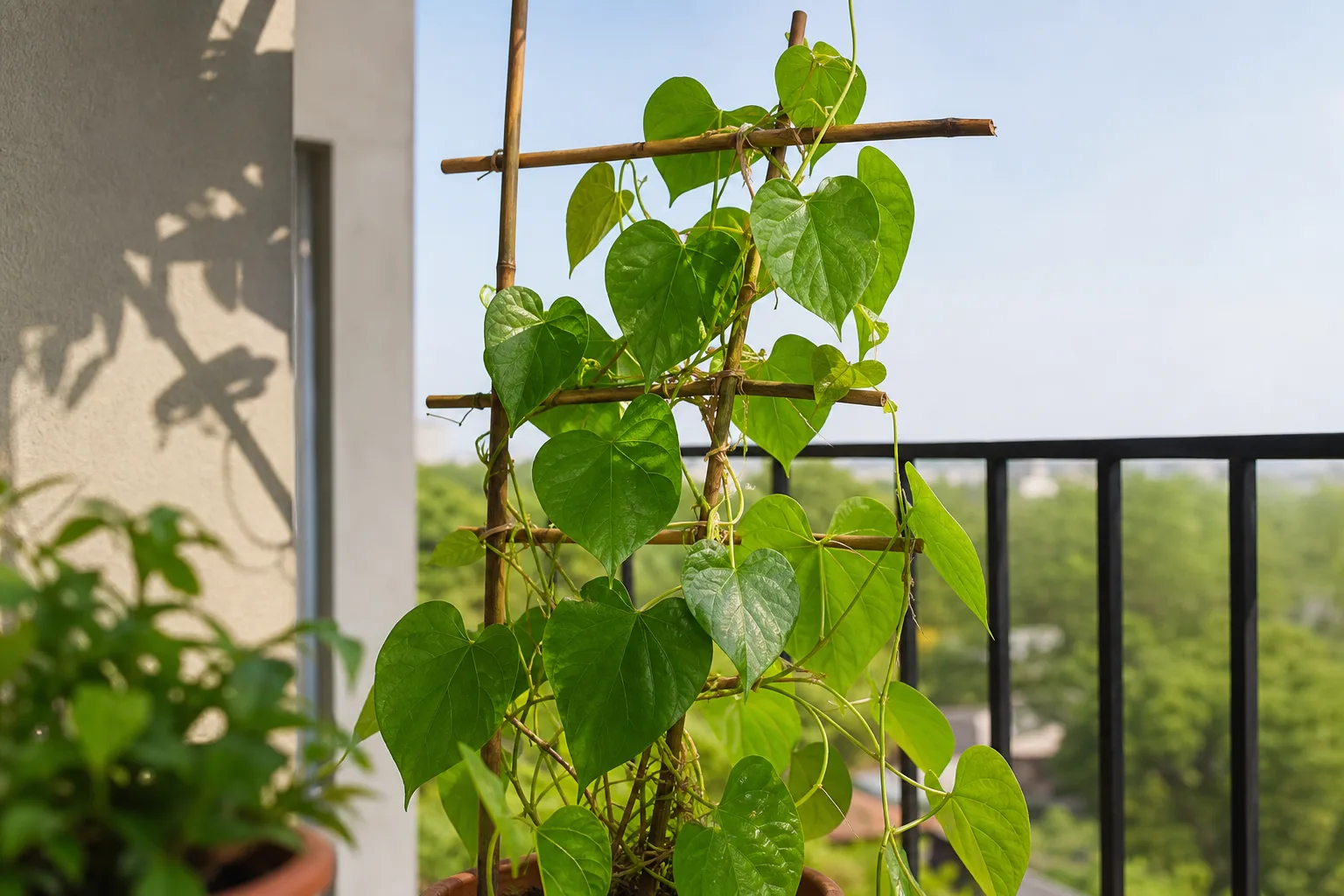
Giloy Repotting Guide: Timing, Pot Size & Soil
Giloy Repotting Guide: Timing, Pot Size & Soil
Giloy (Tinospora cordifolia) is a fast-climbing medicinal vine, not a compact tabletop houseplant that wants a yearly pot upgrade for looks. In containers it fails more often from soggy roots in an oversized pot than from a snug root ball. Kew lists the species as a liana native to the Indian Subcontinent to Indo-China. Useful Tropical Plants and Plants For A Future both describe a large deciduous climber that can reach about 15 m with long thread-like aerial roots when it has a host or trellis. Your balcony pot will never match that scale — and it should not try.
This guide covers when giloy truly needs repotting, the March–June window that matches Indian growth, how big the next pot should be, which mix drains safely, how to move the vine without shredding nodes, and how to tell normal transplant pause from waterlogging. Use it with Giloy watering and Giloy soil rather than changing pot, water, and fertilizer on the same day.
The Short Answer: When and How to Repot Giloy
Repot giloy every 1–2 years, or sooner when roots escape drainage holes, the pot dries within a day of watering, or the vine stalls despite bright light and a firm trellis. The best window in most of India is spring to early monsoon (roughly March–June), while nights are warm and the plant is about to push new nodes — not in the middle of continuous heavy rain.
Move up only one pot size (about 5–7 cm / 2–3 inches wider in diameter). Use a light sandy loam rich in organic matter with excellent drainage — a practical container blend is roughly 50% garden soil or potting mix, 30% compost or well-rotted manure, and 20% coarse sand or perlite. Reattach the main stem to a stake or trellis immediately. Water once to settle the mix, then wait until the top 2–3 cm dry before the next drink. Hold fertilizer for 3–4 weeks. Mild leaf yellowing or a short climb pause is common; sour soil and soft basal stems are not.
Why Giloy Roots Need Air More Than Extra Soil
Giloy evolved as a twining vine of dry districts and deciduous forests across India, Sri Lanka, and Myanmar, with well-drained to moist soil and full sun — it does not tolerate shade. Indian package-of-practices guidance for Tinospora cordifolia is blunt about the root environment: light medium sandy loam rich in organic matter with adequate drainage, and the crop does not tolerate high rainfall or waterlogged conditions (Vikaspedia agro-techniques).
That biology is why oversized pots are dangerous. Extra unused mix stays wet after monsoon showers or a heavy balcony watering. Roots in waterlogged soil cannot absorb oxygen, then decay — Missouri Botanical Garden explains the same overwatering and root-damage pathway for container plants generally. For giloy, a slightly snug pot that dries on a predictable rhythm is safer than a deep tub that stays cold and sour for a week.
Field plantings use host trees or wooden stakes because the vine covers supports quickly. In a pot, the same principle applies: the container holds the root system, while a trellis or railing carries the weight of stems. Repotting that ignores support often looks like “root failure” when the real problem is a collapsed, shaded tangle of stems.
When Giloy Actually Needs a New Pot
Do not repot on a calendar alone. Penn State Extension’s houseplant guidance is a good decision filter: check whether mix dries unusually fast, whether roots grow through drainage holes, and whether growth has slowed despite regular care — then unpot and look for a dense, circling root mass with little mix visible (Penn State Extension — Repotting Houseplants).
Clear root-bound and soil-failure signs
For container giloy, treat these as strong “yes, move it” signals:
- Roots escaping drainage holes or forming a hard mat at the pot base
- Pot drying within a day of a thorough watering in warm weather
- Vine stalling — few new nodes, thin pale shoots — despite Giloy light levels of at least 4–6 hours of direct sun or very bright light and a stable trellis
- Mix that has collapsed into a sour, water-holding sludge after monsoon weeks, even if roots are not yet circling
If the plant is still putting out firm green nodes, the pot holds moisture for a few days (not a week), and no roots are pushing out the bottom, wait. Refreshing the top few centimetres of mix and improving drainage holes is often enough between full repots.
Best Season: Spring to Early Monsoon
Spring through early monsoon (March–June) aligns with giloy’s active climb. Warmth helps fine roots colonize new mix before the heaviest continuous rains arrive. Commercial cuttings are typically taken in June–July from older nodal stems (Vikaspedia), which is a useful reminder that this species recovers fastest when temperatures support growth — the same logic applies to transplanting an established pot plant.
Avoid elective repots in the coolest, dullest weeks if your balcony barely warms, and avoid them in the peak of a wet monsoon spell unless drainage has already failed. A freshly disturbed root ball sitting in days of rain-soaked mix is how giloy develops soft bases and yellow leaves. Emergency moves for sour, anaerobic soil can happen any month — but then prioritize a smaller or better-draining pot, not a bigger one.
Choose Pot Size and Drainage First
Move one size up, not two. A jump from a 20 cm to a 30+ cm pot leaves a ring of wet mix the vine cannot use yet. Prefer containers with multiple drainage holes. Plastic holds moisture longer; unglazed terracotta dries faster and suits giloy’s dislike of prolonged wetness, though it needs more frequent checks in dry heat.
Never put a layer of rocks “for drainage” at the bottom. University of Wisconsin horticulture notes that gravel layers can inhibit drainage and that root-rot fungi thrive in persistently wet media — use a pot with drainage holes and a pasteurized potting mix, not recycled garden mud alone. For outdoor Indian pots, you can blend garden loam in, but keep the mineral sand/perlite fraction high enough that water exits freely.
Weight matters for a climber: choose a wide, stable base so a windy balcony and a loaded trellis do not tip the whole plant after rain.
Soil Mix to Use When You Repot
Match the field recommendation — sandy loam, organic matter, drainage — to a container formula you can mix at home:
- 50% quality potting mix or clean garden loam (not sticky clay scooped from a waterlogged bed)
- 30% compost or well-rotted manure (field plantings use FYM at land preparation; pots need a lighter hand)
- 20% coarse sand or perlite for air spaces
Target roughly pH 6.0–7.5. Moisten the mix before packing so it settles evenly, as Penn State recommends for houseplant repotting. Skip moisture-control gels and peat-heavy “keeps wet for weeks” blends. If last year’s mix smells sour or stays black and cold for days, discard it — do not reuse it as the bulk of the new pot (UW root-rot guidance).
For deeper mix design, see Giloy soil. For feeding after the plant restarts climbing, see Giloy fertilizer — not during the first weeks after the move.
Step-by-Step Giloy Repotting
Water the plant lightly an hour before you start so the root ball slides out without tearing. Wear gloves if you prefer; the bark can flake on older stems. Lay out the new pot, pre-moistened mix, clean shears, and the trellis or stake you will use before you unpot.
- Tip the pot and ease the root ball out. Support the crown; do not yank aerial roots that have glued themselves to the old rim.
- Tease circling roots gently. Trim only mushy, black, or foul-smelling roots; leave firm cream-to-tan roots.
- Add a base of mix so the plant sits at the same depth as before — do not bury woody stem that was previously above the soil line.
- Set the root ball, backfill, and firm lightly. Leave about 2–3 cm of headspace for watering.
- Install or reattach support now, while you can still see the main stem. Tie loosely with soft ties at two or three points.
- Water thoroughly until runoff appears, empty the saucer, and move the pot back to its bright spot.
Loosen roots, keep the crown height, reattach support
Giloy’s aerial roots are normal, not a disease — they are part of how the climber anchors and, in the wild, can root when they reach soil. When repotting, do not rip every aerial root off “to tidy the plant.” Guide a few toward the new mix if they are long enough; leave others attached to the trellis. Keep the white vertical lenticels on older stems intact where you can; rough handling that peels corky bark invites decay, especially if the mix stays wet.
Aftercare for the First Four Weeks
Expect a pause, not instant new metres of vine. Keep the plant in the same bright exposure it had before — giloy cannot grow in shade (PFAF). Water only when the top 2–3 cm feel dry; do not keep the mix constantly moist “to help it settle.” Skip fertilizer and heavy pruning for 3–4 weeks unless you must remove clearly dead stems.
Watch for recovery signals: firm new nodes, aerial root bumps on fresh growth, and leaves that hold turgor through midday heat. If lower leaves yellow while the mix stays wet, increase airflow, empty saucers, and delay the next watering — that pattern is closer to water stress from oxygen starvation than under-watering. Pair this page with Giloy watering for the finger-check rhythm once roots re-explore the pot.
When Not to Repot
Skip elective repotting when:
- The plant arrived this week from a nursery and drainage is already working — let it acclimate first
- You are in a multi-day rain spell with no covered balcony and the current pot still drains
- The vine is heat- or drought-stressed (wilting on bone-dry mix) — water and shade briefly, then reassess
- You planned to change pot size, soil, fertilizer, and hard prune in one afternoon — pick one intervention
If roots are rotting, moving into fresh, freer-draining mix in a clean pot with holes is the exception. In that case, size the new pot to the remaining healthy root mass, not to the old oversized container.
Repotting Stress vs Root Trouble
Mild transplant stress looks like temporary wilting the first hot afternoon, a few yellow older leaves, and slower climbing for one to three weeks while soil moisture still cycles normally and the crown stays firm. Root trouble looks like wilting while the mix is still wet, a sour or rotten smell, soft tissue at the stem base, and brown mushy roots — classic root-rot symptoms described by UW–Madison horticulture.
If you see the second pattern, do not “perk it up” with more water. Unpot, trim soft roots, and restart in a draining mix. If the first pattern appears after a careful spring move, wait and keep care boring. Multiplying the plant from healthy nodal cuttings is often smarter than nursing a fully rotten crown — see Giloy propagation.
When to use this page vs other Giloy guides
Use this repotting page when you are deciding whether to change containers, what pot and mix to use, how to move the vine, or how to nurse it for the first month after a transplant.
Use Giloy overview for identity, mature size, and the full care snapshot. Use Giloy light when pale, leggy stems suggest placement, not pot size. Use Giloy watering when yellowing tracks wet or dry cycles between repots. Use Giloy soil when you need mix recipes without a full transplant. Use Giloy fertilizer only after new growth resumes. Use Giloy pruning to manage length on the trellis once the root ball is stable. Use Giloy propagation when you want new plants from stem cuttings rather than saving a failed pot.
Related Giloy guides
- Giloy care overview — species profile, growth habit, and where this vine fits in a home garden
- Giloy light needs — sun hours and balcony placement that keep nodes tight
- Giloy watering — finger-check timing before and after a pot change
- Giloy soil — drainage-first mixes and pH for containers
- Giloy fertilizer — when to resume feeding after transplant
- Giloy propagation — nodal cuttings if you prefer starting fresh
- Giloy pruning — training and cutting back after the vine settles
Conclusion
Giloy repotting succeeds when you respect the vine’s two non-negotiables: air at the roots and support for the stems. Move the plant when roots escape, the pot dries overnight, or growth stalls for the wrong reasons — not because a calendar app said spring. Choose a modestly larger pot with real drainage, pack a sandy loam–compost–sand mix, reattach the trellis the same day, and keep water and fertilizer conservative until new nodes appear. Time elective moves for spring to early monsoon, treat peak wet-season wet feet as an emergency-only zone, and you will keep this Ayurvedic climber climbing instead of rotting in a pot that was simply too big.