Giloy Propagation: Stem Cuttings & Seeds
Giloy Propagation: Stem Cuttings & Seeds
Giloy Propagation: Stem Cuttings & Seeds
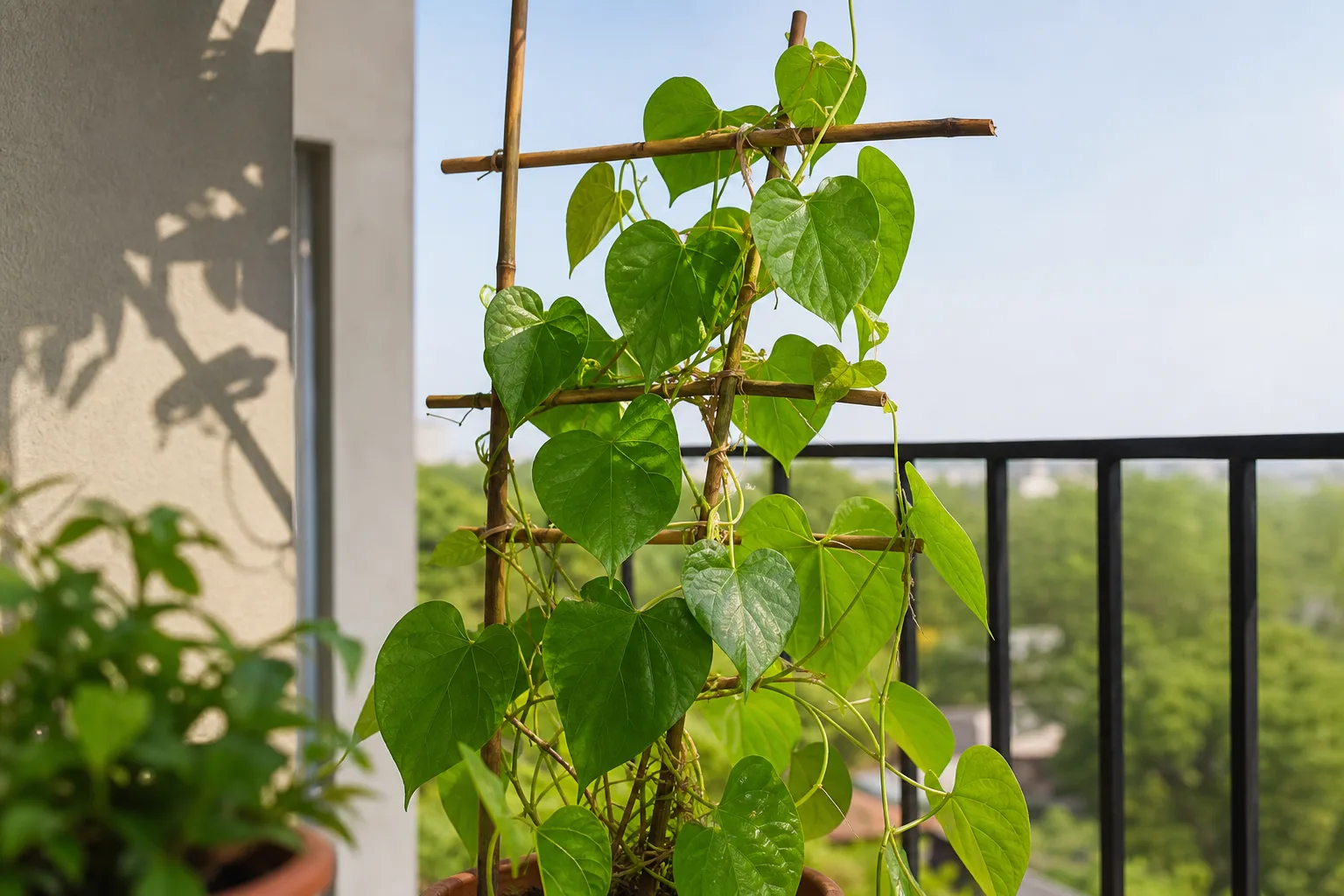
Giloy propagation is one of the more forgiving vine projects you can run on an Indian balcony or terrace—if you treat it like a node-bearing climber, not a soft herbaceous basil cutting. Tinospora cordifolia, also sold as guduchi, amrita, or heart-leaved moonseed, belongs to the Menispermaceae (moonseed) family. It is a large deciduous climber with cordate leaves, a succulent stem, and dangling aerial roots that already signal how easily the plant re-anchors when a node meets moist soil. Official cultivation notes describe the plant as easily raised from stem cuttings, while seed-grown plants take far longer to reach a usable size.
Most home growers want more plants for a medicinal pot, a neem-hosted garden vine, or a shared start for family—not a tissue-culture lab. This guide covers method choice, the June–July cutting window, step-by-step node cuttings, seed sowing with a soak, aftercare on a trellis, and the failures that usually trace back to waterlogging or delayed planting. Pair it with the plant’s light, watering, and soil pages once the cutting is rooted; propagation succeeds only when the same bright, free-draining culture continues.
Why Stem Cuttings Beat Seeds for Home Giloy
Commercial and home agro-techniques treat stem cuttings as the best planting material for a giloy crop. Ministry of AYUSH cultivation guidance states that cuttings taken from mother plants in June–July establish a commercial stand far faster than seed, and that seed-raised plants take more than double the time to mature and yield comparable stem drug. That maturity gap matters at home too: a node cutting already carries stem tissue, stored reserves, and often aerial-root initials, while a seedling must build those structures from scratch under monsoon humidity and heat.
Cuttings also clone the parent. If your vine already climbs well in your microclimate—balcony wind, afternoon sun, a particular trellis—duplicates inherit that growth habit. Seed introduces more unknowns. Plants For A Future notes that T. cordifolia is dioecious: male and female plants are separate, so you need both sexes nearby if your goal is fertile seed. Many balcony growers never see reliable fruit set, which is another reason cuttings dominate home practice.
How Nodes and Aerial Roots Make Rooting Easy
Giloy stems swell slightly at nodes, where leaves attach and where adventitious roots can form when moisture and oxygen are available. Older stems also produce long, thread-like aerial roots in humid weather—the same organs Acta Horticulturae descriptions highlight when summarizing the plant’s climbing, medicinal habit. A cutting with at least one firm node (ideally two to four) and, when available, a short aerial-root stump has a built-in head start: the tissue already “knows” how to root into soil.
Choose older, mature stems rather than the softest pale tip growth alone. AYUSH nursery notes call for cuttings from older stems with nodes, planted promptly. Soft, stressed, yellowing, or pest-riddled wood fails more often because the cutting lacks clean vascular flow and stored energy. Firm green to light-brown stem pieces that snap cleanly and show intact nodes outperform mushy or hollow sections every time.
What Success Looks Like for Cuttings vs Seeds
For stem cuttings, success means the buried node stays firm (not soft or sour-smelling) for the first one to two weeks, then new tip growth or expanding aerial roots appear while the mix stays lightly moist—not soggy. In warm Indian conditions, many growers see early root activity within roughly two to four weeks, with a climb-ready plant after the first flush of leaves and a stake or trellis is in place. Exact days vary with heat, humidity, and cutting age; treat new leaf flush and resistance when you tug gently as better signals than a fixed calendar.
For seed, success means germination after a soak and shallow sowing—often within about 8–10 days in warm May–July nursery conditions when seed is fresh—followed by several weeks of slow seedling growth before transplant size. Even when germination is quick, the path to a thick, harvestable vine is longer than a cutting started the same week. Use seed when you lack a healthy mother plant or want many seedlings; use cuttings when you want speed and a clone.
Best Timing for Giloy Propagation
Timing tracks active growth and workable humidity, not ritual dates alone. The parent vine should be pushing firm green growth, free of chronic yellowing on wet soil, and already trained to some support so you are not cutting from a collapsed, shaded tangle. Avoid taking cuttings the same week you repot a stressed plant or while the mix smells sour—those stems are recovering, not storing energy for rooting.
June–July Window and Monsoon Trade-offs
AYUSH agro-technique guidance specifically recommends obtaining cuttings from mother plants in June–July. That window aligns with warm soil, rising humidity, and the start of monsoon moisture across much of India—conditions that favor adventitious rooting. The trade-off is drainage: giloy does not tolerate high rainfall or waterlogged conditions, and the same guidance calls for light medium sandy loam rich in organic matter with adequate drainage. On balconies, that means a pot that never sits in a saucer of rainwater and a mix that sheds excess monsoon water quickly.
Outside the classic June–July peak, warm, bright months still work if nights stay mild and you can keep cuttings out of cold drafts. Cool, dim winter rooms slow callusing and invite basal rot. If your only parent plant is indoors under weak light, improve placement first using the Giloy light guide before sacrificing stems—weak parent tissue makes weak cuttings.
How to Propagate Giloy from Stem Cuttings
The home workflow is simple: cut node-bearing older stem, keep pieces hydrated, plant within a day into free-draining mix or ground, then provide support as soon as growth resumes. No specialized chamber is required for ordinary balcony batches. Tissue-culture micropropagation exists for elite genotypes in research and conservation settings—Acta Horticulturae and related work address that path—but it is not the everyday method for a terrace vine.
Selecting and Preparing Node Cuttings
- From a healthy mother vine, cut 15–30 cm sections of older stem that include two to four nodes. Shorter pieces can work if at least one strong node will sit in contact with moist mix.
- Make a clean cut just below a lower node with sharp, wiped shears. Remove leaves from the bottom one or two nodes so foliage is not buried.
- If aerial roots are present, keep a short length attached; field practice notes that cuttings with aerial roots thrown over a host can strike into the ground readily.
- Plant within 24 hours of removal. Until then, keep cuttings half-dipped vertically in water—not fully submerged for days in a stagnant jar, which invites soft rot on succulent stems.
- Optional rooting hormone (IBA) is used in some research on Tinospora cuttings, but AYUSH field notes state no specific pretreatment is required before sowing commercial cuttings. For home batches, clean tools, fresh nodes, and fast planting matter more than hormone.
Water Holding vs Direct Soil or Pot Planting
Short water holding is a bridge, not a full water-propagation lifestyle. Giloy’s succulent stem softens quickly if left for weeks in cloudy water. Use the half-dip only until you can pot up the same day or next morning.
Direct planting into pots or prepared ground is the standard nursery path: stem cuttings with nodes are sown directly, at field spacing of about 3 m × 3 m for commercial stands (far closer is fine for a single balcony pot—one cutting per 20–30 cm pot is typical). Use a light mix that matches the plant’s soil needs—roughly sandy loam with compost and coarse sand or perlite so air reaches the buried node. Bury at least one node firmly, leave one node above the surface for shoot growth, water once to settle, then let the top of the mix dry slightly before the next drink.
CSIR–Indian Institute of Integrative Medicine has published agrotechnology for cultivating T. cordifolia across climatic conditions for pharmaceutical supply—useful context that this species is farmed from vegetative starts at scale, not only foraged. Home growers can borrow the same logic: drained media, support, and prompt planting of node wood.
Growing Giloy from Seed
Seed is the backup path when you have no healthy mother vine, when a nursery packet is all that is available, or when you want many seedlings for a hedge-style host planting. Expect slower maturity and, because the species is dioecious, uncertain fruiting later unless both sexes are present. Native range spans dry and deciduous forest habitats of India, Sri Lanka, and Myanmar at low elevations—seedlings still need warmth and drainage even though the species is tropical.
Soak, Sow, and Why Seedlings Stay Slow
Soak seed in clean water for about 24 hours before sowing to speed imbibition. [Flagged: no authoritative source found for this claim] Sow in small poly bags or shallow trays filled with a sandy, compost-amended mix during the warm May–July nursery window when possible. Keep the surface evenly moist—not flooded—and provide bright light without cooking tender seedlings in a sealed plastic bag on a hot ledge.
Germination often begins within about 8–10 days when seed is fresh and warm; transplant readiness may take 4–6 weeks of careful watering. [Flagged: no authoritative source found for this claim] Even then, AYUSH notes that seedling growth is very slow compared with cutting-raised plants. Do not fertilize heavily while roots are forming; wait for true leaves and steady growth, then follow the light feeding approach in the fertilizer guide. Watch for damping-off in cool, stagnant trays—extension guidance on damping-off stresses sterile media, airflow, and avoiding chronic surface wetness for young seedlings.
Aftercare: Support, Soil Moisture, and First Months
Giloy is a large twiner. As soon as a cutting or seedling shows new growth, give it a stake, trellis, railing, or host shrub. Field guidance recommends wooden stakes, trellis, or already-growing shrubs and trees; traditional plantings are often trained onto neem. Without support, new stems sprawl, shade themselves, and stay wetter at the base—exactly the pattern that invites soft stems.
Water when the top 2–3 cm of mix feel dry, matching the plant’s usual watering rhythm. New cuttings need consistent moisture at the node but hate a constantly saturated pot. If monsoon rain keeps the container heavy for days, tip out saucers, improve drainage, or move under a roof edge. Extension guidance on root rot in poorly drained soil is a useful reminder: overwatered media and poor drainage destroy roots even when the grower “meant to be careful.”
Hold fertilizer until you see active climbing. Bright light—several hours of direct sun or very strong light—builds thicker stems and more aerial roots. A shaded cutting may stay alive while failing to climb; fix light before stacking feeds or larger pots. Move into a slightly larger container only after roots knit the mix, following repotting cues rather than upsizing on day one.
Common Giloy Propagation Failures
Basal stem soft and sour. Usually delayed planting, full submersion in stagnant water, or a waterlogged mix. Discard mushy cuttings; start again with fresher node wood in a freer-draining pot.
Cutting stays green but never roots. Often a leafless internode piece with no buried node, or cool dim placement. Re-cut to include a node and move to warmer bright light.
Seedlings collapse at soil line. Classic damping-off risk in wet, poorly aired trays. Use fresher mix, space seedlings, water less often, and improve airflow.
Transplant shock after potting up. Roots torn from a water jar left too long, or a jump into full afternoon sun the same day. Harden gradually; keep the first week milder than the final balcony exposure.
Vine roots but will not climb. Missing trellis or too little light. Add support and reassess the overview placement basics before blaming “bad genetics.”
When to use this page vs other Giloy guides
Use this propagation page when you are taking cuttings, sowing seed, or troubleshooting why a start failed to root. Switch to watering when an established vine yellows on wet mix or wilts on bone-dry soil. Use soil when drainage and mix recipe are the real issue behind repeated basal rot. Use light when thin, pale, non-climbing growth follows a “successful” root. Use repotting when a rooted plant has outgrown its pot or support. Use pruning when you are shaping a mature vine rather than multiplying it. Start from the overview if you still need the big picture of sun, drainage, and pet cautions.
Related Giloy guides
- Giloy overview — habit, placement, and what “settled in” looks like
- Giloy light — sun hours that drive thicker stems and aerial roots
- Giloy watering — dry-down checks that protect new cuttings from rot
- Giloy soil — sandy loam mixes that match nursery guidance
- Giloy fertilizer — when to feed after roots establish
- Giloy repotting — upsizing rooted starts without shock
- Giloy pruning — cutting back for structure once plants climb
Conclusion
Propagating giloy is mostly a timing-and-drainage skill. Take node-bearing older stem cuttings in June–July, plant them within 24 hours into light sandy loam that never stays waterlogged, give each start a trellis, and keep the buried node lightly moist until new growth appears. Use seed when you must, knowing seedlings are slower and fruit set needs both sexes. Once the vine climbs, the same bright light and careful watering that grow mature guduchi keep your new plants honest—multiply the vine, then keep the culture simple.