Guava Light Requirements: Sun, Windows & Shade
Guava Light Requirements: Sun, Windows & Shade
Guava Light Requirements: Sun, Windows & Shade
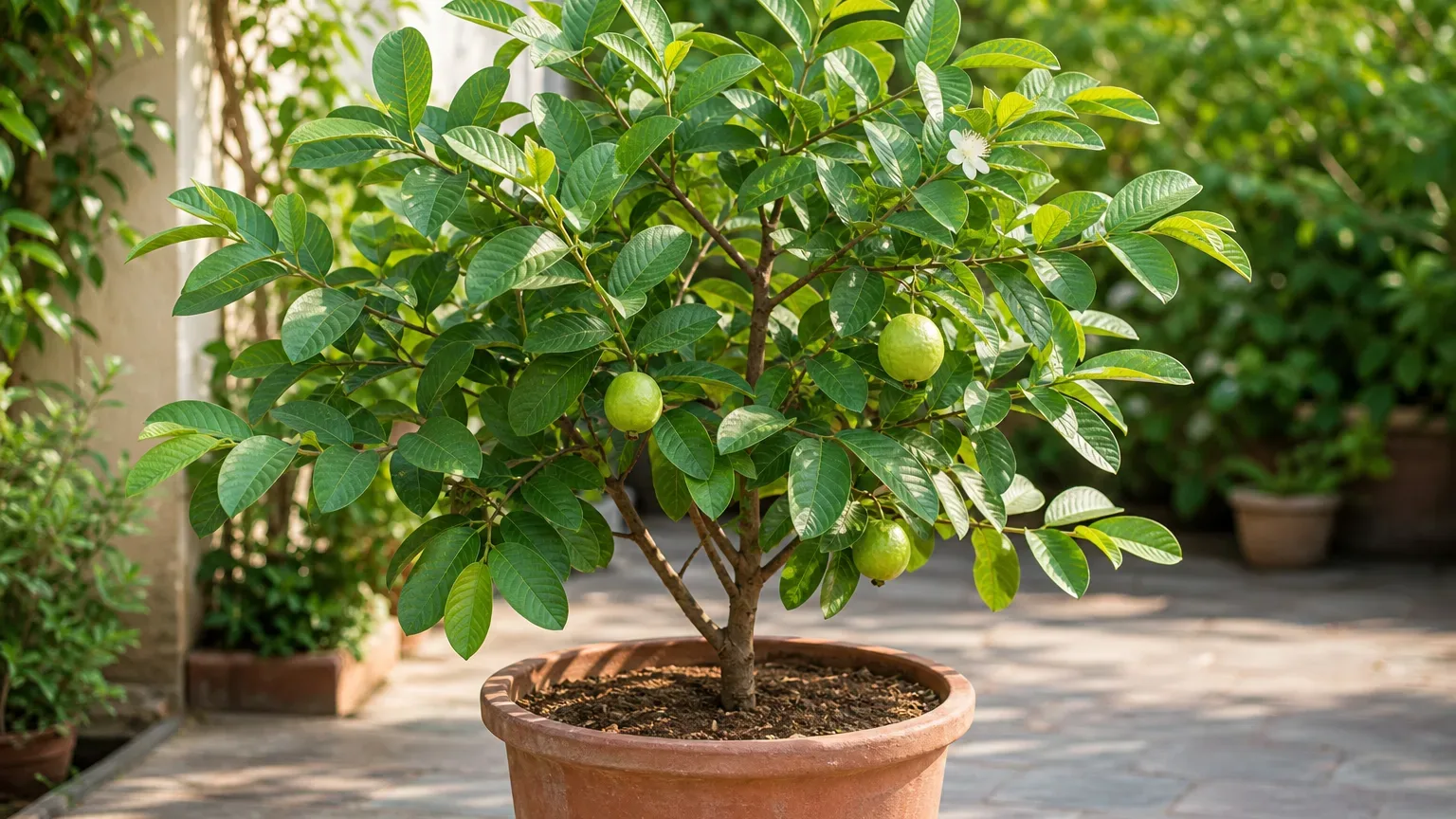
Guava is a tropical fruit tree, not a low-light houseplant. A plant may keep green leaves in a bright-looking room, but strong flowering, compact growth, and useful fruiting require direct sun. For most homes, the right destination is an open terrace, sunny balcony, courtyard, or garden—not a decorative corner several metres from glass.
The placement test is simple: watch the newest shoots. Firm, closely spaced leaves and sturdy branching indicate useful light. Long gaps between leaves, a thin canopy leaning toward one direction, and repeated failure to bloom point toward inadequate exposure, although roots, pruning, nutrition, and tree age can also affect growth and cropping.
The quick answer: give Guava full sun
Aim for at least six hours of unobstructed direct sun each day, with more available light usually better for an established, acclimated tree. UF/IFAS specifically recommends full sun for best growth and fruit production and warns that shading from nearby trees or structures can reduce normal growth and fruiting. This makes six hours a practical floor rather than a promise that every tree receiving exactly six hours will crop equally.
Count the time sun actually reaches the leaves, not the hours a balcony or room seems bright. A neighbouring tower, roof overhang, shade cloth, monsoon clouds, or dense upper canopy can reduce plant-level exposure. If you want fruit, favour an open location with morning-to-midday sun or a long arc of sun across the day.
How much light Guava needs
Guava can grow across wet and dry tropical regions, but its productive form is an open, sunlit tree. Kew records Psidium guajava as a tree of the seasonally dry tropical biome, while Indian production guidance treats it as an outdoor orchard crop rather than a shade crop. Light should therefore be planned at tree scale: enough reaches the outer canopy, lower branches are not permanently buried in shade, and nearby walls or plants do not block most of the day.
There is no universal lux target that guarantees guava fruit. Leaf-level intensity changes by latitude, season, cloud, glazing, and time of day, and a phone meter is better for comparing two positions than proving a biological threshold. Use duration of direct sun, new growth quality, and bloom response as the primary evidence.
Light for flowers and fruit is different from light for survival
A shaded guava can remain alive and produce leaves, especially in warm weather. That does not make shade suitable for fruit production. Guava flowers occur on vigorous new growth, and UF/IFAS notes that the tree flowers on new succulent shoots; a weak, stretched canopy has less well-lit productive growth to work with.
This distinction matters when evaluating an indoor tree. Green foliage proves the plant is surviving, not that it has enough daily energy to build a crop. If a mature, appropriately pruned and fed guava repeatedly makes thin shoots but few flowers, improving light is a higher-value first step than adding more fertilizer.
Best placement for Guava
Start with the spot that has the longest open view of the sky and the least obstruction. Then consider whether the pot will overheat, whether watering is practical, and whether the mature canopy can be kept clear of railings and walls. Sun without enough root volume or water can stress a container tree, so placement and the Guava watering guide must work together.
Do not place a young pot directly under a roof edge where it receives one narrow shaft of noon sun but shade for the rest of the day. A wider, longer exposure is more useful than a short burst. Likewise, avoid crowding the canopy against other trees; Purdue’s guava monograph recommends orchard orientation that gives trees maximum sunlight.
Outdoor gardens, terraces, and balconies
In a garden, choose an open site away from large shade trees and tall structures. The National Horticulture Board’s guava production material uses open orchard spacing and training systems designed around productive canopies, including high-density planting with managed tree form. At home, that translates to maintaining space around the crown rather than allowing guava to become a shaded understory tree.
On an Indian terrace, an east-to-south-east exposure is often the easiest starting point because it supplies long morning light before the hottest part of the day. South and west exposures can also suit established trees, but pale walls, tiles, glass, and parapets may add reflected heat. Ensure the container is large enough, check moisture more frequently, and shade the pot itself if the root ball overheats while leaving the foliage in sun.
Indoor windows and enclosed balconies
If guava must be indoors, use the sunniest unobstructed window—usually south or west in the Northern Hemisphere—and keep the canopy close enough that direct rays reach it. Window direction alone is not enough: tinted glass, insect mesh, deep awnings, and neighbouring buildings can turn a nominally sunny exposure into weak light. Rotate the pot a quarter turn every week or two if one-sided growth develops, but do not move a fruiting tree constantly.
An enclosed balcony can be brighter than a room but hotter than outdoors because glass traps heat and airflow is limited. Ventilate it, keep leaves from touching hot glass, and measure afternoon leaf and pot temperature by touch. Indoor flowering and fruiting remain uncertain even beside a window, so treat a window-only setup as a compromise and use supplemental light if the tree cannot go outside.
Can Guava take strong direct sun?
Yes. An established guava belongs in full sun, and a healthy outdoor canopy can take strong tropical light when roots have adequate water. UF’s tree fact sheet lists full sun as the light requirement, consistent with fruit-production guidance. The important exception is a plant that was raised under nursery shade, kept indoors, or transported under cover.
Sun stress and heat stress often arrive together in containers. A tree can tolerate bright leaves while its black plastic pot becomes dangerously hot and dries rapidly. If leaves wilt only during peak afternoon heat and recover by evening, check root-zone moisture and pot temperature before assuming the light level itself is wrong.
Acclimating nursery Guava without scorching it
Increase direct exposure over roughly 10–14 days. Begin with two or three hours of gentle morning sun, then extend the direct-light period every few days. Hold at the previous exposure if fresh leaves develop bleached tan patches, crisp margins, or abrupt curling on the sun-facing side.
Acclimation does not heal existing damage; it helps new and uninjured tissue adjust. Keep watering steady during the transition, but do not leave the mix saturated. Avoid combining the light jump with hard pruning, repotting, and strong fertilizer, because stacked changes make the cause of any setback impossible to identify.
Can Guava grow in partial shade?
Guava can survive and make foliage in partial shade, but shade is a poor choice when the goal is a compact, fruitful tree. The TNAU guava guide places commercial trees at 5–6 m spacing, a reminder that mature canopies need room rather than close, permanent competition. Light shade for part of the day is less damaging than an entire canopy blocked by a wall or larger tree.
Judge partial shade by its timing. Four hours of open morning sun followed by bright sky light is more workable than a dim site receiving a brief late-afternoon beam. If your only location gets fewer than four hours of direct sun, expect slower growth and unreliable flowering; grow for foliage or add artificial light rather than chasing fruit with extra feed.
Using grow lights for Guava
A grow light can maintain a young guava or supplement a sunny window, but replacing tropical outdoor sun over a tree-sized canopy takes substantial fixture power and coverage. The realistic indoor goal is healthy vegetative growth; fruiting is possible only if total intensity, duration, temperature, nutrition, pollination, and canopy size all cooperate. Do not buy a small clip lamp and assume it replaces a terrace.
Use a full-spectrum white LED sold with credible coverage or photosynthetic photon flux information. Match the illuminated footprint to the entire canopy, not just the top few leaves. Side branches that remain outside the beam will still stretch toward the source and may shed shaded interior leaves.
Fixture, distance, and schedule
Run the light for 12–14 hours daily on a timer when it is the main source, or use it to extend a shorter sunny window day. Start at the manufacturer’s recommended distance because fixtures vary greatly; leaf response and heat are safer guides than a universal centimetre rule. Raise the lamp if the upper leaves bleach or feel hot, and increase coverage or move it closer within its rated range if new shoots stretch.
Give the tree a dark period rather than leaving lamps on continuously. Reassess watering after a week or two because stronger artificial light can speed water use. If the pot remains wet for unusually long periods despite warm conditions, light may still be too weak or the Guava soil mix may drain poorly.
Seasonal light in Indian climates
Indian growing conditions are not one uniform “tropical” setting. In hot, clear pre-monsoon weather, full west exposure beside reflective masonry can combine high radiation with severe root-zone heat. During prolonged monsoon cloud, the same position may become moderate while rain keeps the pot wet. Adjust watering before moving a well-established tree merely because the weather changed for a few days.
Winter placement depends on latitude. Northern growers may need the warmest, sunniest sheltered site, while frost-free southern growers can generally retain outdoor exposure. UF/IFAS places ideal guava growth and production around 23–28°C and notes that growth slows below about 16°C, so a bright cold site and a warm dim site can both limit progress for different reasons.
Warning signs of the wrong light
Light symptoms are patterns, not single-leaf diagnoses. Compare the affected side of the canopy, the timing after a move, internode length, newest leaf size, soil dry-down, and whether the tree blooms. Also inspect roots and moisture before blaming light, because drought, waterlogging, and heat can produce overlapping yellowing or leaf drop.
Make one placement change and watch the next flush. Old stretched stems will not shorten, and scorched patches will not green again. Improvement appears as sturdier new shoots, normal leaf size, and a more balanced canopy.
Too little light
Low-light guava commonly develops long, thin shoots with wide gaps between leaves, small or soft new foliage, one-sided leaning, sparse inner growth, and little flowering on a mature tree. The pot may also dry slowly because the shaded canopy uses less water. Feeding harder does not correct the energy shortage and can create salt stress in a slowly growing root system.
First, move the tree toward longer direct exposure or open competing shade through selective pruning. Do not strip the guava itself bare; retain enough leaf area to power recovery. If outdoor sun is impossible, add a properly sized grow light and evaluate the next six to eight weeks of warm-season growth.
Too much sun or reflected heat
True sun scorch appears mainly on newly exposed, sun-facing tissue as pale, tan, or brown dead patches with relatively sharp boundaries. Heat and drought add crispy margins, midday wilting, rapid pot dry-down, and sometimes fruit drop. Guava tolerates drought once established, but drought during fruit development can reduce fruit size, a relationship documented in the Feedipedia species profile.
Move an unacclimated tree back to its last safe exposure, then resume the staged increase. For an established terrace tree, solve root heating and water supply before reducing all sunlight: insulate or shade the container, mulch lightly without burying the trunk, and water according to moisture below the surface. Permanent shade may stop scorch while also sacrificing flowering.
How light changes watering, pruning, and fruiting
More usable light generally increases growth and container water demand, while shade extends dry-down. That is why a fixed watering calendar fails after a seasonal or placement change. Check the upper 3–5 cm and the deeper root ball, then follow the Guava watering guide instead of watering merely because the balcony is sunny.
Pruning should distribute light, not remove most of the photosynthetic canopy. UF/IFAS recommends selective pruning to open guava trees to sunlight penetration, but sudden heavy thinning can expose previously shaded leaves, bark, and fruit. Use the Guava pruning guide to shorten vigorous shoots and open crowded sections gradually.
Light also sets the ceiling for what fertilizer can achieve. If the tree is stretched and shaded, correct placement before increasing feed. Once it is making sturdy growth in sun, use the Guava fertilizer guide to support that growth without assuming nitrogen can force flowers in a dark position.
When to use this page vs other Guava guides
- Use the Guava overview for whole-plant priorities, mature size, and general placement.
- Use the Guava watering guide when leaves wilt, the pot dries rapidly in sun, or monsoon moisture lingers.
- Use the Guava soil guide when a bright-site container remains wet or roots lack aeration.
- Use the Guava fertilizer guide after light is adequate but warm-season growth remains pale or weak.
- Use the Guava pruning guide to keep a sunlit canopy compact without abruptly exposing shaded tissue.
Related Guava guides
- Guava care overview — the starting point for growing amrud in pots or gardens.
- Watering Guava — match irrigation to sun, heat, rain, and root-zone dryness.
- Guava soil — build a fertile mix that drains after terrace watering or monsoon rain.
- Fertilizing Guava — feed active, well-lit growth without overcorrecting.
- Repotting Guava — give a fast-drying, sun-grown root ball appropriate space.
- Propagating Guava — choose methods and aftercare for young plants.
- Pruning Guava — manage height and canopy light penetration.
Conclusion
Guava light requirements are straightforward: give an acclimated tree full sun, with at least six hours of direct exposure as a practical minimum for productive growth. Choose an open garden, terrace, balcony, or courtyard before an indoor room. Partial shade may keep a tree alive, but it commonly weakens structure and makes flowering less reliable.
If your guava is stretched or unproductive, map the hours when sun actually reaches its leaves before changing fertilizer. If it scorches after a move, step exposure back and acclimate gradually rather than condemning it to permanent shade. Then align watering, pot temperature, and pruning with the brighter placement so the next flush—not the old damaged foliage—can show whether the site works.