Spider Mites on Guava: Identify, Rinse and Prevent
Quick answer
Spider mites on Guava are most convincing when pale stippling or bronzing appears with fine silk and tiny moving mites on leaf undersides. First, rinse the affected leaves with clean water, aiming beneath the foliage. Do not spray a fruiting tree with a pesticide or oil before confirming live mites and checking local guidance.
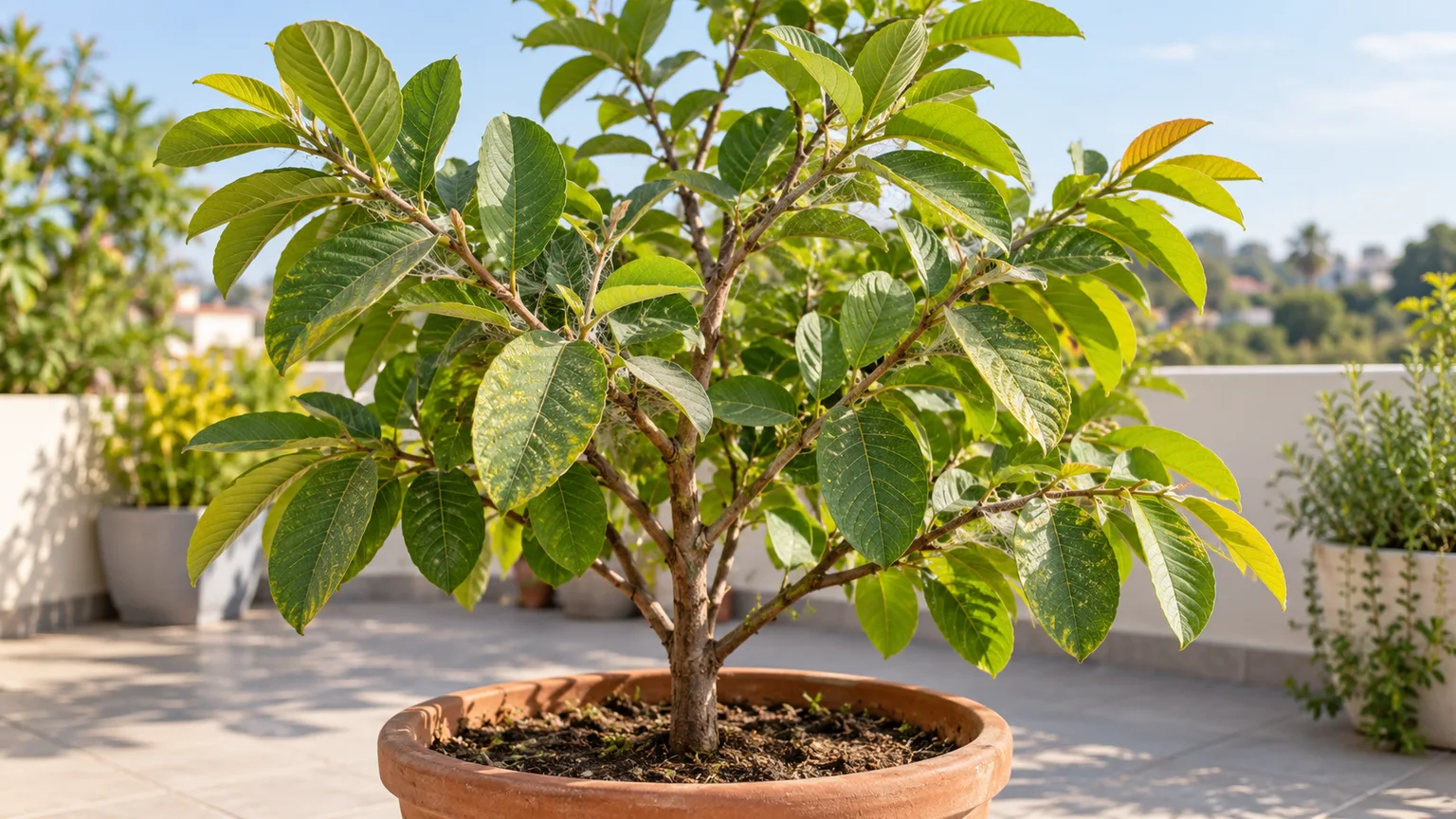
Spider Mites on Guava: How to Confirm and Stop Them
This guide covers spider mites on Guava. See also the general Spider Mites guide, watering, and light pages for this plant.
Spider Mites on Guava: How to Confirm and Stop Them
Quick answer
Confirm spider mites by finding live, moving specks or fresh fine webbing on Guava leaves, usually alongside a field of pale stippling or bronzing. If you find live mites, your first fix is to rinse the affected foliage with clean water, directing the stream under the leaves; water sprays aimed beneath foliage are a standard first control (UC IPM). Do not begin with neem, soap, fertilizer, repotting, or a change to Guava’s normal watering routine.
A speckled leaf alone is not enough to diagnose mites. Guava can also show leaf damage after hot, dry wind, and fungal or algal problems make distinct lesions (UF/IFAS Guava profile). For general spider-mite biology and the common houseplant treatment options, see the spider mites guide. This page focuses on where to check a Guava tree, how to rule out lookalikes, and what to do without putting an edible crop at risk.
What spider mites look like on Guava
Spider mites feed from leaf cells, leaving tiny pale dots that may merge into a dull, bronze or yellowed patch as feeding continues. Fine silk may appear between a leaf and its petiole, along a stem, or across a cluster of leaves when populations build. Look for both signs: mottling on the upper leaf surface and live specks or webbing beneath it. UC IPM describes stippling as an early symptom and yellowing, bronzing, and leaf drop as heavier damage; visible webbing is a useful clue, but it may be absent in an early infestation (UC IPM’s spider-mite guide).
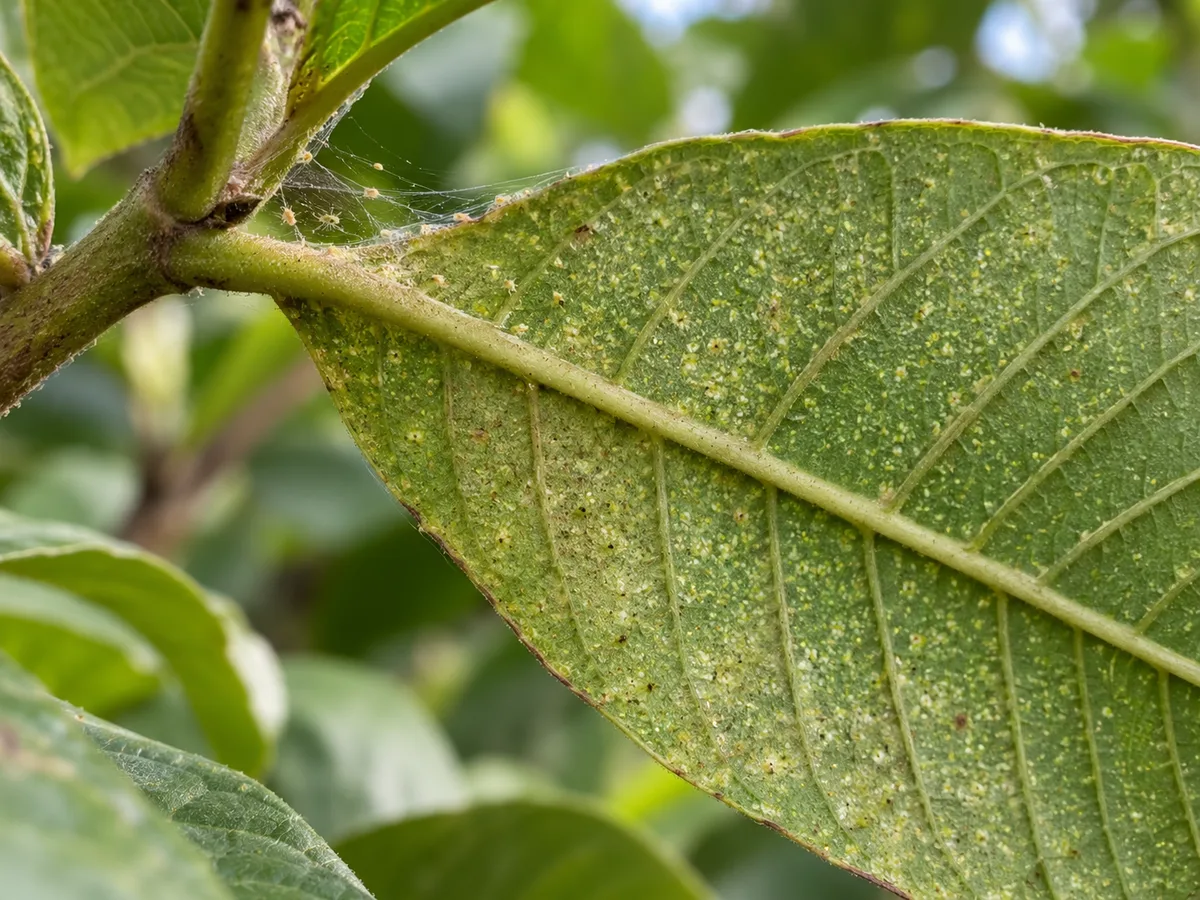
Fine webbing and pale stippling on a Guava leaf underside; confirm the diagnosis by checking for moving mites.
Guava has opposite, oblong leaves with prominent veins on the lower side and fine hairs on young leaf undersides. That normal texture can make a dusty or hairy surface look suspicious. Attached leaf hairs do not shift when you tap or blow gently across the blade; silk forms strands that bridge a gap, and live mites move when you look closely. UF/IFAS describes the leaf shape, lower-side veins, and fine pubescence, while Gardeners’ World recommends a magnifier to find tiny mites and eggs on leaf undersides (UF/IFAS Guava profile, BBC Gardeners’ World’s red spider-mite guide).
Spider mites are extremely small arachnids, not insects (UC IPM). Without a lens, a moving colony can look like dust or colored grains. Spider mites range from green and yellow to red or brown, so do not diagnose a Guava from a red or yellow dot alone (The Spruce’s identification notes). A phone macro view or 10× hand lens is more useful than trying to identify the exact mite species from a casual glance.
UF/IFAS lists mites among the pests Guava growers should monitor year-round, but its Florida home-landscape guide directs growers to local extension for specific pest control rather than giving one treatment for every region or crop stage (UF/IFAS Guava guidance). That distinction matters on a fruiting tree: use the symptoms to confirm that mites are present, then use local crop guidance before choosing a pesticide.
Why a Guava tree gets spider mites
Guava is grown as a sunny, warm-climate fruit tree (UF/IFAS Guava profile). It may spend the hottest months outside on a terrace, patio, or in a dry garden bed, where exposed leaves face heat and dust. Spider mites develop quickly in warm, dry conditions; UC IPM notes that outbreaks are more likely on dusty sites and water-stressed plants, and Gardeners’ World also identifies hot, dry conditions as favorable for red spider mites (UC IPM, Gardeners’ World). This explains why a Guava in a hot courtyard may need more inspection during a dry spell, even though the tree is adapted to warm climates.
A Guava’s broad canopy creates shaded inner leaves and more exposed outer leaves (UF/IFAS Guava profile). Check both: sun-exposed foliage may dry quickly, while crowded inner branches can hide early webbing from a casual walk past the tree. The tree’s opposite leaf pairs and visible midribs make it practical to turn each leaf over and compare a suspect blade with a clean leaf from the same branch. Use the Guava overview to review its normal warm, bright growing conditions before treating every damaged leaf as a pest symptom.
A mite infestation does not mean Guava needs to sit in wet soil or in a steamy room. UC IPM connects plant water stress with more severe mite damage, but overwatering is a separate root problem. Keep the root ball evenly supplied during active growth, let the surface begin to dry between thorough waterings, and maintain free drainage; the Guava watering guide explains how to judge the soil instead of watering by a fixed calendar. The Guava soil guide is useful if a container stays wet for days or drains poorly.
Do not move a Guava into shade as a pest treatment. UF/IFAS recommends full sun for the tree’s growth and fruit production (UF/IFAS Guava guidance); abruptly dimming it can create a second problem without removing mites. If the tree is in a container, use the Guava light guide to keep its placement appropriate while you rinse and inspect it. A change in watering, shade, fertilizer, and spray all at once makes it difficult to tell whether the mites have stopped spreading.
How to check for live spider mites
Inspect before rinsing, because water can remove the evidence you need for diagnosis. Start with several mature leaves from different parts of the Guava canopy: one exposed outer leaf, one from the interior, and one from a lower or shaded branch. Turn each over and check along the main vein, the side veins, and the junction where the leaf stalk meets the twig. Also examine the newest leaves, but do not assume that fresh growth is the only place mites occur.
Use a hand lens or phone macro camera. If you cannot see the underside clearly, hold a sheet of white paper below a suspect leaf and tap the branch once. Watch for tiny specks that move across the paper rather than treating the dust itself as proof. Gardening Know How describes moving mites on leaf undersides and recommends magnification, while UC IPM likewise advises checking for mites before using a treatment (Gardening Know How’s identification notes, UC IPM).
Record what you find: the branch or side of the tree, whether webbing is fresh, and whether speckling is spreading. On a potted Guava, rotate the container and inspect foliage that faces a wall or railing. On a planted tree, sample more than one reachable branch; one webbed leaf does not tell you how far the colony extends. Avoid climbing into a tree or reaching across unstable branches for a closer look.
A confirmed infestation has direct evidence: moving mites, eggs, or fresh silk associated with stippled leaves (UC IPM). Old pale marks with no live pests may remain after the mites have disappeared; UC IPM notes that mites are sometimes gone by the time their leaf damage is noticed (UC IPM). Clean the test area only after you have noted it, then revisit the same leaves in a day or two. If you still cannot find a moving mite, hold off on pesticide and use the Guava problems hub to compare broader causes.
Lookalikes on Guava
Mite stippling tends to be many small, pale feeding marks that accumulate across a leaf (UC IPM). Guava’s other problems are more likely to create a different pattern:
- Hot, dry wind during a new flush: UF/IFAS notes that exposed young leaves can become distorted or damaged in hot, dry, windy weather (UF/IFAS Guava profile). Check whether damage is concentrated on newly opened leaves and the wind-facing side rather than on leaves with mites or silk. Compare recent weather with the tree’s normal watering pattern.
- Red algal spots: Guava’s red alga problem produces reddish to purplish-brown circular spots, not a fine field of pale pinpoints. UF/IFAS also describes anthracnose as larger irregular dead areas on young leaves, sometimes with pinkish spore masses (UF/IFAS Guava disease notes).
- Root or moisture stress: Uniform wilting, yellowing, or brown margins without webbing or moving mites point back to the root zone. Guava can wilt in drought and develop leaf chlorosis when soil stays flooded (UF/IFAS Guava profile). Check soil moisture and drainage before changing the pest plan; waterlogged roots and mite feeding are separate problems.
- Other sap-feeding pests: Sticky honeydew, cottony wax, or clusters of visible insects are reasons to inspect further, but they do not confirm spider mites. UC IPM notes that fine webbing helps distinguish spider mites from small pests such as aphids and thrips (UC IPM); identify the pest you can see rather than spraying for the most familiar name.
Guava leaves are also naturally veined and may be hairy underneath when young (UF/IFAS Guava profile), so not every threadlike or dusty detail is a mite web. Use a lens, compare the suspect surface with another leaf of similar age, and look for movement. A real pest finding should match the leaf damage and the branch pattern, not just one unusual spot.
The first fix: rinse the affected Guava leaves
Once you confirm live mites or fresh webbing, rinse the affected foliage with clean water. Aim a steady, leaf-safe stream at the undersides, where spider mites commonly form colonies, and let runoff drain away from the root zone. On a small container Guava, turn the pot rather than bending the branches toward the nozzle. On a garden tree, focus on reachable affected branches instead of soaking the entire canopy from a distance.
Water can dislodge mites, but a single rinse is a reduction step, not proof that the tree is clear. The Spruce’s horticulture-reviewed guide recommends repeated water sprays aimed beneath leaves; UC IPM similarly says that good coverage on leaf undersides is essential and that repeat applications may be needed (The Spruce’s spider-mite guide, UC IPM). Recheck the marked leaves after rinsing and repeat only when live mites or new webbing remain.
Do not strip every spotted leaf from a Guava to remove mites; a few pale marks are not a reason to hard-prune the tree. Remove a leaf only if it is mostly dead or badly webbed and can be bagged without cutting healthy branches. If a branch is crowded enough to prevent inspection, use a light selective cut and the Guava pruning guide to keep the canopy open without hard-pruning a stressed tree.
A water rinse is a sensible first measure because it avoids coating a fruiting Guava with an unneeded product. If mites persist across several checks, ask a local horticulture or agricultural extension service about options for Guava in your region. UF/IFAS lists mites as a Guava monitoring concern but directs home growers to local extension for specific control guidance; the advice for Florida should not be treated as a pesticide label for India or another country (UF/IFAS Guava guidance).
Oils, soaps, and pesticide decisions
Do not apply a homemade detergent mix or a broad insecticide just because Guava leaves are speckled. First confirm active mites and rinse them. On a fruiting Guava, ask local extension whether a product and its label are appropriate for the crop and harvest stage. An insecticide aimed at other pests may also remove predators that help suppress mites; UC IPM notes that some broad-spectrum insecticides can trigger mite outbreaks, while most woody plants can tolerate low to moderate mite populations when natural enemies remain active (UC IPM).
If a locally registered soap or oil is being considered, check that its current label covers Guava, the intended growing location, and the fruit stage. Contact a local extension agent if the crop or harvest interval is unclear. Oils and soaps must contact mites to work, so poor coverage can waste treatment while a strong sun or heat can increase injury risk. UC IPM warns against these products on water-stressed plants and above 90°F (about 32°C), and advises testing a small area first; those California thresholds are a caution, not a replacement for local product directions (UC IPM’s treatment cautions).
Do not combine a spray, fertilizer boost, hard prune, and root disturbance in one day. Each intervention changes a different part of the Guava’s growing conditions and may add stress. If the tree is already dry, water it according to its soil condition and allow it to recover before considering a contact product. If it has a dense canopy, improve access with selective pruning after the immediate pest pressure is under control. Keep fertilizer on its normal schedule; the Guava fertilizer guide can help distinguish routine feeding from an unnecessary “recovery” dose.
What recovery looks like
Mite damage is physical injury to leaves, so an already stippled or bronzed Guava leaf may stay marked after the pests are gone; heavily infested leaves can later yellow or drop (UC IPM). Do not judge success by expecting old foliage to turn green again. Instead, compare the same marked leaves and shoot tips over several checks: fewer or no moving mites, no expanding webbing, and no new field of stippling are better evidence that control is working.
Guava’s recovery speed depends on active growth. UF/IFAS describes growth slowing or stopping during drought or below about 60°F (16°C), so a cool or dry tree may take longer to produce replacement leaves even when mites are no longer active (UF/IFAS Guava profile). If the Guava is fruiting or has just flushed new growth, avoid sacrificing healthy foliage to cosmetic pruning. Look for the next clean flush once warmth and root conditions support growth again.
Spider mites can multiply quickly in favorable weather. UC IPM notes that a generation may be completed in under a week when temperature and food are favorable, which is why a single inspection is not enough after you find a colony (UC IPM on spider-mite life cycle). Recheck every few days while the weather stays hot and dry, and continue until you have several clean observations. If the tree’s damage is still spreading, the infestation may be larger than the first visible patch or the cause may not be mites.
Prevent another outbreak on Guava
Make inspection part of Guava’s warm-season routine. Once a week, turn over a few leaves in the outer and inner canopy, especially after dry heat, dust exposure, or a period when the container has dried rapidly. Gardeners’ World recommends weekly checks for greenhouse and house plants during active mite season; for an outdoor Guava, the same interval is a practical starting point in hot, dry weather (Gardeners’ World). Check a new nursery tree before placing it beside other container plants, and examine a Guava again before bringing it into a sheltered area for cooler weather. The habit matters more than misting on a fixed schedule.
Keep the tree’s normal care stable. Water deeply when the top layer has dried rather than giving frequent shallow drinks, and keep a container draining freely. A healthy Guava still needs its usual strong light, so do not move it into shade to “discourage” mites. If leaves collect patio dust, rinse them occasionally with clean water and let the canopy dry naturally; UC IPM notes that dust and water stress can favor mite problems and that water washing may help remove dust (UC IPM).
Give Guava enough room for you to inspect it. A crowded canopy touching a wall, railing, or neighboring plant hides the underside of leaves and makes early silk harder to spot. Selective pruning can open a viewing path through branches, but keep enough healthy leaves for the tree to grow and fruit. Avoid unnecessary broad-spectrum pesticide use outdoors, where predatory mites and insects may already be holding a low population in check; UC IPM identifies natural enemies as an important control (UC IPM).
Maintain Guava’s normal sunny placement instead of chasing a pest symptom with unrelated changes. If the Guava repeatedly dries out between inspections, adjust how often you check the soil; if the mix remains wet, solve the drainage issue separately. Healthy care does not guarantee that mites will never arrive, but it gives the tree a better chance to maintain foliage while you catch a small colony early.
When to ask for local help
Get an in-person diagnosis if webbing spreads across several branches, a large share of the canopy bronzes or drops, the new shoots are weakening, or the tree keeps declining after you no longer find live mites. Bring close photos of both leaf surfaces, the whole tree, and the soil or pot setup. Note recent heat, wind, rainfall, irrigation, pesticide use, and whether Guava fruit is present. That record helps an extension agent separate a mite outbreak from wind injury, disease, root stress, or a second pest.
For a fruiting Guava, ask a local extension service to confirm any product and harvest instructions for your location. Do not assume a houseplant dose, an online recipe, or a product sold for another crop is suitable for Guava. If there is no confirmed active mite population, continue monitoring and avoid treating healthy leaves.
When to use this page vs other Guava guides
Use this page when you find moving mites or fine silk with stippling on Guava foliage. If the only signs are yellowing, curling, or wilt without live pests, begin at the Guava problems hub and check its other routes before treating for mites. Use the watering and overview guides listed below to check dry or saturated soil and the tree’s overall sun, warmth, and drainage needs.
Related tool
If the pest is too small to identify confidently, use the Pest Identifier Tool to compare visible clues. Treat its result as a starting point; moving mites, fresh silk, and the leaf pattern still need to agree before you choose a treatment.
Related Guava guides
- Guava overview — use for the whole tree’s light, warmth, and growth conditions.
- Guava watering — use to judge the root zone without keeping the soil saturated.
- Guava light — use to maintain the full-sun placement Guava needs while you inspect it.
- Guava soil — use when a container drains slowly or stays wet.
- Guava pruning — use when a crowded branch blocks inspection or light movement through the canopy.