Guava Soil Guide: Mix, Drainage and pH
Guava Soil Guide: Mix, Drainage and pH
Guava Soil Guide: Mix, Drainage and pH
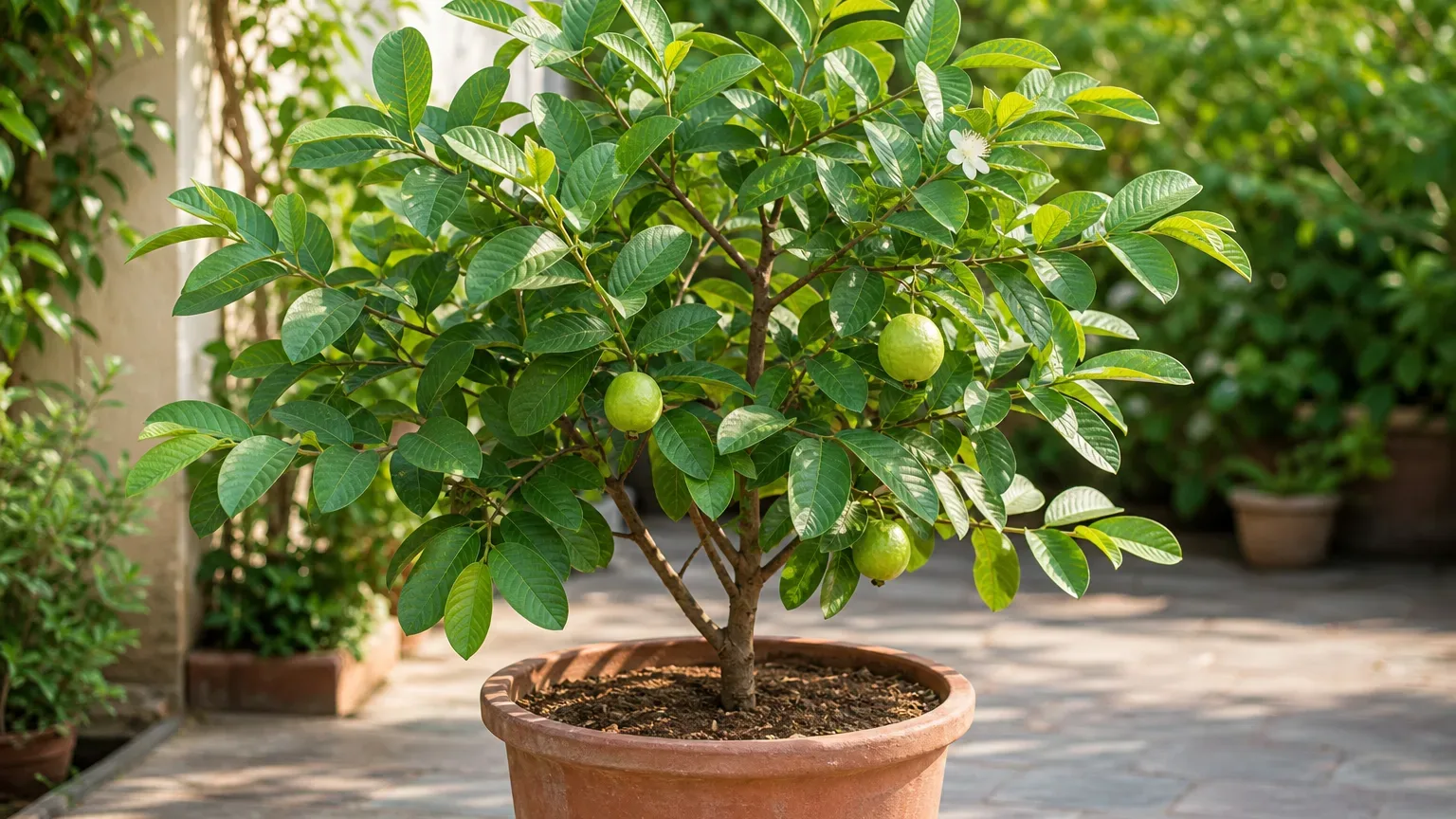
Guava (Psidium guajava), or amrud, is forgiving in the ground but less forgiving in a pot. The tree can grow across sands, loams, rock-derived soils, and organic soils, yet a container compresses its roots into a small column where one over-rich or compacted mix can remain airless for days. The right guava soil therefore holds enough moisture for active growth and fruit development while releasing excess water quickly after irrigation or monsoon rain.
Quick answer: the best soil for Guava
Use a fertile, loose, well-aerated loam or sandy-loam-style mix. For a container, start with 50% quality potting mix or screened sandy loam, 25% mature compost, and 25% coarse aeration material such as perlite, pumice, or small composted pine bark. Every pot must have unobstructed drainage holes, and the finished mix should be moist but crumbly rather than sticky when squeezed.
Aim for pH 5.0–7.0 in pots. This practical container target sits within the UF/IFAS ideal field range of pH 4.5–7, while avoiding the nutrient-management problems that become more likely at either extreme. Do not chase an exact decimal if the tree has firm green growth and the mix drains predictably.
Why Guava tolerates field soil better than potting soil
Guava has genuine soil adaptability. UF/IFAS records growth in a wide range of soil types, and the University of Hawai‘i guava guide likewise says soil type is not a major limitation in Hawai‘i. That evidence describes trees whose roots can explore a broad field profile; it does not mean a bucket of sticky garden clay or fine compost is a safe container medium.
In a garden, water can move sideways and downward, and roots can leave a temporarily wet pocket. In a pot, the bottom layer remains the slowest to dry, organic particles collapse with age, and repeated watering can leach nutrients from the finite root zone; University of Minnesota Extension highlights this loss from container media. Container guava needs more deliberate structure than an established orchard tree.
The ideal Guava soil profile
Good guava soil balances four jobs: anchor a woody top, admit oxygen, store some plant-available water, and retain nutrients without accumulating salts. A mix that races bone-dry hours after watering is not automatically good drainage; it may be root-bound, hydrophobic, or too coarse. A mix that looks dark and rich but stays glossy-wet for a week has the opposite problem.
Texture and drainage
Loam or sandy loam supplies mineral body and moisture buffering, while coarse particles preserve spaces for air. Mature compost contributes stable organic matter, but it should be an amendment rather than the whole root zone. Fine garden soil, pure vermicompost, and uncut cocopeat settle too densely in a large fruit-tree pot, especially after repeated monsoon saturation.
Guava can survive brief wet periods, but this tolerance has limits. UF/IFAS reports that prolonged flooding can lead to chlorosis, leaf and fruit drop, stem dieback, and death, even though short flooding is tolerated moderately well. For a terrace tree, prevention is easier than trying to restore oxygen to a sour, saturated root ball.
Soil pH and iron availability
Guava grows across a broad reaction range, but pH affects which nutrients roots can access. UF/IFAS notes that trees can grow at pH 7–8.5 when supplied with suitable chelated iron, while also identifying susceptibility to iron deficiency in alkaline soils. Treat pale new leaves with green veins as a reason to test pH and drainage, not as proof that the tree simply needs more general fertilizer.
Do not add lime, wood ash, gypsum, elemental sulfur, or iron products by guesswork. A basic laboratory or agricultural soil test is more useful than a cheap probe for an in-ground tree, while a fresh sample tested with a calibrated slurry method can guide a container decision. Saline or sodic soil is a separate problem from alkalinity: research indexed by FAO AGRIS shows guava has some adaptation to salt-affected soils, but UF/IFAS still reports reduced growth and fruiting as salinity rises.
A practical DIY Guava soil mix
Measure ingredients by volume with one bucket or scoop. Ingredient names vary across India, so judge the finished mix by structure: it should accept water evenly, drain freely, and remain slightly springy after squeezing. Screen out stones and undecomposed chunks large enough to leave unstable voids around the root ball.
Container recipe by volume
For a young or medium guava tree, blend:
- 50% base: quality peat- or coir-based potting mix, or clean screened sandy loam
- 25% mature compost: fully decomposed, cool, earthy-smelling material
- 25% coarse aeration: perlite, pumice, rice-husk charcoal, or small composted pine bark
If the base is dense garden loam, lower it to 40% and raise coarse aeration to 35%. If the pot stands in hot, dry wind and empties within a day despite a healthy root volume, use a little more base and a little less coarse material. Never replace all structure with compost: rich does not mean breathable.
Monsoon adjustment for humid Indian climates
Before sustained rain begins, check whether water exits every hole and move the pot out of continuous roof runoff. For an exposed terrace, increase the coarse fraction by roughly 5–10 percentage points when refreshing the mix, and reduce the moisture-holding base by the same amount. This is a practical climate adjustment, not a universal formula; the decisive test is how long the centre of your pot stays wet.
Raise the pot on stable feet so holes remain open, but do not put a gravel layer inside it. Penn State Extension’s review of the drainage-layer myth explains why coarse material at the bottom does not improve drainage through the finer mix above. Put coarse particles throughout the substrate, and use mesh only to stop mix escaping from large holes.
Garden beds, heavy clay, and raised planting
Do not dig a deep “bathtub,” fill it with fluffy potting mix, and plant guava into impermeable clay. Water can collect at the interface. UF/IFAS advises that compost or topsoil added at planting should be mixed with excavated native soil rather than placed as a separate layer, and it recommends a broad mound where flooding is likely.
On heavy Indian black cotton soil or a low monsoon site, plant on a wide raised mound or in a raised bed that sheds surface water. Improve a broad area with organic matter instead of making a tiny amended pocket, and keep the root flare at or just above the settled grade. If the site remains flooded after ordinary rain, choose a better site or a large container; amendment alone cannot repair a drainage basin.
Test the mix before planting
Fill and water the empty pot before committing the tree. Water should soak in rather than bead on top, then emerge from the holes in a steady stream. After 24 hours, reach several centimetres into the mix: it can be evenly damp, but it should not feel slick, smell sour, or release water when squeezed.
Repeat the check after the planted pot has been watered several times because fresh bark, coir, and compost settle. Penn State’s repotting guidance warns against packing potting mix so firmly that water and air movement are restricted. Tap the pot to settle the blend and press only enough to remove large gaps; do not ram it around woody roots.
Adjust Guava soil through India’s seasons
During hot pre-monsoon weather, a sunny guava may use water rapidly, particularly while flowering or filling fruit. Keep the same free-draining mix but protect the surface with a modest organic mulch, kept clear of the trunk. UF/IFAS recommends organic mulch for moisture retention while keeping it away from the trunk, which reduces direct contact with persistently damp material.
During monsoon, stop watering by calendar and inspect the centre of the root zone. Shelter a container from relentless rain if the mix cannot partly aerate between storms, empty saucers, and clear fallen leaves from drainage holes. In a cool or relatively dry Indian winter, water use slows; do not “winterise” the soil by adding extra compost, because that structural change remains when the wet season returns.
Match the container to the soil
A good recipe can still fail in an oversized pot. Move a young guava up one practical size when roots circle densely, emerge from holes, or make the pot dry within a day; UF/IFAS cautions that severely root-bound nursery trees may not establish normally. Use the Guava repotting guide for timing, root inspection, and pot-size decisions.
Terracotta helps a wet-handed grower or monsoon-exposed tree dry faster, while thick plastic retains moisture longer in a hot, windy setting. Material is less important than adequate volume, several open holes, and a mix matched to your actual drying rate. A decorative cachepot is acceptable only if you remove the inner pot for watering and empty all collected water.
Warning signs the soil is wrong
Yellow leaves beside a wet, sour-smelling mix, repeated fruit drop, dark soft feeder roots, and dieback point toward poor aeration or excessive watering. The same guava can wilt in dry soil or wet soil, so push a clean wooden skewer deep into the pot or inspect the root ball before adding water. The Guava watering guide covers that moisture decision in detail.
Fast drying, water running down a gap beside the root ball, stalled growth, and a pot packed with circling roots suggest exhausted or hydrophobic mix rather than “too much drainage.” Brown leaf tips may also reflect salt accumulation; UF/IFAS lists marginal and tip browning, leaf drop, dieback, and small fruit among salinity-stress symptoms. Pale young leaves with greener veins are more consistent with iron unavailability in high-pH media than with a shortage of compost.
How to fix poor Guava soil
If the tree is stable and the mix is merely slow, first stop unnecessary watering, open blocked holes, remove standing saucer water, and improve rain protection. Do not stab the root ball repeatedly or add a sand cap; these actions create channels without rebuilding the compacted core. Wait for active warm growth for a full soil replacement unless roots smell rotten or the pot cannot drain at all.
For emergency wet-soil rescue, slide out the root ball, remove only loose sour mix, trim clearly black or mushy roots with clean tools, and repot into a correctly sized draining container. Keep the tree in bright shelter while roots recover, following the Guava light guide without abruptly exposing stressed foliage to harsher sun. Resume feeding only after stable new growth; the Guava fertilizer guide explains how to avoid adding salts to damaged roots.
When to use this page vs other Guava guides
Use this page to choose ingredients, assess pH and drainage, and correct the physical root zone. Use the Guava overview to coordinate soil with the tree’s full sun, size, and fruiting habit. If the mix is suitable but you are unsure when to soak it, move to watering; if roots have filled the container, use repotting.
Soil cannot compensate for shade or indiscriminate feeding. Check light when growth is weak despite healthy roots, and fertilizer when the mix drains well but growth or leaf colour still suggests a nutrient issue. Diagnose in that order so you do not fertilize an airless root ball.
Related Guava guides
- Guava care overview — placement, growth habit, and whole-plant priorities
- Guava watering — moisture checks and seasonal irrigation
- Guava repotting — pot sizing, root work, and aftercare
- Guava fertilizer — feeding a finite container root zone
- Guava propagation — media needs for new plants
Conclusion
The best guava soil is not the richest mix; it is the mix that stays structurally open through repeated watering. Begin with a loamy, compost-supported base and about one-quarter coarse aeration, then adjust for the density of your ingredients, pot material, sun, wind, and monsoon exposure.
Judge success at root level. Water should enter evenly, leave promptly, and give way to a damp but aerated centre rather than a sour saturated core. Pair that physical test with a sensible pH range and seasonal observation, and guava can use its natural soil adaptability without being trapped by container conditions.