Root Rot on Guava: Symptoms, Diagnosis & Recovery
Quick answer
For a Guava tree wilting in damp mix, stop the next scheduled watering and empty trapped runoff. Confirm root damage before repotting: root rot is more likely when persistently wet soil and soft, discolored roots occur together.
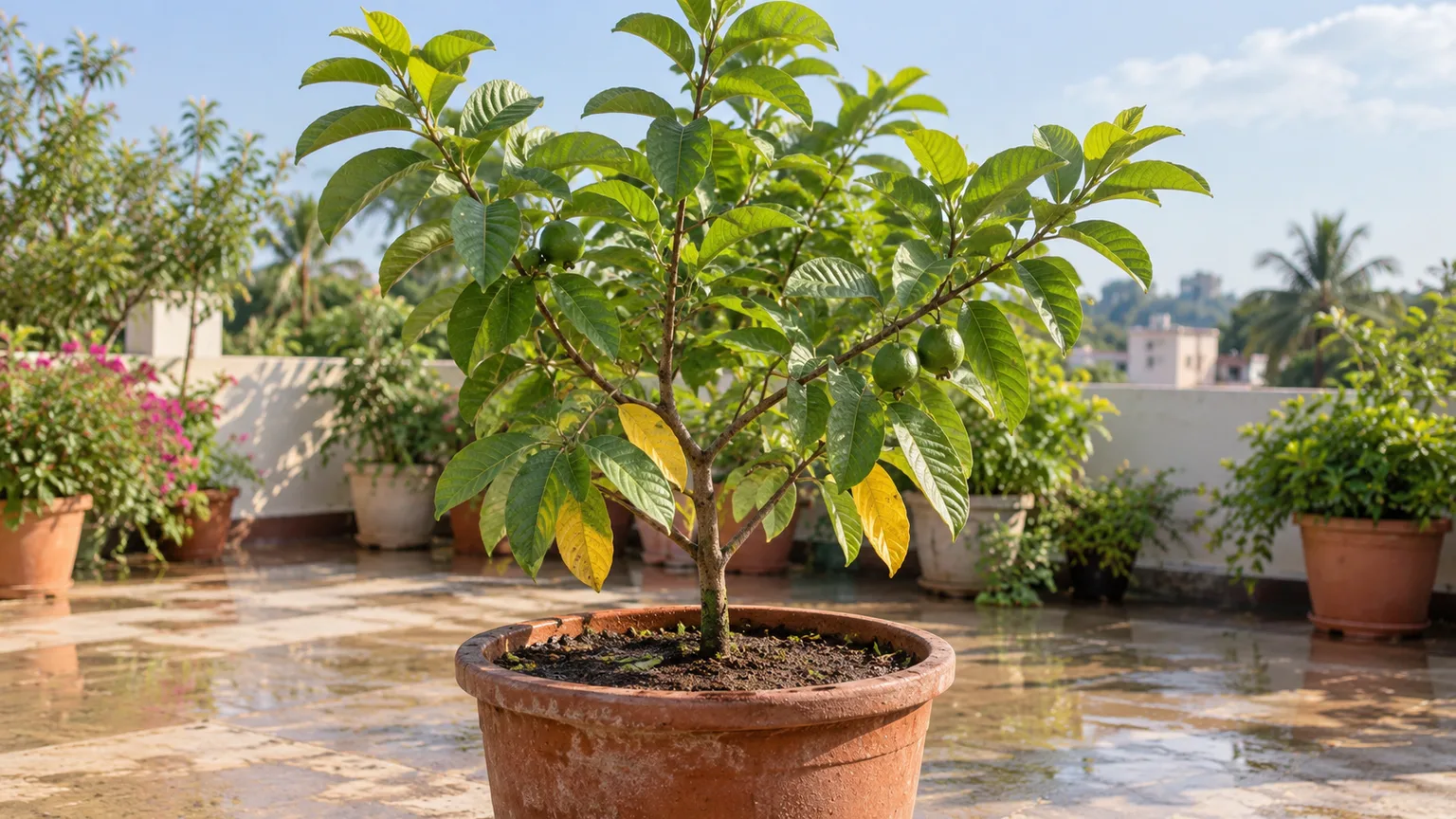
Root Rot on Guava: How to Diagnose, Treat & Prevent It
This guide covers root rot on Guava. See also the general Root Rot guide, watering, and light pages for this plant.
Root Rot on Guava: How to Diagnose, Treat & Prevent It
First, stop the next scheduled watering if the Guava’s mix is still damp, and empty any water trapped beneath the pot. Do not answer wet-soil wilting with another soak. Confirm that roots are actually decaying before pruning or replacing the mix; yellow leaves and drooping shoots alone do not prove root rot.
Guava (Psidium guajava), or amrud, is a sun-loving fruit tree with a root zone that behaves differently in a pot than in open ground. A compact container can stay wet long after the surface dries, while a garden site may hold rainwater around the feeder roots. This guide helps you read those conditions, inspect a potted tree without stripping away healthy roots, and decide when an in-ground tree needs local diagnosis. The Guava care overview covers the full growing setup if root decline is only one part of a larger care problem.
What root rot looks like on Guava
A Guava with damaged roots may wilt even when the soil is wet, lose lower leaves, turn pale or yellow, stop extending new shoots, or show branch dieback. Those canopy symptoms are not specific: UF/IFAS notes that Guava root rot can resemble nutrient deficiency, with chlorosis, stunting, and defoliation above ground. The disease guide says root inspection may reveal necrosis and an underdeveloped root system, which is why a leaf-only diagnosis is unreliable (UF/IFAS Guava disease guide).

On a Guava root ball, look for tissue that has softened or begun to decay; a dark stain by itself is not enough to diagnose rot.
Root rot becomes more likely when several clues coincide: the mix has remained wet for days, the pot feels heavy, water drains slowly or not at all, the root ball smells sour, and fine roots feel soft rather than resilient (Epic Gardening’s root-check guidance). A Guava can also wilt when its root zone is genuinely dry; UF/IFAS notes that drought may wilt immature leaves and shoots (UF/IFAS Guava drought guidance). Yellow leaves can have causes unrelated to roots. Root rot is a conclusion to confirm at the root zone, not a label to apply to every stressed tree. A light overwatering episode alone does not automatically establish disease (Epic Gardening’s root-rot guidance).
The underlying problem is often a root environment that remains saturated long enough to deprive roots of oxygen, with soilborne pathogens contributing to decay (UF/IFAS Guava disease guidance). UF/IFAS reports that Guava root-rot diseases are common where drainage is poor and young trees are overwatered; the listed disease agents include Fusarium and Phytophthora species. Its guidance emphasizes well-drained soil and proper irrigation as cultural prevention (UF/IFAS disease management for Guava). For the general root-rot mechanism across plants, see the root rot symptom guide; the diagnosis and recovery decisions below are specific to Guava.
Why container Guava is vulnerable during Indian monsoon weather
A Guava in a tub has a limited volume of mix to buffer rain, heat, and irrigation. If the pot has too few working holes, sits inside a cachepot holding runoff, or contains a fine mix that has collapsed, the bottom of the root ball may remain wet even while the top looks dry. Penn State Extension recommends a container with drainage holes so excess water can leave instead of waterlogging the mix (Penn State repotting guidance).
During the Indian monsoon, repeated roof runoff can keep a balcony pot saturated even if you stop watering. Move it out from under a downpipe or continuous drip, raise it so the holes stay open, and remove water from its saucer. High humidity by itself does not water a pot, but weeks of rain plus a dense mix can remove the dry-down period Guava roots need. A sunny tree can use water quickly in hot weather; a cooler or shaded Guava often uses less, so a timer that runs unchanged through rainy weeks can overwater it.
The same species-level caution applies in open soil. UF/IFAS describes Guava as moderately tolerant of 7–14 days of wet or flooded soil, but prolonged flooding can lead to leaf and fruit drop, chlorosis, stem dieback, and tree death (UF/IFAS Guava flood-stress guidance). That Florida guidance does not make standing water a safe growing condition or establish a guarantee for every cultivar, pot, or Indian soil type. It recommends choosing a warm planting site that does not remain wet after typical rain; the Epic Gardening Guava guide likewise stresses full sun and good drainage for a home-grown tree.
How Guava’s root habit changes an in-ground diagnosis
Guava is adaptable to several soil textures in the landscape (UF/IFAS Guava soil guidance), but an adaptable tree can still fail in a low spot or compacted planting basin. UF/IFAS notes that air-layered and cutting-grown Guavas tend to have many roots in the upper 30–45 cm of soil (UF/IFAS Guava soil and root profile). Surface grading, runoff, irrigation, and mulch placement can therefore influence a meaningful part of the root zone. Do not dig a deep trench close to the trunk to “air” the roots; cutting roots can add damage without correcting the wet site.
Look for a site pattern before assuming that one Guava has a pathogen. Does water stand after ordinary rain? Is the soil compacted or clay-heavy in a shallow basin? Is an irrigation emitter running daily, or does a lawn sprinkler soak the same area? Are neighboring plants declining in the same low ground? Record those observations and check moisture several centimetres below the surface near the canopy’s outer half, not only beside the trunk. UF/IFAS specifically warns that timed lawn sprinklers can overwater Guava and contribute to root rot (UF/IFAS Guava landscape guide).
If an established in-ground tree is deteriorating, avoid excavating a large section of its root system just to look for brown roots. Guava root rots and root-knot nematodes can produce overlapping above-ground signs, and UF/IFAS documents both disease groups in Guava (UF/IFAS disease guide). A local horticulture extension service or plant diagnostic clinic can advise how to collect a small root-and-soil sample and whether laboratory diagnosis is appropriate. This is especially useful before buying or applying a fungicide: the visible canopy does not identify a pathogen, and a product that targets one organism may not solve another problem; Gardening Know How also advises confirming the cause before using a fungicide (outdoor root-rot guidance).
Confirm the problem in a potted Guava
Start with the history rather than removing the tree immediately. Note the last few waterings, rainfall exposure, how quickly water leaves the holes, and whether the tree moved from sun to shade or was repotted recently. Push a clean wooden skewer several centimetres into the mix near the pot wall and again closer to the centre. If the centre is cool and wet while the surface is dry, wait before watering; if the pot is light and the root zone is dry, drought is more plausible than active root rot.
Next, check the drainage path. Remove the inner pot from any decorative cachepot and empty the saucer. Clear only loose debris blocking the holes, then observe whether the pot begins to drain and dry more normally before making another change. The Guava watering guide explains how to use the 3–5 cm moisture check and adjust observation frequency through heat and monsoon rain.
If the Guava continues to decline in wet mix, slide the root ball out while supporting its base rather than pulling on the trunk. Brush away loose media from a small area at the outside and bottom. Healthy fine roots should feel firm; roots affected by decay are more likely to be softened, dark, or shedding their outer tissue. A sour odor may accompany advanced decay. Epic Gardening advises checking roots directly because wilting, yellow leaves, or soft stems can have causes other than root rot (Epic Gardening root-rot diagnosis). For outdoor trees, Gardening Know How similarly notes that root rot can resemble drought or mineral stress, reinforcing why the root condition matters (Gardening Know How root-rot signs).
Do not scrape or cut every root to find a perfect colour. Guava roots can carry soil stains, and a limited inspection should answer whether decay is actually present. If the root ball holds together, most roots feel firm, and only the mix is slow to drain, correct the drainage setup and watering pattern first. A single wet weekend is not, by itself, proof that a mature Guava has an established pathogen problem; mild overwatering does not always lead to root disease (Epic Gardening’s container guidance).
Tell Guava root rot from lookalikes
| What you notice | What it suggests | What to check next |
|---|---|---|
| Wilting while the pot is heavy and wet; roots feel soft or decay is visible | Root damage is likely | Confirm drainage, inspect how much firm root tissue remains, and use the container rescue steps below. |
| Wilting with a light pot and dry mix; roots remain firm | Drought or a dry root ball is more likely | Water thoroughly once the root zone is dry, then observe whether the leaves regain firmness. |
| Yellow young leaves with greener veins, but roots remain firm | Iron availability or another nutrient issue may be involved, especially in high-pH soil; UF/IFAS notes Guava may need chelated iron at high soil pH (UF/IFAS soil guidance). | Check soil conditions through the Guava soil guide before feeding or adding an amendment. |
| Declining in-ground Guava with swollen galls or distorted roots | Root-knot nematodes are a different possibility | Do not treat it as ordinary overwatering; ask a local diagnostic service about a sample. UF/IFAS lists root-knot nematodes among Guava root pests. |
None of these rows is a lab diagnosis. In particular, yellow leaves, stunting, or dieback cannot tell you which soilborne organism is present. If the root structure is still firm, avoid cutting roots or applying a fungicide simply because the leaves look thirsty. Use the Guava light guide if the tree’s placement changed at the same time; reduced light can slow water use and make a previously adequate watering routine too frequent.
The first fix: pause irrigation and remove trapped runoff
When a potted Guava is wilting but the root zone remains damp, stop its next scheduled soak. Empty standing water beneath the pot and make sure the container can drain freely. This is the first correction because additional water cannot restore function to roots that are already short of oxygen. Do not immediately add fertilizer, a fungicide, hydrogen peroxide, or a second potting mix; first determine whether the tree has root decay or only a slow-drying setup.
Give the pot a short observation window if the tree is not rapidly collapsing and no soft roots have been confirmed. Keep it in bright, steady conditions rather than moving it from shade into harsh afternoon sun during root stress. Recheck moisture below the surface and note whether the pot becomes lighter as it drains. If it dries and the tree stabilizes, keep the current root ball intact and adjust future watering. If it remains saturated, smells sour, or the Guava continues to lose leaves, proceed to root inspection and rescue.
The exact interval depends on pot size, mix, weather, canopy, and whether rain reaches the container. For Guava, the useful check is not a universal number of days: use the depth-based method in the watering guide and let active growth and seasonal conditions determine how often to check. In cool or shaded weather, the same fixed weekly irrigation that worked in sun may leave the root ball wet too long.
If root rot is confirmed in a container Guava
Use a focused repot only when you have found soft, decaying roots or a container that cannot drain. Prepare a clean pot with working holes and a fresh, free-draining medium before lifting the tree. Choose a pot that fits the remaining root mass; after substantial root loss, a larger volume of wet mix can be harder to manage. The Guava repotting guide covers pot size and timing for routine moves, while this section is an emergency exception for damaged roots.
Support the root ball and remove loose, saturated media with your fingers. Cut only roots that are clearly soft, mushy, or dead, stopping when the cut reaches firm tissue. Use a clean, sharp tool and avoid stripping healthy roots just to expose a bare root system. The practical sequence of confirming rot, removing visibly damaged tissue, and replacing compromised mix is consistent with Epic Gardening’s root-rot guidance; Penn State Extension also recommends gentle root handling and a mix that does not become compacted during repotting (Epic Gardening rescue steps; Penn State repotting procedure).
Set the Guava at its previous planting depth; do not bury the trunk flare. Backfill without pressing the mix into a dense block. Water once to settle the fresh medium, allow excess to drain, and empty the saucer, following Penn State Extension’s post-repot watering procedure (Penn State repotting guidance). Keep the tree out of relentless rain while the root ball re-establishes, but do not put it in a dark corner. The goal is a moist, aerated root zone—not a dry spell severe enough to wilt all remaining roots.
Do not fertilize immediately after pruning roots. A damaged root system has less capacity to take up water and dissolved nutrients, so a concentrated feed adds another variable without fixing drainage. Epic Gardening also advises delaying fertilizer while roots recover (root-rot recovery guidance). Resume only after the tree is stable and produces firm new growth; the Guava fertilizer guide can help you return to a measured schedule. Avoid combining root pruning with hard canopy pruning and a sudden change to full afternoon sun in one session.
What to do for an in-ground Guava
You cannot lift an established garden Guava into fresh soil without causing major disturbance, so use a different response from container rescue. Stop irrigation that is not needed, divert roof or path runoff away from the trunk area, and avoid adding more water just because leaves droop. If rain has stopped but the soil stays saturated, the site’s drainage—not the tree’s thirst—is the immediate issue.
Do not excavate roots around the trunk or dig a deep dry moat. Guava’s active roots extend outward beyond the canopy dripline (UF/IFAS Guava root-spread guidance), and extensive digging can remove functional roots while leaving the wet soil condition unchanged. Keep heavy machinery, repeated foot traffic, and fresh fill away from the root zone. If the tree is valuable, the decline is spreading, or several plants show similar symptoms, ask a local extension horticulturist or diagnostic clinic how to sample roots and soil before choosing a treatment.
For a future planting, select a warm, sunny position that sheds water after ordinary rain. Where a site predictably holds water, raise the planting area or use a better-drained location rather than relying on frequent chemical treatment. UF/IFAS recommends avoiding locations that flood and describes planting on a mound where high water tables or flooding are common; adapt that advice to local soil and rainfall rather than copying Florida mound dimensions exactly (UF/IFAS site-selection guidance). The Guava soil guide explains how to evaluate drainage for a container or planting bed before committing another tree.
Recovery: follow the new roots and the next Guava flush
Old leaves that turned yellow or brown may stay damaged or fall. They do not need to become green again for the tree to recover. Better evidence is that the decline stops, remaining roots stay firm, the mix dries at a predictable rate, and the next warm-growth flush produces normal leaves and shoots. A root-damaged Guava may take longer to resume growth if it is cool, shaded, recently repotted, or carrying fruit, so avoid promising a fixed recovery date.
A container tree with several firm roots and a sound trunk can sometimes rebuild roots after the wet conditions are corrected. If most fine roots have collapsed, the root crown is soft, or dieback has moved into major branches, recovery becomes uncertain. Epic Gardening notes that a plant with all roots affected is unlikely to be saved; for a woody fruit tree like Guava, the practical decision depends on whether enough sound roots and living canopy remain to support regrowth (Epic Gardening recovery guidance). If a valuable in-ground Guava is collapsing, get a diagnosis before removing it, because canopy decline does not identify the cause.
Keep a brief record for the next few weeks: when the pot was watered, how long it stayed heavy, whether rainfall reached it, and when new growth appeared. This makes it easier to see whether drainage changes are working and prevents you from alternating between saturation and severe drought while trying to “rescue” the tree.
Prevent repeat root rot through Guava’s growing cycle
For a container tree, keep all drainage holes open and let runoff leave the pot rather than collecting beneath it. Use a stable, appropriately sized pot and a mix that holds some moisture but does not stay slick or sour after a thorough watering. Lift or tilt the container occasionally to learn how its weight changes from wet to ready-for-water. That baseline is more useful than borrowing an exact interval from a different Guava, pot, or climate.
During hot weather, check more often but water only when the root zone has begun to dry. During monsoon, shield the pot from repeated roof runoff, empty saucers, and test the centre of the mix before using an automatic timer. On a garden tree, inspect the soil at several points instead of watering only beside the trunk; avoid planting in a low pocket that holds water. Guava needs full sun, and its growth slows in cool conditions; if light or temperature has reduced growth, do not keep a warm-season irrigation schedule unchanged (Epic Gardening Guava care; UF/IFAS Guava climate guidance).
Keep mulch away from direct contact with the Guava trunk, especially where monsoon moisture is prolonged. Do not pile fresh compost or soil against the stem to hide a decline. If the tree is planted in heavy soil, improve broad site drainage or choose a raised area for future trees; a small pocket of amended soil can still sit inside a larger water-holding basin. Reassess the container mix at routine repotting instead of refreshing it every time one leaf yellows.
When to use this page vs other Guava guides
Use this page when a Guava declines in wet soil and you need to confirm root decay, decide whether to repot, or protect an in-ground tree from prolonged saturation. Use the Guava overview for whole-plant priorities, watering for seasonal moisture checks, and soil for drainage and mix structure. If the problem is a crowded or failed container rather than confirmed rot, use the repotting guide instead of pruning healthy roots as a precaution.
Use the light guide when shade may be slowing dry-down or a placement change coincided with decline. Wait to use fertilizer guidance until roots have stabilized and new growth shows that the tree is active again. Those care pages cover the routes available for Guava while sibling problem pages remain under review.
Related Guava guides
- Guava care overview — use for the tree’s overall growing conditions, growth habit, and seasonal priorities.
- Guava watering — use to decide when a container or garden Guava actually needs another soak.
- Guava soil — use to assess mix texture, drainage, and the root zone’s moisture retention.
- Guava repotting — use for routine pot sizing and root inspection when the tree is crowded rather than rotting.
- Guava light — use when a shaded or newly moved tree is drying slowly or losing vigour.
- Guava fertilizer — use after root recovery to plan a restrained feed during active growth.
Related tool
Try the Root Rot Risk Checker with Guava selected to compare wet-soil, drainage, and root clues before making a larger change.