Guava Care Guide: Grow Amrud in Pots and Gardens
Psidium guajava
Grow Guava (Psidium guajava) in full sun and free-draining soil. Learn when to water, how to keep Amrud compact, and what helps it fruit.
Guava Care Guide: Grow Amrud in Pots and Gardens
Start with wateringThe most common care mistake for GuavaWatering guide →Guava care essentials
Light
Water
Water deeply when the top 3–5 cm of soil is dry. Keep young and container trees evenly moist while establishing, then allow slight drying between soaks. Avoid drought from flowering through fruit development and never leave the root zone waterlogged.
Soil
Fertile, well-draining sandy loam or loam. Guava tolerates many soil types, but container roots need aeration and reliable drainage; aim for pH 5.0–7.0.
Humidity
Temperature
Fertilizer
High-pH soil can trigger iron chlorosis even when fertilizer is present.
About Guava
Guava is native to Tropical America, from southern Mexico and the Caribbean to northern South America, typically reaches Up to 6–10 m tall and wide unpruned; commonly maintained at 1.8–3 m for home growing indoors, with moderate to fast in warm weather; growth slows below about 16°c or during drought growth. Guava has a tree like growth habit and part of the Myrtaceae family. It is also known as Amrud, Tropical Guava, Common Guava, Guayaba, and Goiaba.
| Detail | Information |
|---|---|
| Also known as | Amrud, Tropical Guava, Common Guava, Guayaba, Goiaba |
| Native region | Tropical America, from southern Mexico and the Caribbean to northern South America |
| Mature size | Up to 6–10 m tall and wide unpruned; commonly maintained at 1.8–3 m for home growing |
| Growth rate | Moderate to fast in warm weather; growth slows below about 16°C or during drought |
| Growth habit | Tree Like |
| Scientific name | Psidium guajava |
| Family | Myrtaceae |
Guava Care Guide: Grow Amrud in Pots and Gardens
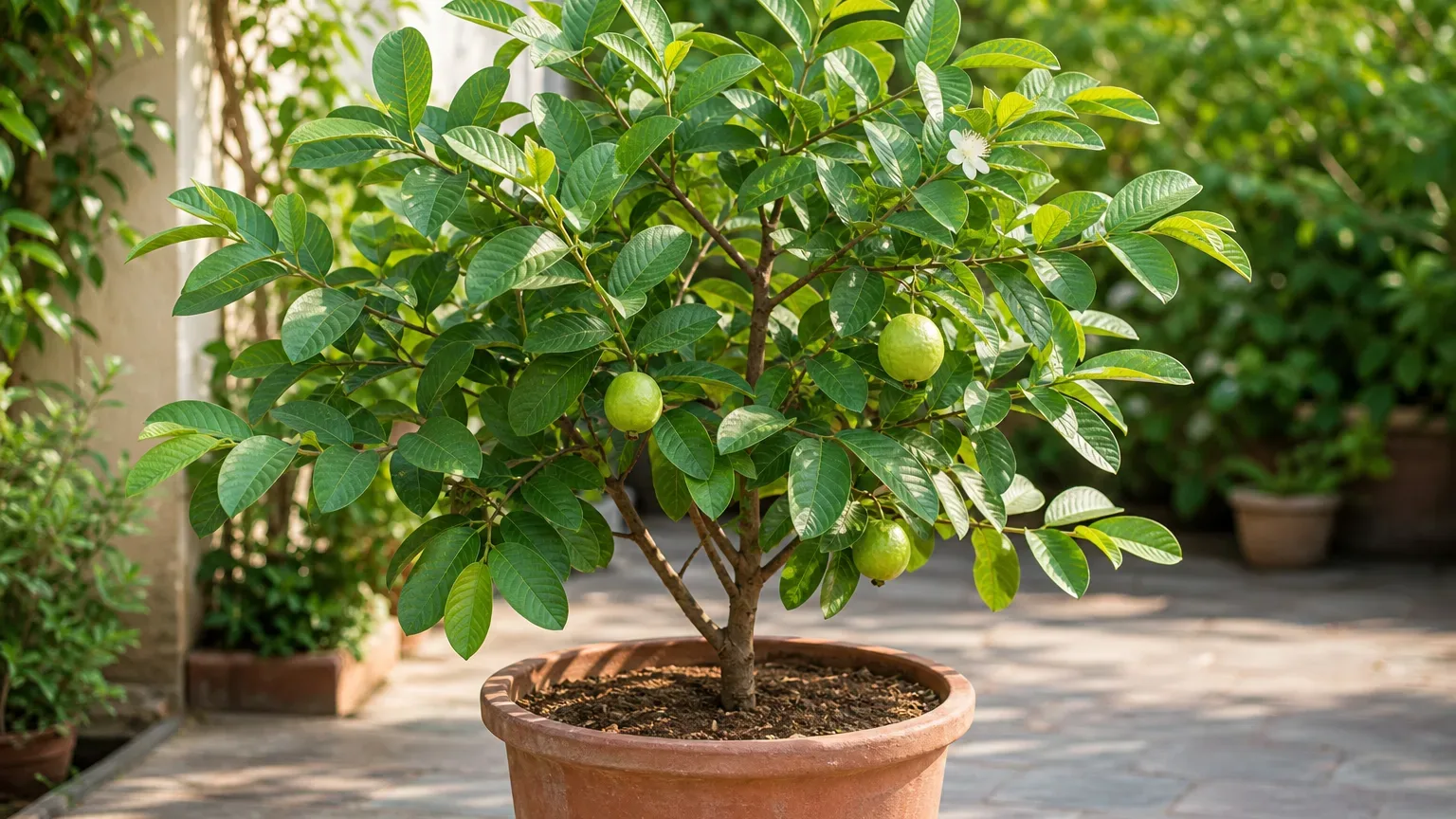
Guava, or amrud, is a sun-loving fruit tree rather than a foliage plant for a dim room. Psidium guajava belongs to the Myrtaceae family, and the USDA Plants profile records it as a tree species. In a warm Indian garden it can become a broad, productive tree; in a pot it needs deliberate root-zone management and pruning to remain compact.
The first priorities are simple: put it outdoors in strong sun, use a container with dependable drainage, water deeply after the upper mix begins to dry, and give the canopy enough space for air movement. Fruit is never guaranteed by care alone, but strong light, active roots and healthy new shoots give a suitable cultivar the conditions it needs to flower and hold a crop.
Guava care at a glance
Give guava at least six hours of direct sun, preferably more where summer heat is not reflected from concrete onto a small pot. Singapore’s government gardening guidance describes a minimum of six hours for the tree, while UF/IFAS recommends full sun for best growth and fruit production. A bright window is not equivalent to an open terrace because glass, walls and roof overhangs greatly reduce usable light.
Water until the full root ball is wet and excess drains, then check again only after the upper 3–5 cm has started to dry. Use fertile, free-draining soil rather than dense garden clay in a pot. Feed modestly during warm active growth, prune selectively to control height, and protect young plants from frost, prolonged waterlogging and abrupt exposure to fierce afternoon heat.
Know the tree you are growing
Common guava is native to tropical America but is now cultivated widely across tropical and subtropical regions. An Australian rainforest identification resource describes its naturalised distribution and tree form, while the NParks species record confirms the botanical name Psidium guajava and family Myrtaceae. This tropical background explains why warm conditions and long, bright days suit it better than cool indoor culture.
Cultivars differ in fruit colour, flavour, seediness, vigour and mature size. Indian growers may encounter Allahabad Safeda, Lucknow 49/Sardar, Lalit, Arka Mridula or Arka Kiran; Tamil Nadu Agricultural University lists regionally used cultivars. Choose for your local climate and intended use, not merely from a fruit label.
Growth habit and realistic size
An unpruned guava is a branching tree, not a naturally miniature patio shrub. UF/IFAS notes that landscape trees may reach about 6 m and recommends using selective pruning to maintain manageable dimensions; a home tree can often be held around 1.8–3 m where the container and cultivar are suitable. Restricting roots can slow growth, but a tiny pot is not a substitute for canopy training.
Expect moderate to fast growth in warm weather. UF/IFAS gives 23–28°C as an ideal range for growth and production and reports that growth slows below about 16°C or during drought. Those figures are useful context, not a demand for climate control: in most warm Indian locations, the practical job is protecting a young tree from unusual cold and keeping a hot container from drying completely.
Choose a warm, sunny placement
Place guava on an open terrace, sunny balcony, courtyard or garden edge where nearby walls and taller plants do not shade it for most of the day. Rotate a container every week or two if one side faces a wall, because an uneven canopy becomes harder to balance. Leave space around the foliage; crowding against a parapet may trap humid air during monsoon and hide scale insects or leaf spots.
Acclimate nursery foliage over roughly a week when moving it from shade net to harsh sun. Begin with morning sun, then lengthen exposure while watching new leaves for pale, crisp patches. Established foliage tolerates strong tropical light, but tender leaves formed under shade can scorch before the plant adjusts.
Can guava grow well in a container?
Yes, guava can grow and fruit in a large container, but the pot must behave like a managed root zone. Start only one size wider than the nursery root ball, ensure several unobstructed drainage holes, and step up gradually as roots fill the mix. A huge pot around a small root system remains wet for too long; a severely rootbound pot can dry within hours and shed flowers or fruit.
A compact or less vigorous named cultivar is easier to manage than an unknown seedling. Use a stable pot that will not topple as the canopy broadens, and plan for periodic Guava repotting or root work once the largest movable size is reached. If the balcony receives less than six hours of direct light, treat the plant primarily as foliage rather than expecting reliable fruit.
Water by the root zone, not the calendar
Check 3–5 cm into the mix with a finger or wooden skewer. If that layer is dry and the pot feels noticeably lighter, soak slowly until water runs from every drainage hole, then empty the saucer. Do not respond to a hot afternoon wilt automatically: first check whether the deeper mix is dry, because wilt in wet soil can indicate damaged, oxygen-starved roots.
Young trees and fruiting container plants need closer attention than established trees in the ground. UF/IFAS reports that established guava tolerates prolonged drought but that drought during fruit set and development can reduce set and fruit size. Research in subtropical India likewise found that irrigation scheduling and mulch affected guava yield, reinforcing the value of even moisture during fruit development without constant saturation.
In hot, dry weather a rooted container may need checking daily, though not necessarily watering daily. During monsoon, move pots away from roof runoff and pause irrigation while rain keeps the root zone wet. The Missouri Botanical Garden explains that saturated soil excludes oxygen and damages roots; drainage is therefore a care requirement, not an optional pot feature.
For a deeper diagnostic method and seasonal examples, use the Guava watering guide.
Build a fertile but airy soil mix
Guava tolerates many landscape soils, but containers are less forgiving because roots cannot explore beyond a wet or compacted pocket. A practical mix is roughly half quality potting mix or screened sandy loam, one-quarter mature compost, and one-quarter coarse pine bark, pumice or perlite. The goal is a blend that wets evenly, drains promptly and still holds enough moisture to prevent the root ball from lurching from soaked to dust-dry.
UF/IFAS gives an ideal landscape pH of about 4.5–7 and notes that high-pH soil can induce iron deficiency unless iron is managed appropriately. Do not repeatedly add fertilizer to pale foliage without checking drainage and pH; wet roots and alkaline mix can both limit uptake. The Guava soil guide covers mix adjustments and high-pH warning signs in more detail.
Feed for steady growth, not soft excess
Feed only a rooted, actively growing tree. In a container, use a balanced fruit-tree fertilizer at the label’s container rate, divided into modest applications through warm growth rather than one heavy dose. Flush the pot with plain water periodically, because fertilizer salts have nowhere else to move in a confined root zone.
Bearing guava needs adequate potassium, while high-pH conditions may reveal iron deficiency as yellow young leaves with greener veins. Field-crop fertilizer schedules from extension sources are not safe container recipes: soil volume, root mass and product concentration differ. Start conservatively and use the Guava fertilizer guide before correcting a suspected deficiency.
Prune to manage size and renew fruiting wood
Train a young plant around several well-spaced branches, then remove dead, crossing, inward-growing and excessively upright shoots. Guava flowers on vigorous new growth arising from older wood or shoot ends, and UF/IFAS describes selective pruning as a way to maintain height while opening the canopy to sunlight and air. This makes pruning part of fruiting management, not merely cosmetic shaping.
Avoid stripping the canopy during peak heat. Sudden heavy pruning can expose bark and fruit that developed in shade, while repeated shearing creates dense outer growth and a bare interior. Make selective cuts after harvest or before a warm growth flush, disinfect tools between unhealthy plants, and see the Guava pruning guide for timing and cut placement.
Start with the right planting material
Seed is inexpensive but unpredictable. Seedlings may not match the parent fruit and can take years to bear; UF/IFAS gives a possible range of three to eight years. Vegetative methods such as air layering, cuttings, grafting and budding preserve a named cultivar, and TNAU specifically identifies layers as guava planting material.
For a home fruit tree, buy a healthy grafted, layered or otherwise vegetatively propagated cultivar from a reliable nursery. Reject plants with tightly circling woody roots, trunk wounds, scale colonies or sour-smelling mix. The Guava propagation guide explains why air layering is often more practical than seed when cultivar identity matters.
Support flowering and fruit development
Sun, mature new growth and a functioning root system matter more than any “flower booster.” Avoid drought while flowers open and fruit enlarges, but do not keep the pot wet in an attempt to prevent fruit drop. Some drop is normal; repeated drop alongside pale leaves, stalled shoots or saturated soil calls for root-zone diagnosis.
Do not combine repotting, hard pruning and heavy feeding when a tree is flowering. Each intervention changes the balance between roots and canopy, and stacking them creates avoidable stress. Pollinating insects can help even when a cultivar is self-fruitful, so avoid spraying broad-spectrum insecticides over open flowers.
Adjust guava care through Indian seasons
During hot pre-monsoon weather, check pots frequently, shade only the container wall if roots overheat, and mulch lightly without piling material against the trunk. During monsoon, prioritise drainage and airflow, remove fallen diseased material, and withhold irrigation until the mix actually begins to dry. TNAU’s cultivation guidance also emphasises well-drained soil and irrigation as needed, rather than permanently wet ground.
During a cooler or drier winter, growth may slow, so lengthen the interval between watering and reduce feeding. In frost-prone north Indian locations, move a portable tree beside a warm wall under cover and protect the root ball overnight. Resume stronger feeding and structural work only when warmth and visible new growth return.
Read common warning signs correctly
Yellow leaves plus slow-drying, sour-smelling soil point first toward excess moisture or poor aeration. Yellow new leaves in a draining pot may instead indicate high-pH iron chlorosis. Limp new growth in genuinely dry soil suggests drought, while limp growth above a wet root ball requires inspection before any more water.
Brown leaf margins can follow severe dry-down, salt accumulation or hot desiccating wind. A tree that grows vigorously but does not flower may be too young, shaded, overfed with nitrogen or repeatedly pruned at the wrong stage. Diagnose the whole pattern—soil moisture, light, recent treatment and which leaves are affected—rather than treating one symptom in isolation.
Keep pet-safety claims cautious
Ripe guava is a familiar human food, but that does not prove that every leaf, twig, seed or fallen fermenting fruit is safe for every companion species. Pet-specific veterinary evidence for browsing Psidium guajava is limited. Prevent pets from chewing treated foliage or eating large amounts of fallen fruit, and contact a veterinarian if ingestion is followed by vomiting, diarrhoea or unusual behaviour.
When to use this page vs other Guava guides
- Use this overview to understand guava’s whole growing system and decide whether your site can support a sun-loving tree.
- Use Guava light to assess a balcony, terrace or garden position and acclimate foliage safely.
- Use Guava watering when leaves wilt, soil stays wet, or seasonal frequency is unclear.
- Use Guava soil for container recipes, drainage problems and pH-related yellowing.
- Use Guava fertilizer before choosing a product or correcting a suspected nutrient deficiency.
- Use Guava repotting when roots circle, the tree becomes unstable or the pot dries within a day.
- Use Guava propagation to compare seed, air layering, cuttings and grafted plants.
Related Guava guides
- Guava plant hub — species profile, key care facts and the complete care cluster.
- Guava pruning — detailed size control and fruiting-wood decisions.
- Guava light — direct-sun targets and sun-stress diagnosis.
- Guava watering — root-zone checks for pots, gardens and monsoon weather.
- Guava soil — free-draining mixes and pH management.
- Guava fertilizer — feeding through active growth and fruiting.
- Guava repotting — pot sizing and aftercare.
- Guava propagation — methods that preserve cultivar traits.
Conclusion
Successful guava care begins with accepting what the plant is: a warm-climate fruit tree that wants open sun, active roots and room for a branching canopy. In the ground, choose a non-flooding site; in a container, make drainage, gradual pot sizing and selective pruning non-negotiable. Water deeply after the upper root zone begins to dry, then adjust the interval to heat, rain, pot size and fruit development.
For an Indian terrace or garden, the biggest seasonal shift is from rapid dry-down before monsoon to prolonged moisture during it. Watch the root zone instead of the calendar, protect a young plant from unusual cold, and make only one major intervention at a time. With a suitable named cultivar and realistic expectations, guava can remain manageable while producing healthy growth, flowers and eventually fruit.
How to care for Guava?
When should you water Guava?
Water deeply when the top 3–5 cm of soil is dry. Keep young and container trees evenly moist while establishing, then allow slight drying between soaks. Avoid drought from flowering through fruit development and never leave the root zone waterlogged.
- Check 3–5 cm below the surface - Water deeply when the top 3–5 cm of soil is dry.
- water thoroughly only when that layer feels dry - Water deeply when the top 3–5 cm of soil is dry.
- Drain excess water - Water deeply when the top 3–5 cm of soil is dry.
What soil works best for Guava?
Fertile, well-draining sandy loam or loam. Guava tolerates many soil types, but container roots need aeration and reliable drainage; aim for pH 5.0–7.0.
- 50% quality potting mix or sandy loam - Fertile, well-draining sandy loam or loam.
- 25% mature compost
- 25% coarse perlite, pumice, or pine bark - Fertile, well-draining sandy loam or loam.
Grower notes for Guava
What matters most with Guava
Guava is a tropical fruit tree, not a low-light foliage plant. Give it full sun for the strongest flowering and fruiting, then match watering to the root zone rather than a rigid calendar. UF/IFAS notes that established trees tolerate drought, but water stress during bloom and fruit development reduces set and fruit size. In a pot, excellent drainage is essential because roots have much less room to escape saturated soil.
Best placement in a real home
Place Guava outdoors on a sunny terrace, balcony, or warm courtyard with at least 6 hours of direct sun. A tree can reach about 6 m in the landscape, but regular selective pruning can hold it near 1.8–3 m. Growth is strongest around 23–28°C and slows below about 16°C. Protect young plants from frost, cold drafts, and reflected heat from walls that dries a small pot too quickly.
Before you buy this plant
Choose a named, vegetatively propagated cultivar when fruit quality and time to harvest matter. Seed-grown Guava does not reliably match its parent and may need 3–8 years to fruit; air-layered, grafted, budded, or cutting-grown plants preserve cultivar traits and usually crop sooner. Reject plants with circling woody roots, trunk wounds, scale insects, or soil that smells sour.
First month after bringing it home
Keep the tree in strong light, but acclimate nursery foliage to harsh afternoon sun over several days. Water when the upper 3–5 cm dries and empty the saucer after each soak. Do not combine repotting, hard pruning, and fertilizer immediately after arrival. First learn how quickly the pot dries and watch for scale, thrips, whiteflies, or stressed new leaves.
Pet-aware note for Guava
Ripe Guava fruit is a familiar human food, and Plants For A Future records no known hazards for Psidium guajava. That is not the same as a veterinary pet-safety classification for every plant part or animal. Prevent pets from chewing leaves, bark, seeds, or large amounts of fruit, and contact a veterinarian if ingestion causes vomiting, diarrhoea, or unusual behaviour.
How to tell Guava is settling in
A settled Guava produces firm, normally sized new leaves and holds growth without repeated wilting or off-season yellowing. Flowers and fruit are bonuses, not the first test of establishment. Some fruit drop is normal, but repeated drop alongside pale leaves or wet soil points to stress. Repot when roots become densely circled or the container dries within a day, preferably as warm growth begins.
Is Guava safe for pets?
Ripe Guava is widely eaten by people, and Plants For A Future reports no known hazards for Psidium guajava. Pet-specific evidence is limited, so prevent chewing of leaves, bark, seeds, and large amounts of fruit.
Psidium guajava has no known hazards recorded by Plants For A Future, and its ripe fruit is a common human food. This does not verify every plant part as safe for cats, dogs, birds, rabbits, horses, or reptiles. Keep non-fruit parts and fallen fermenting fruit out of reach, and seek veterinary advice if a pet develops symptoms after ingestion.
Watering Guava
For Guava, check 3–5 cm below the surface; water thoroughly only when that layer feels dry and water every 3–7 days for container trees in warm weather; every 7–14 days in cooler months, adjusted for pot size and rainfall. Increase during hot, dry weather and from bloom through fruit fill; reduce during cool weather and rainy periods.
| Detail | Information |
|---|---|
| How often | Every 3–7 days for container trees in warm weather; every 7–14 days in cooler months, adjusted for pot size and rainfall |
| How to check | Check 3–5 cm below the surface; water thoroughly only when that layer feels dry |
| Seasonal changes | Increase during hot, dry weather and from bloom through fruit fill; reduce during cool weather and rainy periods |
Signs of overwatering
- persistently yellow or pale leaves
- leaf and fruit drop
- sour-smelling, slow-drying soil
- stem dieback or root rot
Signs of underwatering
- soft new leaves wilting
- dry brown leaf margins
- reduced fruit set or small fruit
- paused new growth
Soil & potting for Guava
Use a mix of 50% quality potting mix or sandy loam, 25% mature compost, 25% coarse perlite, pumice, or pine bark for Guava. Free-draining but moisture-retentive; prolonged saturation can cause chlorosis, dieback, and root decline. Target soil pH around 5.0–7.0 ideal; can grow at higher pH with appropriate iron management. Repot every 1–2 years while young; refresh the upper mix and root-prune established container trees when upsizing is no longer practical, ideally in spring or the start of warm active growth.
| Detail | Information |
|---|---|
| Recommended mix | 50% quality potting mix or sandy loam, 25% mature compost, 25% coarse perlite, pumice, or pine bark |
| Drainage | Free-draining but moisture-retentive; prolonged saturation can cause chlorosis, dieback, and root decline |
| Soil pH | 5.0–7.0 ideal; can grow at higher pH with appropriate iron management |
| Repotting frequency | Every 1–2 years while young; refresh the upper mix and root-prune established container trees when upsizing is no longer practical |
| Best season to repot | Spring or the start of warm active growth |
Signs it needs repotting
- roots circling densely or exiting drainage holes
- pot dries completely within a day
- growth stalls despite full sun and appropriate feeding
- tree becomes unstable or top-heavy
Humidity & temperature for Guava
Fertilizer & pruning for Guava
Use high-pH soil can trigger iron chlorosis even when fertilizer is present. for Guava.
| Detail | Information |
|---|---|
| Fertilizer type | High-pH soil can trigger iron chlorosis even when fertilizer is present. |
Common problems on Guava
Yellow Leaves
MediumLikely cause: Common on this plant type; confirm with recent watering, light, and root checks.
Quick fix: Inspect the plant and correct the most likely care stressor before stacking treatments.
Full fix guide →Brown Tips
MediumLikely cause: Common on this plant type; confirm with recent watering, light, and root checks.
Quick fix: Inspect the plant and correct the most likely care stressor before stacking treatments.
Full fix guide →Root Rot
MediumLikely cause: Common on this plant type; confirm with recent watering, light, and root checks.
Quick fix: Inspect the plant and correct the most likely care stressor before stacking treatments.
Full fix guide →Overwatering
MediumLikely cause: Common on this plant type; confirm with recent watering, light, and root checks.
Quick fix: Inspect the plant and correct the most likely care stressor before stacking treatments.
Full fix guide →Underwatering
MediumLikely cause: Common on this plant type; confirm with recent watering, light, and root checks.
Quick fix: Inspect the plant and correct the most likely care stressor before stacking treatments.
Full fix guide →Spider Mites
MediumLikely cause: Common on this plant type; confirm with recent watering, light, and root checks.
Quick fix: Inspect the plant and correct the most likely care stressor before stacking treatments.
Full fix guide →Mealybugs
MediumLikely cause: Common on this plant type; confirm with recent watering, light, and root checks.
Quick fix: Inspect the plant and correct the most likely care stressor before stacking treatments.
Full fix guide →Aphids
MediumLikely cause: Common on this plant type; confirm with recent watering, light, and root checks.
Quick fix: Inspect the plant and correct the most likely care stressor before stacking treatments.
Full fix guide →Leggy Growth
MediumLikely cause: Common on this plant type; confirm with recent watering, light, and root checks.
Quick fix: Inspect the plant and correct the most likely care stressor before stacking treatments.
Full fix guide →Slow Growth
MediumLikely cause: Common on this plant type; confirm with recent watering, light, and root checks.
Quick fix: Inspect the plant and correct the most likely care stressor before stacking treatments.
Full fix guide →Wilting
MediumLikely cause: Common on this plant type; confirm with recent watering, light, and root checks.
Quick fix: Inspect the plant and correct the most likely care stressor before stacking treatments.
Full fix guide →Drooping Leaves
MediumLikely cause: Common on this plant type; confirm with recent watering, light, and root checks.
Quick fix: Inspect the plant and correct the most likely care stressor before stacking treatments.
Full fix guide →Low Humidity
MediumLikely cause: Common on this plant type; confirm with recent watering, light, and root checks.
Quick fix: Inspect the plant and correct the most likely care stressor before stacking treatments.
Full fix guide →Not Enough Light
MediumLikely cause: Common on this plant type; confirm with recent watering, light, and root checks.
Quick fix: Inspect the plant and correct the most likely care stressor before stacking treatments.
Full fix guide →Fungus Gnats
MediumLikely cause: Common on this plant type; confirm with recent watering, light, and root checks.
Quick fix: Inspect the plant and correct the most likely care stressor before stacking treatments.
Full fix guide →Mold on Soil
MediumLikely cause: Common on this plant type; confirm with recent watering, light, and root checks.
Quick fix: Inspect the plant and correct the most likely care stressor before stacking treatments.
Full fix guide →