Not Enough Light on Guava: Signs, Checks & Fixes
Quick answer
If your Guava receives less than about six hours of direct sun, first move its container to the brightest open position it can safely occupy. If it grew indoors or in shade, increase sun in stages; do not try to force recovery with fertilizer or hard pruning.
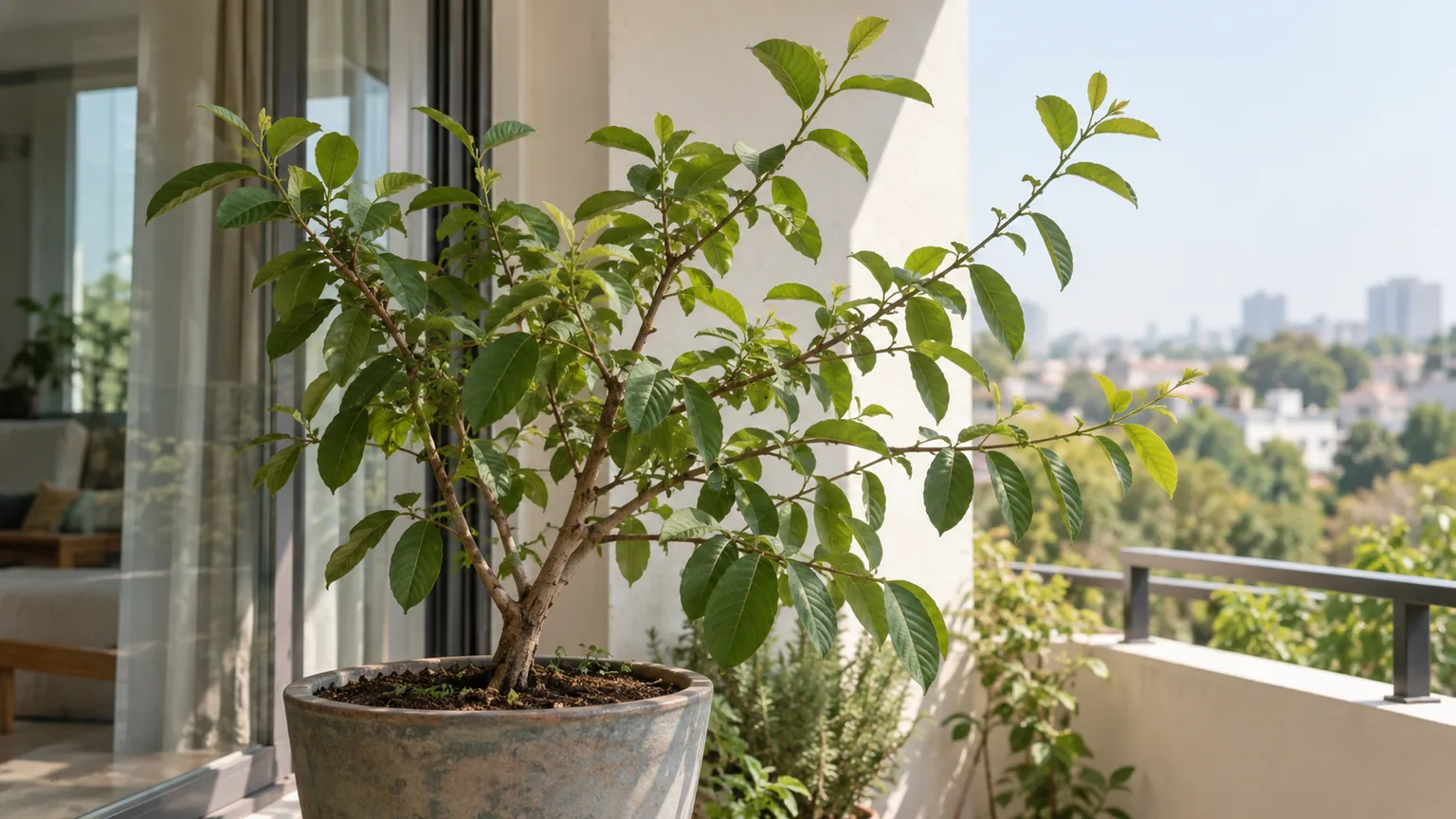
Not Enough Light on Guava: How to Confirm and Fix It
This guide covers not enough light on Guava. See also the general Not Enough Light guide, watering, and light pages for this plant.
Not Enough Light on Guava: How to Confirm and Fix It
Quick answer
If a potted Guava gets only a brief stripe of sun or spends most of the day in a room that looks bright to you, do one thing first: move it toward the brightest open position that can give its leaves longer direct sun. Aim for about six hours daily as a practical minimum; if the tree grew under shade or behind glass, increase exposure in stages rather than shifting it straight into the hottest midday sun. Do not feed or hard-prune it before correcting a clearly dim location.
Guava is a fruit tree, not a low-light foliage plant. A tree may hold green leaves in shade while still making weaker growth and fewer fruits; NParks notes that indirect light slows Guava growth and lowers fruit production. UF/IFAS recommends full sun for best growth and fruit production, while Singapore’s NParks uses six hours of sunlight as a practical benchmark. These facts explain the preferred location; they do not guarantee a crop after a move, because tree age, cultivar, temperature, water, and pollination also affect production (UF/IFAS crop guidance).
What insufficient light looks like on Guava
Look for a pattern in the latest shoots, not one imperfect leaf. Guava has opposite leaf pairs, so compare several new stem sections for unusually long bare gaps between them and see whether the shoots repeatedly orient toward the brighter opening. These are practical clues, not a Guava-specific diagnostic rule. A peer-reviewed overview describes shade avoidance as a growth response that helps plants reach for light, including elongation under shade in studied species (Frontiers in Plant Science); that broad evidence does not prove a particular Guava branch is light-starved.
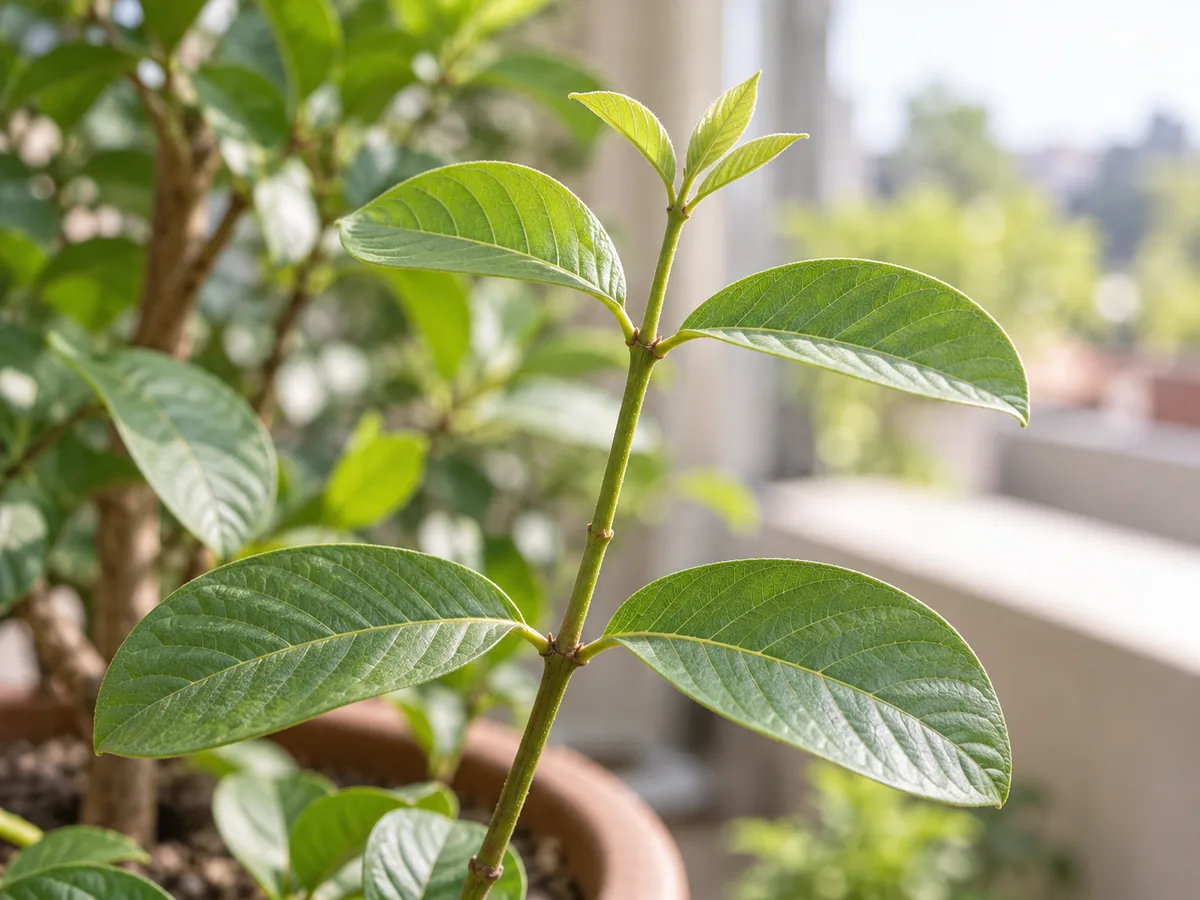
On Guava, compare the spacing between leaf pairs on several new shoots; a repeated stretch toward the open side is more useful than a single long branch.
The strongest clue is often the relationship between the whole crown and its surroundings. If most of the plant points toward a balcony opening, a window, or a gap above a wall, while the opposite side stays sparse, check how many hours direct sun reach the leaves. A tree against a shaded wall may receive daylight without receiving enough direct exposure for a compact canopy or dependable crop. In a shared garden, a taller tree can shade the Guava at the part of the day when the sun would otherwise reach it.
Do not mistake every flush of upright new growth for etiolation. Guava flowers on vigorous recent growth, and a shoot that lengthens after pruning or a seasonal growth flush may be normal. UF/IFAS describes the flowers as appearing in leaf axils of recent growth and notes that the tree flowers on vigorous new shoots. Low light becomes more plausible when several successive shoots stay thin and widely spaced, the crown repeatedly reaches one direction, and flowering remains poor despite a mature tree and otherwise suitable conditions.
Why Guava responds differently to a dim site
A living Guava is not necessarily a fruiting Guava
The first distinction is survival versus performance. A shaded Guava can keep leaves and put on some growth, particularly when it is warm, but that does not mean the location is suitable for a fruit tree. UF/IFAS recommends full sun for best growth and production and says trees shaded by nearby trees or structures may not grow normally or produce much fruit. NParks gives a practical benchmark of at least six hours of sunlight and notes that Guava can grow with six hours of indirect light, but more slowly and with fewer fruits. The amount of light needed to keep foliage alive is therefore not the same as the exposure that supports a productive tree.
This matters most for a balcony pot or a young tree kept indoors. A room can look bright while the canopy sits several metres from the window or behind tinted glass. The Spruce describes north-facing or partly shaded windows as typical low-light positions, while bright indirect light is more likely near a well-lit window. That room-based description is only a starting point for Guava: a fruit tree needs a more open, sunlit position than most plants sold as low-light houseplants.
Guava’s new growth and flowers are part of the light check
Guava produces flowers on new shoots, so the newest growth is a better diagnostic record than old leaves. Compare the length of several recently formed stem sections and the size and spacing of their paired leaves. If the new flush stays sturdy and leafy but a mature Guava does not flower, light is only one possibility; pruning timing, tree maturity, temperature, water stress, nutrition, and pollination can also affect cropping. If the shoots themselves are repeatedly sparse and stretched in the same dim direction, light moves higher on the list.
A single long branch can also be a response to pruning rather than a sign that the entire plant needs more light. Tamil Nadu Agricultural University advises pruning past-season terminal growth to encourage lateral branches in its regional production calendar. That calendar is specific to its growing region and should not be copied month for month elsewhere, but it illustrates why an isolated post-pruning shoot needs context before you label the whole tree light-starved.
A one-sided Guava is not always leaning toward a window
Trace the trunk and main branches before changing placement. A Guava that has developed a slant in a persistently windy position may have grown more on its leeward side; UF/IFAS notes that constant wind can give trees a slanted appearance because of more growth on the leeward side. That shape differs from a recent window-seeking pattern in which the newest flexible shoots and leaf canopy orient toward a bright opening. A trunk that has always leaned, but has firm new growth and adequate sun, does not need an emergency move just because it is not perfectly upright.
Confirm low light before you move the pot
Use a simple exposure log. For two or three representative days, note when direct sun actually falls on the leaves, not just when the balcony or room feels bright. Check morning, midday, and afternoon; a wall, roof overhang, neighboring building, shade cloth, balcony rail, or dense canopy can block the plant even when the sky looks open. If the tree is in a fixed garden location, observe whether the obstruction shades the top, lower branches, or only one side.
Then compare the tree’s response. Mark one or two new shoot tips with a loose tag or take a photo from the same angle. Record whether the next leaves emerge at similar spacing, whether new branches stay upright without reaching across the crown, and whether the tree forms flowers in its normal season. A phone light-meter app may help compare two possible spots at the same time of day, but treat the reading as a relative comparison rather than a universal Guava threshold; sunlight changes with cloud, season, window glass, and latitude.
Finally, confirm that another stressor is not driving the same symptoms. Test the soil below the surface and lift the pot if it is small enough to do safely. A mix that remains wet for many days, smells sour, or causes yellowing and dieback needs a root-zone check, not more light alone. A genuinely dry root ball, wilting soft shoots, and crispy margins point more toward water shortage; UF/IFAS notes that drought stress can stop growth in Guava. Growth may slow in cool weather as well: UF/IFAS places ideal growth and production around 23–28°C and notes that cold can slow growth below about 16°C.
Lookalikes to rule out on Guava
| What you see | More likely explanation | What to check next |
|---|---|---|
| Long, thin new shoots repeatedly reaching the same opening; direct sun is limited | Possible insufficient light | Count sun reaching the leaves and compare several new shoots before moving the tree. |
| Yellow leaves, wet mix that stays heavy, sour smell, or branch dieback | Waterlogging or root decline | Check drainage and root firmness; the Guava watering guide and soil guide help separate irrigation from light. |
| Limp new leaves with a genuinely dry root ball, or crisp margins after hot weather | Drought or heat stress | Check moisture below the surface and the pot’s afternoon temperature before increasing sun further. |
| Yellowing without a repeated lean or stretch pattern | Possible root or nutrient issue, including iron availability | Check drainage and soil pH; UF/IFAS notes Guava can develop iron deficiency in alkaline, high-pH soil. |
| New leaf damage after a move into strong sun | Abrupt sun exposure or heat injury | Compare the damaged side with the formerly shaded side and step back to the last safe exposure; the first-fix section explains staged acclimation. |
| One old branch angles away from the rest while the trunk has long been wind-shaped | Wind or structural growth pattern | Judge the newest shoots and actual light hours rather than forcing the trunk upright. |
| Sticky residue or visible aphids on new shoots | A sap-feeding pest issue rather than a light-only problem | Inspect leaf undersides and shoot tips; TNAU notes that aphids feed on Guava’s new shoots and leave honeydew. |
UF/IFAS describes how flooding can cause leaf drop, chlorosis, and stem dieback in Guava, while drought can stop active vegetative growth. Those overlaps explain why yellow leaves, slow growth, or a bare branch are not enough to diagnose light stress by themselves. When the pattern is mostly root-zone symptoms, use the Guava problems hub to route to the specific watering or root guide.
The first fix: give the Guava a brighter position
If your exposure log shows less than about six hours of direct sun, make one targeted change: place the container where the canopy gets a longer, more open stretch of sunlight. Choose the spot that stays bright for the largest part of the day rather than one that receives a brief, intense patch through glass. Singapore NParks and UF/IFAS both point to full sun as the productive growing position for Guava. Purdue’s older NewCROP account describes orchard layouts with rows oriented for sunlight, reinforcing that exposure has to reach the canopy rather than merely the surrounding space.
For a tree raised indoors, under a porch roof, or behind shade cloth, do not jump from dim conditions to a full day of tropical noon sun. Begin with gentle morning exposure, then add time in increments over several days; Colorado State University Extension recommends longer periods of sun as shade-grown houseplants harden off outdoors. If the latest leaves develop new bleached or crisp patches, pause and return to the last tolerated exposure before increasing light again. The goal is a brighter destination without confusing acclimation stress with the original problem.
Avoid making three other changes at once. Do not hard-prune a weak canopy, repot a stable tree, and increase fertilizer in the same week as the light move. Guava’s healthy leaf area is useful for the next flush, and shade is not corrected by extra nutrients. If the container sits in wet soil, first bring watering back in line with actual drying; after any placement change, check the root ball before following the old sunny-site schedule. Use the Guava light guide for placement detail and the Guava watering guide to recalibrate moisture after the move.
What to do if your Guava must stay indoors
Treat an indoor window as a compromise, not as an equivalent to a sunny garden. Put the plant as close as practical to a large, unobstructed window where direct light reaches the leaves; a bright-looking room several metres from glass can still be a dim site for a fruit tree. Turn the pot only if the same side continues to face the window and the tree is not flowering or carrying fruit that you need to keep stable. Keep leaves from pressing against hot glazing, and check the root ball more often after light improves because a warmer, brighter position can change how quickly a container dries.
A grow light can supplement a window or maintain a young Guava, but a small clip lamp will not illuminate a broad tree canopy evenly. Choose a fixture whose coverage reaches the whole crown and follow its rated distance and schedule; there is no single wattage or timer setting that guarantees fruit for every cultivar and room. If only the top leaves receive light, lower interior branches may continue to reach toward the fixture. If the tree is large and persistently weak indoors, a sunny outdoor terrace or garden may be a more realistic long-term solution than adding several small lamps.
Do not use new flowering or fruiting as the first test of success. A young tree may not be mature enough to flower, and temperature, pruning, water, nutrition, and pollination also influence crops. For indoor Guava, a steadier flush of leaves is a reasonable first goal; consider the Guava fertilizer guide only after light and root conditions are suitable and the plant resumes active growth.
Recovery: judge the next Guava flush, not old stems
An old stretched branch does not become compact when the tree moves into brighter light. Existing internodes stay long, yellowed leaves may still drop, and sun-damaged tissue does not turn green again. Keep enough healthy foliage for the tree to make energy, and wait for a new growth flush before judging whether the location works. In warm, active weather, look over several weeks for firmer shoots, more normal spacing between leaf pairs, and less one-sided reaching; cool weather can delay that response.
Flowering is a later and less dependable signal. UF/IFAS says Guava flowers on vigorous recent growth, but a stronger light position cannot make a young or otherwise stressed tree fruit on command. If the canopy improves but flowering remains poor, check plant age, pruning history, seasonal warmth, and water during flowering and fruit development. A productive tree needs those conditions as well as light.
If new foliage continues to thin or the tree loses leaves rapidly after the move, stop increasing sun and reassess. Check for a dry pot, standing water, abrupt heat at the container, cold nights, or pests before assuming the light correction failed. When a container Guava has few firm roots, persistent sour soil, or progressive dieback, the root problem may be more urgent than the canopy shape; follow the Guava overview for the basic growing conditions and use a root-specific guide if the root zone is confirmed to be failing.
Prevent the problem in the next season
Choose the Guava’s permanent position by tracking sun at canopy level through the season. A terrace that gets morning sun in one month may be shaded later by a neighboring building or a growing tree. Keep a simple note of the direct-sun window and revisit it when daylight shifts, new structures cast shadows, or the canopy expands. For a garden tree, avoid planting close to a larger tree or structure that will shade the crown; UF/IFAS specifically warns that nearby shade can limit Guava growth and fruit production.
Keep the crown open without stripping it. If another plant or crowded branches block the Guava’s own interior, selective thinning can let more light reach inner branches. Gardening Know How describes how thinning opens the canopy to light and airflow; use the Guava pruning guide to plan cuts around the tree’s growth and fruiting cycle. If nearby vegetation casts the shade, correct the obstruction rather than removing most of the healthy Guava leaves.
Match watering to the changed exposure. Check the top few centimetres and the root ball before watering instead of using a fixed weekday. The Guava soil guide is useful if water lingers despite a bright position, while the Guava overview covers the full-sun, drainage, and size-control priorities together.
When to use this page vs other Guava guides
Use this guide when the repeated pattern is sparse, elongated new growth and the tree’s actual sun exposure is limited. If the shoot spacing is unusually wide but the tree has already been moved into adequate light, compare the more focused Guava leggy-growth guide; that sibling page is for stretched branches and pruning decisions, while this page covers the exposure diagnosis and first light correction. Use the global not-enough-light guide for the general symptom pattern shared across plant types, then return here for Guava’s fruit-tree light needs.
Related tool
Use the Plant Problem Diagnosis Tool to compare light stress with watering, soil, and pest clues before making another change.
Related Guava guides
- Use the Guava care overview for whole-tree priorities and the difference between a healthy foliage tree and a productive fruit tree.
- Use the Guava light guide for placement, window, seasonal, and supplemental-light choices once low exposure is likely.
- Use the Guava watering guide if the pot dries too quickly after a move or stays wet in a shaded position.
- Use the Guava soil guide when drainage or a persistently wet mix is the stronger clue than light.
- Use the Guava pruning guide when the Guava has recovered enough to reshape a crowded canopy without removing most healthy leaves.
- Use the Guava fertilizer guide only after the light and root zone are suitable and active growth still needs nutrition.