Bats Flying Around Your Yard at Night: What It Means
Seeing bats flying around your yard at night? Learn why they circle gardens, which plant benefits are real, when to inspect your home, and how to help safely.
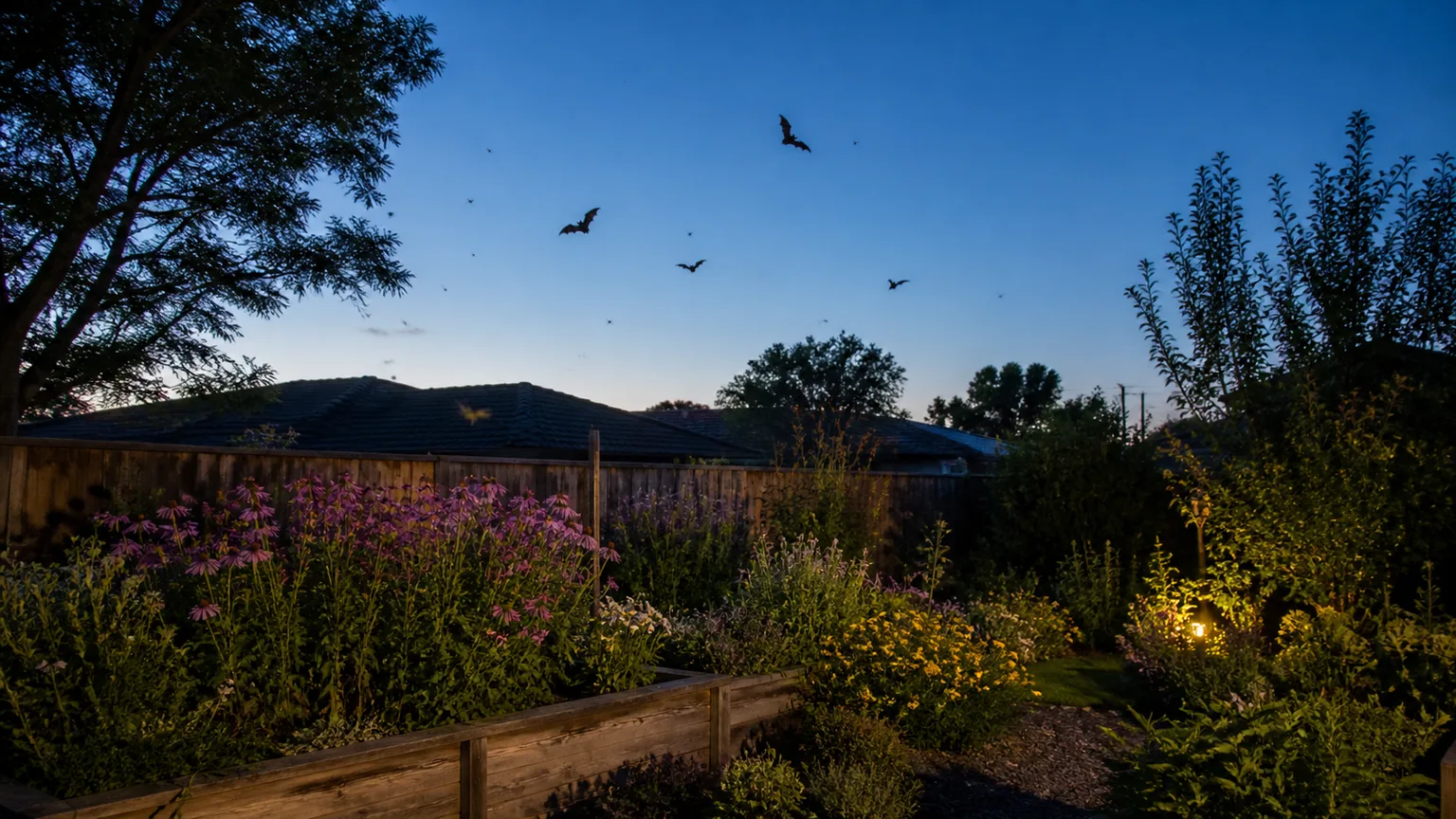
If bats are looping over your lawn or vegetable beds at dusk, they are usually hunting—not targeting your house, your pets, or your hair. That flight is often a good sign: your yard has enough insects, cover, or water to function as part of a nighttime food web.
The useful answer is more precise than “bats are good” or “bats are dangerous.” Watch where they are flying, look for repeated entry into a building, and keep your distance from any bat on the ground. In most cases, you can let the night shift work while making a few changes that support bats without inviting them into your attic.
Why Bats Circle Your Yard After Dark
Bats circle yards because yards concentrate the things they need: flying insects, edges between trees and open space, and sometimes open water. Twilight is a particularly active period because many insects leave vegetation or emerge near ponds, porch edges, and garden borders at the same time that bats leave a daytime roost.
Most bats a gardener sees over a temperate North American yard are insectivorous bats. They use echolocation to find moving prey in low light, then change direction quickly as they pursue it. The looping, swooping flight can look erratic from below, but it is often a feeding pattern rather than a sign of distress.
Rutgers New Jersey Agricultural Experiment Station explains that bats may forage within a few kilometers of their roost and return to the same roost each day. That makes a busy yard useful without making the yard the bat’s home; the bats may be commuting from a tree cavity, bridge, barn, or other structure nearby. Read the Rutgers overview of bats in integrated pest management for the ecological context behind that local relationship.
Seeing bats is therefore not proof that your home has an infestation. It is better evidence that insects are available in the air above your property. Treat the sighting as an observation first, then look for building-specific clues before you start sealing holes or buying a bat box.
What They Are Hunting Over Your Garden
The insects bats catch are not all the pests a gardener notices during the day. Rutgers lists moths, beetles, flies, cicadas, leafhoppers, and true bugs among the major groups found in bat diets, with examples that include corn earworm moths, cucumber beetles, stink bugs, fruit flies, and tomato pinworms.
That list matters because the bat benefit is strongest when a plant problem has a flying or night-active stage. A bat may reduce adult moths that would otherwise mate and lay eggs, but it will not patrol each tomato leaf for every caterpillar, aphid, or slug. Bats are one layer of a garden’s integrated pest management, not a replacement for scouting.
Moths, Seasons, and the Bat Activity You See
Many vegetable caterpillars begin as adult moths. If bats catch some of those moths, fewer eggs may be laid later, which can reduce pressure on crops over time. That is a population effect, not an instant cure: a large moth population, nearby fields, weather, and the number of bats foraging all change the result.
This distinction prevents a common mistake. If you find fresh holes in kale or frass inside a tomato, do not assume the bats have failed or that the plants need a stronger spray. Inspect the leaves and fruit, identify the pest stage, and use the least disruptive control that fits the diagnosis. Bats can help intercept adults in flight while you still hand-pick caterpillars or use a physical barrier on the crop.
The same logic applies to mosquitoes. Some insect-eating bats do consume mosquitoes, but a mosquito problem is driven mainly by breeding habitat, weather, and species. Bats are not a guarantee that a patio will become mosquito-free, and a yard with standing water can produce more mosquitoes than the bats can remove.
Not every bat eats the same food or uses the same habitat. Insect-eating bats dominate the garden story in many temperate regions, while fruit-, nectar-, or pollen-feeding bats become more important in tropical and subtropical ecosystems. A bat circling a Midwestern vegetable plot and a bat visiting an agave in the Sonoran Desert may be providing very different plant benefits.
Season changes the picture as well. Warm evenings can produce more visible feeding, while drought, cold, migration, hibernation, maternity activity, smoke, or a local insect hatch can change when bats appear. A quiet week does not prove that the habitat is poor, just as one spectacular evening does not prove that one bat is controlling every garden pest.
Gardening Know How’s discussion of night pollinators is useful for this regional distinction: it describes bats as insect feeders in many gardens while also noting that bats pollinate night-blooming plants in warmer regions. Use local extension or wildlife guidance if you are choosing plants specifically for a bat species in your area; do not copy a tropical plant list into a cold-climate garden and expect the same result.
Feeding Activity vs. a Nearby Roost
The same bats can be feeding over your garden and roosting somewhere nearby, but those are separate questions. The flight pattern tells you about foraging; the place where bats enter and leave tells you about a roost.
Start with the simple decision rule: if bats appear after sunset, stay airborne, and disperse across the yard or tree line, observe them and leave them alone. If they repeatedly emerge from one crack in a roofline, soffit, chimney, wall, or outbuilding, investigate the building issue from the ground and get wildlife-exclusion advice before closing that opening.
Cues That Usually Mean “They’re Feeding”
Normal feeding activity has a few recognizable cues:
- It begins around dusk or later, not as a bat lying exposed on the ground.
- Several bats make broad arcs over a lawn, garden, pond, or tree edge.
- Their flight is quick and controlled, with repeated passes through the same insect-rich airspace.
- They leave the area after feeding or shift toward a neighboring tree line.
- They do not repeatedly collide with windows, fall, or crawl on the ground.
Even quiet, close passes are not an invitation to interact. Bats can maneuver around people, but a person should not try to catch, photograph at arm’s length, or redirect one. Watch from a path or chair, keep children back, and keep pets away from the flight zone.
Cues That Justify a Building Inspection
Look more closely at the structure—not at the bats—if you see repeated emergence from one opening, guano accumulating below a gap, scratching or squeaking from a wall or attic, or bats entering a building before dawn. None of those clues tells you the exact species or the correct exclusion date, and a roost may be legally protected depending on where you live.
Do not plug the opening while bats are using it. A badly timed repair can trap bats inside the building or push them into the living space. The safer sequence is to document the location from outside, keep people and pets away, and contact a qualified wildlife professional or local wildlife agency for species- and season-appropriate exclusion advice.
The goal is to keep a beneficial night visitor out of the occupied parts of the house while preserving a safe roost option elsewhere. Bat-house guidance from the U.S. Fish & Wildlife Service can help with construction context, but it does not replace local rules or an assessment of an active building roost.
How Bats Help Plants—and Where the Benefit Stops
Bats help plants most reliably through the insects they remove from the air. They can also pollinate or disperse seeds in particular ecosystems, but those services depend on species and geography. A strong article about bats should hold both facts at once: they are valuable wildlife, and they are not a magic pesticide or universal pollination service.
The Realistic Pest-Control Benefit
The best evidence for plant benefits comes from looking at what happens when bats are excluded. Penn State Extension summarizes a two-year corn-field experiment in which corn earworm populations were about 60% higher and earworm damage was about 50% greater in plots where bats could not forage. That is meaningful evidence of pest suppression, but it came from a crop experiment with a specific pest—not a promise that a backyard colony will protect every cucumber or rose.
Rutgers also frames bats as generalist predators within integrated pest management. Their diet includes many insects that affect vegetables, fruit trees, turf, and ornamentals, but the practical effect depends on whether the pest is flying when bats are active, how much habitat is available, and whether pesticides have removed the insects bats need to eat.
A reasonable gardener’s expectation is modest and useful: bats may reduce the number of adult moths, beetles, flies, and other flying insects around a property, especially when the yard connects to trees, water, meadow, or other habitat. They will not replace crop covers, leaf inspections, sanitation, pruning, hand-picking, or a targeted treatment when a confirmed infestation is already damaging plants.
Pollination Is Regional, Not a Universal Backyard Effect
Some bats are important pollinators of night-opening flowers and crops such as agave, bananas, mangoes, guava, and some cacti. These relationships are especially significant in tropical and desert regions, where plant flowers may be large, pale, strongly scented, and open at night.
That does not mean every bat over a flower bed is pollinating it. In much of North America, a bat crossing your garden is more likely to be pursuing insects than drinking nectar or moving pollen. Gardening Know How describes this split clearly in its guide to night pollinators, while Bat Conservation International recommends thinking first about native plants and the native insects they support.
For a home gardener, the indirect route is usually the strongest one: grow locally appropriate plants, preserve insect habitat, and let the bats choose whether the yard is worth visiting. If you grow a night-blooming, bat-pollinated crop in a region where that relationship is documented, local botanical or extension guidance is more useful than a general backyard claim.
Why Bat Guano Is Not a DIY Fertilizer
Bat droppings contain nutrients, which is why guano has a long history as a fertilizer ingredient. That fact is not a reason to scrape droppings from an attic, chimney, or enclosed roost and add them to a vegetable bed.
The CDC’s histoplasmosis guidance says activities that disturb soil or plant matter containing bird or bat droppings can increase exposure to Histoplasma, a fungus whose spores can be inhaled. It recommends professional cleanup for large amounts of droppings. The risk is associated with disturbed, dusty accumulations; it is not a reason to panic over a few pellets beneath an outdoor flight path.
If a bat house is occupied, place it where droppings will fall onto soil, mulch, or a non-food area rather than a grill, play surface, doorway, or harvest table. Bat Conservation International specifically warns against placing a house above a barbecue and says maintenance should happen only when the house is unoccupied. Let small outdoor deposits break down in place, keep children away from the pile, and call a qualified cleanup service for a large, dry, enclosed accumulation.
Make Your Yard More Bat-Friendly Without Making It Messy
You do not need to build a pond, stop mowing the entire property, or install a box immediately. A bat-friendly yard is usually a series of small habitat decisions: more insects, a safe water edge, less unnecessary light, and fewer broad-spectrum sprays.

Plant for Insects First
Start with plants that fit your region, soil, moisture, and sun. Native plants support native insects that local bats already know how to hunt, and a mix of trees, shrubs, grasses, perennials, and ground-level cover creates more niches than a single row of identical flowers.
Night-scented or pale flowers can help draw moths and other nocturnal insects, especially when blooms continue into the evening. The best plant is not the one with the most dramatic name; it is the one that survives your site and contributes food, cover, or a long flowering window without needing constant chemical treatment.
Bat Conservation International’s guide to gardening for bats recommends native plants, moth host plants, trees, light-colored flowers, and fragrant plants. In practice, that can mean leaving a small edge of longer grass, keeping some leaf litter under shrubs, delaying the removal of every seed head, and allowing a few non-invasive host plants to support caterpillars rather than treating every nibble as a crisis.
Leave natural cover where it does not create a fire, pest, or trip hazard. A log pile, brush edge, mature tree, or quiet hedge can shelter insects and create the layered structure bats use around feeding areas. Keep dead trees only when an arborist confirms they are safe; wildlife value never overrides the risk of a falling limb.
Add Water With an Open Flight Line
Bats often drink by skimming the surface of open water while flying. A pond, stream, stock tank, or broad water feature can therefore serve two roles: it gives wildlife a drinking place and it supports aquatic insects that become food for bats.
The important detail is access, not decoration. Keep at least part of the water surface open, avoid loose netting that can snag wings, and leave a clear approach above and across the water. A tiny, deep-sided container is less useful if bats cannot skim it or if other animals can fall in and cannot climb out.
Place water where you can maintain it. Refresh birdbaths, remove excess algae, and choose a setup that will not become a mosquito nursery. Water is a habitat feature, not a promise that bats will appear every night.
Keep Night Lighting Low and Pesticides Targeted
Bright lights can change the behavior of moths and other nocturnal insects, even when they seem helpful because insects collect around a porch bulb. Use the least light needed for safe movement, aim fixtures downward, shield them from the garden, and use motion controls for security lighting when practical.
The Independent’s garden feature on bats, drawing on Bat Conservation Trust advice, recommends preserving dark corridors and using lighting only where it serves a clear safety purpose. That is a useful design rule: light the steps and door, not the entire tree line, pond edge, and bat-house entrance.
Pesticides create a second trade-off. A broad spray may remove the insects that attract bats, and careless applications can expose non-target wildlife. Scout first, identify the pest, use barriers or hand-picking where they work, and follow the product label when a treatment is genuinely needed. Supporting bats does not mean accepting severe crop damage; it means treating chemical control as one targeted tool rather than the default response to every insect.
Install a Bat House Only If It Fits Your Yard
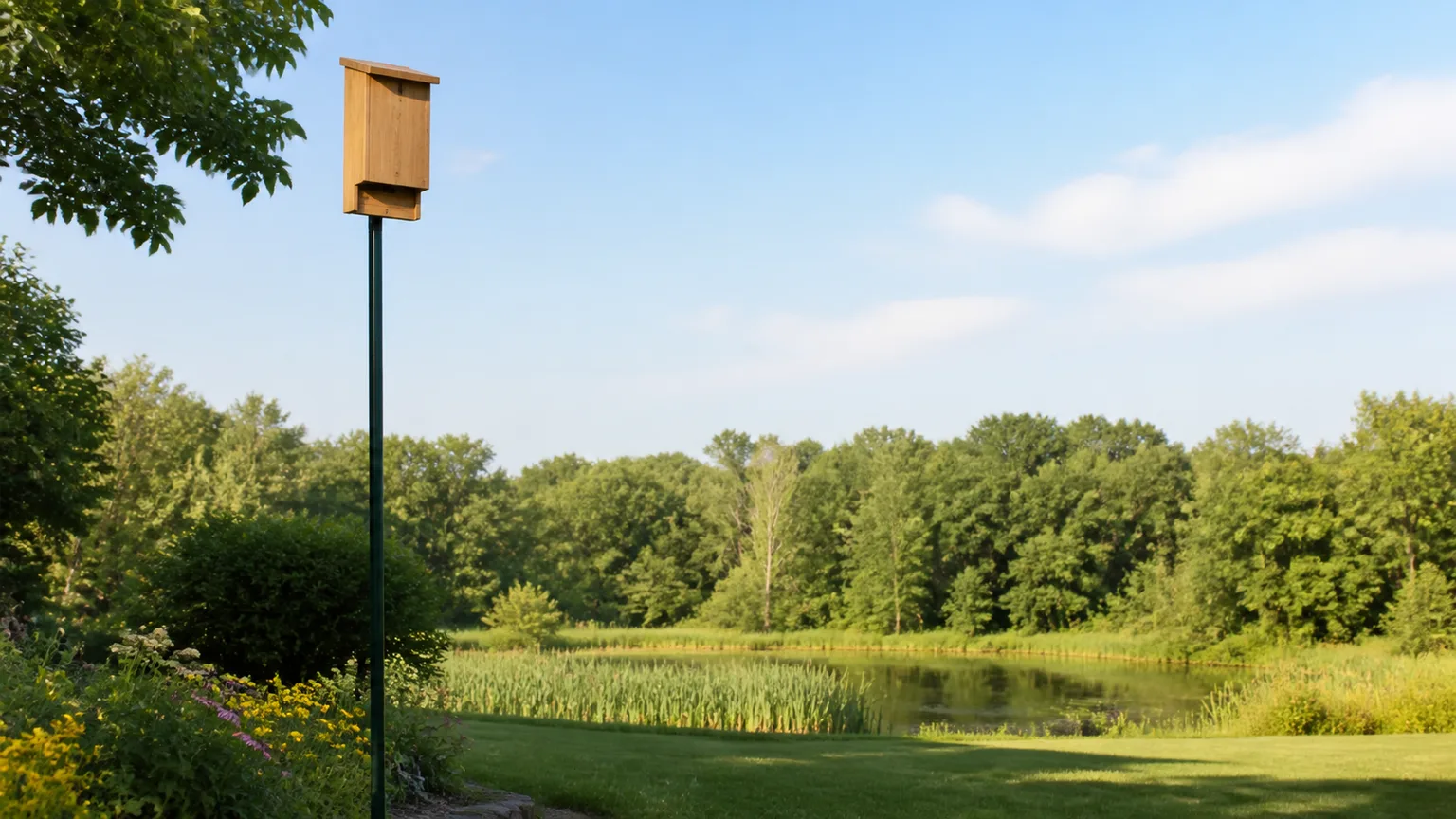
A bat house is an optional habitat project, not a bat magnet. If your yard lacks a suitable flight path, has outdoor cats waiting below, or cannot keep the box in a safe temperature range, planting and preserving habitat may be the better first step.
Choose a House That Is Safe to Occupy
Choose a durable house made from natural, untreated wood with rough interior surfaces that bats can grip. Avoid smooth plastic, metal interiors, interior paint, and attached mesh; Bat Conservation International warns that mesh can trap young bats and that a house with unstable temperature can harm bats rather than help them.
A taller, multi-chamber design gives bats more temperature choices than a tiny decorative box. Seal gaps that create drafts, provide appropriate ventilation for your climate, and use exterior-grade, water-based paint or stain only on the outside. Design matters because a box can overheat, stay too cold, admit predators, or become a wasp nest.
Do not add guano, scents, or captured bats to make the box seem occupied. Bats must find a roost on their own, and the house should be accessible for inspection and repair without opening it while bats are inside. If you are building from plans, compare the design with current guidance from Bat Conservation International’s bat-house guidelines and the U.S. Fish & Wildlife Service rather than relying on a novelty product listing.
Place It for Temperature and Flight Access
Mount the house high enough to give bats at least 12 feet of open space below the exit; higher can be safer where cats or other predators are a concern. A pole or a suitable building wall is generally easier to protect than a tree because branches can block the entrance and give predators a route to the box.
Sun exposure must match your climate. In a cool region, several hours of sun can help keep the roost warm; in a hot region, afternoon overheating is a serious risk, so morning sun, ventilation, shade structures, or a paired warm-and-cool setup may work better. Do not copy a south-facing recommendation blindly across climates.
Keep the entrance clear of branches, wires, and dense vegetation. Place the house near the feeding habitat and water you already have, but away from the busiest patio activity. If you have outdoor cats, reconsider the location or keep cats indoors during peak bat activity; bats drop from a house before gaining full flight, which makes low exits vulnerable.
Occupancy is never guaranteed. Bat Conservation International notes that some successful houses take as many as five years to be used, and a house may be occupied only briefly. Install it carefully, record the date and conditions, and judge the project by whether it provides safe habitat—not only by whether you see bats the following week.
When Bat Activity Is Actually a Safety Issue
The safest bat is a bat you do not touch. The CDC’s rabies-prevention guidance says to keep your distance from wildlife, never approach animals that appear injured, sick, or dead, and contact public-health or animal-control authorities when help is needed.
A bat flying normally overhead is not the same risk as a bat on the ground, in a room, or caught by a pet. If a bat lands in the garden, keep people and pets away and call a local wildlife rehabilitator or animal-control office for instructions. Do not pick it up with bare hands, move it with a broom, or encourage children to “rescue” it.
If a bat touches or bites a person, wash any wound immediately with soap and water for 15 minutes and contact a healthcare professional or health department urgently. If a pet mouths or catches a bat, do not handle the bat or the pet’s mouth with bare hands; secure the pet away from people and call a veterinarian and local public-health authority for next steps.
If a bat is loose inside the house, close interior doors, remove people and pets from the room, and call for local guidance before attempting capture. A bat in a living room may simply be lost, but any possible contact—especially when someone was asleep, a child was unattended, or a pet had access—deserves a public-health assessment rather than guesswork.
Conclusion
Bats flying around your yard at night are usually there because the yard is offering food in the air. Their presence can support plants by reducing some adult moths, beetles, flies, and other night-flying insects, but the benefit is species- and habitat-dependent; it will not replace scouting or every other form of pest management.
Your best next move is simple: watch from a distance, check whether the flight is normal or tied to one building opening, keep the night sky as dark as practical, grow plants that support insects, and avoid collecting droppings. Add a bat house only when you can provide safe height, temperature, clear flight access, and protection from predators. Give bats room to choose the yard on their terms, and call professionals when a bat is grounded, indoors, touched, or living in a structure.