Wilting on Guava: Causes, Checks & Fixes
Quick answer
Before watering a wilting Guava, check the root zone 3–5 cm below the surface. Dry mix calls for a slow, thorough soak; wet mix calls for a pause in watering and a drainage check. Guava’s soft new growth can wilt during drought, but a wet, declining tree may have damaged roots or a disease problem.
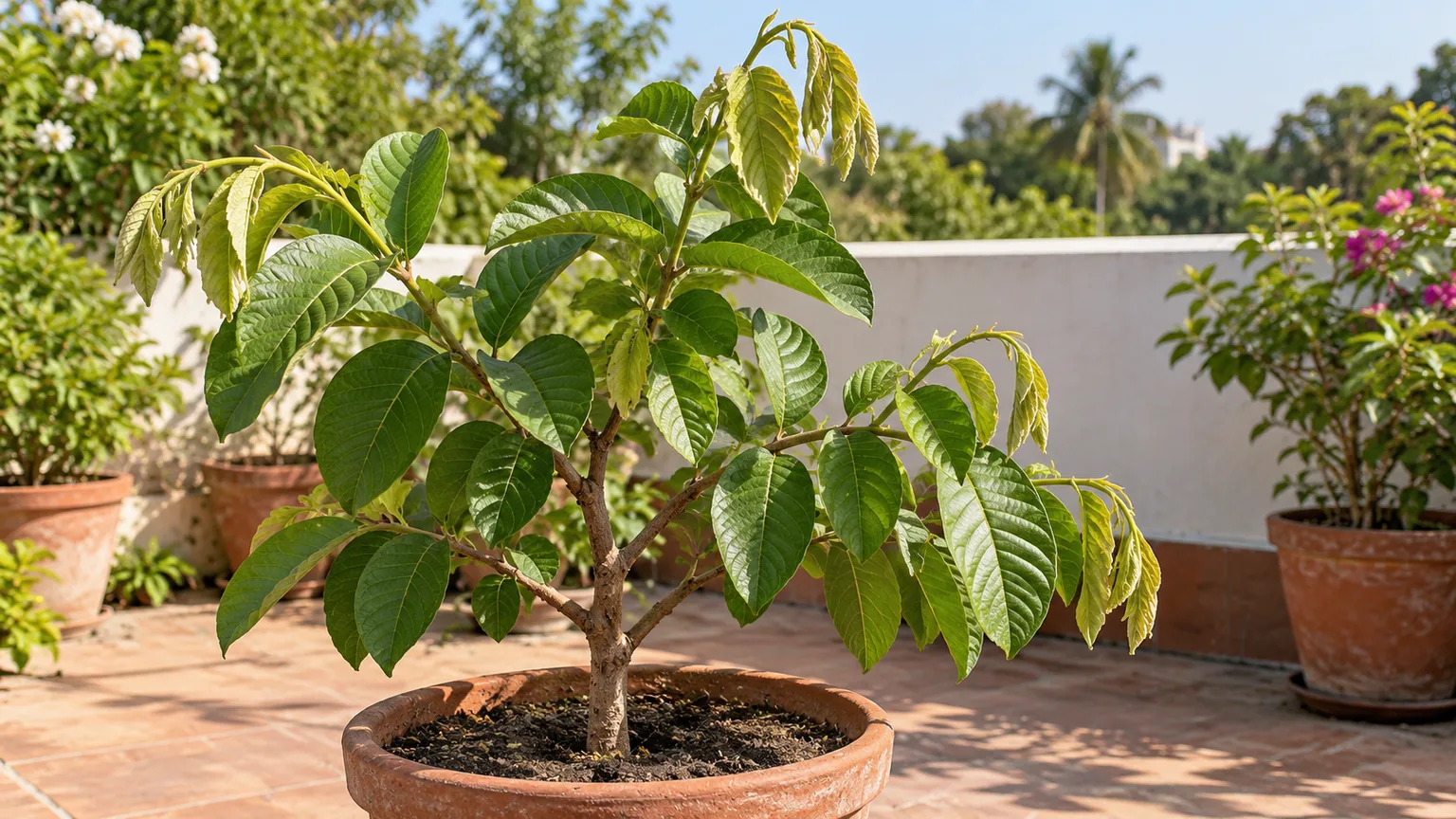
Wilting on Guava: Causes, Checks & Fixes
This guide covers wilting on Guava. See also the general Wilting guide, watering, and light pages for this plant.
Wilting on Guava: Causes, Checks & Fixes
Quick answer
Before watering a wilting Guava, test the root zone 3–5 cm below the surface. If that layer and the deeper root ball are dry, water slowly until the mix is evenly moist and excess drains away. If the pot is still heavy and wet, do not add water: check whether the container drains, whether rain or a saucer is keeping it saturated, and whether the tree is showing root or stem decline. The symptom alone cannot tell you which direction to take.
Guava is a tropical fruit tree, not a plant that should stay constantly wet; UF/IFAS describes its warm-climate growth. Its soft new leaves may wilt during drought even when an established tree can survive a dry spell by pausing growth. For the full growing context, start with the Guava care overview; this guide narrows the diagnosis to a tree whose leaves or shoots have lost firmness.
What wilting looks like on Guava
A wilted Guava shoot hangs below its usual angle, and the leaf blade feels limp rather than simply pointing downward under its own weight. Guava’s newest leaves and soft flush may show drought wilt before a mature branch looks affected; UF/IFAS notes that immature Guava leaves and wood can wilt under drought (immature Guava leaves may wilt). Compare the same branch in the morning and later in the day, and note whether the symptom is spreading.
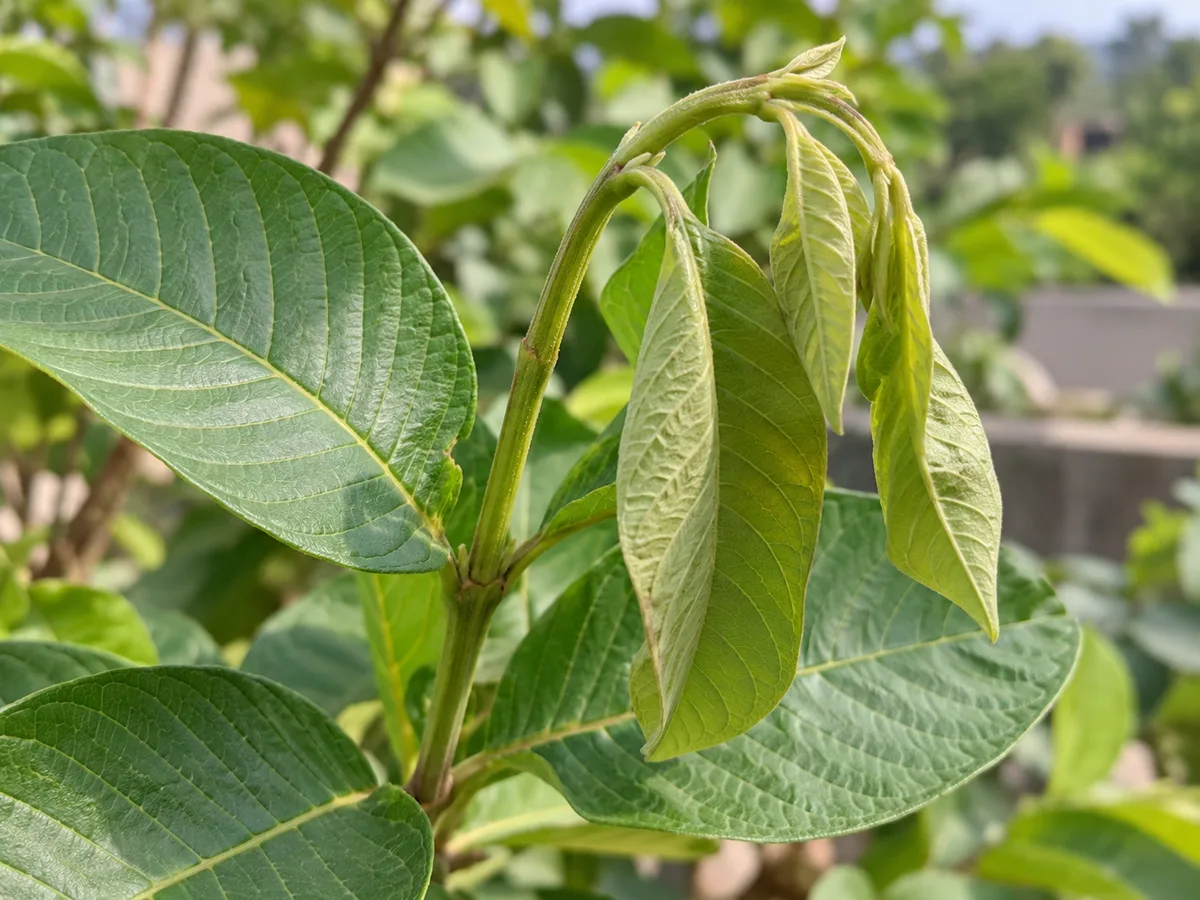
Soft Guava flush can lose firmness during water stress; check the root zone before deciding whether to add water.
The word “wilting” describes a visible loss of firmness, not a cause. For the general explanation of how plants wilt, see the wilting symptom guide. On Guava, the useful distinction is whether water is missing from a dry root ball, unavailable because roots are stressed in wet soil, or being lost faster than the roots can supply it during heat or wind.
Check Guava’s root zone before watering
Start at the soil surface, then check 3–5 cm down near the outer part of the root ball. The surface may look dry while the lower mix is still saturated, particularly after rain or repeated small waterings. Lift a manageable pot to compare its weight with how it feels after a full soak and a proper drain. In the ground, use a narrow trowel several centimetres from the trunk; do not stab close to the crown or large roots.
Use these patterns as clues, not as a diagnosis by themselves:
| What you find | What it suggests on Guava | First response |
|---|---|---|
| Light pot, dry mix at depth, limp soft tips | The root ball may be short of water, especially after heat or wind | Give one slow, thorough watering, then let it drain |
| Heavy pot, wet mix several days after watering, pale leaves or stalled growth | Roots may be short of oxygen or already damaged | Pause watering and check drainage before repotting |
| Wilt that peaks in hot afternoon sun but eases later, with mix not bone-dry | Heat load may temporarily exceed the roots’ supply | Shade the pot from reflected heat while you recheck moisture |
| Progressive wilt with branch dieback, sparse canopy, or distorted roots | Root disease or another serious decline is possible | Isolate the diagnosis from routine watering; contact local extension |
The Guava watering guide explains how to use the upper 3–5 cm as a check rather than following a fixed weekday schedule. Also inspect drainage holes and remove a nursery pot from standing runoff. If the mix repeatedly stays wet, the Guava soil guide can help you evaluate the medium without immediately disturbing a stressed root ball.
Why Guava wilts even when the tree can tolerate dry periods
Soft flush and fruiting trees have different water demands
Guava can withstand dry weather by slowing or stopping vegetative growth, but UF/IFAS notes that immature soft wood and leaves may wilt under drought. The same guidance warns that drought during fruit set can reduce fruit set, while drought during fruit development can reduce fruit size. That is why “Guava tolerates drought” is not a reason to leave a young potted tree or a flowering, fruiting tree dry for a long stretch. Guava drought responses.
Young Guava in a container has less soil volume than a mature in-ground tree, so a sunny, windy terrace can dry its root ball quickly. Epic Gardening describes Guava as drought-tolerant once established and notes that its active moisture uptake is concentrated in upper soil layers (Guava growing guidance). Treat that as a prompt to check the actual mix, not as a universal schedule: a fresh transplant, a small nursery pot, fruit load, pot material, and monsoon rain all change dry-down.
If the root zone is dry, wilted tender leaves are consistent with water shortage. The tree may pause new growth to conserve resources, and fruit may drop or size poorly if stress coincides with flowering or fruit fill. Restore a normal moisture pattern rather than keeping Guava waterlogged afterward. Extra fertilizer cannot replace water or repair injured roots.
Wet-soil wilt points toward uptake failure
When a Guava wilts in soil that remains wet, adding water is the wrong first move. UF/IFAS explains that poor drainage and overwatering deprive roots of oxygen and can start decay; affected Guava may show chlorosis, stunting, or defoliation, while damaged roots become necrotic and underdeveloped. Those symptoms overlap with other problems, so inspect the root zone and the trend in new growth rather than relying on a single yellow leaf. See the indexable Guava overwatering guide for waterlogged-mix triage and the Guava root-rot guide for root inspection and salvage limits. UF/IFAS’s Guava disease guide covers the documented root-rot patterns.
A sour smell, water that sits on top, or a mix that stays glossy and wet are reasons to inspect drainage, not proof that a particular pathogen is present. In a pot, confirm that water can leave through open holes and that a decorative cachepot is not holding runoff. A compacted or oversized volume of fine mix can remain wet long after the exposed surface dries, because container-media water retention changes with particle size and pore space (NC State potting-media guidance). NC State Extension explains that container drainage holes prevent roots from standing in water, while aerated potting media preserve root-zone air space. NC State container drainage guidance.
If the plant remains wilted in wet soil, slide the root ball out only when you need to confirm serious root decline. Healthy roots should still feel firm; widespread dark, soft, or sloughing roots plus persistent wilt make root damage much more likely (Guava root symptoms). Do not wash or prune every root just because the leaves droop. For a mildly stressed Guava with mostly firm roots, restoring drainage and allowing the mix to approach the plant’s normal dry-down is less disruptive than an automatic repot.
Heat, reflected sun, and wind can outpace a container root ball
Guava likes sun and warmth, but a small container can heat and dry faster than the surrounding garden bed. A dark pot in direct summer sun can become hotter than the root zone of a tree planted in the ground; NC State Extension notes that dark containers absorb more heat and can raise potting-media temperature. Move the container a short distance out of reflected afternoon heat if its wall is hot to the touch, but keep the tree in bright conditions rather than parking it in deep shade. Check the soil again before watering because a hot pot can have either dry or wet roots.
If leaves are limp only during the hottest part of the day, but recover by the next cool period and the root ball is neither bone-dry nor saturated, heat and wind may be part of the load. This is a pattern to monitor, not a Guava-specific diagnostic test. Reduce heat on the pot first and protect a newly moved tree from harsh exposure. The Guava light guide covers full-sun placement and acclimation; wilting alone is not a reason to remove a healthy Guava from the light it needs.
Recent root disturbance can explain a sudden slump
A Guava that starts wilting soon after repotting, planting, root pruning, or damage from digging may have lost enough fine roots to temporarily reduce water uptake. PAU’s account of Guava wilt disorder describes abiotic stress and root injury as contributors to plant decline and discusses the interaction with Fusarium, rather than presenting every wilt as a single simple infection. PAU’s Guava wilt report. The practical lesson for a home grower is to record recent root disturbance and avoid adding several new stresses at once.
If this is a container tree and roots circle densely or the pot dries completely within a day, restricted roots may be part of the background. Do not repot on the first day of wilting unless the medium has failed, drainage is blocked, or root rot is evident. When the tree stabilizes, use the Guava repotting guide to decide whether the next size of pot is actually needed.
The first fix depends on the moisture reading
If the Guava root ball is dry
Water the mix slowly and evenly until the full root ball is moist and a small amount drains from the bottom. If water runs straight down a gap without wetting the mix, pause and apply several smaller passes so the medium has time to absorb water. Then empty the saucer or cachepot. If the mix has pulled away from the pot edge, keep using small passes until water begins entering the root ball, then let it drain; do not leave the pot standing in water overnight.
After that single correction, return the tree to a stable, bright, warm position and check the mix again before the next watering. Do not repeat a soak just because leaves still look tired an hour later. Guava roots and soft shoots need time to respond, and an already-wet root ball can make water stress worse. If the tree was dry during flowering or fruit development, keep moisture more even through that stage rather than trying to compensate with constant saturation.
If the Guava root ball is wet
Stop routine watering until the mix has begun to dry. Make sure the pot is not sitting in collected runoff, uncover any blocked drainage holes, and move the plant to a warm, airy place with its usual suitable light. If the tree is in the ground, redirect irrigation away from the trunk and check whether a low area or recent heavy rain is keeping the root zone saturated.
Do not fertilize a wilted tree to force new leaves. Do not start a fungicide or soil drench from a leaf symptom alone; the leaf pattern cannot identify a pathogen or a suitable treatment, and Guava root disorders can have overlapping symptoms. If wet soil persists or wilt advances, inspect roots once and decide whether the mix itself needs replacing. When repotting is justified, remove only roots that are clearly dead or soft, keep the crown at its original soil level, and use a free-draining medium in a pot with unobstructed holes.
If moisture is reasonable but the pot is very hot
Cool the root container without creating a new low-light problem. Shift it away from a sun-baked wall or reflective paving, or shade the pot itself during the hottest hours while leaving most of the canopy in bright sun. If Guava is grown in a movable container and a cold night is the trigger, move it to a sheltered, warmer spot and return it to its usual bright position when conditions moderate; container mobility is one practical advantage noted in Gardening Know How’s Guava container guidance.
Make one change, then watch whether the new leaves regain firmness and whether new wilt stops. A terrace tree that has moved from a shaded nursery into full sun may need gradual acclimation. Avoid combining a new location with heavy pruning, repotting, or a strong feed. The goal is to reduce the stressor you have evidence for, not to impose a full reset on the tree.
When Guava wilt may be a disease problem
A mature garden Guava that declines over several weeks, develops sparse foliage or branch dieback, and wilts despite an appropriately moist root zone needs closer investigation than a pot that dried during a heat wave. Root rot caused by Fusarium or Phytophthora is associated with poor drainage and root decay in Guava. UF/IFAS also reports Guava nematode root infections where wilt and dieback above ground can accompany distorted roots or root galls. Guava root-disease symptoms.
India also has a serious orchard condition called Guava wilt disease or wilt disorder. A Punjab Agricultural University report describes an interaction among abiotic stress, root injury, and Fusarium infection (PAU’s Guava wilt report). It summarizes field experiments with management approaches, but it is not a home-garden diagnostic key or a universal cure. Do not apply a chemical mentioned in a news release to a container tree; ask a local horticulture extension service or plant clinic what is registered and appropriate in your area.
At home, photograph the whole tree, the affected branch pattern, the trunk base, and any abnormal roots. Record when wilt began, irrigation and rainfall, recent transplanting or digging, and whether decline is isolated to one branch or spread across the canopy. Keep soil from a declining tree off healthy pots and clean tools after working on roots. These steps help a local diagnostician decide whether the likely problem is watering, root disease, nematodes, or another cause.
Fine Gardening notes that root-rot symptoms can overlap with other plant declines and recommends laboratory identification when pathogen spread is a concern. plant diagnostic lab. If a landscape Guava is declining quickly, or the root collar or trunk is soft, seek local advice rather than repeatedly changing irrigation and hoping for a turnaround.
Lookalikes: wilt, drooping, yellowing, or normal leaf turnover
Guava branches naturally carry leaves at different ages, so one older leaf loosening is not the same as an entire shoot losing firmness. A true wilt affects tissue that should otherwise be held firm and tends to involve several leaves or a shoot. A downward-facing branch with firm leaves is not automatically wilt; check leaf firmness before deciding that it needs more water. Compare new and old growth.
| Pattern | More likely explanation | Useful next step |
|---|---|---|
| Soft leaves plus dry, light root ball | Underwatering or a pot that has dried too far | Rehydrate once, then use the Guava watering guide to set a moisture check |
| Wilt plus wet soil, yellowing, or dieback | Root stress, overwatering, or disease | Inspect drainage and compare the root-zone pattern |
| Stable leaves hang but do not feel limp; branch bends under fruit | Branch load or growth habit rather than acute wilt | Check branch support and fruit load; do not water by appearance alone |
| New leaves are small and shoots stretched toward one side | Light limitation may be contributing to weak growth | Compare the site with Guava’s normal light needs |
| Wilt after disturbance, roots still mostly firm | Temporary uptake disruption may be possible | Stabilize care before making another root change |
If wilt is paired with yellowing that persists after you correct the moisture problem, the leaves may reflect root injury rather than a separate nutrient deficiency. Do not feed first. If your Guava has stable leaf positions but genuinely limp tissue is absent, use the drooping leaves guide for Guava to separate posture changes from water-loss wilt.
Recovery: what should change first
With mild drought stress, the first reassuring sign is that new or recently wilted soft tissue begins holding its shape after the root ball is properly rehydrated. Existing leaves that have turned brown, scorched, or necrotic will not become green again, and leaves already shed will not regrow on the same spot. A brief pause before watering again is more useful than repeatedly soaking the Guava to chase leaf posture.
After excess-water stress, improvement is usually slower because roots must resume uptake or be replaced by new growth. Look for no further spread of wilt, fewer newly yellowing leaves, and firm new shoots during warm active growth. If wilt continues to spread despite corrected drainage, or the trunk base softens, the plant may have extensive root or stem injury. A Guava with most roots decayed and no firm living tissue may not be recoverable; Fine Gardening cautions that root-rot disease can be difficult to reverse (root-rot recovery limits). Be honest about that limit rather than repotting it repeatedly.
Use a simple log for the next several weeks: date, root-zone feel, pot weight, weather, and the condition of the newest leaves. For an in-ground tree, note rainfall and irrigation at the tree’s root area rather than only beside the trunk. This record is more useful than a fixed weekly calendar because Guava dry-down changes with container size, canopy, sun, wind, season, and fruit load.
Prevent repeat wilting through Guava’s growing cycle
For a container Guava, water deeply when the upper 3–5 cm begins to dry, then let excess run out. Adjust the interval for heat, wind, rainfall, pot size, and growth rather than following a fixed count of days. Keep the pot on feet or a surface that does not block drainage, and never let runoff remain in a cachepot. Container mixes need both moisture retention and air spaces; do not add a bottom layer of gravel as a substitute for a well-structured mix.
A young tree needs closer monitoring than an established landscape tree because it has less root volume to draw from. In warm weather, check more frequently during new-leaf flush and fruit development. UF/IFAS identifies drought during fruit set and development as a concern for Guava production, while Epic Gardening’s practical guide also emphasizes checking soil around an established tree rather than watering automatically. Give water to the root zone, not the leaves, and keep mulch away from the trunk in a garden bed.
Avoid stress stacking. Do not prune heavily, repot, change light abruptly, and fertilize all in the same recovery window. If the soil is wet, correct the wetness first; if the pot is dry, rehydrate it before deciding whether nutrients or pruning are relevant. When the tree is stable, the Guava pruning guide can help you open the canopy without removing so much foliage that the root-to-shoot balance changes abruptly.
For in-ground trees, improve the site’s drainage and avoid routine irrigation when the soil is already moist. UF/IFAS describes prolonged flooding as a risk for leaf drop, chlorosis, stem dieback, and even tree death, despite Guava’s tolerance of short wet periods. Do not interpret that short-duration tolerance as permission to keep a container saturated. If water repeatedly pools after rain, correct the grade or planting site instead of trying to solve standing water with more frequent small irrigation.
When to use this page vs other Guava guides
Use this page when Guava tissue has become limp and you need to decide whether the problem is dry roots, wet roots, heat, or a more serious decline. Use the indexable Guava problems hub to compare other plant-specific symptoms. If the mix remains wet, the Guava overwatering guide explains waterlogged-root triage. The root-rot guide covers root decay in more depth. If leaf posture changes without limp tissue, the separate drooping-leaf guide is the better starting point.
Related Guava guides
- Guava care overview — whole-tree growing needs and site choice.
- Guava watering guide — moisture checks and seasonal adjustments.
- Guava soil guide — drainage and aeration when a pot stays wet.
- Guava light guide — sun exposure, acclimation, and heat load.
- Guava repotting guide — when root crowding or failing mix justifies a pot change.
- Guava root-rot guide — root decay, confirmation, and salvage limits.
- Drooping leaves on Guava — posture changes without clear loss of leaf firmness.
Related tool
If the root zone is consistently drying too quickly or staying wet, use the Plant Watering Calculator as a starting point for your pot and conditions. Check the soil before following any suggested interval; the calculator cannot see Guava’s actual root moisture, rain, or drainage.