Aphids on Guava: Identify, Treat and Prevent
Quick answer
Aphids on Guava usually cluster on tender shoot tips and the undersides of fresh leaves. Look for live pear-shaped insects, distorted new growth, and sticky honeydew; first rinse the affected flush with a firm, leaf-safe stream of water.
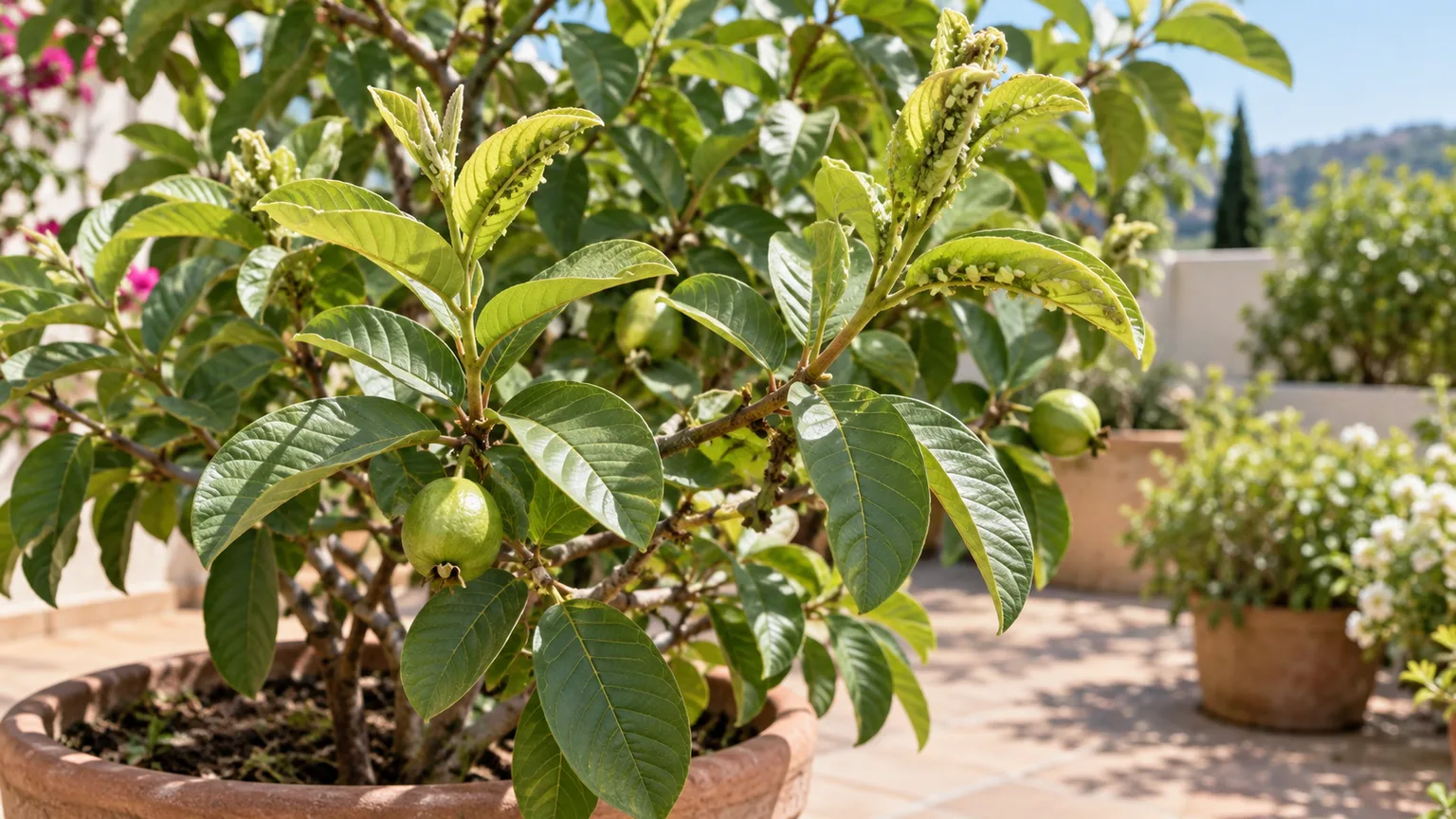
Aphids on Guava: How to Spot Them and Protect New Growth
This guide covers aphids on Guava. See also the general Aphids guide, watering, and light pages for this plant.
Aphids on Guava: How to Spot Them and Protect New Growth
What aphids look like on Guava
Aphids on Guava usually gather on the soft tips of new shoots and the undersides of recently opened leaves, as Purdue’s Guava pest profile notes. Look for a visible group of tiny, pear-shaped insects, a puckered or curled shoot tip, and a clear sticky film on the leaf or branch below it; Washington State University’s aphid guide describes the same colony and honeydew clues. First rinse the affected flush with a firm, leaf-safe stream of water; the Guava overview explains how this fruiting tree’s active growth fits into its wider care routine.

A mild aphid colony on the tender tip of a Guava shoot.
Color alone is not a reliable test because aphids can be green, yellowish, pink, or dark, and winged and wingless forms may occur in the same colony (Washington State University Pestsense). Purdue’s Guava reference also reports honeydew and sooty mold around feeding colonies (Purdue’s Guava pest profile).
For the broader pest life cycle and general aphid management, see the aphid guide. This page stays focused on where to inspect Guava and how to protect the tree’s next flush.
Why aphids cluster on Guava’s new flush
Guava is a woody fruit tree that puts out soft vegetative shoots during active warm growth. Those tips are the places to inspect first: the Purdue Guava profile describes aphids on the underside of new shoots, while UF/IFAS notes that Guava flowers on vigorous new growth. A colony on a young shoot can therefore distort the next leaves and occupy growth that may later carry flowers or fruit; it does not mean the tree’s roots are failing.
An unusually lush flush can make a colony easier to sustain. Washington State University notes that aphids thrive on lush new growth and cautions against overfertilizing (WSU Pestsense); use the Guava fertilizer guide to keep feeding measured instead of applying extra nitrogen to force rapid leaf growth. Check after warm weather, pruning, or any period when several soft tips emerge at once.
How to confirm aphids before treating
Inspect the newest Guava flush before spraying. Turn over several young leaves, check the folded tip and short stem joints, and look for live insects rather than relying only on old leaf damage. A hand lens helps, but a clear close-up on a phone is often enough to see a cluster of soft-bodied insects holding still on the plant.
Confirm the diagnosis with a combination of clues:
- Small insects grouped along tender stems or leaf undersides, with smaller nymphs among larger adults.
- Fresh leaves that are puckered or distorted where the insects are feeding.
- A sticky coating beneath the colony, sometimes accompanied by ants or black sooty mold.
Inspect Guava’s canopy in zones
Do not judge the whole tree from one folded leaf. On a container Guava, rotate the pot slowly and inspect one soft tip on the sun-facing side, one inside the canopy, and one lower shoot. On a planted tree, sample reachable tips in more than one part of the canopy; aphids often favor tender ends, so a clean older branch does not rule out a colony on the latest flush (WSU Pestsense).
Turn each sampled leaf over, check where its short stem meets the shoot, and look into any folded leaf before deciding how much foliage to remove. If the insects are difficult to see, tap one affected tip over white paper and inspect the fallen specks with a phone camera or hand lens. Record which tips have live insects and whether honeydew is present. There is no universal aphid count that calls for spraying a Guava; this small map lets you tell whether colonies are staying on one flush or spreading into new parts of the tree.
One curled leaf without insects or honeydew is not proof of aphids. If the Guava has broad yellowing but no live colony, compare possible causes in the Guava problems hub and check recent watering before treating a pest that is not there.
First fix: rinse the affected Guava shoots
Aim a firm but controlled stream of clean water at the infested shoot tips, then rinse both sides of the leaves. Support the young branch with your free hand if the flush is very soft, and reduce the pressure if leaves tear or bend sharply. Water can knock aphids off the plant, but a single rinse may not reach every insect tucked into a curled tip; both Washington State University and The Spruce’s aphid-removal guidance recommend physical water removal as an initial control, with follow-up inspection.
If Guava is in a container, keep the pot stable and let it drain freely after rinsing; avoid flooding the root ball as a side effect of treating the canopy. The Guava watering guide covers how to distinguish a needed soak from extra water that the pot does not need.
For a small potted tree, turn the pot so the stream reaches the leaf undersides without twisting a soft shoot. If the mix is loose or the pot has an open top dressing, a loose cover over the surface can prevent it washing out; remove the cover as soon as rinsing is over so the mix can drain. On a ground-grown Guava, target only the occupied branches first instead of blasting the entire canopy. A focused rinse makes the next inspection useful: you can revisit the same tips and see whether live aphids remain, rather than losing track of insects across a wet tree. The WSU guide also recommends protecting potting mix from spillover while washing and repeating the rinse when aphids return (WSU Pestsense).
What to do if aphids return
Recheck the shoot tips and leaf undersides over the next several days. If live aphids remain or reappear, rinse those sections again; repeated removal matters because aphids can drop off when disturbed and climb back onto the plant (WSU Pestsense). For a small, clearly localized colony that a spray cannot reach, remove only the most heavily infested tip and discard it rather than cutting back healthy branches across the tree. Gardeners’ Path also recommends hosing aphids off before moving to sprays, while Washington State University’s guide lists pruning localized infestations as a physical option (Gardeners’ Path’s control guide).
Be selective with pruning on Guava. UF/IFAS describes flowers forming on vigorous new shoots (UF/IFAS Guava guidance), so stripping every curled tip may remove productive growth as well as the pests. Keep healthy buds and shoots, and use the Guava pruning guide if you need to shorten a branch without turning pest control into a hard canopy prune.
Protect Guava flowers and developing fruit
If the colony sits on a shoot that is carrying flowers or small fruit, rinse and reassess before cutting the whole branch. Guava flowers form on vigorous new growth, so the newest flush can matter to the next crop as well as to the canopy. Purdue’s Guava profile places aphids on new shoots (Purdue’s Guava pest profile), while the RHS fruit-aphid guide notes that aphids on fruit trees can distort foliage and leave honeydew on leaves and fruit, without necessarily reducing the crop (RHS fruit aphid advice).
Sticky residue on a Guava fruit does not by itself show that an insect has bored into it. Look upward along that branch for a colony on leaves or shoot tips, and check several nearby fruit before deciding that the fruit itself is the source of the damage. Once the insects are removed, rinse surface residue from accessible fruit with clean water before eating; do not put household detergent or a pesticide mix on edible Guava. If the fruit is split, soft, or otherwise damaged, assess that separately instead of treating the aphid colony as the only possible cause.
If colonies persist on a fruiting Guava after washing and selective removal, ask a local extension service before using a pesticide. Only consider a product whose current local label permits Guava, the crop stage, and the growing location; follow all directions, including any harvest interval (WSU Pestsense label guidance). Skip homemade dish-detergent mixtures and do not transfer a pesticide list from another country or crop setting.
Lookalikes: when Guava leaf damage is not aphids
Use the insects and residue to separate aphids from other common Guava problems. Damaged foliage alone is not enough to choose a treatment. UC IPM’s houseplant chart likewise distinguishes spider-mite stippling and webbing from sticky foliage and visible sap-feeding pests (UC IPM diagnosis chart).
| What you find | More likely explanation | Next step |
|---|---|---|
| Soft-bodied insects grouped on tender tips, with sticky honeydew | Aphids | Rinse the affected flush and monitor it. |
| Pale, slow insects covered by cottony white wax | Mealybugs | The waxy covering is a useful distinction from aphids (Clemson Extension). |
| Fine pale stippling with very fine webbing, but no sticky droplets | Spider mites | Inspect leaf undersides for mites or webbing; this damage pattern differs from a sticky aphid colony. |
| Curling or yellowing with no visible insects, honeydew, or webbing | Another care or leaf problem | Recheck the Guava light guide and watering pattern before treating. |
If you see several symptoms at once or cannot match them to one pattern, start from the Guava problems hub and follow the closest visual match.
Recovery and when to escalate
Leaves that already curled while the aphids were feeding may stay misshapen; removing the insects does not reshape injured tissue. Better signs are a clean, expanding Guava flush, fewer live aphids at each check, and no new sticky deposits under the affected branches. A small colony on a well-established fruit tree can be tolerable while natural predators are active, but young container Guava with repeated shoot distortion deserves closer monitoring. RHS and Colorado State University Extension both describe fruit-tree aphid colonies as part of a wider predator-prey system, and Colorado State notes that established trees can tolerate low to moderate populations (Colorado State’s fruit-tree aphid guidance).
Track the next Guava flush
Take a quick photo of two or three affected shoot tips before the rinse, then return to those same tips during follow-up checks. Count live colonies, not old curled leaves: leaf tissue that expanded under feeding may stay distorted after the aphids are gone. If the old damage looks unchanged but new Guava leaves are opening without insects or fresh honeydew, the treatment is working even if the tree does not look perfect yet.
Guava’s new growth depends on active growing conditions, and its flowering shoots are part of the fruiting cycle. A cool spell or a slow period can delay the next visible leaf (UF/IFAS Guava climate guidance), so do not respond to a short wait by repeating sprays on a tree with no live aphids. Continue checking the original flush and inspect again when a new soft tip opens; UF/IFAS describes Guava flowers forming on vigorous growth, which is why the next healthy flush is a better recovery marker than the old damaged leaf (UF/IFAS Guava guidance).
Escalate if colonies spread across the canopy after repeated rinsing, shoots begin to die back, or honeydew and sooty mold keep accumulating on leaves or fruit. Look for lady beetles, lacewing larvae, and parasitized aphids before reaching for a broad-spectrum spray; preserving natural enemies can help keep aphid numbers from rebounding. RHS explains that aphids support many predators and that fruit-tree colonies may be reduced by them (RHS fruit aphid advice). If several Guava leaves are yellowing without visible aphids, follow the yellow-leaf diagnosis instead of repeating a pest treatment.
Prevent aphids during the next Guava flush
Inspect the terminal shoots and leaf undersides once or twice a week while Guava is actively pushing new growth, especially after pruning or a warm spell. Catching a few clustered insects early is easier than cleaning a whole canopy after the leaves have curled. Avoid heavy nitrogen feeding that creates a long, soft flush; use the plant’s fertilizer guidance to keep amounts and timing appropriate.
Keep the tree growing steadily rather than trying to cure aphids through a sudden change in light or irrigation. Guava does best with strong light, so use the light guide when weak or elongated growth points to shade; keep its root zone aerated using the soil guide if a container remains wet long after watering. These conditions support normal growth but do not replace inspecting the actual shoot tips for live aphids.
Check a container Guava before bringing it indoors
If cool weather means moving a potted Guava to a porch or room, inspect the newest leaves and branch joints before it sits close to other plants. Aphids can arrive on a plant and can move between plants by crawling or flying, so a hidden colony on the Guava’s folded tips can become a problem for nearby pots too (WSU Pestsense). Rinse visible colonies outdoors when possible, then keep the Guava apart while you recheck its new growth over the next few days.
Do not move a treated Guava straight into a crowded indoor plant group just because the visible aphids fell off during the wash. Look again under the leaves and along the tender stem joints before returning it to its usual spot. If you use any pesticide, follow the label’s instructions for indoor or outdoor use and for edible fruit; the label, not a general houseplant recipe, determines where that product can be used (WSU Pestsense label guidance).
Related tool
If the insects are too small to identify confidently, use the Pest Identifier Tool to compare the visible signs before choosing a treatment. It can help narrow possibilities, but live aphids and honeydew on the shoot remain the confirming clues.
Related Guava guides
- Use the Guava care overview for the tree’s overall growth, fruiting, and seasonal priorities.
- Use Guava watering if you are unsure whether a wilted tree needs water after canopy rinsing.
- Use Guava soil guidance when drainage stays slow or a container remains wet.