How to Grow and Care for Pineapple Guava (Feijoa)
Learn how to grow pineapple guava (feijoa), choose a site and cultivar, manage pollination, handle frost, prune lightly, and harvest green fruit at the right time.
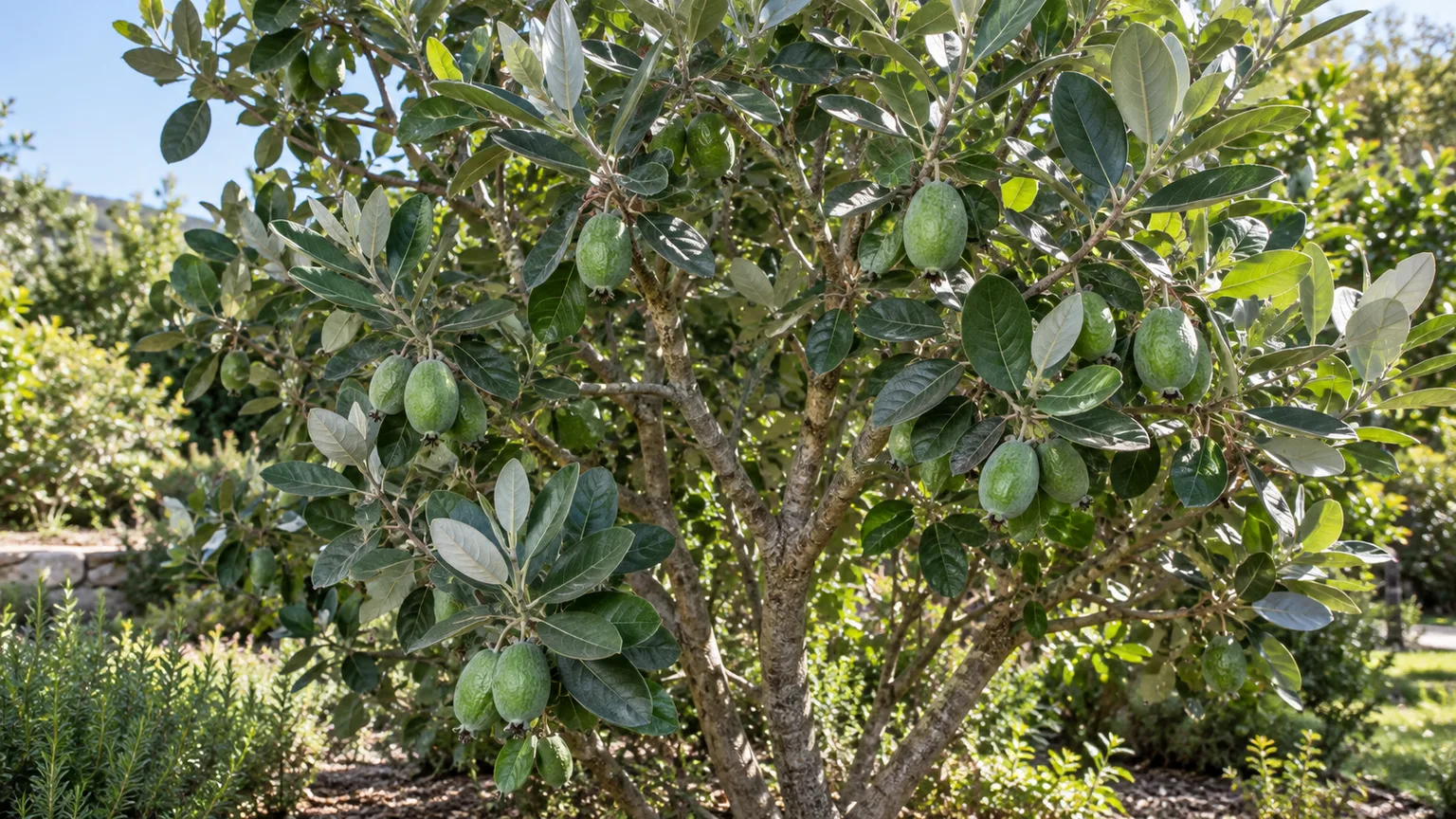
Pineapple guava is an evergreen South American shrub or small tree with silvery-backed leaves, showy red-and-white flowers, and fragrant green fruit. It can make a handsome hedge in a mild coastal garden, but a healthy shrub does not automatically produce a reliable harvest: winter cold, summer heat, cultivar, water, and pollination all affect the crop.
The most dependable plan is to choose a sheltered site with plenty of sun and fast drainage, keep young roots evenly moist, and select fruiting cultivars with pollination in mind. If you want fruit rather than foliage alone, ask a local nursery or Extension office which cultivars have cropped well nearby. Then let naturally fallen fruit—not a calendar or a color change—tell you when to harvest.
Pineapple guava care at a glance
| Need | Practical starting point | Important limit |
|---|---|---|
| Light | Full sun for the best flowering and fruiting; light afternoon shade can help in very hot sites | Deep shade often reduces blooms and fruit |
| Soil | Well-drained loam or sandy soil; avoid a site that stays waterlogged | A wet root zone can cause decline even when the leaves look thirsty |
| Water | Water deeply while establishing, then during prolonged dry spells and fruit development | Drought tolerance does not mean a young plant or developing crop needs no water |
| Climate | Mild-winter, Mediterranean or subtropical conditions are the safest fit | A hardiness-zone range does not guarantee fruit set or quality |
| Pollination | Check the exact cultivar; a compatible second cultivar often improves yield | “Self-fertile” is not consistent across every cultivar list or growing region |
| Pruning | Keep a natural multi-stem shrub or train a small tree with light structural cuts | Repeated shearing removes flowering wood and can reduce fruit |
Pineapple guava is a good choice when you want an attractive evergreen that can also provide fruit. It is a less predictable choice if you need a heavy crop in a very hot lowland, a cold inland site, or a tightly clipped hedge. Decide which role matters most before you choose the cultivar and planting position.
Identify feijoa—and separate it from common guava
The accepted botanical name used by many current horticultural references is Acca sellowiana. You will also see Feijoa sellowiana in older and still widely used gardening material; both refer to pineapple guava, also called feijoa or guavasteen. It belongs to the myrtle family, Myrtaceae, but it is not the common guava, Psidium guajava. The RHS plant profile and NC State Extension Plant Toolbox describe pineapple guava as a separate evergreen shrub species.
That distinction matters when you buy a plant or compare growing advice. Pineapple guava has opposite, oval leaves that are dark green above and noticeably pale or silvery underneath; the bark is gray, and the plant often grows with several stems from the base. Common guava has a different growth habit and foliage. A nursery tag that says only “guava” is not enough to confirm which plant you are buying—look for Acca sellowiana or feijoa.
The flowers are another useful identification cue. In spring or early summer, depending on climate, feijoa produces fleshy pale petals around a conspicuous tuft of red stamens. The petals are edible, and the fruit is usually oval to pear-shaped with green skin and fragrant, soft flesh when ripe. Flavor descriptions vary by cultivar and palate; pineapple, guava, and strawberry comparisons are shorthand, not a guarantee of identical sweetness or texture.
Match the plant to your climate before planting
Pineapple guava performs best in mild-winter climates with a long enough season for flowers to set and fruit to mature. It is commonly listed for USDA zones 8 through 11, but these numbers describe average annual extreme winter lows; they do not capture the timing of a freeze, wind exposure, heat spikes, cultivar differences, or the conditions needed for fruiting. The UF/IFAS Extension guide to growing feijoa in Florida notes that tree injury is likely below about 20°F (-6.7°C), while fruit can be injured at warmer temperatures. Those are regional guidance points, not universal guarantees for every plant.
Before planting, compare your winter lows and summer pattern with local experience. A sheltered coastal garden with mild winters is different from an exposed inland site that has the same zone number. Ask whether nearby plants flower and fruit, not simply whether they survive. In a colder climate, a large container that can be moved to a protected, bright, frost-free place may be more realistic than expecting a young in-ground shrub to crop outdoors every year.
Hardiness zones do not guarantee a fruit crop
Cold is only one part of the climate equation. UF/IFAS reports that feijoa fruit may be damaged around 28°F (-2°C), and high heat above roughly 100°F (38°C), particularly with low humidity, can also damage fruit. It also describes a possible chilling requirement for flower-bud initiation, but emphasizes that the amount is poorly studied and cultivar-dependent. In other words, the plant can survive a site where flowering or fruiting remains inconsistent.
This is why blanket claims such as “hardy to a particular temperature” can mislead. A brief cold snap after a plant is established is not the same as a prolonged freeze on a young shrub, and survival of the wood is not the same as protection of flowers or fruit. If your climate is near the plant’s edge, start with a protected microclimate, avoid a low frost pocket, mulch the root zone, and treat early harvests as a trial rather than a promise.
Choose a sunny, sheltered planting site
For fruit, give feijoa as much sun as your climate allows. NC State Extension says flowering and fruiting are best in full sun, while the plant tolerates light shade. In a hot inland garden, some afternoon shade can reduce heat stress; in a cool or cloudy climate, shade is more likely to cost you flowers and fruit. Avoid planting where a wall or paving reflects intense heat onto a young shrub through the hottest part of the day.
Wind protection matters for both establishment and fruit quality. Strong wind can stress the shallow-rooted plant, break weaker branches, and bruise fruit against stems. Choose a site sheltered by a fence or other windbreak without making the root zone stagnant or deeply shaded. If the plant is intended as a hedge, leave enough space for mature width and access to fallen fruit; UF/IFAS gives roughly 7 to 14 feet between plants depending on whether growers want a hedge or individual trees. A home gardener can use that range as a planning reference, then adjust for cultivar size and local pruning goals.
Plant in spring after the worst frost risk has passed in colder regions, or during a mild season when roots can establish before weather becomes extreme. Dig a hole about as deep as the root ball and wider than it, loosen circling roots gently, and set the plant at the same soil level it had in its nursery pot. Do not bury the trunk flare or create a deep compost-filled pocket. Backfill with the native soil, water slowly to settle it, and add a broad organic mulch layer while keeping mulch a few inches away from the stems.
Avoid digging or cultivating repeatedly beneath the canopy. Feijoa roots are relatively shallow; weed by hand near the trunk and top up mulch as it decomposes. If you have poorly draining clay, a high water table, or a spot where rain stands for hours, choose a raised mound or another location rather than trying to fix the hole with a small quantity of sand or gravel.
Water for establishment and fruit quality
Water a newly planted feijoa deeply enough to wet the root ball and surrounding soil. For the first growing season, check moisture several inches below the surface every few days during hot, dry weather; water when that zone is drying, not automatically on a rigid weekly schedule. As the plant establishes, extend the interval. Rainfall, soil texture, temperature, wind, plant size, and mulch all change how quickly the root zone dries.
Established plants can tolerate some drought, but extended dry spells may reduce flowering, cause small fruit, or trigger premature fruit drop. Pay particular attention from flowering through fruit development. If a dry summer overlaps with fruit set, slow deep watering is more useful than frequent surface sprinkling because it encourages moisture into the root zone. In sandy soil, check more often; in heavy soil, wait longer and confirm that excess water drains away.
The opposite mistake is keeping the root zone constantly wet. Yellowing leaves and weak growth are not automatic proof that a plant needs more water. Check the soil first: if it is saturated, sour-smelling, or still wet well below the surface, improve drainage and reduce irrigation rather than adding another soak. A layer of mulch helps conserve moisture, but a thick mound against the trunk can keep bark too wet and conceal problems.
Build a well-drained root zone and feed modestly
Feijoa grows in a range of soils but performs best where water drains freely. UF/IFAS reports a preferred pH range of about 5.5 to 7.0 for its Florida growing conditions, while the RHS profile describes cultivation in several soil textures when drainage is good. Treat those as useful regional guides, not a reason to alter soil without testing. If leaves yellow, first check drainage, irrigation, and a soil test before adding acidifier or fertilizer.
Spread compost as a surface mulch or incorporate modest organic matter across a broad planting area before planting. Do not put concentrated fertilizer or a thick layer of rich compost directly beneath the root ball. A young shrub needs time to establish roots; pushing rapid leafy growth with heavy nitrogen does not solve poor pollination, insufficient light, or a climate mismatch.
For feeding, use a soil test and local Extension recommendation where available. If growth is healthy, the plant is flowering, and the soil is reasonably fertile, a conservative application of a balanced fertilizer in the active growing season may be enough. Follow the product label for the plant’s size and avoid late-season heavy feeding in cold regions, where tender new growth can be more vulnerable to winter damage. More fertilizer is not a substitute for correct drainage, steady moisture, or a second compatible cultivar.
Plan pollination around the cultivar, not a rule of thumb
Feijoa has flowers with both male and female structures, but that does not mean every cultivar reliably pollinates itself. Some named selections can set fruit alone; many produce larger or more dependable crops when pollen comes from a different, compatible cultivar. The NC State Extension profile identifies both self-pollinating and partner-dependent selections, while the more production-focused UF/IFAS guide cautions that self-fertility varies and that cross-pollination often improves yield. The practical advice is to verify the cultivar, not assume the common name tells you enough.
If fruit is the main goal, buy two distinct cultivars that flower at overlapping times and ask the nursery to confirm they are suitable pollination partners in your region. Two plants of the same clone may not provide the same advantage as two genetically different selections. Where space is tight, seek a cultivar known locally to fruit alone, but understand that a single plant may produce fewer fruits. Nearby feijoa in a neighbor’s yard could help if they bloom together, though you may not know their cultivar or flowering overlap.
Gardeners sometimes hand-pollinate flowers to test whether lack of pollen transfer is the bottleneck. Use a clean, soft small brush to move pollen between open flowers on different plants during dry daytime conditions, then mark a few treated flowers and compare fruit set with untreated ones. This is a diagnostic experiment, not a guarantee: heat, frost, plant age, drought, and cultivar compatibility can still limit fruit development.
When a second feijoa is worth the space
Choose the second plant when you have room, want a meaningful crop, or have a cultivar whose fruit set is known to improve with cross-pollination. Choose one plant when the shrub is primarily ornamental, space is limited, or you have confirmed that your cultivar crops reliably alone. If you are not sure which category your plant belongs to, ask for the cultivar name and pollination notes before purchasing; “self-fertile” on a general tag may conceal partial rather than strong self-fertility.
The sources do not describe every cultivar identically. That variation is a reason to get local advice, not to declare one reference wrong. UF/IFAS focuses on production and distinguishes strong self-fertility from partial self-fertility, while the NC State profile lists several selections as self-pollinating. For the home gardener, the low-risk decision is simple: select a locally proven self-fruiting cultivar if planting one, or choose two compatible cultivars if fruit reliability matters more than saving space.
Follow the flowering-to-fruit timeline
Feijoa flowers on new growth and usually blooms in spring or early summer, with timing shifting by hemisphere, cultivar, and local weather. A mild winter may not provide the same flower-bud cues as a cooler region, and a late frost can damage blossoms even when the shrub itself remains alive. During bloom, avoid hard pruning and unnecessary root disturbance. Keep moisture reasonably even, and do not assume every blossom should become a fruit; some flower drop is normal.
After successful pollination, tiny fruit begin to develop behind the flower. Fruit maturation can take around five to six months in some climates, but the exact interval varies with temperature and cultivar. UF/IFAS reports roughly 20 to 26 weeks from flowering to maturity in Florida. Use that as a planning range, then watch the plant and gather fruit as it ripens rather than expecting a single date every year.
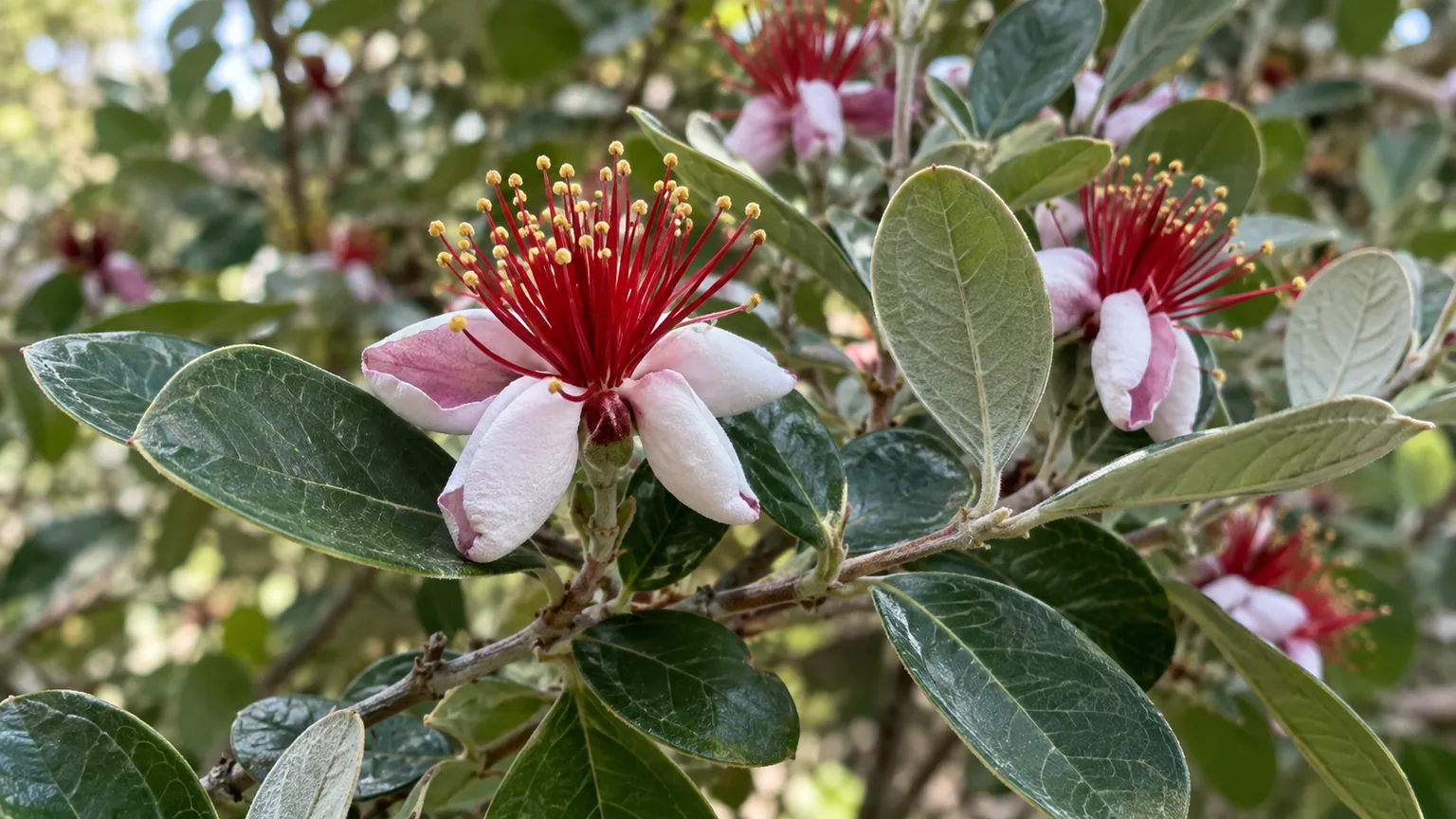
The season’s sequence is useful when diagnosing a problem. No flowers points first toward insufficient sun, plant immaturity, pruning at the wrong time, or local climate. Flowers without swelling ovaries raises pollination or frost questions. Small fruit that later drops suggests water stress, heat, wind, or a naturally heavy set. A fruit that has grown to size but remains on the branch may simply need more time.
Harvest by drop, aroma, and texture—not skin color
Pineapple guava fruit stays green as it ripens, so color alone is a poor harvest test. Many fruits detach and fall naturally when mature. Place a soft mulch under the canopy to cushion them, then check the ground daily during the season. The UF/IFAS guide describes fallen fruit as a useful backyard maturity cue, and practical growers at Homestead and Chill also recommend frequent collection because ripe fruit can bruise and soften quickly.
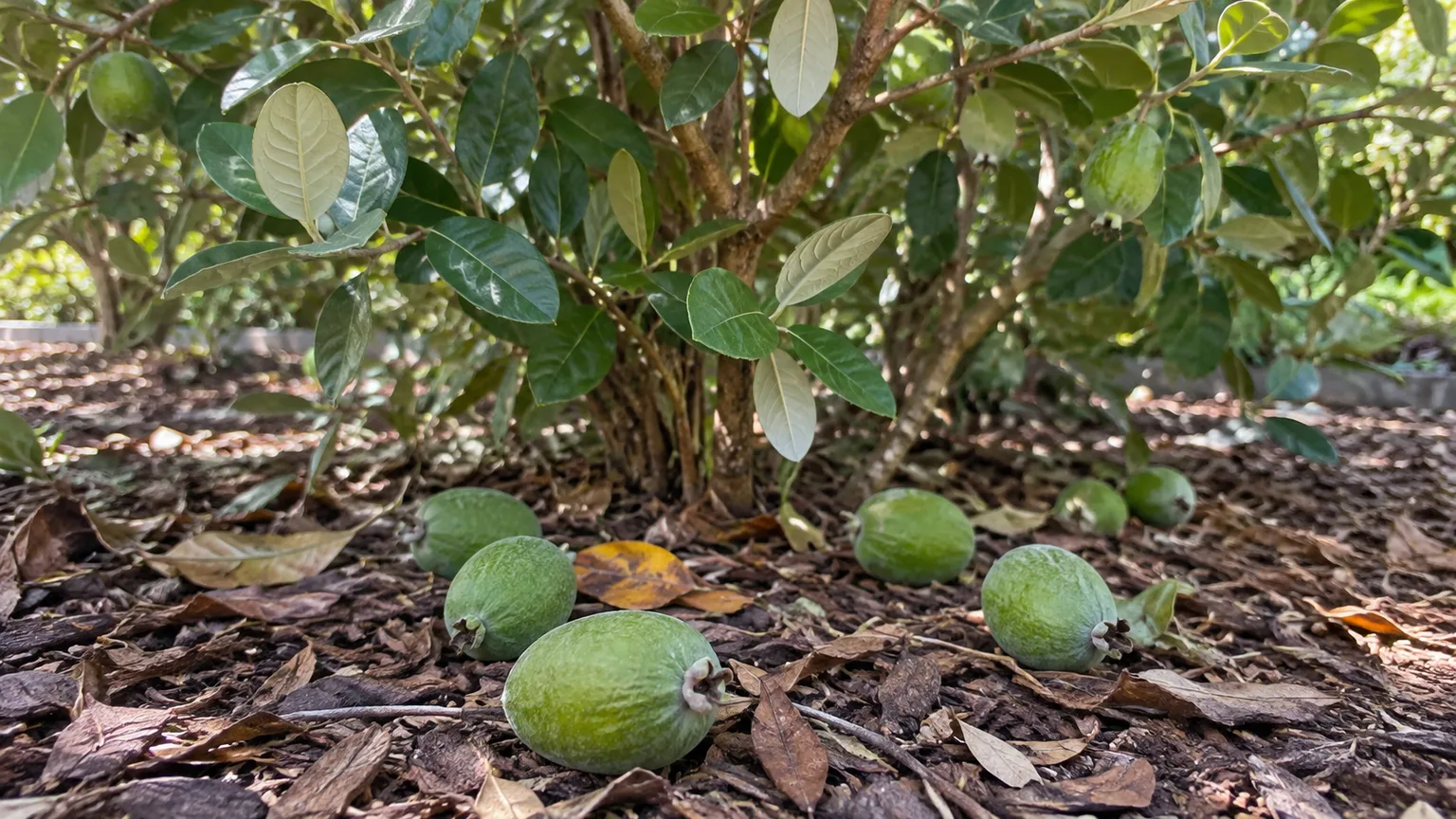
A ripe feijoa usually has a sweet fragrance and yields slightly when gently pressed, though preferred texture varies. Cut one open: the flesh should be aromatic and soft around the seed cavity, not hard, dry, or sour. Some growers prefer a firmer stage; others wait until the center softens more. Try fruit from your own plant at different stages, but do not wait for the skin to turn yellow or red as with many other fruits.
Pick up fallen fruit promptly and discard any that are split, fermented, moldy, or heavily bruised. Do not leave a week’s worth under the shrub and expect it to store well. If you want to catch rather than gather fruit, use a clean net or tarp that does not hold standing water or rub against branches. A soft mulch is often simpler and reduces impact damage.
Use ripe fruit soon. Cut it in half and scoop the aromatic flesh with a spoon, or use it in yogurt, baking, sauces, or preserves. Refrigeration can extend storage for a short period, but feijoa is not a long-keeping fruit; check frequently and freeze pulp if you need to preserve a larger harvest. The edible petals can be sampled in small amounts from correctly identified, pesticide-free flowers, but avoid stripping many flowers from a plant when you are trying to produce fruit.
Prune for the form you want without cutting away fruiting wood
Decide whether you want a dense shrub, hedge, or small tree while the plant is young. A multi-stem shrub needs little shaping and can screen a fence or patio. To form a small tree, select a strong central stem and gradually remove competing low shoots over several seasons rather than clearing the trunk in one severe cut. Gradual training limits stress and lets you see how the plant responds.
Feijoa does not need annual hard pruning to remain healthy. Remove dead, damaged, crossing, or badly placed branches, and make selective cuts to keep a path clear or open some light into the canopy. The RHS recommends little routine pruning, with late-spring removal of winter-damaged growth in its climate. In warm fruit-growing regions, timing can differ; avoid cutting heavily just before flowering because feijoa flowers on new growth and a severe cut can remove the season’s potential crop.
Hedges can be clipped lightly to maintain a boundary, but repeated formal shearing sacrifices flowers and fruiting shoots and may leave a dense outer shell with less light inside. If harvest matters, keep the hedge looser and prune after fruiting or after the local harvest, making selective cuts rather than repeated topiary-style trims. Clean pruning tools between diseased plants, and avoid cutting so much that sun suddenly reaches previously shaded bark and foliage.
Grow pineapple guava in a container with realistic expectations
A container is useful if your winter climate is marginal, your yard is small, or you want to move the plant to shelter. Choose a sturdy, wide pot with several open drainage holes and a free-draining container mix. Feijoa roots are relatively shallow, so width and stability matter more than an unusually deep pot. Begin with a container only modestly larger than the root ball; an oversized pot can retain wet mix around a small root system.
Place the pot outdoors in a sunny location during the growing season and water whenever the root zone is drying, which may be more frequent than in-ground watering during hot, windy weather. Do not let the pot sit in a saucer of water. Refresh the mix or move up one pot size when roots fill the container and water runs straight through, rather than repotting on a fixed annual schedule. A compact cultivar can be easier to manage, but pruning and a pot do not turn a naturally large shrub into a tiny houseplant.
Move a container plant before a damaging freeze, not after the leaves have blackened. Keep it in a bright, cool, protected place and reduce watering as growth slows; do not keep the mix saturated indoors. Bring it back outside gradually after hard frost risk passes. A plant that is moved indoors for winter may still struggle to fruit if it receives too little light, experiences abrupt temperature changes, or lacks a compatible pollination partner.
Propagate seedlings or named cultivars with different goals
Growing feijoa from seed is inexpensive and satisfying, but the seedling will not reliably match its parent in fruit size, flavor, season, or growth habit. UF/IFAS notes that seedlings are genetically variable and can be useful as rootstocks; they are a gamble when your goal is a named cultivar. Start with clean seed from fully ripe fruit, rinse away the pulp, and sow it in a sterile, well-drained medium. Keep it warm and evenly moist, not waterlogged, then pot up seedlings as they develop true leaves.
To reproduce a named cultivar, use a vegetative method or buy a labeled plant. Semi-ripe cuttings in summer are one option listed by the RHS, but success is not guaranteed. UF/IFAS describes clonal propagation as challenging, with better results reported under controlled conditions such as bottom heat and mist. Air layering or layering a low branch may work for a home gardener, but it takes time and the rooted plant may still need careful aftercare.
For most growers, purchasing a nursery plant with a confirmed cultivar name is the practical choice. If you want to experiment, grow a seedling as an ornamental or future trial plant and label it clearly. Do not assume that a seedling from a delicious fruit will produce equally good fruit; it may take several years to find out.
Troubleshoot poor growth, leaf yellowing, and fruit drop
Start by identifying which stage is failing. A weak plant with little new growth needs a site and root check; an attractive shrub without flowers needs a light, age, pruning, or climate check; flowers without fruit need pollination and frost questions; small fruit that drop needs water, heat, wind, and crop-load checks. Change one likely cause at a time so you can tell whether the plant responds.
Yellow leaves have several possible causes. Persistent yellowing with wet soil points toward poor drainage or root stress; pale new growth in alkaline soil may indicate nutrient availability problems. Check the moisture below the surface and test soil pH before applying acidifier or a micronutrient product. Yellowing on a single older leaf can simply be normal turnover, so avoid treating every leaf as a crisis.
Scale insects and fruit flies are reported in some regions, although feijoa is often relatively low-maintenance. Inspect leaf undersides and stems periodically, especially if the plant is already stressed. Identify the insect before using a treatment, remove small infestations where practical, and follow local Extension and product-label advice for edible crops. Wind-blown branches can also scar fruit, so a sheltered position and selective removal of rubbing branches are more useful than routine spraying.
Diagnose flowers without a dependable crop
If the shrub blooms but fruit set is sparse, first confirm whether the blossoms were damaged by late frost or high heat. Next, check the cultivar name and whether another compatible feijoa flowers nearby at the same time. If you have only one partially self-fertile plant, a second cultivar is often a better long-term fix than adding more fertilizer. Also consider the shrub’s age: newly planted or young specimens may flower before they are mature enough to carry a meaningful crop.
If tiny fruits form and then drop, review moisture during the weeks before and after flowering, recent heat spikes, and wind exposure. A dry spell can matter even on an established plant, while waterlogged soil can impair roots and create similar above-ground symptoms. Keep notes on bloom date, rainfall, temperature extremes, fruit set, and drop. One season’s log can help distinguish a recurring pollination gap from weather stress or a cultivar that simply ripens poorly in your climate.
Conclusion: choose the right site, then let the plant show you
Pineapple guava is easiest to grow when its ornamental and fruiting roles are both considered from the start. Give Acca sellowiana sun, shelter, good drainage, a mulch-protected root zone, and deep water during establishment and dry fruiting periods. For a serious harvest, choose locally proven cultivars and treat pollination as a cultivar question rather than assuming every plant is self-fertile.
Keep pruning light, protect young plants at the cold edge, and remember that a plant may survive a climate that does not reliably produce fruit. When harvest season arrives, ignore the unchanged green skin: gather naturally fallen fruit every day, smell and sample it, and use it while the flesh is still fresh. That combination of realistic expectations and close observation will tell you far more than a generic zone label or calendar can.