When to Prune Fruit Trees: Timing by Species
Learn when to prune apples, peaches, cherries, citrus, and more. Use this season-by-season guide to time cuts, protect buds, and avoid frost damage.
The short answer: prune by species and purpose
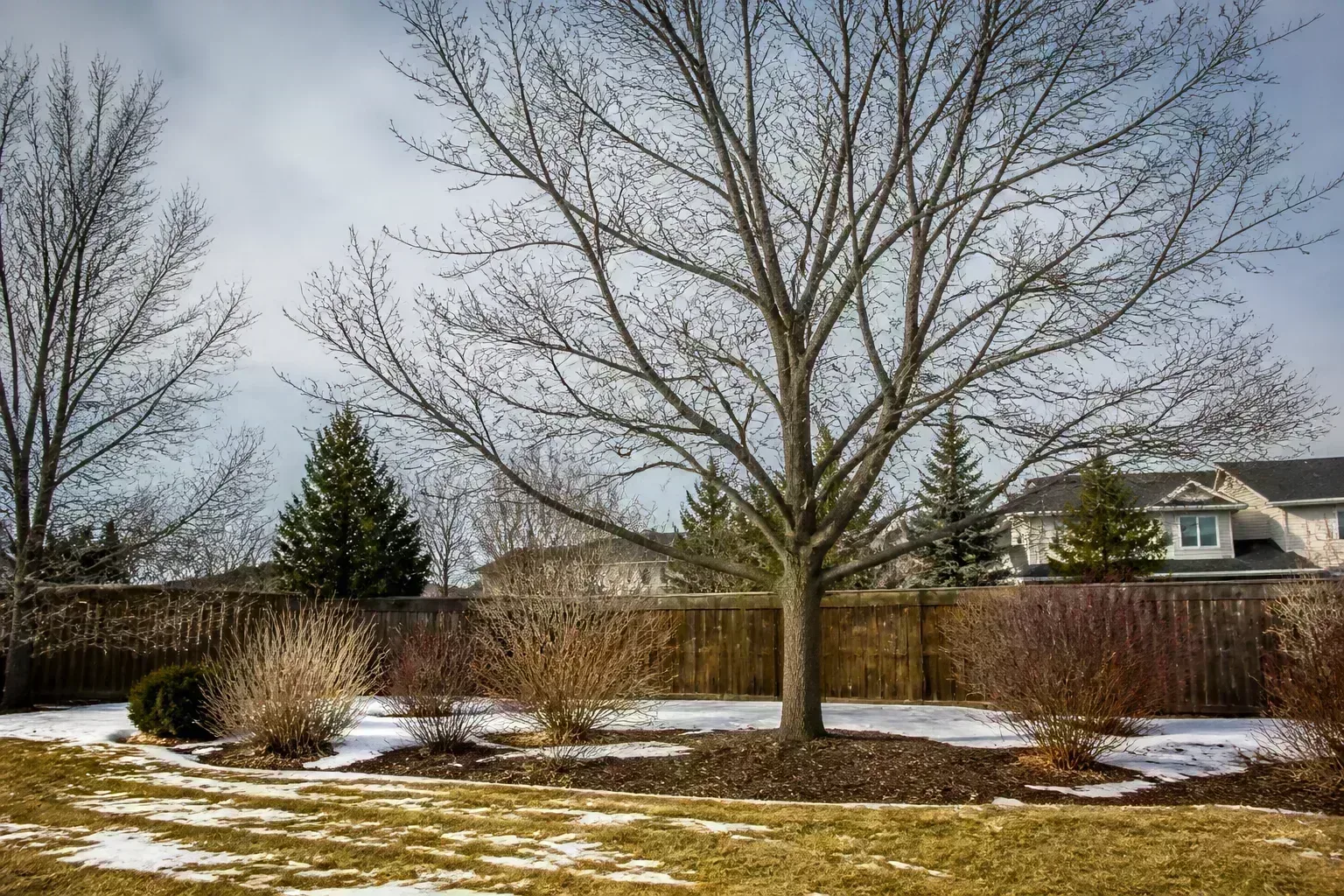
For most deciduous fruit trees, the best time for major structural pruning is after the coldest part of winter has passed but before spring bud swell. The exact month varies with climate, but the plant cue is consistent: the leaves are gone, buds have not opened, and the forecast does not call for a sharp freeze immediately after you cut.
That rule fits established apples, pears, and quince especially well. It does not fit every fruit tree or every pruning job. Peaches and nectarines often need late-winter or early-spring pruning when buds are beginning to swell; cherries are commonly pruned after harvest; citrus and other evergreen fruit trees are usually scheduled around harvest and active growth; and trained apples and pears may need a separate summer trim to control size and expose fruit to light.
Think of pruning as a timing-and-purpose decision, not a holiday on the calendar. A dormant cut usually stimulates spring growth, a summer cut can restrain vigor, and an emergency cut removes a hazard whenever necessary. The Utah State University Extension guide to training and pruning apple trees makes this growth-response distinction explicit: dormant pruning leaves the tree with more stored energy relative to its canopy, while summer pruning removes resources during active growth.
Use a three-question decision rule before cutting
Before you pick up the pruners, answer three questions: What kind of fruit tree is it? What is the tree doing now? What do you want the cut to accomplish? Those answers are more reliable than a generic instruction such as “prune in winter.”
1. What kind of tree and training form is it?
Start with the broad group. Apples, pears, and quince are pome fruits that commonly tolerate dormant structural pruning. Peaches, nectarines, apricots, plums, and cherries are stone fruits with different disease and fruiting-wood considerations. Citrus, avocado, guava, and many figs grow in warmer conditions and may not follow the dormant calendar used for a leafless apple in a cold winter.
Then look at the shape. A free-standing bush or standard tree is managed differently from a cordon, espalier, fan, pyramid, or other restricted form. The RHS guidance on summer pruning apples and pears reserves summer pruning mainly for trained forms, while free-standing bush and standard trees are primarily managed with winter pruning. A trained tree may need a small, deliberate summer cut even when its neighboring orchard tree should be left alone.
2. What is the tree doing now?
Dormant means the tree has lost its leaves and has not started the new season’s expansion. Swollen buds, green tips, open flowers, and fresh shoots tell you the tree is moving into active growth. If buds have just started to swell, finish only the cuts you truly need; if flowers are open, avoid casual branch removal that could knock off the crop or change the tree’s energy balance.
Also inspect the wood you plan to keep. Apples and pears often carry fruit on older spurs, while peaches and nectarines depend heavily on last season’s shoots. Cutting a branch is also cutting away a future crop, so identify fruiting wood before shortening healthy branches. If you cannot tell which buds are vegetative and which are fruiting, make a light cleanup pass and defer the bigger decision until you have a species-specific guide or local extension advice.
3. What is the goal?
Use dormant pruning when you need to build or correct the framework, remove crowded wood, reduce height gradually, or renew aging branches. Use summer pruning when you need to reduce excessive vigor, remove water sprouts, manage a trained shape, or improve light around developing fruit. Remove dead, broken, diseased, or dangerous branches whenever safety requires it, but choose a dry, calm day and cut back to sound wood when possible.
Timing guide for common fruit-tree groups
The table below gives a starting point for common backyard trees. It is not a substitute for the tree’s actual growth stage, local freeze pattern, cultivar, rootstock, and disease history, but it prevents the most common category error: treating every fruit tree as an apple.
| Fruit-tree group | Main pruning window | What that window is for | Main caution |
|---|---|---|---|
| Apples, pears, quince | Late winter to early spring, before bud break | Framework, light, size, renewal | Do not prune so early that a severe freeze follows, and do not strip fruiting spurs |
| Peaches and nectarines | Late winter or early spring near bud swell; light summer work | Select fruiting shoots, keep an open center, manage shade | Cold-sensitive cuts and excessive removal can reduce the crop |
| Sweet cherries | Usually after harvest in summer | Limit size and reduce wet-season disease exposure | Avoid routine dormant pruning where bacterial canker is a concern |
| Plums and apricots | Varies by species, cultivar, and training; often dry-season or post-harvest work | Renewal, light, and shape | Prune on a dry day and avoid blanket winter advice |
| Citrus and other evergreen fruit | Around or after harvest, during suitable active growth | Shape, height, deadwood, and crowding | Harvest periods vary; do not remove branches carrying the next crop |
| Figs | Often spring or after the main crop, depending on climate and crop type | Replace fruited wood and control shape | Timing must protect overwintering fruitlets in some climates |
Apples, pears, and quince
For established free-standing apples and pears, prune while dormant from leaf fall through late winter, finishing before bud break. A late-winter window is usually safer than the first weeks after leaf fall because pruning temporarily lowers cold tolerance in nearby tissue and can encourage growth that is poorly hardened before a hard freeze. In a cold region, wait until the worst temperatures have passed; in a mild region, the same physiological window may arrive earlier.
Young apples and pears need formative pruning, not a drastic annual haircut. The RHS advice for newly planted trees places initial pruning between leaf fall and bud burst and emphasizes choosing a small number of evenly spaced, wide-angled branches. A young tree is using its first seasons to build a strong scaffold, so removing too much can delay flowering and weaken the path to a manageable, harvestable crown.
Free-standing mature trees can use either traditional winter pruning or a regulated approach that replaces selected older branches without continually enlarging the canopy. For an established tree you want to keep at roughly the same size, the RHS regulated-pruning method recommends working during dormancy and removing no more than about 10 to 20 percent of the canopy in a year to limit watershoot production. Treat that as a conservative ceiling for major renewal, not a target to hit.
Peaches and nectarines
Peaches and nectarines need a more careful answer than “winter.” In regions where late-winter cold can damage fresh cuts, prune closer to spring bud swell, after the most severe freezes but before flowers open. The Penn State Extension guidance on peach pruning explains that pruning can occur in summer or during dormancy, but the objectives differ: summer cuts reduce shading and vigor, while dormant cuts manage size, structure, and excess fruiting wood.
These trees are commonly trained to an open-center or vase shape, with the middle kept open so light reaches the fruiting zone. Peaches bear most of their crop on one-year-old wood, so a mature tree needs a supply of healthy, moderately vigorous shoots rather than a collection of old gray branches or long, shaded limbs. Remove unproductive, strongly upright growth and retain well-placed one-year shoots; blindly shortening every branch can remove the very wood that would have flowered.
Summer pruning can be useful when upright shoots shade the center or when a vigorous tree is running beyond its allotted space. It is not permission to strip the canopy during hot weather. Make the smallest set of cuts that solves the light or height problem, and remember that crop thinning after bloom is a separate job from branch pruning.
Cherries, plums, and apricots
Stone fruits in the Prunus group do not share one perfect calendar. Sweet cherries are often best pruned just after harvest, when dry weather helps reduce the opportunity for bacterial canker to enter and spread through fresh wounds. The practical Gardening Know How guide to post-harvest pruning highlights sweet cherry as a key exception to the usual dormant-season rule.
Plums and apricots also deserve a weather-aware schedule. Vigorous plums may need summer thinning to control upright shoots, while the right window for a large limb can vary by region, cultivar, disease pressure, and whether the tree is free-standing or trained. The RHS fan-trained tree guidance recommends spring and summer work on a dry day and notes that stone-fruit pruning should be completed by late summer for trained trees to reduce fungal-disease risk.
Do not turn “summer pruning” into “prune whenever the fruit is ripe.” First identify the fruiting habit and the branch you are replacing. A cut that removes last year’s fruiting wood may be correct for one trained peach but wrong for a plum that carries fruit on older spurs. If you have a mature, neglected Prunus tree or a branch larger than you can safely handle from the ground, use local extension or an arborist rather than experimenting with a major cut.
Citrus, figs, and other warm-climate fruit
Evergreen fruit trees do not enter the same deep leafless dormancy as apples in cold climates. Citrus, avocado, guava, and kumquat are usually pruned around the harvest cycle and the flush of new growth. The post-harvest fruit-tree overview from Gardening Know How describes post-harvest pruning as appropriate for several evergreen fruit trees, while also warning that harvest dates vary by species and location.
For these trees, the first question is not “Is it January?” but “Has this crop finished, and will this cut remove flowers or fruit for the next cycle?” A light removal of dead, damaged, crossing, or badly placed wood is easier to justify than a major size reduction during a stressful heat wave or a flush of flowering. Protect the tree’s remaining leaves, because an evergreen canopy is the engine supporting both current fruit and future growth.
Figs are especially dependent on the local crop cycle. Some types carry tiny overwintering fruits that should be preserved, while others produce their main crop on current-season growth. If you do not know which crop your fig carries, postpone hard pruning until you can identify the cultivar and the fruiting wood.
What each pruning season is really for
Late winter to early spring
This is the main structural season for most deciduous pome fruit and many other trees. Without leaves, you can see the leader, scaffold branches, rubbing points, dead stubs, and crowded interior. The tree’s stored reserves are ready to support new growth, so cuts made now tend to produce a stronger spring response than the same cuts made during summer.
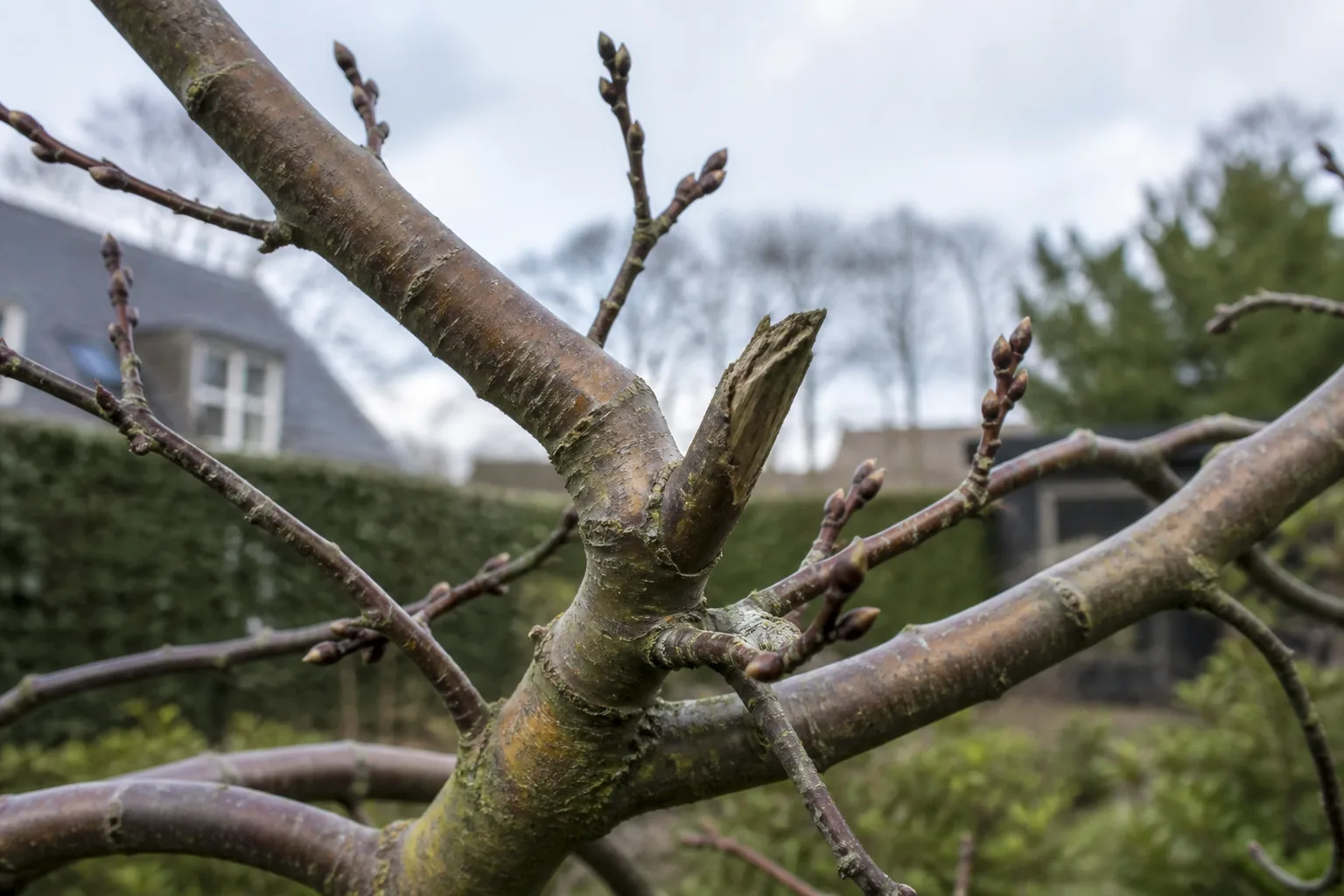
Bare branches and dormant buds make it easier to choose structural cuts before spring growth begins.
Late winter is not the same as any day labeled “winter.” Finish after the coldest part of the season, before buds open, and avoid a severe freeze immediately after major cuts. In Utah State University Extension’s apple guidance, dormant pruning is described as a way to create the desired form and direct vegetative growth, while early-season pruning before maximum hardiness can expose tissue to low-temperature injury.
Use this window for three priorities: correct the framework, remove wood that blocks light or airflow, and renew older fruiting branches gradually. Do not use it as an excuse to shorten every branch to the same length. The best dormant cut is the one that solves a structural problem while preserving enough productive wood to carry the coming crop.
Summer
Summer pruning removes leaves and active shoots while the tree is spending resources on growth, so it generally reduces vigor rather than stimulating a large flush below the cut. That makes it useful for trained apples and pears, over-vigorous trees, upright water sprouts, and branches that are shading fruit during the growing season.
For restricted forms, timing depends on the shoot’s maturity, not just the month. RHS guidance places summer pruning of trained apples and pears in the period when new shoots have begun to stiffen and the lower portion is woody, with the exact date shifting according to vigor, weather, and locality. A light, well-timed cut can keep a cordon or espalier compact; a late, heavy cut can prompt unwanted regrowth or remove buds already being prepared for the next season.
Summer is also a good time to rub or snap off small, unwanted watersprouts while they are still soft, especially after a large dormant cut. Larger limbs should not be tackled casually from a ladder in heat, wind, or wet weather. If the tree is under drought or heat stress, stabilize its growing conditions before adding a major wound.
Fall and early winter
Routine structural pruning is usually the wrong job for fall on deciduous fruit trees. After leaf drop, the tree is preparing for dormancy; a cut made too early can stimulate tender shoots, and a wound made close to hard freezes has less time to be protected. This is why “the leaves are falling, so it must be pruning time” is an unreliable shortcut.
Fall is still a useful inspection season. Mark branches that cross, rub, hang over a path, or show disease; remove a clearly dangerous limb if waiting would create a hazard; and plan the dormant session once the coldest weather has passed. If you remove diseased material, carry it away from the tree and clean tools before returning to healthy wood.
A safe cut sequence for an established tree
Remove hazards and the three Ds first
Begin with dead, damaged, and diseased wood, then remove branches that threaten people, buildings, paths, or utility lines. This cleanup often changes the canopy enough that you need fewer large cuts than you expected. Work from the outside of the tree and trace each branch back to its origin before cutting; a small twig may be part of a larger crossing or weakened limb.
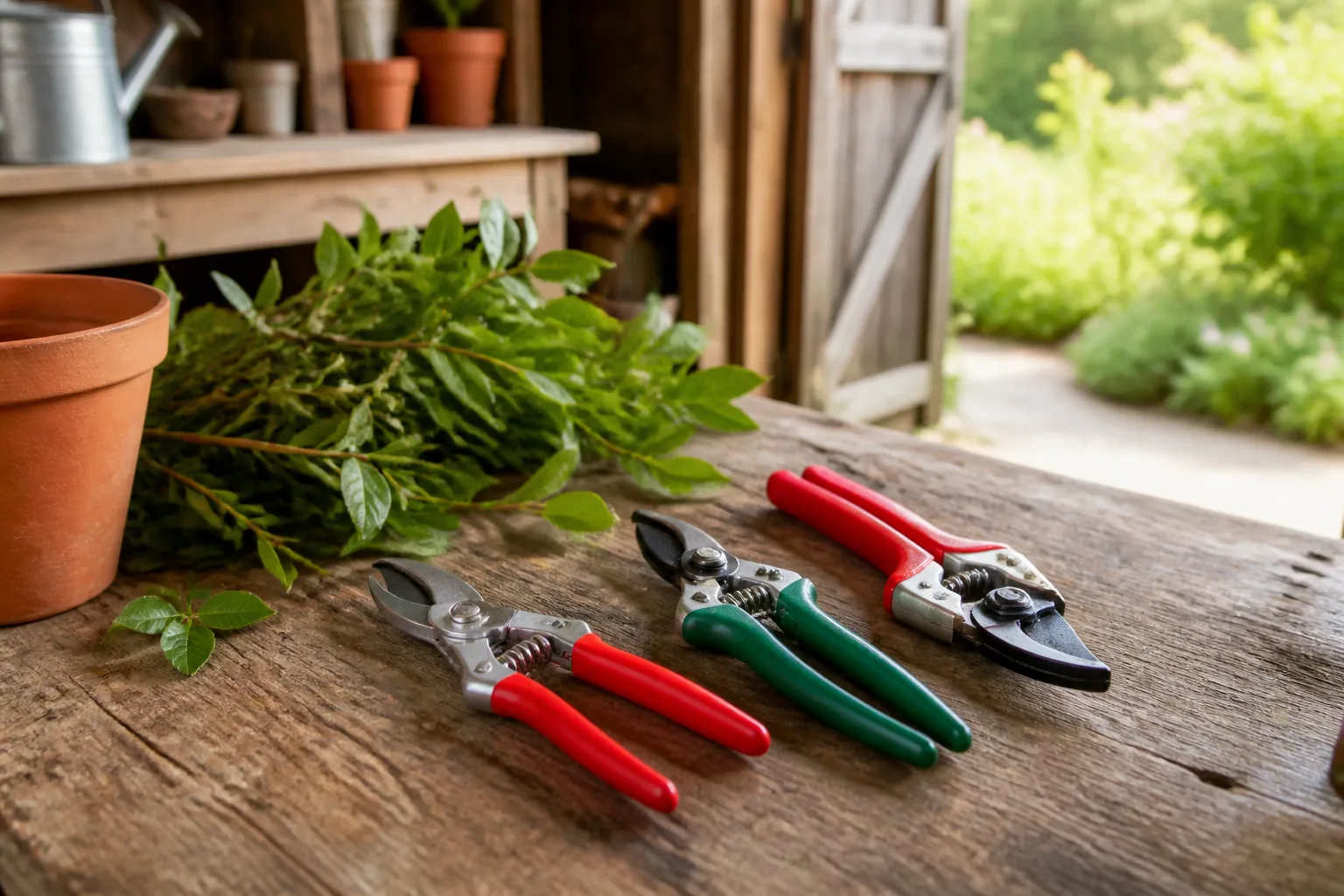
Use a sharp, clean tool that matches the branch diameter before you start.
Use bypass pruners for small live shoots, loppers only within their rated capacity, and a sharp pruning saw for larger limbs. When a heavy branch could tear as it falls, use a staged cut with an undercut and a separate top cut, or hire a professional. A stable tripod ladder and a second person are safer than stretching from an ordinary ladder; if your feet are not on firm ground, the branch is not a do-it-yourself cut.
Open the canopy without stripping it
Your goal is not to make the tree look empty. Remove one of two rubbing or crossing branches, clear strong shoots growing into the center, take out suckers from below the graft union, and thin congested growth so light and air can reach the fruiting zone. Leave short, well-placed fruiting spurs and useful one-year shoots when the species relies on them.
Step back after every few cuts and view the tree from all sides. A balanced canopy should have a clear framework, not a hollowed-out center with a fringe of branches on the outside. The Fine Gardening guide to dwarf fruit trees is useful here because it treats size control as an ongoing combination of initial training, winter pruning, and restrained summer growth rather than one annual topping cut.
Match the cut to the growth you want
A thinning cut removes a shoot or branch at its point of origin or back to a suitable side branch. It is the usual choice for opening space and reducing the number of competing shoots because it does not create a dense cluster of regrowth immediately below the cut. A heading cut shortens a branch to a bud or side shoot and can stimulate branching below it; use it deliberately to build young scaffolds or redirect a branch, not as a reflexive way to lower a mature tree.
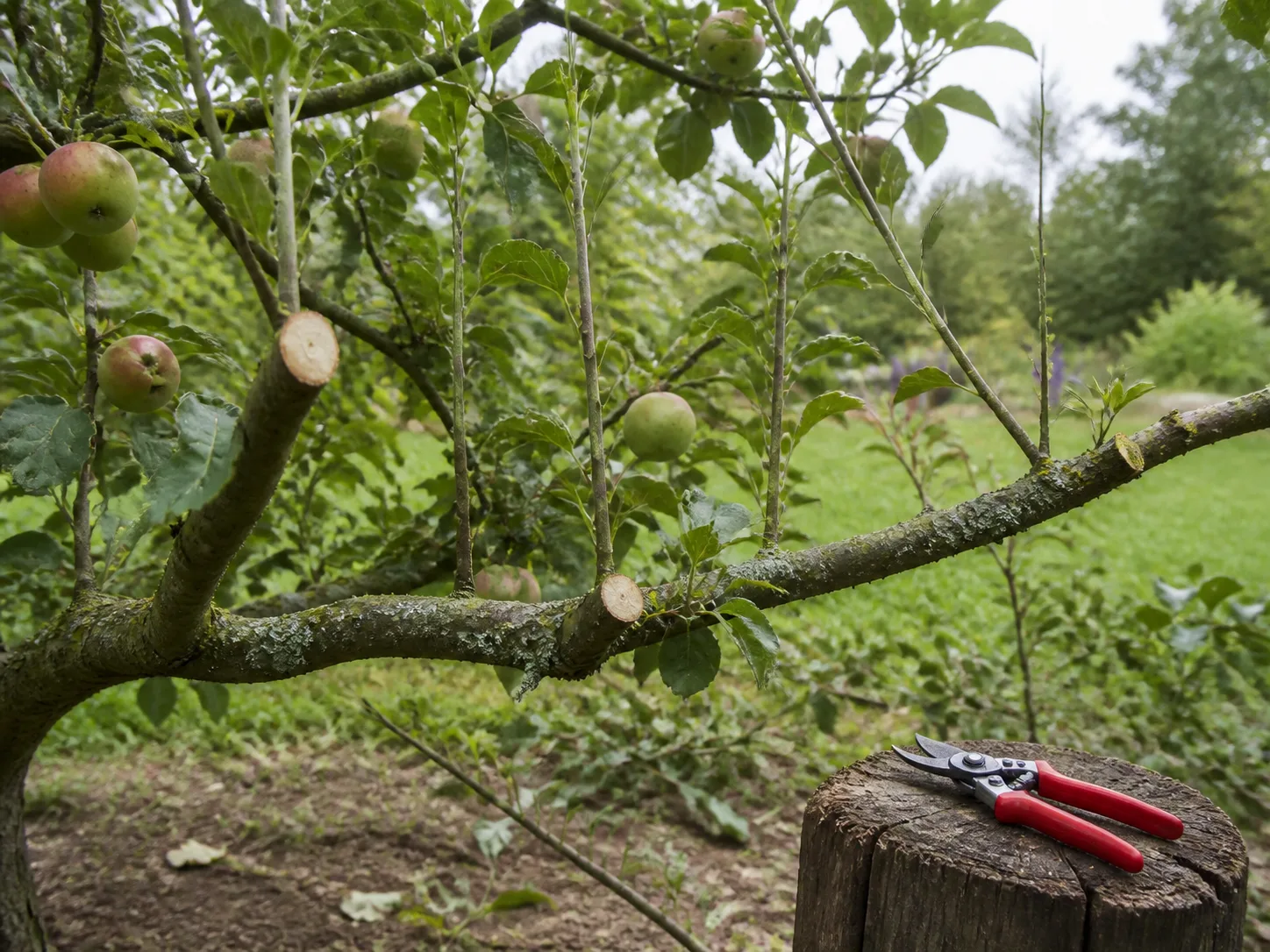
Trace a branch to its collar or side branch before choosing a thinning or heading cut.
Cut just outside the branch collar when removing a whole branch, and do not leave a long snag or cut into the collar. When shortening a branch, choose a healthy bud or side branch that points in the direction you want future growth to travel. The GrowVeg pruning guide summarizes the practical reason for preserving the collar: it is part of the tree’s natural defense against decay, so a flush cut can create a larger internal problem than a properly placed collar cut.
Do not paint routine pruning wounds with a sealant unless a local authority specifically recommends a product for a documented disease situation. Clean, sharp cuts, dry weather, correct timing, and removing infected wood are more important than covering every wound.
Young trees need training before a heavy crop
The first one to three years are about building a strong, harvestable structure. Depending on the species and desired form, that may mean a central leader with tiered scaffolds for an apple or pear, or an open vase with three to five well-spaced branches for a peach. The common goal is wide, strong branch attachments and enough light in the lower canopy.
It is normal for a young tree to produce little fruit while its framework develops. Remove competing leaders, narrow-crotched branches, low suckers, and poorly placed shoots, but avoid taking every small side branch simply because it looks untidy. The Fine Gardening first-year pruning sequence shows why young trees may need an initial heading cut followed by measured spring and late-summer adjustments; the exact height and cut depend on the tree’s size, rootstock, and intended form.
If a newly planted apple or pear arrives with no side branches, formative pruning can encourage the first scaffold shoots. A container-grown tree planted while actively leafy may be better left to establish until the following dormant season. For a peach planted in fall, spring pruning before bud break can balance the top with the newly established root system, but a late cold snap is a reason to wait rather than to obey a fixed date.
How much to remove and how to handle an overgrown tree
There is no single safe percentage for every tree, but a useful home-orchard rule is to keep major renovation conservative and staged. For established apples and pears, the RHS regulated-pruning guidance uses roughly 10 to 20 percent of the canopy in a year to limit watershoots; a young tree may need a different formative cut, while a damaged limb may need removal regardless of percentage.
Overgrown trees are often harmed by a well-intentioned one-day rescue. Removing the entire top or many large limbs can trigger a flush of tall, weakly attached watershoots, expose bark to sun, remove several years of fruiting wood, and leave you with a tree that is harder to manage. Spread renovation over two or three dormant seasons, starting with hazards, deadwood, the worst crossing limbs, and branches that block the main framework.
If you need to reduce height, remove a tall branch back to a substantial outward-growing side branch rather than making a blunt heading cut across the top. The side branch should be large enough to take over without becoming a weak stub, and the tree should retain enough leaf area to recover. When a mature tree is too large for safe ground-based work or has a split trunk, call a qualified arborist; fruit production does not justify a fall injury.
Weather, disease, and mistakes that cost next year’s fruit
Delay major cuts when the forecast calls for a hard freeze, high wind, persistent rain, or saturated ground. Fresh cuts and fragile ladder footing create two separate risks: the tree can suffer cold or disease injury, and the gardener can lose control of the tool or branch. A dry day with a calm forecast is worth waiting for, especially for stone fruit.
Disease history can override a calendar. If fire blight has affected an apple or pear, remove infected wood well below visible symptoms, disinfect tools between cuts according to local extension guidance, and dispose of the material rather than composting questionable branches. The USU apple guide specifically treats removal of diseased wood and tool sanitation as part of disease management; follow the disease-specific recommendation for the product and concentration instead of guessing.
The last exception is the emergency branch. A storm-split limb hanging over a walkway, roof, or play area is a safety problem, not a seasonal pruning project. Keep people clear, do not climb an unstable tree, and bring in an arborist for large, elevated, or entangled branches.
The most expensive mistake is pruning by the tree’s common name without checking its fruiting wood. Removing old apple spurs can reduce the crop; removing last season’s peach shoots can remove most of next year’s flowers; and pruning a cherry in a wet dormant period can increase disease exposure. The second most expensive mistake is treating a trained espalier like a free-standing tree and missing the summer size-control work it needs.
Other common failures are topping a mature tree, removing more than the canopy can support, leaving stubs, making flush cuts, pruning during a heat or drought stress event, and failing to clean up diseased branches. A tree that responds with a forest of watershoots is often telling you that the previous session removed too much or used too many heading cuts.
Finally, do not confuse pruning with fruit thinning. Branch pruning sets the framework and the supply of fruiting wood; fruit thinning adjusts the number of developing fruits after bloom so the remaining crop can size properly. Treating a heavy fruit set with a saw is a poor substitute for the smaller, later crop-management decision.
Conclusion
The best time to prune fruit trees is the window that matches species, tree form, purpose, and weather. For many apples, pears, and quince, that means late winter after the hardest cold and before bud break. For peaches and nectarines, prune closer to spring bud swell; for cherries and some other stone fruits, use a dry post-harvest or summer window; and for citrus, avocado, guava, and figs, follow the harvest and growth cycle rather than a leafless-tree calendar.
When the timing is right, begin with hazards and the three Ds, open the canopy selectively, preserve productive wood, and choose thinning or heading cuts for a reason. If the tree is overgrown, stressed, diseased, or too large to reach safely from the ground, a staged plan or professional assessment will protect more fruit—and more of the tree—than a heroic afternoon with the saw.