African Violet Care Guide: Light, Watering, Soil
Stop leaf rings and crown rot. Learn African violet care: filtered light, crown-safe watering, airy soil, and bloom fixes.
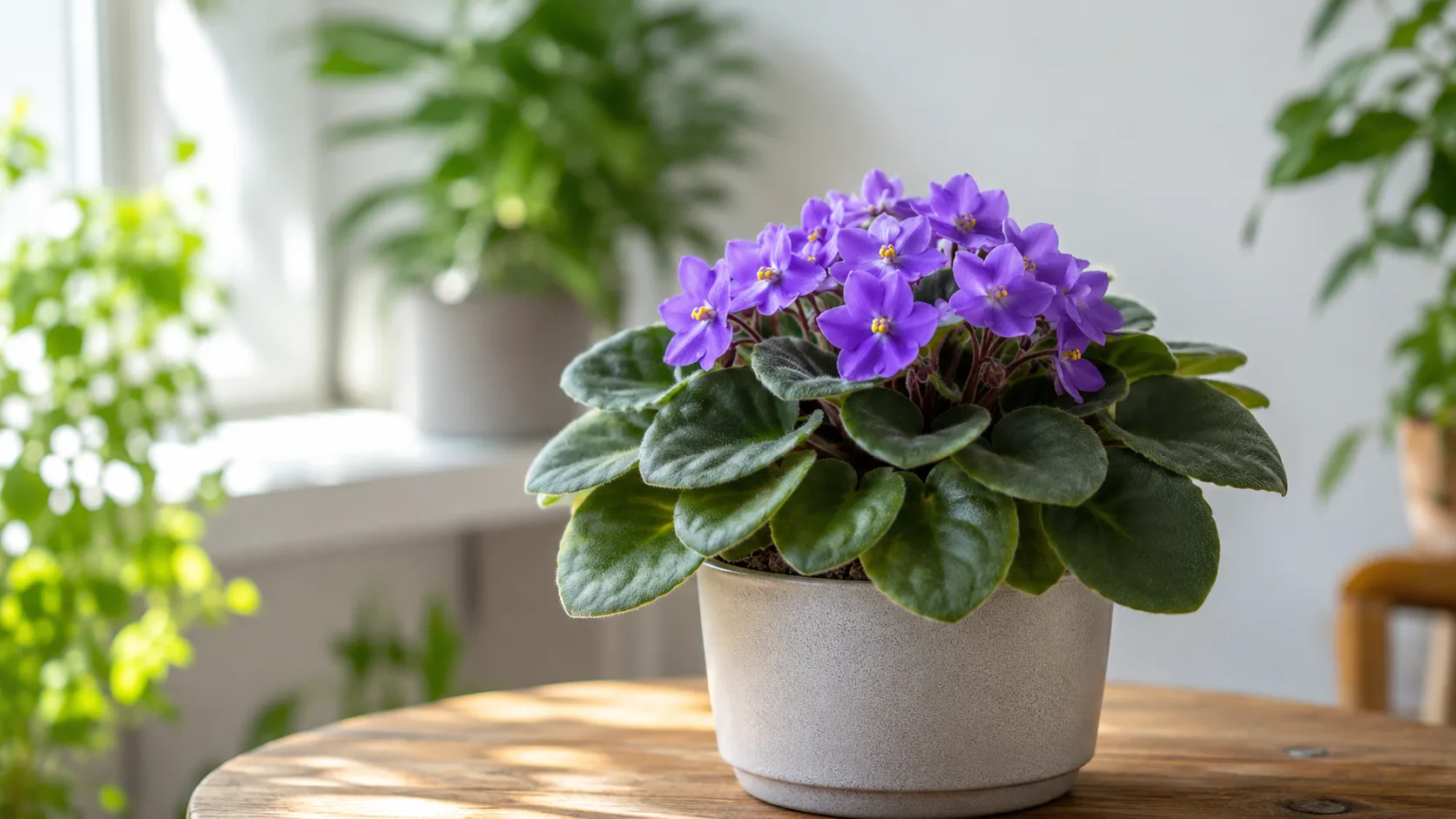
Cold water on warm fuzzy leaves leaves pale rings. A wet crown collapses while outer leaves still look fine. A plant stays green for months and never sets a bud because the room is bright to you and dim to a blooming gesneriad. Those three failure modes—not generic “fussy plant” lore—are what good African violet care actually prevents.
Treat African violets as compact flowering houseplants with a soft central crown, fine shallow roots, and leaves that mark when wet. Give them bright filtered light, an airy mix that never stays muddy, room-temperature water kept off foliage, and a pot small enough that the root zone finishes drying between drinks. Do that consistently and fertilizer, humidity tweaks, and leaf cuttings become optional upgrades instead of rescue missions.
Written by Sai Ananth, who grows standard and miniature African violets on east-window sills and a small grow-light shelf in a heated home, and reviewed by Dr. Priya Menon (botanist and indoor plant specialist) for physiology and indoor stress framing.
Who This Guide Helps (and When to Open the Hub)
Use this page when you want one practical framework: where to place the plant, how to decide when to water, what mix and pot size to use, how to keep blooms coming, and which problem to check first. It is for new owners and for growers who want a full refresh without opening six tabs.
Use the African Violet care hub when you already know the symptom—no flowers, crown rot, white spots, root rot—or need topic depth on light, watering, soil, fertilizer, repotting, or propagation.
If limp leaves sit on a still-heavy pot, open root rot or overwatering before you change fertilizer. If the plant is green but flowerless after weeks of “bright” placement, start with not enough light rather than a stronger bloom formula.
What Makes African Violets Different
Most indoor flowering plants are treated either as temporary gift blooms or as tough foliage plants that happen to flower. African violets sit in the middle. Under good care they can bloom for much of the year; Clemson HGIC notes popularity comes partly from blooming about 10 to 12 months of the year when conditions hold. That long window is why small care errors show up quickly: weak light means fewer flowers, and wet soil means limp leaves on a still-wet pot.
University of Georgia Extension classes plants by size—miniature (often about 6 to 8 inches or less across), semi-miniature, standard (roughly 8 to 16 inches), and large—and notes that flower and leaf forms vary widely while the cultural rules stay similar. (UGA Extension)
Crown, Fuzzy Leaves, and Bloom Habit
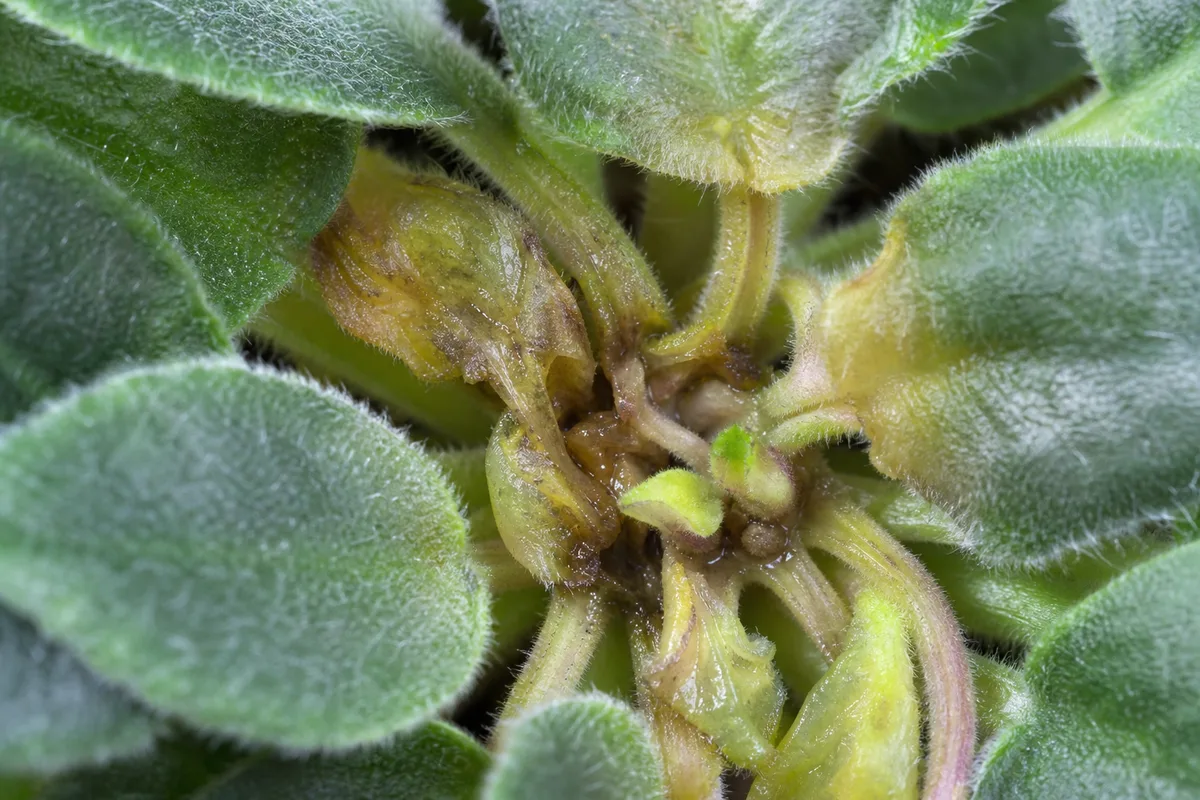
The crown is the growing point where new leaves emerge at soil level. If that point stays wet, cool, and poorly aired, crown rot can start while outer leaves still look salvageable. UF/IFAS and other extension guides stress potting depth and watering practice because the crown should sit just above the mix, not buried in wet media. (UF/IFAS)
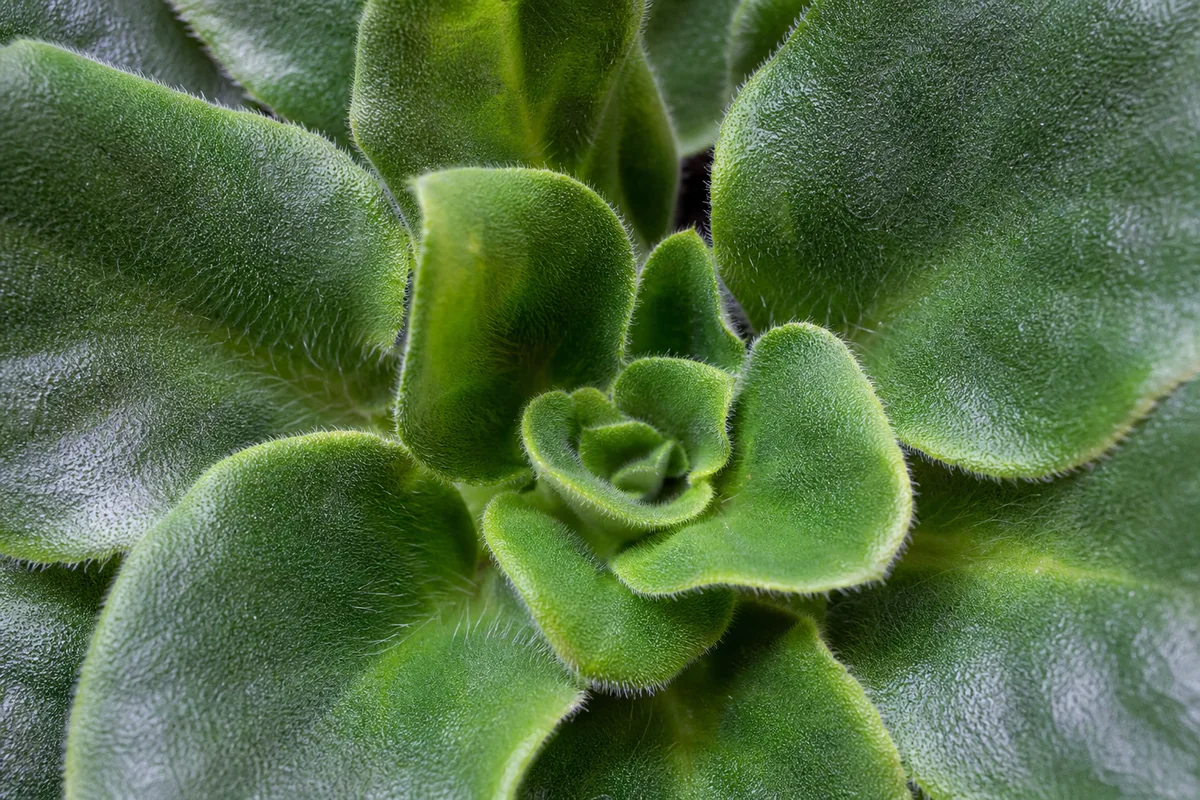
Fuzzy leaves hold water droplets. Cold water on warm foliage can leave yellowish or white rings and streaks; wet leaves in strong light can mark permanently. That is why bottom watering became default advice, and why top watering only works when you aim carefully under the canopy with room-temperature water. The plant is not fragile in every way, but it is unforgiving about wet crowns and cold leaf splash.

Botanical Profile and Forms (Standard, Miniature, Trailer)
Gardeners still say Saintpaulia, and shop tags often print Saintpaulia ionantha. Modern taxonomy places African violets in Streptocarpus sect. Saintpaulia within the Gesneriaceae family. For care, the tag name matters less than the habit: a soft central crown, fine shallow roots, and fleshy hairy leaves.
Wild relatives come from warm, humid, forest-filtered habitats in eastern Africa rather than hot open sun. That origin explains the indoor preference for bright but gentle light, steady warmth, and moisture without waterlogging.
Form differences that change care slightly:
- Standards need a pot roughly one-third the leaf span (a 12-inch rosette often wants about a 4-inch pot). (Smithsonian Gardens)
- Miniatures and semis dry faster in tiny pots; check weight more often and resist upsizing “for convenience.”
- Trailers sprawl; keep the same crown-dry and bright-filtered rules, but expect more stems and more even light across the plant.
Quick Care Snapshot
For a healthy indoor African violet, aim for bright indirect light, water when the top of the mix feels somewhat dry and the pot feels lighter, use a light soilless mix with strong drainage, keep the plant in a slightly snug pot, and fertilize weakly and often during active growth. Comfort is roughly 65–75°F (18–24°C) for most homes (bloom comfort band), with Smithsonian Gardens’ broader 65–80°F as a workable indoor range; humidity in a moderate indoor band rather than bone-dry air. (Cornell Cooperative Extension) (Smithsonian Gardens)
| Care factor | Baseline target | Deeper guide |
|---|---|---|
| Light | Bright filtered; start ~12–14 hours with real darkness | African violet light |
| Water | Top half-inch somewhat dry; room-temp water; drain well | African violet watering |
| Soil | Airy peat/coir + perlite/vermiculite; ~pH 6.0–6.5 | African violet soil |
| Pot | Small; plant often blooms better slightly root-bound | African violet repotting |
| Feed | Dilute fertilizer frequently; flush salts monthly | African violet fertilizer |
The snapshot is a starting point, not a calendar. A 4-inch plastic pot under a warm grow light may need water twice as often as the same cultivar in a cool north room. Learn your pot’s wet and dry weight, then adjust.
Light Indoors: Windows, Distance, and Plant Signals
African violets need bright, indirect light, not harsh afternoon sun and not a dark corner. Survival light and blooming light are different. A plant can stay green for months in a dim room and still refuse to flower. UF/IFAS targets bright light around ~1000 foot-candles without direct sun—roughly within about 3 feet of a usable southeast- or west-facing window—and notes that duration matters as much as intensity. (UF/IFAS)
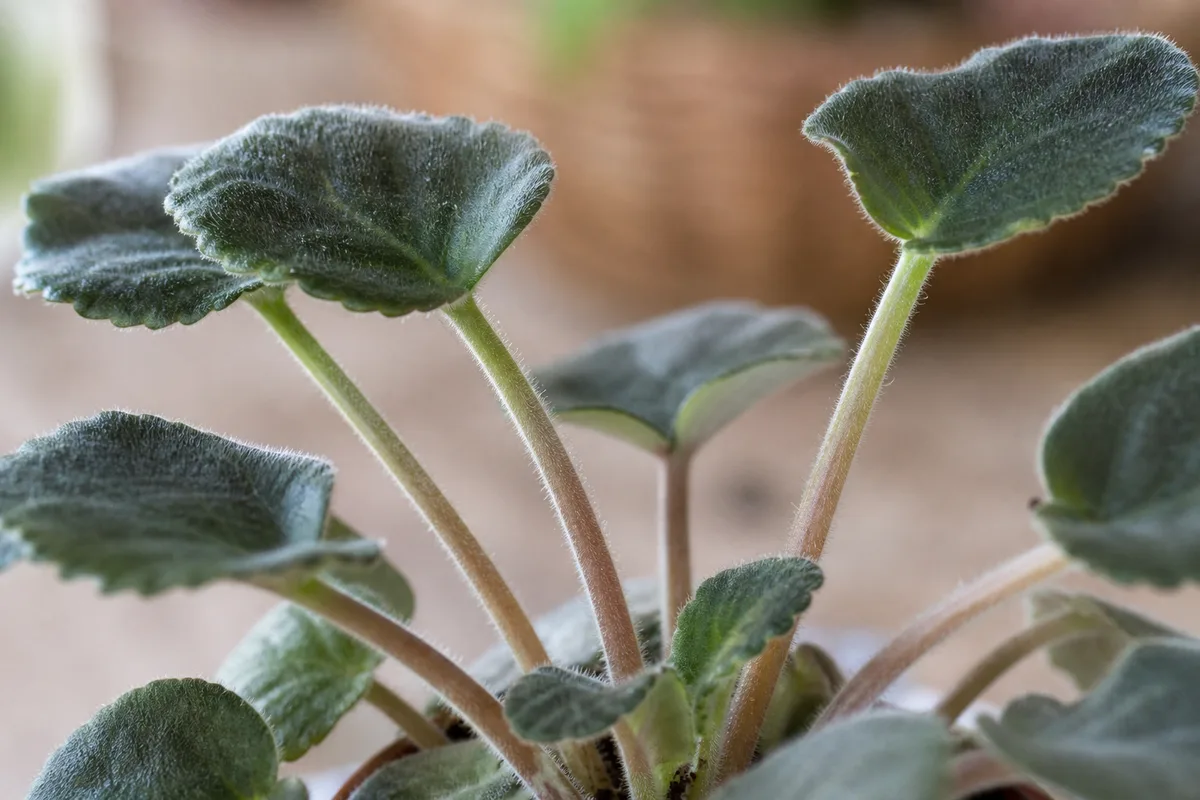
Read the plant before you trust the window label. Leaves that stretch upward on long stems usually want more light. Leaves that bleach, yellow, or become brittle and scorched usually have too much intensity or heat. A balanced plant keeps a neat rosette with leaves that sit outward rather than climbing the light source.
Window Placement That Works Year-Round
East-facing windows are often the easiest year-round choice because morning sun is gentler. Cornell Cooperative Extension recommends strong bright light without direct sun, noting that an east window is often best in winter and that northern exposures can work better in hot summers. (Cornell Cooperative Extension) South and west windows can work behind a sheer curtain or set back from the glass, especially in winter; hot midday beams through glass are a common leaf-scorch trigger. UGA similarly recommends south or west in winter and east or north in warmer seasons. (UGA Extension)
Distance matters as much as direction. Keep plants close to usable light—many window growers succeed within about two feet of the glass. A plant across the room from a “bright” window may be in decorative light only. Rotate the pot a quarter turn every few days so the rosette stays symmetrical.
What we observed (east window): On a standard purple African violet in a 4-inch plastic pot on an east sill (about 70–72°F, winter RH roughly 30–40%), the plant held foliage well but set almost no buds until we moved it from ~36 inches off the glass to within ~12 inches of the pane behind a sheer. Within about five weeks, flower stalks appeared while watering stayed on the same dry-down check. Distance, not a fertilizer change, unlocked bloom.
Grow Lights and How We Choose a Starting Schedule
If windows are weak, inconsistent, or blocked, a timed LED or fluorescent setup is often more reliable than chasing the perfect sill. Sources disagree on exact hours—and that disagreement is useful if you treat it as a starting rule, not a fight.
- UF/IFAS: about 8 to 12 hours of light (up to 16), with roughly 8 hours of darkness.
- UMN Extension / UGA: about 14 to 16 hours of light with darkness when the goal is flowering; UGA likewise recommends about 14 to 16 hours under artificial light at roughly 600 foot-candles. (UGA Extension)
- Cornell: fluorescent lights for 12 to 16 hours a day, fixtures about 10 to 12 inches above plants. (Cornell Cooperative Extension)
- UGA: about 600 foot-candles for 14 to 16 hours under artificial light, tubes 12 to 15 inches above foliage. (UGA Extension)
LeafyPixels starting rule: begin with a full-spectrum LED on a 12 to 14 hour timer and a real dark period (≥8 hours). If the plant stays green but flowerless after 4 to 6 weeks, push toward the UMN 14–16 hour end or raise intensity slightly. If leaves bleach, tighten hard in the center, or look scorched, shorten toward the IFAS 8–12 hour band or raise the fixture. Darkness still matters; constant 24-hour lighting is not a bloom shortcut. For fixture choice and photoperiod basics, see the grow lights complete guide.
What we observed (grow light): The same cultivar under a full-spectrum LED about 12 inches above the crown on a 13-hour on / 11-hour off schedule (room ~70°F) set buds more reliably than the east-sill plant had in mid-winter, and the 4-inch pot dried to “water me” weight about every 6 to 7 days instead of every 9 to 11 days on the cooler sill. More usable light meant shorter watering intervals—not a fixed calendar.
Watering: When, How, and Why Leaves Spot
Water when the mix tells you to, not when the calendar does. Overwatering is repeatedly named as the top killer; NC State Extension flags overwatering as the number one issue for African violets. In moderate humidity many growers water about once a week, but arid homes dry pots faster and humid rooms dry them slower.
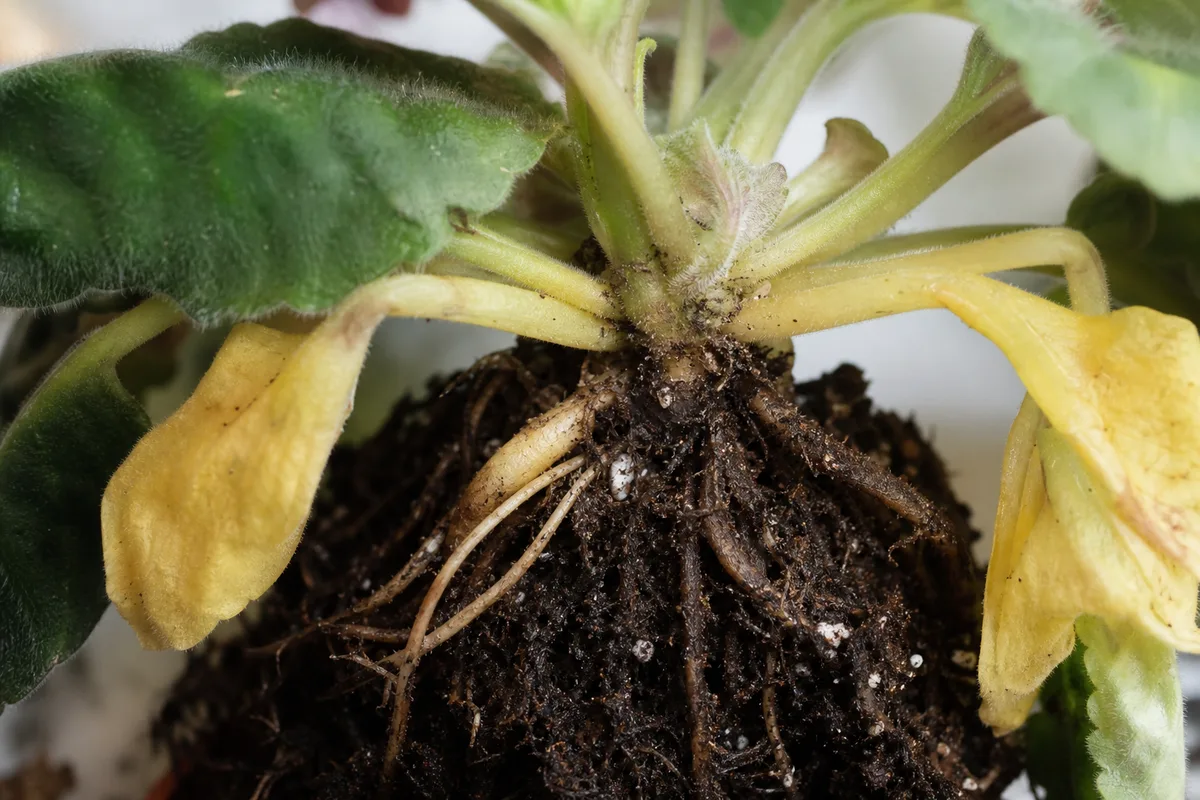
The goal is evenly moist, oxygenated mix, not a swamp and not a bone-dry brick. UF/IFAS advises watering when the soil surface feels dry to the touch, before the mix becomes hard or the plant wilts, and discarding water that drains into the saucer. (UF/IFAS) If leaves wilt while the soil is still wet, stop watering and inspect for root damage rather than pouring more. That limp-wet pattern is a classic root rot signal.
What we observed (watering interval): In a heated room at about 70°F and 35% RH, a standard violet in a snug 4-inch plastic pot with peat-perlite-vermiculite mix usually needed water every 7 to 9 days when we waited for the top half-inch to feel dry and the pot to feel light. The same plant in a larger 6-inch pot stayed heavy for 12 to 14 days and stalled blooms—more wet mass, not a thirstier plant.
General indoor watering skill still transfers: check, then water. Pair this page with how to water indoor plants the right way for the dry-down mindset, then apply African violet’s stricter crown and leaf rules.
Bottom Watering vs Top Watering vs Wicks
| Method | Best for | Watch-outs |
|---|---|---|
| Bottom watering | Keeping leaves and crown dry | Flush salts from the top monthly; never leave pot sitting in drained water |
| Careful top watering | Salt flush; thorough soak | Aim under leaves; room-temp water only |
| Wick / self-watering | Steady moisture for collectors | Need open mix; periodic top flushes; avoid soggy reservoirs |
Bottom watering: place the pot in a shallow saucer of room-temperature water for up to about 30 minutes, lift when the surface feels moist, and drain thoroughly. Smithsonian Gardens warns not to let pots sit longer than about 30 minutes in standing water. (Smithsonian Gardens)
Top watering: pour slowly onto the mix under the leaves until water runs from the drainage holes, wait, then empty the saucer. Cornell recommends flushing salts with a thorough top watering at least once a month and draining any water still in the saucer after about an hour. (Cornell Cooperative Extension)
Wick and self-watering setups can work, but they need a more open mix and occasional top flushes so salts do not concentrate around fine roots. For wick-style systems in general, see DIY self-watering systems.
Water Temperature, Softened Water, and Leaf Rings
Use room-temperature water. Cold water on warm leaves can cause yellowish spots or streaks; water that is too hot or too cold can leave white rings. (UF/IFAS) UGA notes that cold water at about 55°F or below can cause ring spot, and that even about a 10°F difference between leaf and water can damage tissue. Letting tap water stand overnight helps equalize temperature and can reduce chlorine for sensitive growers.
UMN Extension advises against softened water (and against routinely chlorinated water when alternatives exist), preferring room-temperature distilled, rain, or reverse-osmosis water when municipal water is harsh. (UMN Extension) Softened water carries salts that stress fine roots over time.
Do not mist African violets. Smithsonian Gardens is explicit: water on foliage may cause permanent leaf spotting; raise humidity with trays or a humidifier instead. For room humidity tactics that do not wet fuzzy leaves, see the houseplant humidity guide.
What we observed (leaf-ring case): After top-watering with water taken straight from a cold tap onto a warm plant under a bright east sill, pale ring marks appeared on several mature leaves within a day. Those scars did not green back. Switching to room-temperature water and bottom watering stopped new rings; we removed only the worst marked leaves once new growth was clean.
Soil, pH, Pot Size, and Repotting Without Burying the Crown
African violets have fine roots that need air as much as moisture. Dense garden soil and heavy all-purpose mixes stay wet too long in small indoor pots and invite rot. Pack the mix loosely. Do not compress it around the crown.
Pots must have drainage holes. Decorative cachepots are fine only if the nursery pot can drain and you empty standing water. Clay pots dry faster than plastic; plastic holds moisture longer. Choose the material that matches your watering habits.
Mix Recipes and Drainage
A dependable homemade mix is equal parts peat moss or coconut coir, perlite, and vermiculite, or a store African violet mix lightened with extra perlite if it feels dense. UF/IFAS recommends mixtures such as equal parts peat moss, vermiculite, and perlite, with a soil pH around 6.0 to 6.5. Smithsonian Gardens similarly recommends equal parts peat, perlite, and vermiculite. (Smithsonian Gardens)
If a bagged mix already lists a balanced pH, you usually do not need to add lime. If your mix stays muddy after watering, add more coarse perlite before the next potting. If it dries into a hydrophobic brick in one day, you may need more moisture-holding coir or vermiculite—or less intense heat on a hot sill.
Snug Pots and Crown Depth
African violets often bloom better when slightly root-bound. Smithsonian Gardens states the container diameter should measure no more than one-third the width of the plant’s leaf span—for example, a 12-inch leaf span in a 4-inch pot. Cornell stresses annual repotting into fresh mix and that burying the crown invites crown rot. (Cornell Cooperative Extension) UGA recommends setting the crown slightly above the soil line when repotting. (UGA Extension)
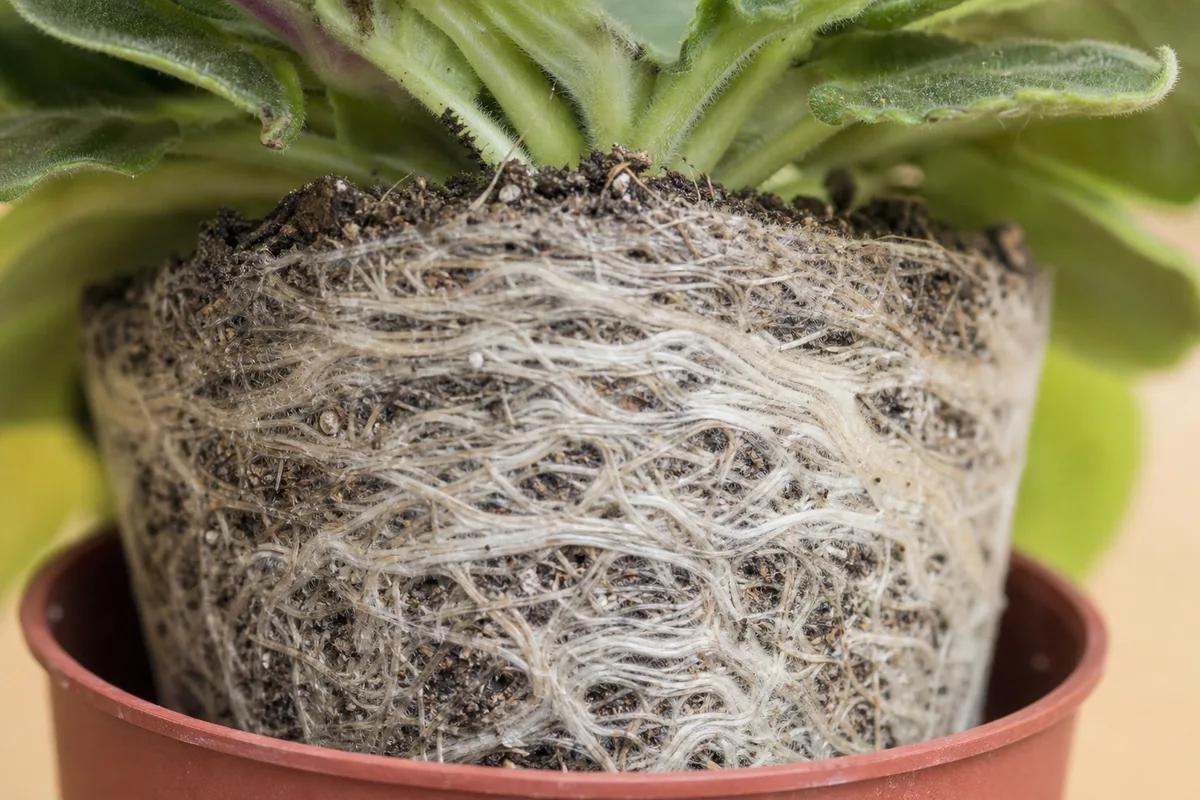
What we observed (crown depth): After one repot where mix was packed high against the crown “to stabilize” the plant, the center softened within about ten days while outer leaves still looked firm—early crown rot. Replanting into fresh airy mix with the crown clearly above the surface and keeping water off the center stopped the slide; mushy crowns that collapse fully are often not salvageable.
Repot when the neck becomes long and bare, roots fill the pot completely, the mix stays sour or compacted, or the plant stops blooming despite good light and feeding. After a routine repot, water lightly to settle the mix, then resume your normal dry-down check.
Fertilizer, Temperature, and Humidity Without Misting
African violets are moderate feeders. A practical rule used widely by growers is weekly, weakly: if a fertilizer label assumes monthly feeding, use about one-fourth strength every watering instead. UF/IFAS recommends water-soluble formulas such as 20-20-20 or 15-30-15 mixed at one-fourth the recommended rate and applied with watering, always discarding drained solution. (UF/IFAS) Smithsonian Gardens similarly suggests half or quarter strength every watering with a balanced formula such as 20-20-20. (Smithsonian Gardens)
Watch for fertilizer stress. Tight, bunched centers and rusty-looking new leaves can signal overfeeding; pale growth and weak flowering after light is fixed can mean the plant needs a steadier dilute feed. Flush the pot with plain water monthly so salts do not crust on the surface. Light and root health still matter more than any bottle claim.
Temperature: Cornell cites an optimum around 65–75°F, with reduced bloom below about 60°F or above about 80°F, and warns against cold drafts and frosty glass. Treat 65–75°F as the comfort band for reliable blooms and 65–80°F as the broader workable range listed by Smithsonian Gardens. (Smithsonian Gardens) UF/IFAS adds that prolonged high heat reduces growth and flowering. (UF/IFAS)
Humidity: helpful, but wet leaves are not. Use a pebble tray with the pot above the water line, group plants, or run a nearby humidifier. Never mist fuzzy foliage. Dry forced-air rooms raise watering frequency; they do not justify spraying leaves.
Problem Diagnosis Order: No Blooms, Crown Rot, Leaf Rings, Pests
Most African violet problems compress into four buckets: light too weak for blooms, roots too wet for too long, water on leaves or crown, and pests or salts after long neglect. Clemson HGIC lists crown and root rot and Botrytis among primary disease issues, with excessive watering, poor drainage, high humidity, contaminated media, and pests as major drivers. (Clemson HGIC)
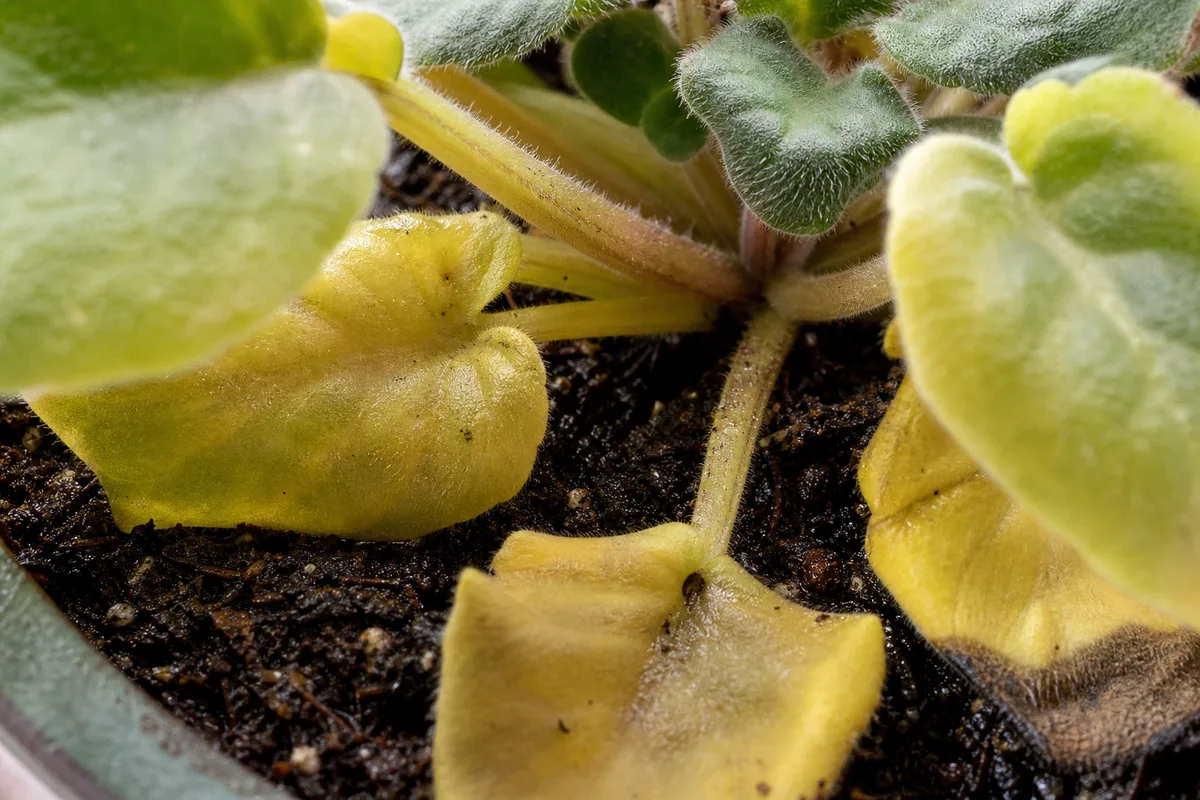
Use this order under stress—change one major variable at a time:
- Pot weight / moisture — heavy + limp → investigate overwatering / root rot; light + limp → water thoroughly and check mix hydrophobicity.
- Crown firmness — soft, collapsing center → crown rot; keep water off the growing point.
- Growth shape — stretch / upright petioles → more light (not enough light); bleach / scorch → reduce intensity.
- Leaf marks — pale rings after watering → temperature/splash issue (white spots); spreading fuzzy lesions → disease path (leaf spot disease).
- Pests — mealybugs, thrips, cyclamen mites (distorted centers). Cornell flags mealybugs, thrips, and cyclamen mites as recurring African violet pests. (Cornell Cooperative Extension) Quarantine new plants; discard severely mite-distorted plants rather than spreading them through a collection. UF/IFAS notes cyclamen mites are very difficult to control and discarding may be the best strategy. (UF/IFAS)
No flowers usually means insufficient usable light, an oversized wet pot, skipped darkness under grow lights, or recovery from root stress. Move into brighter filtered light or onto a timed grow light before doubling fertilizer.
Leaf Propagation and Pet Safety Basics
African violets are one of the easiest flowering houseplants to multiply. UF/IFAS describes leaf-petiole cuttings as the standard method: take a firm mid-plant leaf, trim the petiole to about 1 to 1.5 inches, insert it into a light mix such as half vermiculite and half sand or potting mix, and wait for roots in roughly three to four weeks, with plantlets following a few weeks later. (UF/IFAS) Flowering on new plants often takes several months. Multiple-crown plants can also be divided so each piece has roots. Step-by-step timing and failure modes live in the propagation guide. Propagate from healthy leaves only.
On pet safety, the ASPCA lists African violet (Saintpaulia spp.) as non-toxic to dogs, cats, and horses. Non-toxic still does not mean the plant should be a snack. Keep pots where pets cannot dig out the mix or shred leaves, and call a veterinarian if a pet shows distress after chewing any houseplant.
Related Guides
- African Violet care hub — overview and full cluster navigation
- African Violet watering — crown-safe methods and dry-down checks
- African Violet light — windows, duration, grow-light setup
- African Violet soil — mix recipes, pH, drainage
- Grow lights for indoor plants — timers, distance, photoperiod
- Houseplant humidity guide — raise RH without misting fuzzy leaves
- How to water indoor plants the right way — general check-then-water logic
Conclusion
Successful African violet care comes down to a few non-negotiables: bright filtered light with a real dark period, room-temperature watering only when the mix has dried enough, airy soil in a snug draining pot, and a dry crown. Get those right and fertilizer, humidity tweaks, and leaf propagation become optional upgrades.
When something goes wrong, change one major variable at a time. If leaves are limp and the pot is still wet, open root rot before you move the plant, fertilize harder, or repot into a bigger container. A plant that looks dramatic is usually asking for better light or less water around its crown—not a total reinvention of its care routine.