White Spots on Houseplant Leaves: Causes and Fixes
White spots on leaves are a broad symptom with three common indoor causes: mineral deposits from hard water, fungal growth such as powdery mildew, and sap-sucking pests including mealybugs. Correct identification prevents unnecessary treatments. Residue from water often appears as chalky dots that wipe away cleanly. Fungal patches may look powdery and expand over time. Pest-related white spots are often cottony clusters at leaf joints and undersides. A structured inspection is the fastest way to diagnose. Check whether the spots are on the surface or within tissue, examine growth tips and nodes, and look for stickiness or insect movement. If infection or pests are present, isolate the plant and start targeted treatment immediately. If residue is the cause, adjust water quality and leaf-cleaning habits. Early action keeps cosmetic spotting from becoming growth-limiting damage.
White Spots on Houseplants
Still unsure?Match your symptoms to the most likely problems in under a minute.Run diagnosis →Understand and fix white spots
White spots can come from mineral residue, powdery growth, or pest clusters; whether spots wipe off easily is the fastest first test.
Overview
White spots on leaves are a broad symptom with three common indoor causes: mineral deposits from hard water, fungal growth such as powdery mildew, and sap-sucking pests including mealybugs. Correct identification prevents unnecessary treatments. Residue from water often appears as chalky dots that wipe away cleanly. Fungal patches may look powdery and expand over time. Pest-related white spots are often cottony clusters at leaf joints and undersides.
A structured inspection is the fastest way to diagnose. Check whether the spots are on the surface or within tissue, examine growth tips and nodes, and look for stickiness or insect movement. If infection or pests are present, isolate the plant and start targeted treatment immediately. If residue is the cause, adjust water quality and leaf-cleaning habits. Early action keeps cosmetic spotting from becoming growth-limiting damage.
White Spots patterns: what you see vs. likely cause
Match your plant to the closest pattern, then start with the first step before trying other fixes.
| What you see | Likely cause | First step |
|---|---|---|
| Powdery white coating that wipes off | Powdery mildew | Improve airflow; remove affected leaves; apply fungicide if spreading |
| Hard white crust on leaf surface | Mineral deposits from hard water or fertilizer | Wipe with damp cloth; flush soil and use filtered water |
| Cottony white clumps in leaf axils | Mealybugs | Dab with alcohol on a swab; follow with insecticidal soap |
| White spots only on oldest leaves | Splash residue or dried hard-water droplets | Clean leaves; switch water source if spots return on new growth |
How to identify it
- Spots may be chalky, fuzzy, or cottony depending on cause.
- Wipe test: mineral spots remove easily, tissue damage does not.
- Cottony clusters at nodes suggest mealybugs.
- Powder-like film that spreads suggests fungal growth.
- Sticky honeydew may accompany pest-related white deposits.
- Pattern may be strongest on leaves near watering direction.
When to worry
Treat urgently if white patches spread in days, appear fuzzy, or are paired with distorted new growth and sticky residue.
Common causes
Hard-water mineral residue
Calcium and magnesium salts dry on leaf surfaces after misting or overhead watering, creating white specks.
Powdery mildew
Fungal growth forms a white dusty coating, often in stagnant airflow with moderate humidity swings.
Mealybug infestation
Mealybugs produce cottony wax around feeding sites, usually near nodes and leaf axils.
Pesticide or foliar feed residue
Concentrated sprays can dry into white spotting if dilution or rinsing is inconsistent.
Salt spray from substrate
Salt-laden droplets can splash onto lower leaves during watering and dry as pale deposits.
Step-by-step fix
Perform a wipe-and-loupe check
Gently wipe spots and inspect with magnification to separate residue from active fungi or insects.
Clean foliage safely
Use a soft cloth with diluted mild soap or plain water to remove surface buildup without damaging cuticles.
Target the true cause
Use fungicidal approach for mildew, or insecticidal/physical removal for mealybugs; avoid broad random spraying.
Improve airflow and spacing
Better ventilation reduces fungal persistence and keeps leaf surfaces dry between care events.
Adjust water quality and method
Use filtered water when needed and avoid overhead wetting that leaves repeated mineral spotting.
Repeat monitoring weekly
Recheck new growth and leaf undersides for 3-4 weeks to confirm spots are no longer spreading.
Prevention tips
- Avoid frequent overhead watering on foliage.
- Clean leaves monthly to prevent residue accumulation.
- Quarantine new plants for pest inspection.
- Maintain airflow to discourage fungal films.
- Use correctly diluted foliar products.
Common mistakes
- Treating mineral residue as a severe pest outbreak.
- Ignoring cottony node clusters until spread is extensive.
- Using strong cleaners that burn leaf surfaces.
- Skipping follow-up after first treatment round.
Related care topics
These care guides help prevent repeat issues once you have treated the immediate problem.
White spots on a houseplant can be dried minerals, spray residue, powdery mildew, mealybugs, scale covers, whitefly stages, bleached tissue, or old scars. These causes share a color but little else. Mineral deposits need cleaning and a change in water practices; pests require repeated inspection and control; powdery mildew calls for environmental management; dead white tissue cannot be wiped or sprayed back to green.
The most useful first question is not “What kills white spots?” It is whether the white material sits on the leaf surface or whether the leaf tissue itself has changed. A gentle wipe, magnification, and a record of how the pattern spreads will usually narrow the possibilities without exposing the plant to unnecessary chemicals.
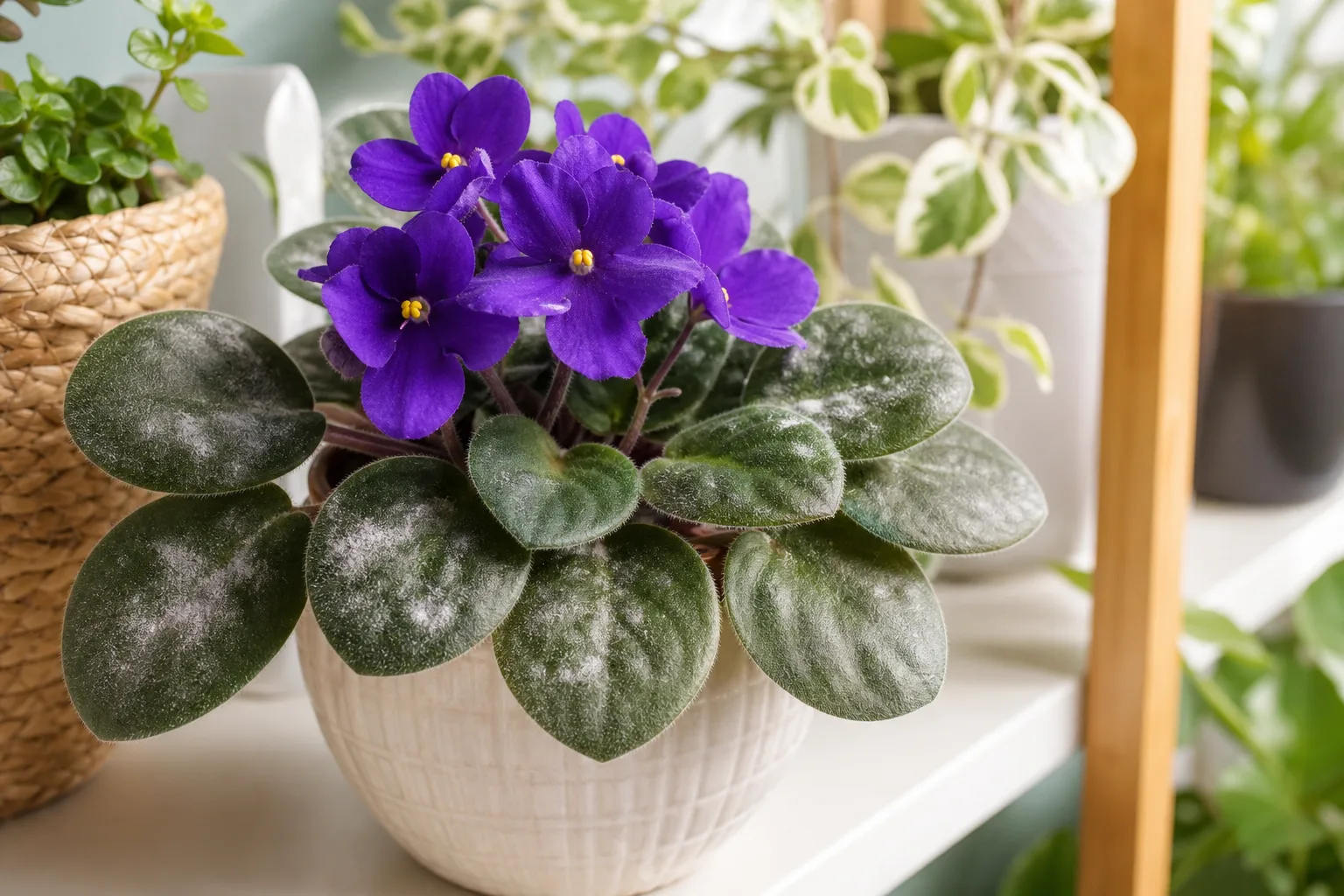
This guide uses extension and integrated-pest-management sources to connect visible evidence with a proportionate action. The African violet images are comparison aids, not a diagnosis. Surface texture, location, plant species, and progression matter more than color alone.
Quick Diagnosis: Surface Material or Damaged Tissue?
Examine the plant before cleaning it. Surface material may look chalky, dusty, powdery, waxy, or cottony. Tissue damage lies within the leaf and stays in place when wiped. It may be pale, silver, bleached, corky, or necrotic.
Use bright indirect light and a hand lens. Photograph the top, underside, petiole junctions, stems, and any nearby sticky residue. Check neighboring plants without touching them with the same hands or tools.
| What you see | More likely cause | Best next check |
|---|---|---|
| Chalky rings matching dried droplets | Hard-water minerals | Wipe test and watering direction |
| Expanding powdery patches | Powdery mildew | Spread over days and susceptible plants |
| Cottony clumps at nodes or veins | Mealybugs | Defined insect bodies and honeydew |
| Hard white or pale covers on stems | Armored scale | Raised covers and feeding damage |
| Tiny white adults fly when disturbed | Whiteflies | Juveniles on leaf undersides |
| Smooth pale tissue that will not wipe | Bleaching, feeding scar, or scorch | Exposure and pest history |
| Crystalline film after a spray | Product residue | Application record and pattern |
The UC IPM houseplant guide describes powdery mildew, mealybugs, scales, and whiteflies as distinct indoor problems. Matching the spot to the correct category avoids using fungicide on an insect or insecticide on a mineral deposit.
The Wipe-and-Loupe Test
Choose one small area. Dampen a soft white cloth with plain lukewarm water and support the leaf from below. Wipe once without scrubbing.
- Comes off as chalky residue: minerals or dried spray become more likely.
- Smears like powder and returns or expands: powdery mildew remains possible.
- Lifts as a cottony body: inspect for mealybugs.
- Stays within smooth tissue: bleaching, scarring, or feeding damage is more likely.
- Feels raised and shell-like: scale or corking deserves magnification.
The wipe test is a sorting tool, not a laboratory test. Powdery mildew can wipe partially away, and mealybug wax can smear. Look for the structure left behind and inspect other sites before deciding.
Afterward, wash the cloth and hands. Do not use the same cloth on another plant.
Repeat the check in three locations: one new spot, one older spot, and one sheltered site such as a node. Mineral residue should behave similarly wherever the same droplets dried. A pest population is more likely to show bodies concentrated in protected areas. Powdery mildew may show colonies at different stages, from faint circular dusting to merged patches.
Use a clean hand lens or phone macro camera without pressing against the plant. Photograph a ruler beside the spot for scale. A good sequence of dated close-ups is more valuable for diagnosis than one heavily enlarged image with no sense of size or progression.
Hard-Water and Spray Residue
Tap water containing dissolved minerals can leave pale rings or specks when droplets evaporate. The pattern is often strongest on horizontal leaves or the side routinely misted. Residue usually follows droplet boundaries and returns in the same places after overhead watering.
Fertilizer, foliar feed, pesticide, humidifier “white dust,” and leaf-cleaning products can also leave deposits. Review what entered the room before assuming disease. An ultrasonic humidifier filled with mineral-rich water may distribute fine white material over leaves, shelves, and nearby objects.
Clean a test area with plain water first. If mineral marks remain, use only a plant-safe method appropriate to the species; delicate, fuzzy, glaucous, or wax-coated leaves can be damaged by rubbing. African violet foliage is especially vulnerable to rough cleaning and persistent water sitting on the leaf.
Prevent recurrence by watering at the substrate level, directing mist away from foliage, or changing the water used in a device that creates deposits. Do not assume distilled or filtered water is required for every plant; the practical goal is to stop repeated visible deposition.
If residue appears only after fertilizing, review both dilution and application method. Fertilizer salts can dry on splashed lower leaves or accumulate along pot rims. Flush the substrate only when appropriate for the species and mix, allow it to drain fully, and correct the application rather than repeatedly washing delicate foliage.
A white deposit does not prove that minerals inside the plant are toxic. Surface residue and root-zone salt accumulation are related only when the same water or fertilizer practice creates both. Look for separate root-zone evidence such as crust on the mix, burned tips, poor drainage, or a documented high-solids water source.
Use this image to compare spot distribution. The photograph cannot reveal whether material wipes away, feels cottony, or consists of damaged tissue, so complete the physical inspection.
Powdery Mildew
Powdery mildew is a group of fungal diseases that produces white to gray superficial growth on leaves, stems, flowers, or buds. It often begins as separate circular patches that expand and merge. The Purdue Plant and Pest Diagnostic Laboratory notes that indoor infections can affect African violet, begonia, ivy, jade, and kalanchoe, and that severe infections may lead to browning and death of affected tissue.
Under magnification, the patch looks like a fine network or dusting rather than a dried water ring. It may appear on both leaf surfaces depending on the host and pathogen. New patches forming over days are stronger evidence than one stable mark.
Powdery mildew fungi are generally host-specific. Wisconsin Horticulture explains that the fungus infecting one plant type may differ from the fungus on another. That does not mean an affected plant should remain in a crowded collection; similar environmental conditions can favor mildew on multiple susceptible hosts.
Remove badly affected leaves when the plant can tolerate it, space plants, improve gentle air movement, and keep foliage dry. Bag removed tissue. Do not shake a powdery leaf over the collection.
Conditions That Favor Powdery Mildew
Indoor powdery mildew is often associated with poor air movement, lower light, cool conditions, crowding, and humidity patterns that favor fungal growth. Purdue recommends ventilation, avoiding overcrowding, and keeping leaves dry rather than routinely misting affected plants.
The exact conditions vary among powdery mildew species. Unlike many leaf-spot fungi, powdery mildew does not necessarily require free water on the leaf to infect. Therefore, “drying the leaf” is part of a broader environmental correction, not a guarantee.
Improve the environment in measured steps:
- Separate overlapping foliage.
- Move the plant into suitable brighter light gradually.
- Water the substrate early enough that splashed leaves can dry.
- Use gentle room circulation rather than a strong fan directly on the plant.
- Remove heavily infected material.
- Monitor nearby susceptible plants.
Do not strip most foliage at once. A weakened plant still needs healthy leaf area to recover.
Monitor the underside of leaves as well as the top. Some powdery mildew species are more conspicuous on one surface, and a faint colony can be missed until it expands. Use side lighting to reveal the change in texture. If only one species is affected while unrelated neighbors remain clean, that is compatible with host-specific fungi, though it does not replace diagnosis.
Dispose of infected material in a closed bag. Do not compost it beside susceptible plants or shake leaves indoors. Clean the immediate surface after pruning and wash hands before handling the rest of the collection.
Mealybugs, Scale, and Whiteflies
Mealybugs are small, soft-bodied insects covered with white wax. They collect in leaf axils, along veins, around stems, and in protected folds. Wisconsin Horticulture’s mealybug guide describes their cottony covering, sap feeding, plant weakening, and honeydew production.
Scale insects may appear as pale, gray, tan, or brown bumps. Armored scales have covers that can look like white spots and generally do not produce honeydew; soft scales are more likely to produce sticky residue. UC IPM’s scale guidance emphasizes distinguishing scale groups because biology and management differ.
Whiteflies look like tiny white moth-like insects when adult. Disturbing a leaf may send them flying, while flat juveniles remain attached underneath. Their feeding can cause yellowing, and their honeydew creates shine or supports sooty mold.
Pest evidence often combines features:
- white material plus stickiness;
- distorted new growth;
- insects in sheltered sites;
- ants visiting the plant;
- yellow stippling or leaf drop;
- recurrence after the visible white material is cleaned.
Cottony Insects Versus Powdery Fungus
Mealybugs form discrete oval bodies or clusters with fibrous wax. Some move when disturbed. Powdery mildew spreads as a continuous superficial growth integrated with the affected area.
Compare:
| Feature | Mealybugs | Powdery mildew |
|---|---|---|
| Typical location | Nodes, veins, folds, leaf axils | Broad leaf, stem, flower surfaces |
| Structure | Individual cottony bodies | Powdery film or circular colonies |
| Movement | Insects may move | No insect body movement |
| Sticky honeydew | Common | Not produced |
| Best control category | Insect management | Disease and environment management |
Do not use color as the sole criterion. A dense mealybug colony can resemble fungal growth, while powdery mildew can gather in sheltered leaf areas.
Bleaching, Scorch, and Other White Tissue Damage
If the spot does not wipe away and the surface is smooth or papery, the tissue itself may be bleached or scarred. Sudden intense light can bleach exposed sections before they become tan or brown. Cold, chemical sprays, edema scars, thrips feeding, and mechanical rubbing can also leave pale marks.
Light injury usually matches the exposed side and follows a recent move or seasonal change. Spray injury may mirror droplet patterns and appear after treatment in strong light or heat. Thrips damage often looks silvery and may include black fecal specks or distorted new growth.
The RHS leaf-damage guide recommends evaluating light, temperature, watering, pests, and physical injury together. A fixed white scar is not automatically fungal, especially when no surface growth returns.
Dead bleached tissue will not regain chlorophyll. Protect future growth and leave stable damaged leaves in place if they still contain useful green area.
Normal anatomy is another look-alike. Some plants have pale hairs, wax bloom, raised mineral structures, or variegated flecks that occur in a consistent pattern. Compare several healthy leaves and reliable botanical photographs. A feature repeated on every mature leaf, unchanged over time, and integrated with normal growth is less likely to be an active problem.
Do not scrape a natural wax layer to test it. Glaucous coatings help some plants manage water and light, and fingerprints or abrasions may become permanent marks.
Match the White Material to Action and Escalation
Use the smallest action that fits confirmed evidence. The wipe test narrows the category; it does not identify every insect or fungus by itself.
| Evidence you can confirm | Proportionate action | Reassess or escalate when |
|---|---|---|
| Chalky rings follow dried droplets and lift with gentle cleaning | Change the deposition source and clean only as the species tolerates | Marks keep returning without a water, spray, or humidifier source |
| Powdery colonies expand over days | Isolate, improve spacing and suitable light, remove badly affected tissue | Growth continues despite corrected conditions and label-directed care |
| Discrete cottony bodies occupy nodes or veins | Isolate and manage as mealybugs after confirming insect bodies | Colonies spread into protected sites or roots |
| Raised covers remain fixed on stems or leaf veins | Identify soft versus armored scale before control | Live scale persists despite correctly targeted treatment |
| Smooth white or silver tissue never wipes away | Correct the exposure, pest, or injury source; monitor new growth | Fresh damage spreads or the crown and petioles are involved |
Seek a plant clinic or extension diagnosis when rapid spread continues, the plant is valuable, treatment repeatedly fails, or the mark cannot be assigned to a cause. Send sharp photographs of both leaf surfaces, a size reference, the whole plant, and a dated progression rather than a single cropped close-up.
Clean Leaves Without Causing Injury
Plain lukewarm water and a soft cloth are the starting point for smooth, sturdy leaves. Support the leaf and wipe gently. For fuzzy or fragile species, avoid rubbing; use species-specific guidance and prioritize changing the source of residue.
Do not apply mayonnaise, milk, detergent, essential oils, vinegar mixtures, or leaf shine as a general cleaning solution. These may clog surfaces, leave new residue, attract dust, or cause phytotoxicity. Acidic solutions can damage sensitive foliage.
If a plant is infested, clean the pot, saucer, shelf, and nearby window after recording pest locations. Cleaning reduces honeydew and visible wax but does not eliminate hidden eggs or insects. Keep cleaning tools plant-specific until the infestation is resolved.
Treat the Confirmed Cause
Match treatment to evidence:
- Mineral or spray residue: clean safely and change the deposition source.
- Powdery mildew: isolate, remove heavily affected tissue, improve spacing and light, and use a labeled fungicide only if needed.
- Mealybugs: physically remove visible insects and consider labeled insecticidal soap or horticultural oil.
- Scale: identify the scale group, remove accessible insects, and target susceptible life stages with a labeled control.
- Whiteflies: wash leaf undersides, monitor adults, and use a labeled product if physical controls are insufficient.
- Bleached or scarred tissue: correct the exposure or injury source; do not spray dead tissue.
The Clemson houseplant disease guide advises cultural management and lists disease-control options, but product availability and labels change. Confirm current local registration and host suitability rather than copying an active ingredient from an old list.
Avoid treating every plant in the room “just in case.” Inspect them and treat only within label directions. Unnecessary spraying can injure plants and obscure the original symptom.
Product Labels and Plant Sensitivity
Read the entire pesticide label. It specifies the target pest or disease, permitted site, mixing, protective equipment, hazards, reapplication interval, and restrictions. A product marketed as natural can still injure foliage or people when misused.
Test soaps, oils, or other contact products on a small section and wait for the label-recommended observation period. African violets, ferns, succulents, and tender new leaves may react differently. Avoid treating drought-stressed plants or applying oils in heat or intense light.
Never combine products unless the label explicitly permits it. Sulfur and horticultural oils can be incompatible when applied too close together. A stronger mixture is not necessarily more effective.
Treatment failure often comes from a wrong diagnosis rather than a weak product. Fungicide cannot remove an insect’s wax, and soap cannot stop powdery mildew. Recheck the white material after the first intervention: if defined insects remain, return to pest management; if powder reforms from the leaf surface, reassess disease; if no material returns, the original problem may have been residue.
Keep applications out of direct sun and extreme temperatures when the label advises it. Protect floors and furnishings, prevent drift, and never apply an outdoor-only product inside. If the plant is edible, verify that the crop and harvest restrictions are explicitly covered.
A Four-Week Monitoring Plan
Week 1: Photograph, isolate if pest or mildew is plausible, perform the wipe-and-loupe test, and apply the targeted first action. Clean nearby surfaces.
Week 2: Inspect marked areas and new growth. Look for fresh powder, insects, sticky residue, or new tissue bleaching. Repeat products only as labels allow.
Week 3: Check sheltered sites and neighboring plants. Confirm that environmental changes have not created drought, low light, or cold-draft stress.
Week 4: Compare the number of new spots, not the appearance of old scars. Continue isolation until repeated inspections show no active pest or fungal growth.
Count spots on the same two or three marked leaves rather than relying on memory. Note fresh colonies separately from old bleached scars. For pests, record live insects and sticky honeydew; for mildew, record new powdery growth; for residue, record whether spots return after the water or spray source changes.
If the plant produces clean new foliage for several weeks, gradually return it to the collection. Keep enough spacing to inspect it. A cosmetic white scar may remain indefinitely and does not by itself mean the problem is active.

The macro image helps compare surface pattern, but magnification in person is needed to distinguish grains, fungal threads, wax, insects, and changed tissue.
Escalate if lesions spread into petioles or crowns, the plant develops rapid leaf collapse, treatments cause injury, or identification remains uncertain. Extension plant clinics can often assess sharp photographs and samples.
Prevention for a Mixed Houseplant Collection
Quarantine new plants and inspect leaf axils, undersides, and stems before placing them in the collection. Space foliage so air can move and leaves can be examined. Avoid sharing runoff and clean tools between plants.
Water at the substrate level where practical. If a humidifier produces white deposits, review the manufacturer’s water guidance and move it away from foliage. Apply foliar products only when needed, at the correct dilution, and under conditions specified by the label.
Keep a treatment record. Note the date, product, target, dilution, and result. This prevents accidental overapplication and helps distinguish recurring mineral deposits from a pest or disease cycle.
Learn each species’ normal markings. Variegation, natural wax, cystoliths, trichomes, and patterned foliage can be mistaken for problems. A stable feature present on every healthy leaf may be anatomy, not damage.
Photograph a healthy reference leaf when the plant enters your collection. That baseline makes later comparisons faster, especially for naturally fuzzy, silver, splashed, or wax-coated cultivars.
Conclusion
White spots on houseplant leaves are a diagnostic category, not a single condition. Mineral deposits, spray residue, powdery mildew, mealybugs, scale, whiteflies, and damaged tissue require different actions.
Start by deciding whether the material sits on the surface. Use a gentle wipe, magnification, location, stickiness, and change over time to confirm the category. Then clean, isolate, or treat only as the evidence supports. Old scars may remain, but the absence of new spots and healthy new growth will show that the real cause has been addressed.
Plants commonly affected
These houseplants often struggle with white spots. Open a care guide or plant-specific troubleshooting page for tailored fixes.
 Medium
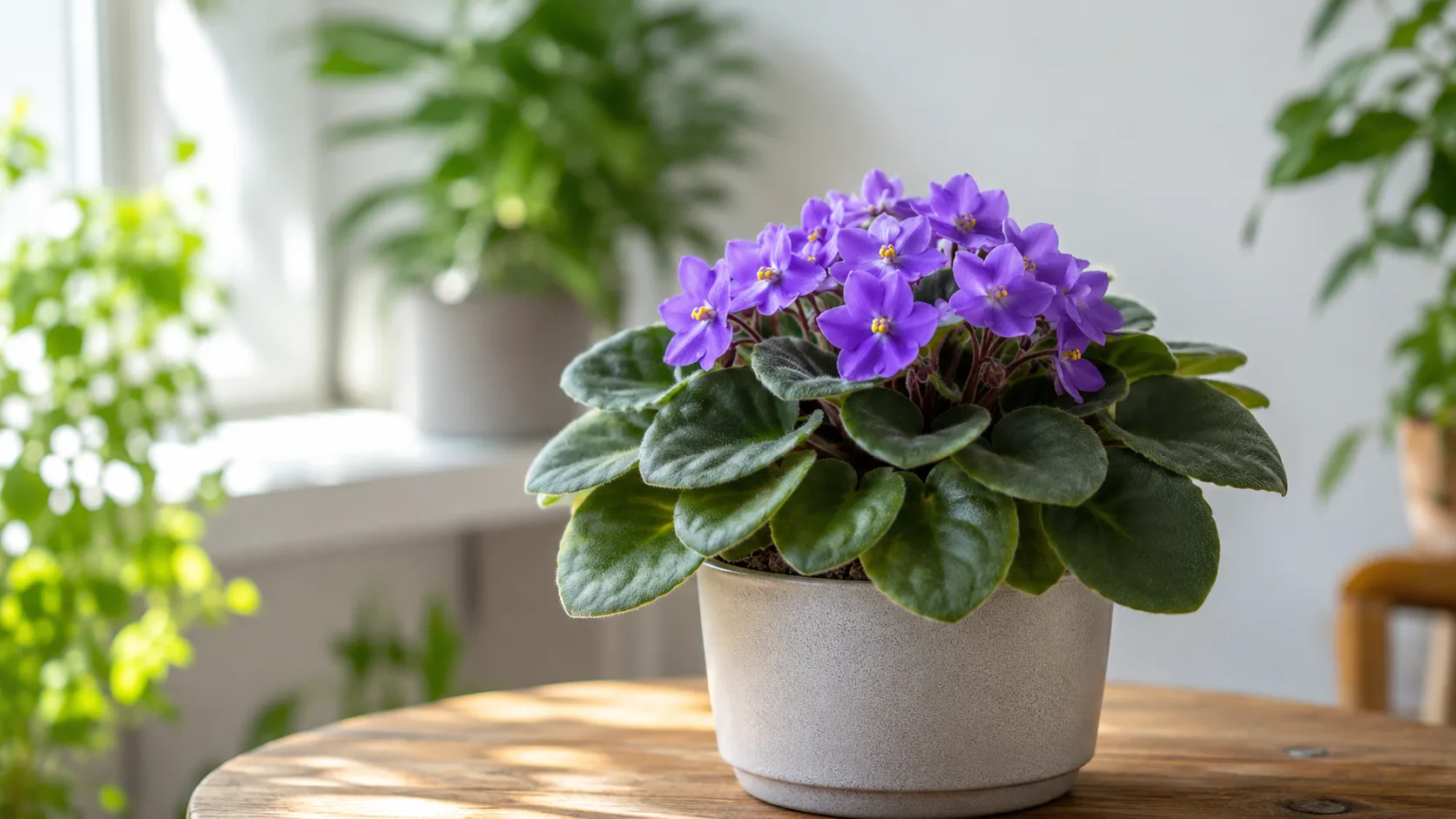
African Violet
Likely causeWhite Spots on African Violet: White spots on African Violet leaves can result from issues like powdery mildew, pests, nutrient deficiency, hard water minerals, sunburn, or chemical burns. Prevention involves proper care, including
Quick fixInspect African Violet, confirm white spots matches your symptoms, then adjust care or treat per authoritative guides.
 Medium
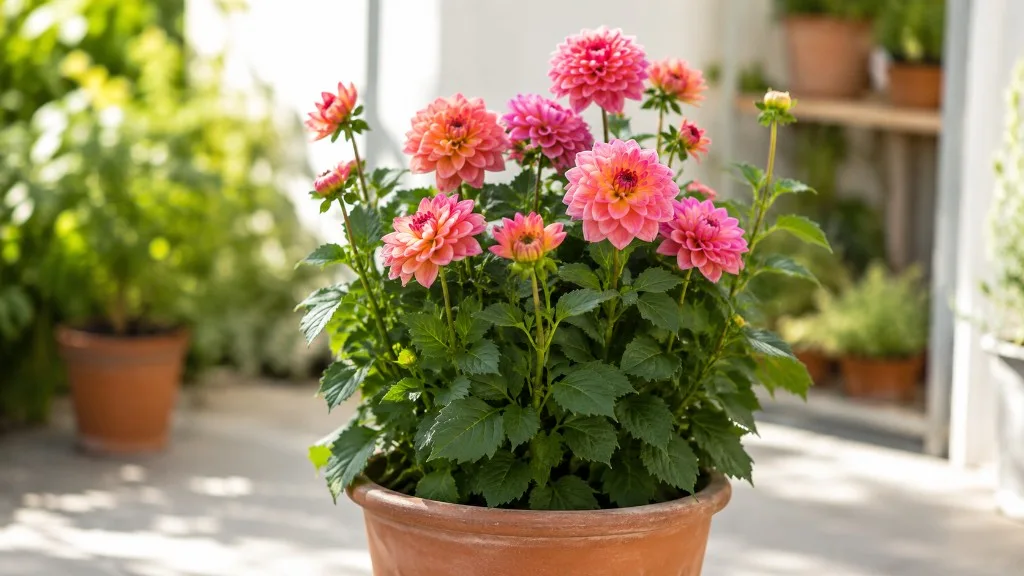
Dahlia
Likely causePowdery mildew from cool nights combined with warm days and poor airflow
Quick fixSpray with neem oil or potassium bicarbonate solution; improve airflow
 Medium
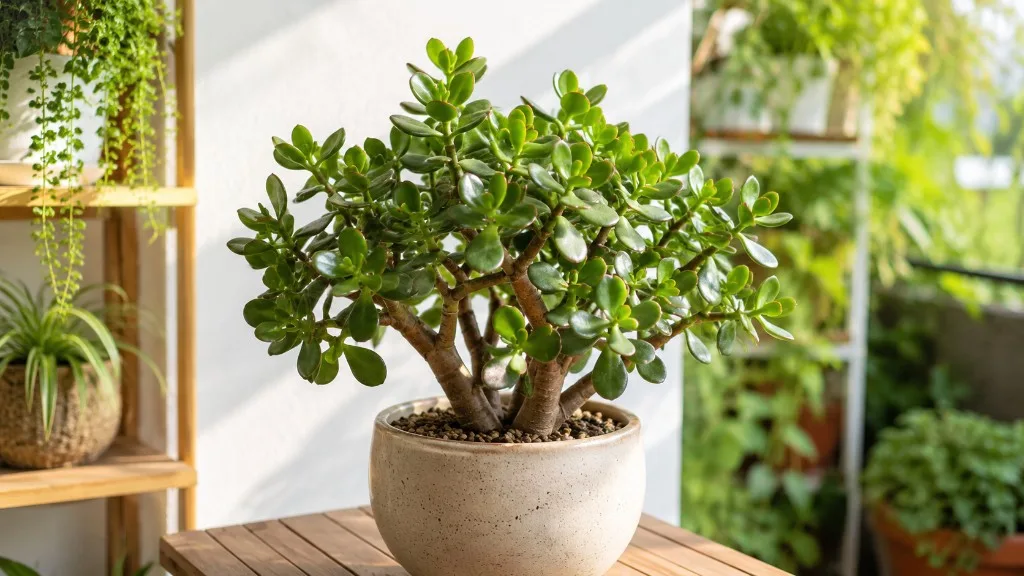
Jade Plant
Likely causeSep 2, 2025 · There are two primary reasons you’ll see white dots on your jade. One is incredibly common and benign; the other is less frequent but requires a bit more action. This is, by far, the most likely reason for the white dots . It’
Quick fixConfirm diagnosis on your Jade Plant, then address the most likely care or pest factor described in current extension guidance.
 Easy
EasyJava Fern
Likely causeOf all the available aquarium plants in the trade, Java fern (Microsorum pteropus) is one of the most popular. Praised for its hardness and adaptability, it’s a suitable cultivar for a wide variety of tanks. Java fern care is simple and thi
Quick fixConfirm diagnosis on your Java Fern, then address the most likely care or pest factor described in current extension guidance.
 Medium
Lemongrass
Likely causeJun 29, 2023 · Powdery mildew is a fungal disease characterized by a white powdery growth on the surface of leaves and stems. It can cause leaf distortion and stunted growth if left untreated.
Quick fixConfirm diagnosis on your Lemongrass, then address the most likely care or pest factor described in current extension guidance.
 Medium
Maidenhair Fern
Likely causeAug 5, 2024 · Powdery mildew is a fungal disease characterized by white or gray powdery spots on leaves and stems. It develops in warm, dry conditions with poor air circulation, making it more prevalent during late summer or in poorly venti
Quick fixConfirm diagnosis on your Maidenhair Fern, then address the most likely care or pest factor described in current extension guidance.
 Medium
Manjula Pothos
Likely causeThe Happy Leaf Manjula Pothos is cultivated via mutations from the Epipremnum pinnatum ‘Compacta’ plant by Ashish Hansoti. The patented scientific name is named after him as Manjula pothos Epipremnum ‘HANSOTI14’. The Manjula Pothos grows wa
Quick fixConfirm diagnosis on your Manjula Pothos, then address the most likely care or pest factor described in current extension guidance.
 Medium
Maranta Leuconeura
Likely causeJul 1, 2023 · These small, white insects form cotton-like clusters on the plant’s stems and undersides of leaves. They suck sap from the plant, causing stunted growth, yellowing leaves, and a sticky residue known as honeydew.
Quick fixConfirm diagnosis on your Maranta Leuconeura, then address the most likely care or pest factor described in current extension guidance.
 Medium
Marble Queen Pothos
Likely causeFeb 22, 2026 · The white and cream sections of a marble queen leaf contain little to no chlorophyll. Chlorophyll is what the plant uses to convert light into energy, so the more white on a leaf, the less photosynthesis is happening.
Quick fixConfirm diagnosis on your Marble Queen Pothos, then address the most likely care or pest factor described in current extension guidance.
 Medium
Heartleaf Philodendron
Likely causeJan 9, 2024 · Among the common pests that look or leave white marks on your plants are spider mites, mealy bugs, scale insects, and white flies. To start getting rid of the pests, isolate them from the rest of your plants first. Pests can r
Quick fixConfirm diagnosis on your Heartleaf Philodendron, then address the most likely care or pest factor described in current extension guidance.
 Medium
Prayer Plant
Likely causeJan 6, 2024 · Helminthosporium leaf spot is a fungal disease that causes yellow or brown spots on Prayer Plant leaves. In addition, it can also form purple or brown lesions on the stems.
Quick fixConfirm diagnosis on your Prayer Plant, then address the most likely care or pest factor described in current extension guidance.
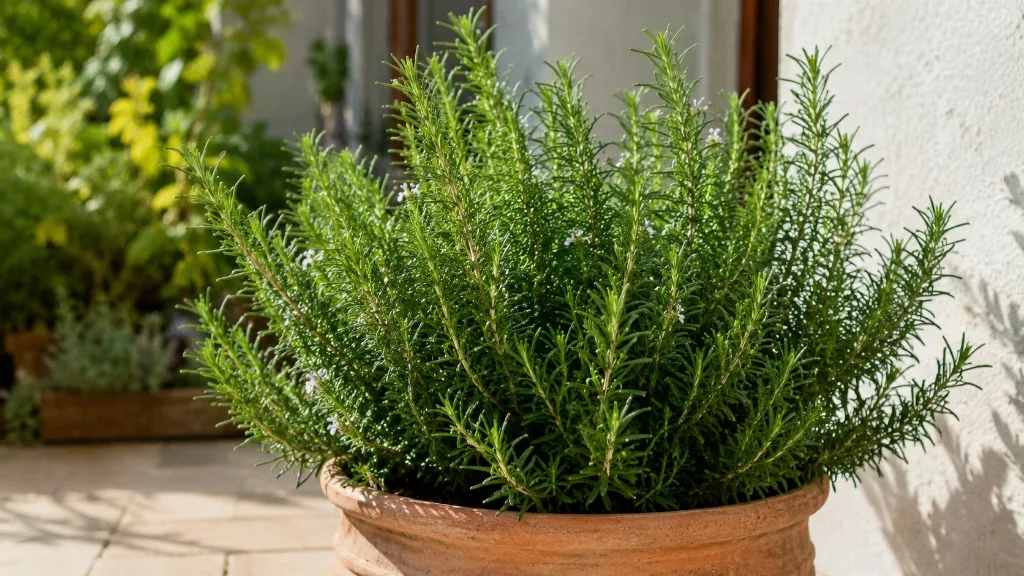 Medium
Rosemary
Likely causePowdery mildew from poor airflow and high humidity
Quick fixImprove air circulation; spray diluted neem oil weekly; remove affected stems