Houseplant White Spots: Causes, Diagnosis and Fixes
Diagnose white spots on houseplants — powdery mildew, salt crust, mealybugs, edema, or mold — then fix the right cause with clear next steps.
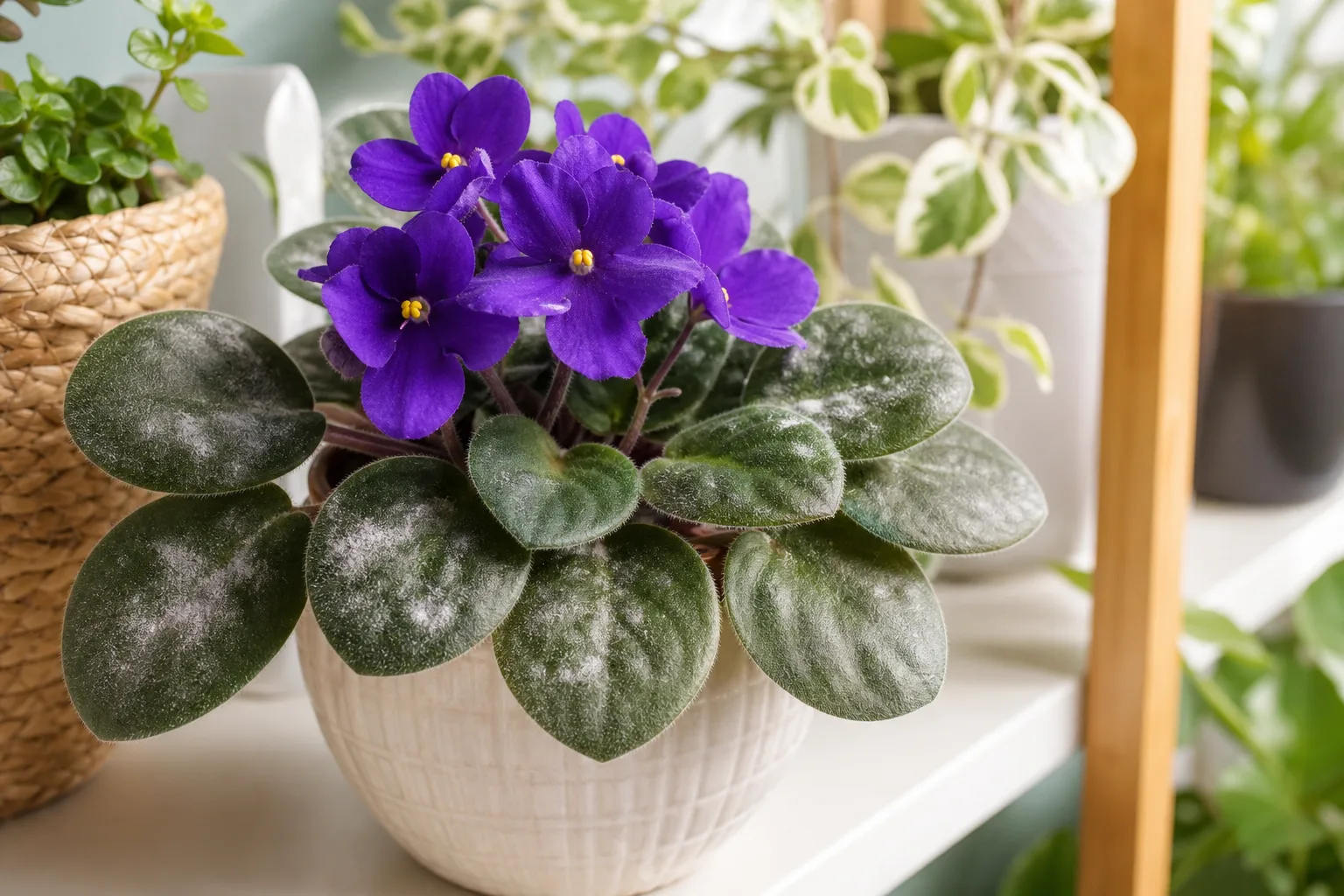
White spots on houseplants are not one problem. The same “white on green” complaint can be a living fungus, mineral scale, a cottony pest, a watering disorder, or harmless mold sitting on wet soil. Treat the wrong category and you spray fungicide on salts, drown a plant that needed leaching, or ignore mealybugs while they colonize leaf axils.
This guide is a diagnostic path for houseplant white spots: how to tell powdery mildew from hard-water salts, mealybugs, edema, and mold on soil, then apply the fix that matches. Spotted tissue rarely returns to perfect green. Success means new growth stays clean and the pattern stops spreading.
One LeafyPixels misdiagnosis that still teaches the rule: an African violet with pale leaf flecks looked like early mildew until a fingernail scrape and a room-temperature watering change proved cold-splash marks. The white stayed on old leaves; the next flush was clean without any fungicide.
What White Spots on Houseplants Usually Mean
Indoors, most white markings fall into five buckets: infectious powdery mildew on foliage, soluble-salt deposits from water or fertilizer, sap-sucking pests with white wax (especially mealybugs), physiological edema that scars tan or corky after watery blisters, and saprophytic mold growing on damp organic mix rather than infecting living leaf tissue. Clemson HGIC notes that many houseplant “diseases” are really cultural problems, while true pathogens still appear when conditions favor them (Clemson HGIC).
A useful field habit is to ask where the white sits and what it feels like. Leaf-surface dust that smears like chalk powder points toward mildew. Hard crust on the pot rim or soil points toward salts. Cotton tucked into stem joints points toward pests. Raised corky scars on undersides after wet, low-light weeks point toward edema. Fuzzy film only on the mix surface points toward soil mold. Location and texture beat a generic “white spots” search every time.
Contagious vs not: powdery mildew and mealybugs can move to nearby susceptible plants. Salt crust, edema scars, and cold-water marks do not. Soil-surface mold is not a leaf epidemic, but shared soggy conditions can produce fuzz on every pot on a wet shelf.
Powdery Mildew vs Salts vs Pests vs Edema vs Mold
Use this comparison before you buy a spray or flush a pot. The first correct category saves a week of wrong treatment.

| Feature | Powdery mildew | Salt crust | Mealybugs / wax pests | Edema | Soil-surface mold |
|---|---|---|---|---|---|
| Typical look | Dusty white–gray film on leaves, stems, buds | Hard chalky white–grey scale on soil, rim, sometimes tips | Cottony clumps in axils, nodes, undersides | Watery blisters → raised corky tan/white scars, often undersides | Soft fuzzy white film on damp mix |
| Feel / test | Rubs partially; returns if conditions stay cool/stagnant | Scrapes like mineral scale; not soft | Smears; insects may move; sticky honeydew common | Scars stay put; not dusty powder | Soft mycelium; no crawling on leaves |
| Contagious? | Yes among susceptible hosts under favorability | No | Yes via contact, tools, crawlers | No | Not a leaf epidemic; wet shelves share risk |
| First fix | Isolate, prune infected parts, airflow, brighter light | Leach pot; change water/fertilizer habits | Isolate; alcohol swab or labeled soap/oil | Water less in low light; empty saucers | Scrape top mix; dry-down and airflow |
| Wrong move | Ignoring humidity/stagnation and only wiping | Scraping salts then watering less without leaching | Treating as mold or mildew only | Fungicides or alcohol on scars | Vinegar drenches or panic discard for fuzz alone |
Why the Wrong Label Makes Things Worse
Mildew needs airflow and sanitation. Salts need leaching and water quality changes. Mealybugs need contact kill on every generation. Edema needs moisture balance. Mold needs dry-down. If you only wipe leaves or only skip one watering, the driver that matches the real category keeps producing new white marks.
Powdery Mildew — Dusty White Coating on Leaves
Powdery mildew is a group of host-linked fungi that leave a white, powdery coating on leaves, stems, and flowers (RHS). On houseplants, Clemson describes white powdery growth or dry brown papery spots from several fungal genera, often starting from spores on debris or outdoor hosts (Clemson HGIC). Missouri Botanical Garden lists African violets, begonias, ivy, jade, kalanchoe, poinsettia, and rosemary among common indoor susceptibles and notes the disease thrives in cool, damp, poorly ventilated conditions (Missouri Botanical Garden).
The coating can look like someone dusted flour on the leaf. Rubbing removes some powder temporarily but does not eliminate the fungus living on the surface tissue. UC IPM notes powdery mildew often on grape ivy, kalanchoe, begonias, and pileas, and that the white-to-gray growth is the fungus and its spores on the tissue surface (UC IPM). For a deeper mildew-only workflow, use the powdery mildew on houseplants guide after you confirm the dusty leaf film.
How Powdery Mildew Starts and Spreads Indoors
Powdery mildew fungi are often host-specific: the species on African violet is not the same as the species on rosemary, so one plant may not inoculate a dissimilar neighbor even when both can get “powdery mildew” under shared poor conditions (Missouri Botanical Garden). Spores still move by air within a tight shelf of susceptible plants. Cool nights, stagnant corners, crowded foliage, and high humidity around leaves favor outbreaks. RHS advises improving ventilation, spacing, and growing conditions to avoid and manage many fungal problems indoors (RHS).
Do not confuse powdery mildew with downy mildew. Penn State emphasizes that the two diseases differ in biology and symptoms even when both produce pale foliar coatings (Penn State Extension). Indoors, the classic dusty white surface film on upper leaves is the pattern this guide treats as powdery mildew until a specialist says otherwise.
Cultural Fixes and When Fungicides Help
Isolate the plant at the first dusty patches. Remove and discard heavily infected leaves. Improve spacing and gentle airflow. Move the plant into brighter indirect light if the species tolerates it. Avoid wetting leaves when you water. Do not push soft, nitrogen-heavy growth that mildew loves (Missouri Botanical Garden; UC IPM).
Labeled fungicides for indoor ornamentals can protect new growth after cleanup on valuable plants, but they are not a substitute for airflow and sanitation. Clemson notes many indoor gardeners find chemical options cost more than replacing a cheap plant (Clemson HGIC). Always follow the label, ventilate the room, keep pets and children away from treated foliage until dry, and never assume a “mildew spray” will fix salt crust or mealybugs.
Hard-Water and Fertilizer Salt Crusts
White chalk on the soil surface or pot rim is usually mineral and fertilizer salts, not disease. Clemson describes white-to-grey crusty deposits as a salt-buildup sign and warns not to confuse them with white or yellow mold-like growth of saprophytic soil fungi (Clemson HGIC). Hard irrigation water adds calcium and magnesium with every pour; fertilizer adds more soluble salts; evaporation concentrates both in a closed pot.
Salt stress often pairs with brown tips and margins. UC IPM lists overfertilization and other soluble salts among common causes of tip and margin browning alongside uneven watering (UC IPM). If your white “spots” are actually crust rings and tip burn on calatheas, peace lilies, or spider plants, shift to the hard water for houseplants guide for water testing and safer sources.
How to Tell Salt Crust from Mold
Salt crust is hard, crystalline, and scrapes like kettle scale. Mold is soft or fuzzy and sits on persistently damp organic mix. Scraping salts without leaching only cosmetics the surface while roots still sit in a salty profile. Scraping mold without dry-down invites the fuzz back in days. When the white is only on soil, compare both mold on soil and hard-water salt patterns before you change fertilizer schedules.
Leaching, Water Changes, and Tip Burn Recovery
Water thoroughly until runoff leaves the drainage holes, then empty the saucer so the pot does not sit in mineral-rich wastewater (Clemson HGIC). Periodic leaching washes accumulated salts from the root zone. Remove thick surface crust and top up with fresh mix if needed (Clemson HGIC). Cut fertilizer strength and frequency during low light seasons. Old browned tips will not regreen; judge progress by clean new leaves after you change water and flush habits.
Mealybugs and Other White Pest Lookalikes
Mealybugs are soft, oval sap suckers covered in white wax. UC IPM describes whitish cottony, powdery, or waxy material along leaf veins and where leafstalks join stems, with stunting, yellowing, and wilting when populations build (UC IPM). N.C. State notes fluffy white ovisacs, honeydew, and sooty mold as part of the damage picture (N.C. State Extension). Unlike mildew film or salt scale, mealybug colonies are three-dimensional clumps that smear and may crawl slowly when disturbed.
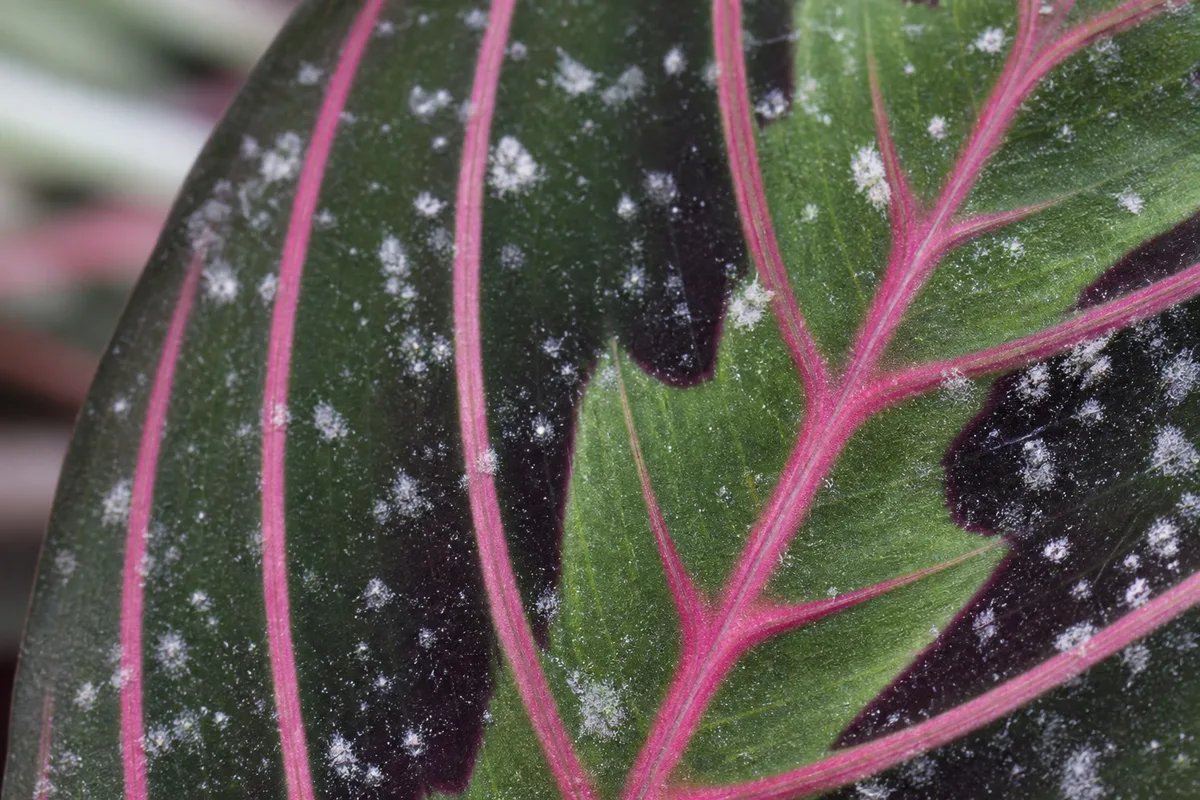
Whiteflies can also flash white when foliage is shaken, but adults are tiny winged insects, not cotton stuck in axils. Scale crawlers and woolly stages can confuse diagnosis on woody stems. If the white is pest wax, follow mealybugs on houseplants for full treatment cycles rather than a one-time leaf wipe.
Spot-Treating Mealybugs Without Misdiagnosing Mold
Isolate the plant. Dab visible insects and egg masses with a cotton swab and 70% isopropyl alcohol after spot-testing a leaf, then repeat every few days as crawlers hatch (UC IPM; N.C. State Extension). Insecticidal soap or horticultural oil labeled for the plant can help with broader coverage when applied thoroughly to crevices. Heavy, non-responsive infestations often warrant discarding the plant to protect the rest of the collection (UC IPM).
Household safety: isopropyl alcohol is flammable — work away from open flames, ventilate, and keep treated plants and leftover solution out of reach of pets and children until surfaces are dry (UC IPM). Alcohol does nothing useful on salt crust or edema scars, and mildew needs sanitation more than a mealybug swab schedule.
Edema — Corky White or Tan Spots That Are Not Contagious
Edema (oedema) is a physiological disorder, not an infection. Wisconsin Horticulture describes small translucent, fluid-filled blisters on leaf undersides that can enlarge, burst, and scar into tan corky patches (Wisconsin Horticulture). Clemson links rough corky swellings on petioles and lower leaf surfaces to excessive soil moisture, poor light, and cool temperatures, especially on succulent plants in winter (Clemson HGIC). Growers often call those scars “white spots” or “fungus,” then spray while continuing to water heavily in low light.
Edema scars do not wipe off like mildew powder and do not crawl like mealybugs. They also do not spread from plant to plant. New blisters appear only while roots take up more water than leaves can release under high humidity, low light, cool air, or poor ventilation (Wisconsin Horticulture).
Watering and Environment Changes That Stop New Blisters
Water less frequently in cloudy or low-light periods. Water in the morning so media can drain before cool, humid evenings. Empty standing water in saucers about 30 minutes after watering. Improve spacing, airflow, light, and drainage so leaves can transpire normally (Wisconsin Horticulture; Clemson HGIC). Existing corky scars stay; healthy new leaves are the recovery metric. Fungicides will not erase edema marks. Pair this with sound watering technique so thorough flushes do not become chronic soggy saucers in winter.
Cold-Water Marks and Other Non-Infectious Spots
Clemson notes that watering with cold water or splashing water on leaves can leave white or straw-colored spots on some plants (Clemson HGIC). African violets are classic for cold-splash marks that look alarming but are cultural injuries — compare the species white spots, powdery mildew, and edema pages when one plant keeps confusing you (cold splash, mildew film, and corky undersides often overlap on the same genus). Use room-temperature water and keep foliage dry when a species is known to mark. Residue from foliar sprays, hard-water droplets that dry on leaves, and dust can also read as white flecks until you wipe a test area.
If white appears only after misting or overhead watering, fix technique before assuming disease. Persistent dusty films that expand across leaves still deserve a mildew check. Sticky white fluff in joints still deserves a pest check.
Step-by-Step Diagnosis Workflow
Work top to bottom so you do not skip the cheap tests.
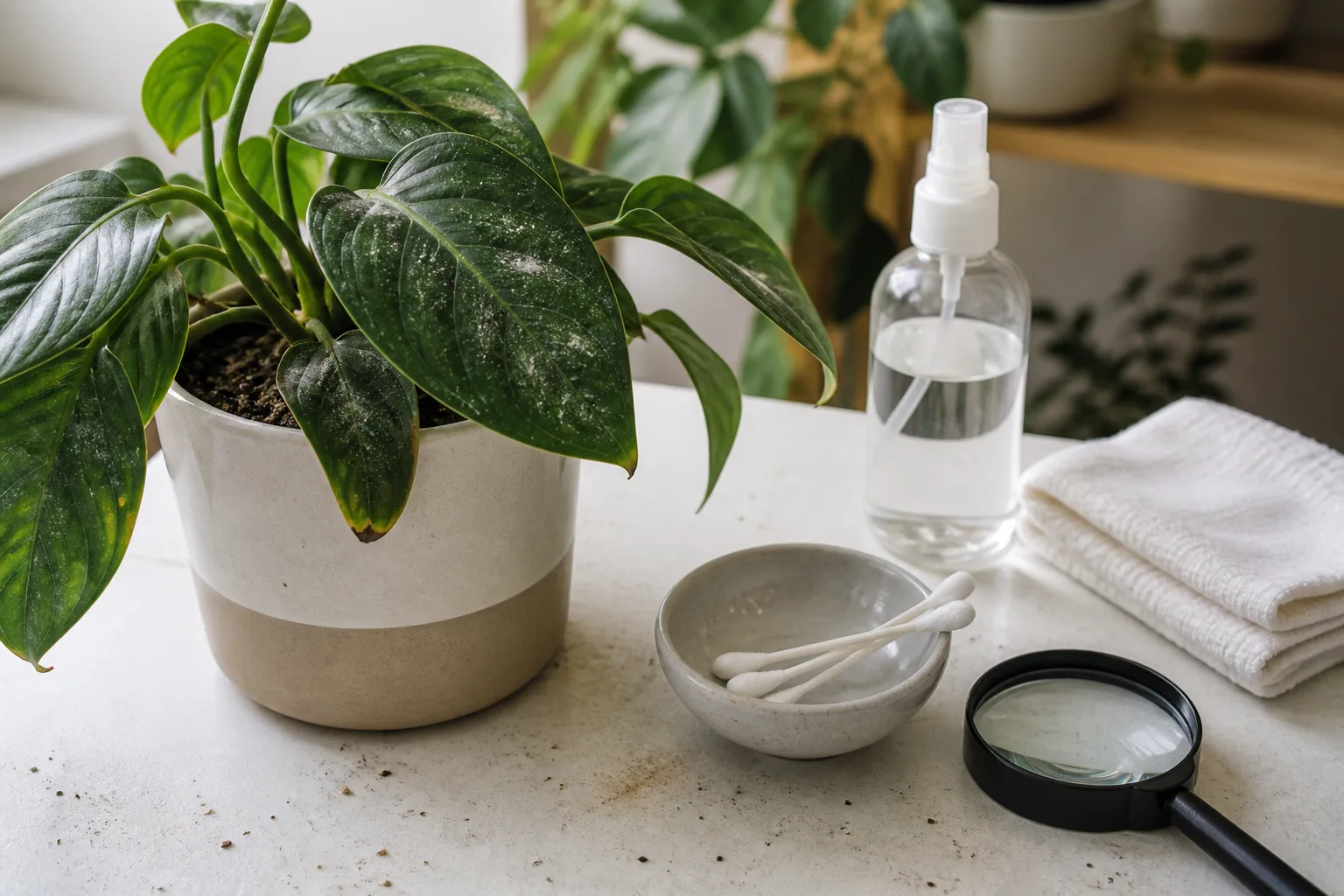
- Locate the white. Leaf blade, leaf underside, axils/stems, pot rim/soil surface, or all of the above.
- Touch test. Soft dusty film, hard crust, cotton that smears, raised cork, or fuzzy soil mycelium.
- Look for movement or honeydew. Sticky shine plus cottony clumps favors mealybugs. A shake that launches tiny white flying adults favors whiteflies, not mildew.
- Check recent care. Cool stagnant corner, hard tap water, heavy fertilizer, wet saucers in low light, cold splash, or constant misting.
- Assign a primary category using the comparison table, then apply only that category’s first fixes for 7–14 days.
- Escalate if the pattern spreads fast across many plants, stems soften, or a valuable plant stays ambiguous after cultural correction.
Photograph the symptom in daylight before you prune or wipe. Side-by-side photos of leaf surface, underside, axils, and soil surface make later second opinions much clearer.
First-Hand Notes From Misdiagnosed White Spots
These LeafyPixels editorial notes are from plants we tracked after wrong first guesses — useful because each cause left a different recovery clock.
African violet, cool bathroom shelf (cold splash misread as mildew): Pale irregular flecks appeared after iced-tap watering. A dry fingertip wiped nothing dusty; no sticky axils. Switching to room-temperature bottom watering stopped new flecks within one flush (~10–14 days). Old marked leaves never cleared; we removed only the ugliest ones for aesthetics.
Calathea in hard municipal water (salt crust, not mold): A hard white ring on the terracotta rim scraped like scale. Tip burn worsened while fertilizer stayed on a weekly schedule. One thorough leach with runoff emptied from the saucer, then filtered water and half-strength feed, produced cleaner new leaves in about two weeks. The rim crust thinned after scraping plus leaching; scraping alone had failed the week before.
Peperomia on a crowded shelf (mealybugs, not soil mold): Cottony clumps sat in leaf axils with a faint sticky sheen on neighboring leaves. Soft white fuzz on the mix surface distracted the first look. Isolating, alcohol-swabbing axils every three days for two weeks, and letting the top mix dry stopped both the pests and the soil fuzz. New leaves stayed clean; scars from feeding did not fill in.
Jade plant, winter low light (edema scars sprayed as fungus): Corky tan-white bumps on leaf undersides stayed put under a fingernail. Cutting winter water, emptying the saucer within 30 minutes, and adding a small fan stopped new blisters; old scars remained as cork.
Treatment Decision Guide by Cause
Once the category is clear, keep the response narrow.
Powdery mildew: Isolate, prune infected tissue into trash (do not compost into houseplant mix), increase airflow and appropriate light, keep leaves dry, consider a labeled indoor fungicide only after cultural cleanup — away from pets/children until dry. Deep dive: powdery mildew on houseplants.
Salts / hard water: Leach thoroughly, empty saucers, reduce fertilizer, switch sensitive plants to better water. Deep dive: hard water for houseplants.
Mealybugs: Isolate, alcohol swab or labeled soap/oil on a repeat schedule, discard severe cases. Deep dive: mealybugs on houseplants.
Edema: Reduce watering in low light, empty saucers, improve drainage and airflow; do not fungicide scars.
Soil mold: Scrape top mix, fix dry-down — mold on soil.
If two causes coexist — for example salt crust plus mealybugs on a neglected shelf — treat pests first for contagion control, then leach and correct watering so the plant can recover.
Discard when mealybugs blanket stems and keep returning after weeks of thorough treatment, when powdery mildew ruins most foliage on an inexpensive plant, or when soft stem rot joins any foliar symptom and the plant collapses. UC IPM explicitly supports disposal for heavy mealybug cases that threaten other plants (UC IPM). Bag the plant before trash disposal. You rarely need a lab for ordinary home white spots if the touch tests are clear; seek extension help when a valuable collection keeps spreading ambiguous lesions after two weeks of dry foliage, airflow, and pest checks.
Prevention Habits That Stop Most White Spots
Buy clean plants and quarantine new arrivals for a couple of weeks. Give foliage breathing room instead of a packed canopy against a cold window. Water at the soil line with room-temperature water, thoroughly enough to leach, then dump runoff. Match fertilizer to active growth, not to guilt in winter. Keep humidity supportive without creating stagnant, leaf-wet microclimates that favor mildew. Inspect axils monthly for cottony pests before colonies densify.
Prevention is mostly boredom done consistently: airflow, sane watering, clean tools, and early isolation. That routine prevents more white-spot emergencies than any bottle on a shelf.
Related Guides
- Powdery mildew on houseplants — use when the white is a dusty leaf film and you need mildew-only cleanup
- Hard water for houseplants — use when chalky rim/soil crust and tip burn point to minerals, not fungus
- Mold on soil — use when fuzzy white growth sits on damp mix, not on living leaves
- Mealybugs on houseplants — use when cottony axil clumps smear or crawl and honeydew appears
- Leaf spot disease on houseplants — use when lesions are brown/tan spots rather than white films or wax
- How to water indoor plants the right way — thorough watering without leaving saucer lakes that feed edema and mold
- Houseplant symptom checker — when white marks overlap yellowing, pests, and wet-soil stress
Conclusion
White spots on houseplants are a category problem first and a product problem second. Dusty leaf films point to powdery mildew and need isolation, pruning, and airflow. Hard chalk on rims and mix points to salts and needs leaching plus better water. Cotton in axils points to mealybugs and needs contact treatment on a schedule. Corky underside scars point to edema and need watering and light corrections. Fuzzy soil films point to mold and need dry-down.
14-day checklist: confirm texture and location, isolate anything infectious or pest-driven, apply only the matching fix, photograph new growth, and refuse to spray fungicide on minerals or alcohol on cork scars. When new leaves stay clean, you fixed the driver — even if old marks remain as history on the plant.