Hard Water for Houseplants: Signs and Safer Options
Hard water leaves white crust, tip burn, and stressed roots. Spot sensitive plants, test TDS vs hardness, and pick safer watering options.
If your watering can leaves a chalky film, pots grow a white rim, and calatheas keep browning at the tips no matter how carefully you water, the problem may be the water itself. Hard water is not a mystery disease. It is dissolved calcium and magnesium riding into every pot, concentrating as water evaporates, and stressing plants that evolved with soft forest moisture.
This guide explains what hardness means, how to tell mineral crust from mold, which plants complain first, how Indian municipal and borewell supply often fits the picture, and which safer options are worth the effort.
Bench note (Bengaluru apartment, March 2026): On one third-floor flat that rotated corporation supply and borewell backup, a TDS meter read ~280 ppm at the kitchen drinking tap after the building RO and ~920 ppm at the bathroom “plant tap” fed from the storage tank. A total-hardness strip on the plant tap landed in the very hard band (darker than the 180 mg/L CaCO₃ guide color). A calathea on exclusive bottom watering with that tank water grew chalky rim crust within three weeks; after two top flushes and a switch of the sensitive shelf to rested RO blend (~150 ppm), new leaves opened with clean margins while old tips stayed brown. Single-home observation — not a city average.
Written by Sai Ananth; horticulture review by Dr. Priya Menon (botanist and indoor plant specialist).
What Hard Water Actually Means
In plain terms, hard water is water that carries a lot of dissolved calcium and magnesium. Those minerals are not dirt floating in the cup. They are ions that stay dissolved until water evaporates or until chemistry pushes them out as scale on kettles, glassware, pot rims, and the surface of potting mix.
For houseplants, hardness matters because containers are closed systems. Outdoor garden soil can leach minerals downward into the landscape. A plastic nursery pot cannot. Every watering that does not flush thoroughly leaves a little more behind. Fertilizer adds its own soluble salts on top. Over months, the root zone becomes saltier even when you never overfeed.
Soft to Very Hard — USGS Scales and What TDS Misses
Water utilities and geologists usually report hardness as milligrams per liter (mg/L) of calcium carbonate. The U.S. Geological Survey’s widely used bands are a good mental model:
- Soft: 0–60 mg/L
- Moderately hard: 61–120 mg/L
- Hard: 121–180 mg/L
- Very hard: more than 180 mg/L
Household TDS meters do not measure hardness alone. They estimate total dissolved solids, which includes hardness minerals plus sodium, chlorides, nitrates, and everything else dissolved. A high TDS reading is a hint, not a hardness certificate. Soap that barely lathers, white scale on a kettle, and chalky rings in a glass are useful rough signals when you do not have a lab report.
Penn State Extension’s irrigation-water guidance notes that hardness above about 150 mg/L commonly causes scaling and foliar deposits, while very soft water below about 50 mg/L may leave plants short of calcium and magnesium unless fertilizer supplies them. That greenhouse framing helps explain why houseplant pots show crust long before a landscape does.
Hardness vs Chlorine, Fluoride, TDS, and Softener Sodium
Hardness is also distinct from other tap-water issues people mix together. Use this decision frame before you buy a filter:
| Contaminant / reading | What it is | Resting overnight | Carbon filter | Rainwater / RO / distilled | Softener (Na ion exchange) |
|---|---|---|---|---|---|
| Hardness (Ca + Mg) | Scale-forming minerals | No | Little to none | Yes (RO/distilled/rain) | Removes Ca/Mg but adds sodium |
| Free chlorine | Common disinfectant | Often yes | Often yes | Yes | Not the goal |
| Chloramine | Stable disinfectant | Unreliable | Variable | RO/distilled better | Not the goal |
| Fluoride | Tip-burn risk on some species | No | Usually no | Rain/RO/distilled | No |
| Softener sodium | Na swapped for hardness | No | No | Avoid softener water; use RO/rain/unsoftened | Creates the problem |
| TDS meter reading | Total dissolved solids | Slight change only | Slight change | Drops sharply with RO/distilled | Can stay high (sodium remains) |
If you only remember one distinction: resting water can help with chlorine and temperature. It does not make hard water soft.
How Hard Water Shows Up on Indoor Plants
Hard water rarely kills a tough snake plant overnight. It usually shows up as a pattern: deposits where water evaporates, tip burn on sensitive species, and slow decline when salts and fertilizer stack together.
White Crust on Soil and Pot Rims (Not Mold)
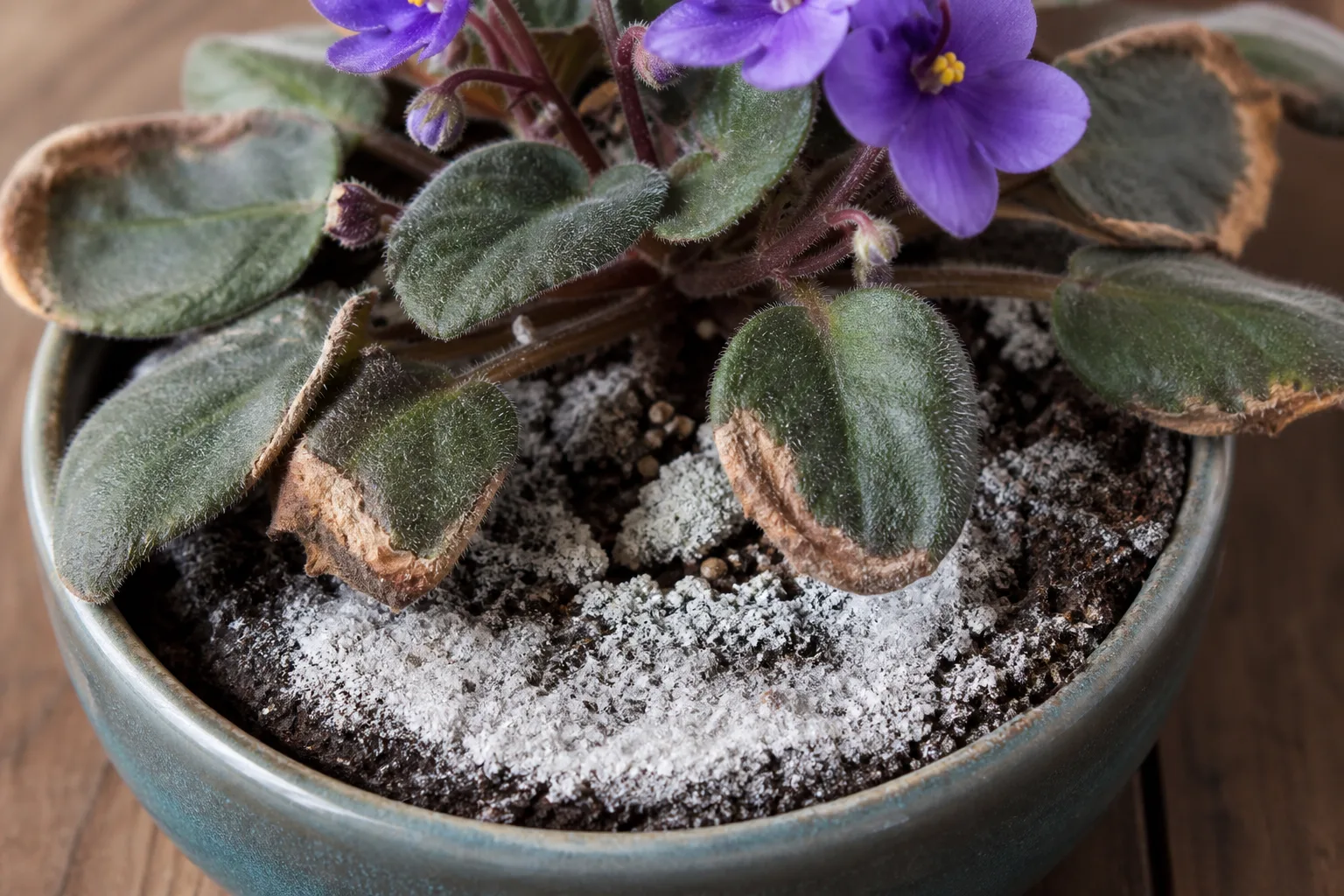
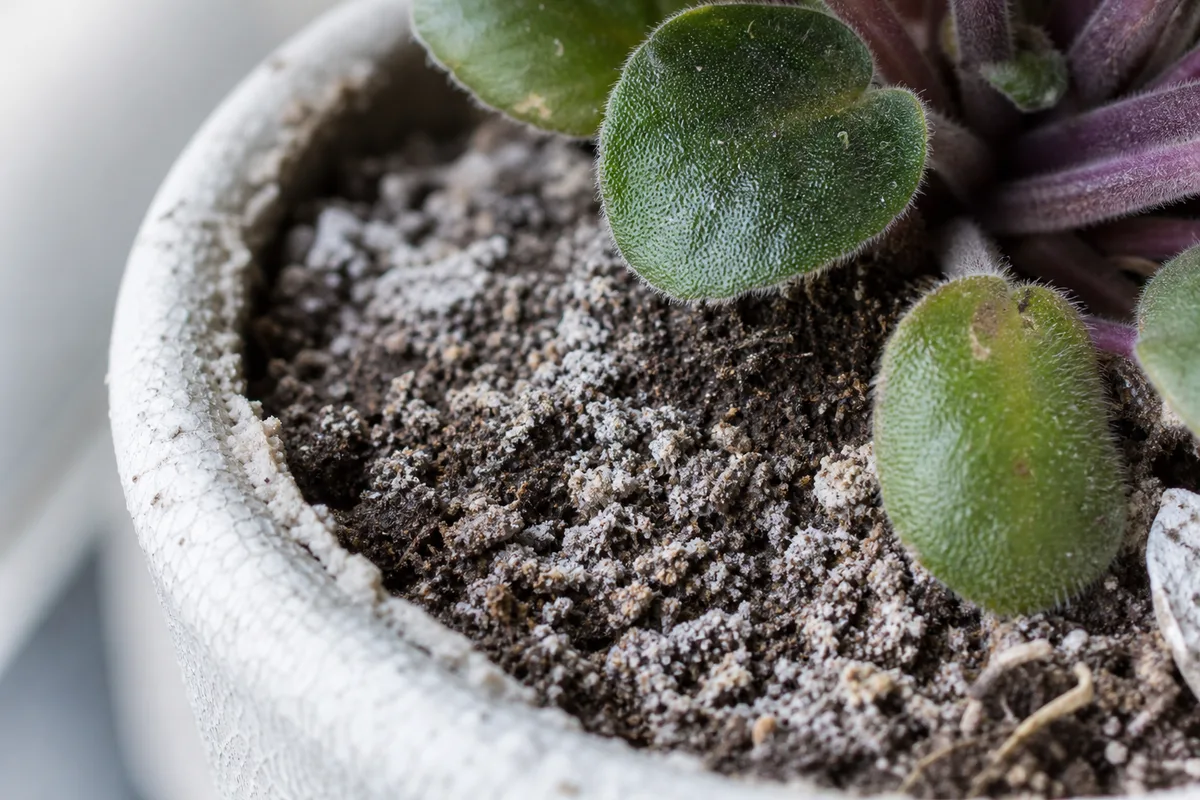
A hard, chalky white or tan crust on the soil surface, drainage hole, or pot rim is a classic mineral or fertilizer salt deposit. Clemson’s houseplant disease guidance draws a useful bright line: white to grey crusty deposits signal salt buildup and should not be confused with the white or yellow mold-like growth of saprophytic soil fungi.
Use a finger test. Salt crust feels brittle and crystalline. It scrapes like chalk. Mold looks soft, fuzzy, or webbed and often appears when the mix stays wet and airy organic bits are rotting on the surface. If you are unsure, read the mold on houseplant soil guide and the salt build-up problem page before you treat the pot like a fungus problem.
Crust alone does not prove the plant is doomed. It proves evaporation is concentrating salts at the wet-dry edge. That is common in hard-water homes, terracotta pots, and rooms with strong airflow.
Bench note (flush interval, April 2026): On a 14 cm plastic pot of peace lily watered with ~700–900 ppm tank water and light monthly fertilizer, scraped rim crust returned in about five to six weeks when we only bottom-watered. After a calendar top flush every four weeks (two to three pot volumes of runoff, saucer emptied), the rim stayed mostly clean for the next eight weeks of active growth. Same plant, same fertilizer brand — watering direction and leaching made the difference.
Tip Burn, Wilting, and Root Stress Patterns
Tip burn is the symptom people notice first on prayer plants and ferns. Leaf tips yellow, then brown and crisp, while the rest of the leaf may still look fine. Hard water contributes in two ways: mineral salts accumulate at leaf margins through the transpiration stream, and related tap-water chemistry (especially fluoride in some municipal supplies) can worsen tip necrosis on sensitive species. Clemson lists brown leaf tips and margins among salt, watering, and fluoride/chlorine issues and recommends resting water 24 hours for fluoride- or chlorine-sensitive plants — useful for chlorine and temperature, not for hardness.
Do not assume every brown tip is hard water. Low humidity, underwatering, heat from AC vents, and fertilizer burn create similar edges. Hard-water suspicion rises when:
- several sensitive plants share the same tap and the same tip pattern
- white crust returns after you scrape it
- tips worsen after you increase fertilizer instead of flushing
- tougher plants on the same water look fine while calatheas and ferns do not
High soluble salts also make it harder for roots to take up water. A plant can wilt while the mix still feels moist. Clemson notes that fertilizer and minerals from hard water can accumulate, damage roots, and contribute to wilting. If growth has stalled, tips keep burning, and a crust keeps returning, treat water quality and salt load as a root-zone problem, not a “needs more food” problem.
For tip triage that covers humidity and salts together, use the brown tips on houseplants guide.
Which Houseplants Are Most Sensitive
Some houseplants tolerate moderately hard tap for years. Others advertise every mineral insult on their newest leaf. Sensitivity often clusters in thin-leaved tropicals from the prayer-plant family, many ferns, peace lilies, spider plants, and several dracaenas. Extension and grower lists for fluoride-related tip burn overlap hard-water complaints because the same plants often dislike mineral-heavy municipal water; detailed species lists commonly include calathea, maranta, peace lily, spider plant, and several dracaenas.
Prayer Plants, Ferns, Peace Lilies, and Tip-Burn Prone Plants
Calathea, maranta, and related prayer plants are the classic complainers. Their thin leaves show tip and margin burn quickly when water is hard, fluoridated, or inconsistently applied. Growers who switch these plants to rainwater, filtered water, or carefully managed RO water often see cleaner new leaves within one or two growth cycles even though old browned tips never turn green again.
If your calathea already has crispy edges, fix water and humidity together. These plants also hate dry air, so hard water is rarely the only stressor. Pair water changes with the calathea care guide rather than chasing fertilizer.
Maidenhair fern and many other ferns dislike salty root zones and inconsistent moisture. Peace lilies often brown at the tips when soluble salts climb. Spider plants are famously tip-burn prone; fluoride and accumulated salts are frequent suspects. Dracaenas and lucky bamboo appear on the same tip-burn pattern lists.
Tougher aroids and drought-tolerant plants — many pothos, ZZ plants, and snake plants — usually cope with ordinary hard tap if you water thoroughly and flush occasionally. Use plant sensitivity as a triage tool: if only the soft-water preferrers are failing, water chemistry deserves a closer look before you rebuild every care routine.
| More sensitive shelf | Usually more tolerant |
|---|---|
| Calathea, maranta, ctenanthe | Pothos, many philodendrons |
| Maidenhair and thin ferns | Snake plant, ZZ plant |
| Peace lily, spider plant | Mature monstera in chunky mix |
| Many dracaenas / lucky bamboo | Most hardy succulents (if not overfed) |
Testing and Rough Diagnosis at Home
You do not need a laboratory to decide whether water is a plausible cause. Build a short evidence stack:
- Look for deposits. Kettle scale, watering-can film, and pot-rim crust point to mineral-heavy water or fertilizer salts.
- Compare species. Tip burn limited to calathea, maranta, ferns, and peace lilies is more informative than one crispy leaf on a neglected pot.
- Check watering habits. Frequent bottom watering or tiny sips that never drain concentrate salts. Colorado State’s houseplant watering guidance warns that subirrigation can accumulate soluble salts on the soil surface and recommends periodic top watering to leach them.
- Use a simple test kit or report. A hardness test strip, a municipal water-quality report, or a borewell lab panel beats guessing. A TDS meter helps track change after you switch sources, but interpret it as total dissolved solids, not pure hardness.
- Rule out lookalikes. Fuzzy surface growth is more likely mold or algae than salt. Dry, crispy tips with bone-dry mix may be underwatering or low humidity instead.
If crust, tip burn on sensitive plants, and high hardness or TDS line up, treat water quality as a primary fix. If none of those line up, return to watering rhythm, light, and humidity before buying an RO unit for the plants alone.
Ask your apartment society for the latest water test if one exists. One local hardness number beats ten city blog posts.
Hard-Water Reality in Indian Municipal and Borewell Supply
India’s indoor-plant problem is often a water-source problem as much as a care problem. Many cities mix municipal surface water with borewell backup. Borewell and groundwater supplies commonly run harder because water dissolves calcium and magnesium from rock and soil on the way to the tap — the same groundwater mineral pathway USGS describes for hard well water.
For drinking-water standards in India, Bureau of Indian Standards IS 10500:2012 lists total hardness (as CaCO₃) with an acceptable limit of 200 mg/L and a permissible limit of 600 mg/L when no alternate source is available. That range is written for human drinking water, not for calatheas. A tap that is “acceptable” for people can still be rough on thin tropical leaves in a small pot.
City-level hardness varies by neighborhood, season, tanker deliveries, and whether your floor is drawing from a softener, RO reject line, or raw tank. Treat any viral “Delhi vs Mumbai hardness ranking” as unverified orientation unless you have a named lab report for your building. What matters in practice:
- If your building’s drinking water already goes through RO, that RO reject or pre-RO tap is often the hard stream your plants are getting from the kitchen’s “non-drinking” tap.
- Bathroom and kitchen taps may not share the same source after pressure pumps, storage tanks, and softeners.
- Monsoon rain collection, where safe and practical, is one of the few free soft-water options that matches tropical plant preferences.
- For broader climate-aware plant choices, see indoor plants for India and monsoon houseplant care in India.
Safer Water Options That Actually Help
Safer water is not one product. It is a match between your tap, your plant list, and how much labor you will actually sustain.
Resting Tap Water Overnight
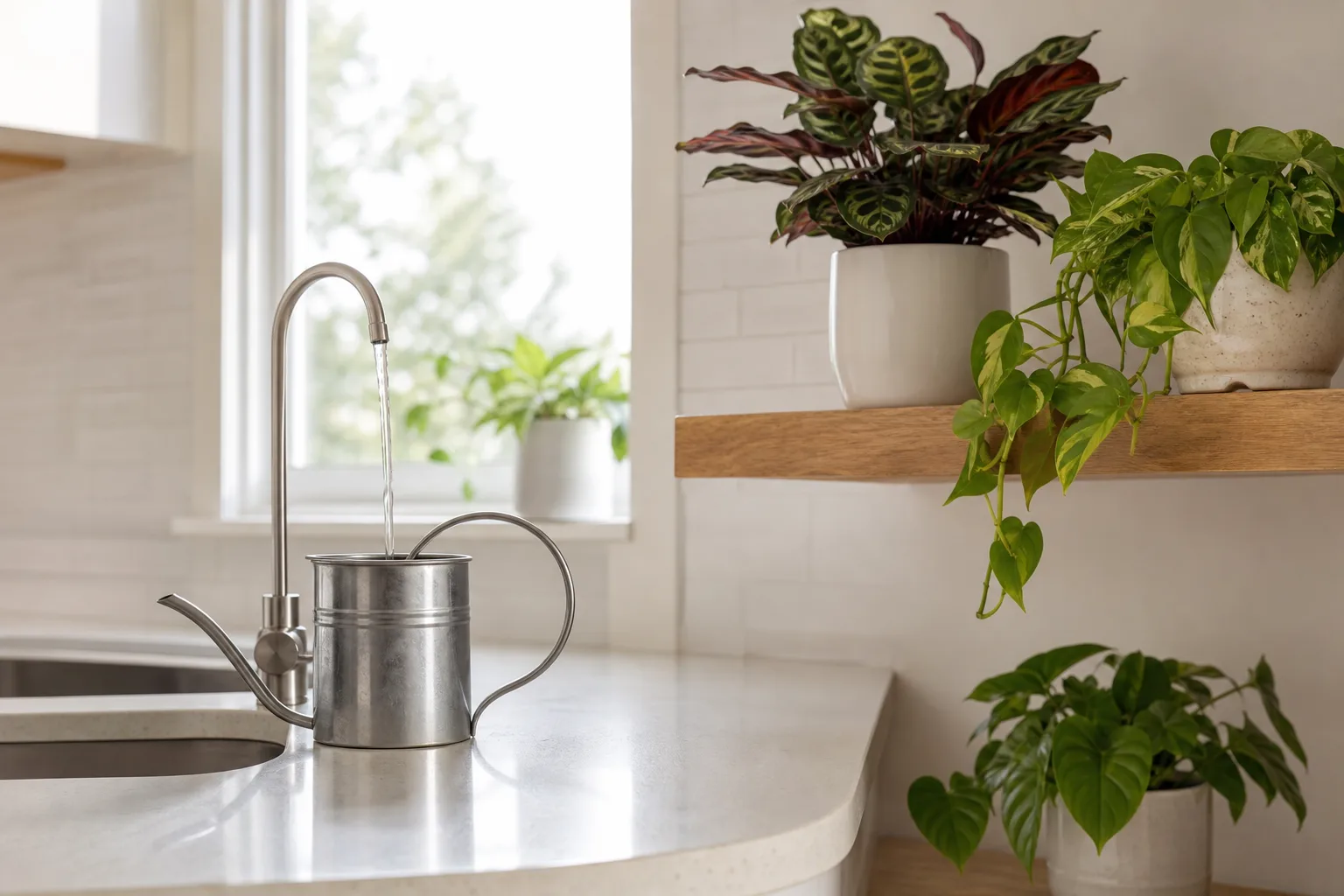
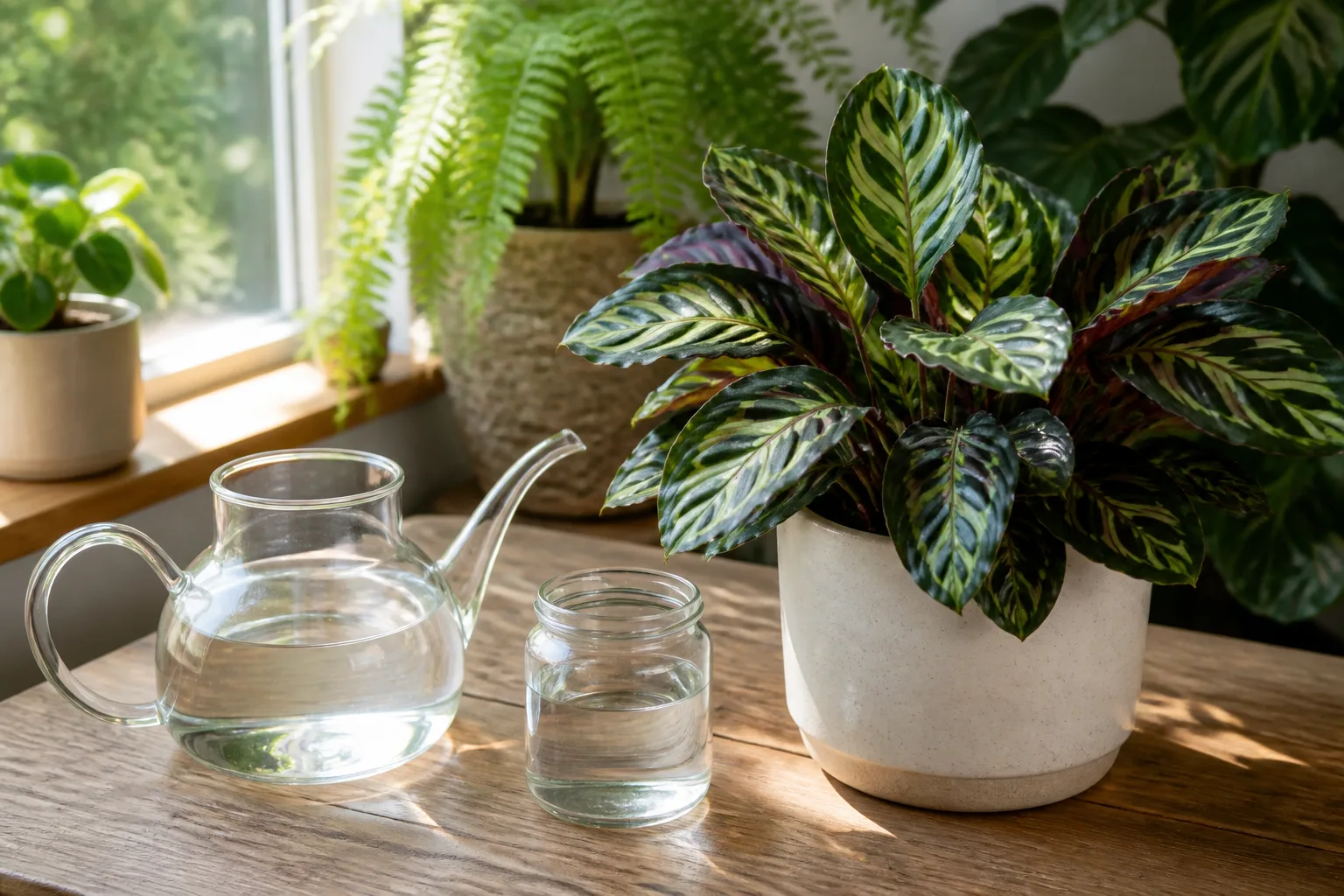
Filling cans and leaving them uncovered overnight is still useful. Clemson recommends letting water stand at room temperature for about 24 hours before use for plants sensitive to fluoride or chlorine. Resting helps with:
- bringing water to room temperature so roots are not shocked by cold tap water
- allowing free chlorine to dissipate in many municipal systems
Resting does not:
- remove calcium and magnesium hardness
- reliably remove chloramine
- remove fluoride
- undo sodium from a water softener
Use resting water as a baseline upgrade for every plant. Do not expect it to solve hard-water crust on its own.
Rainwater, Carbon Filters, and Filtered Blends
Rainwater is usually soft and low in dissolved minerals when collected cleanly from a non-toxic surface and stored covered. It is one of the best options for calatheas, marantas, and ferns if you can collect it safely. Avoid runoff from painted or treated roofs you do not trust, and do not let storage become a mosquito nursery — use covered, screened containers and empty stagnant water.
Carbon filtration (pitcher filters, under-sink carbon) often improves taste and can reduce chlorine and some other contaminants. It does not turn very hard water into soft water. It is a sensible middle step when tap smells strongly of chlorine and your plants are only mildly sensitive.
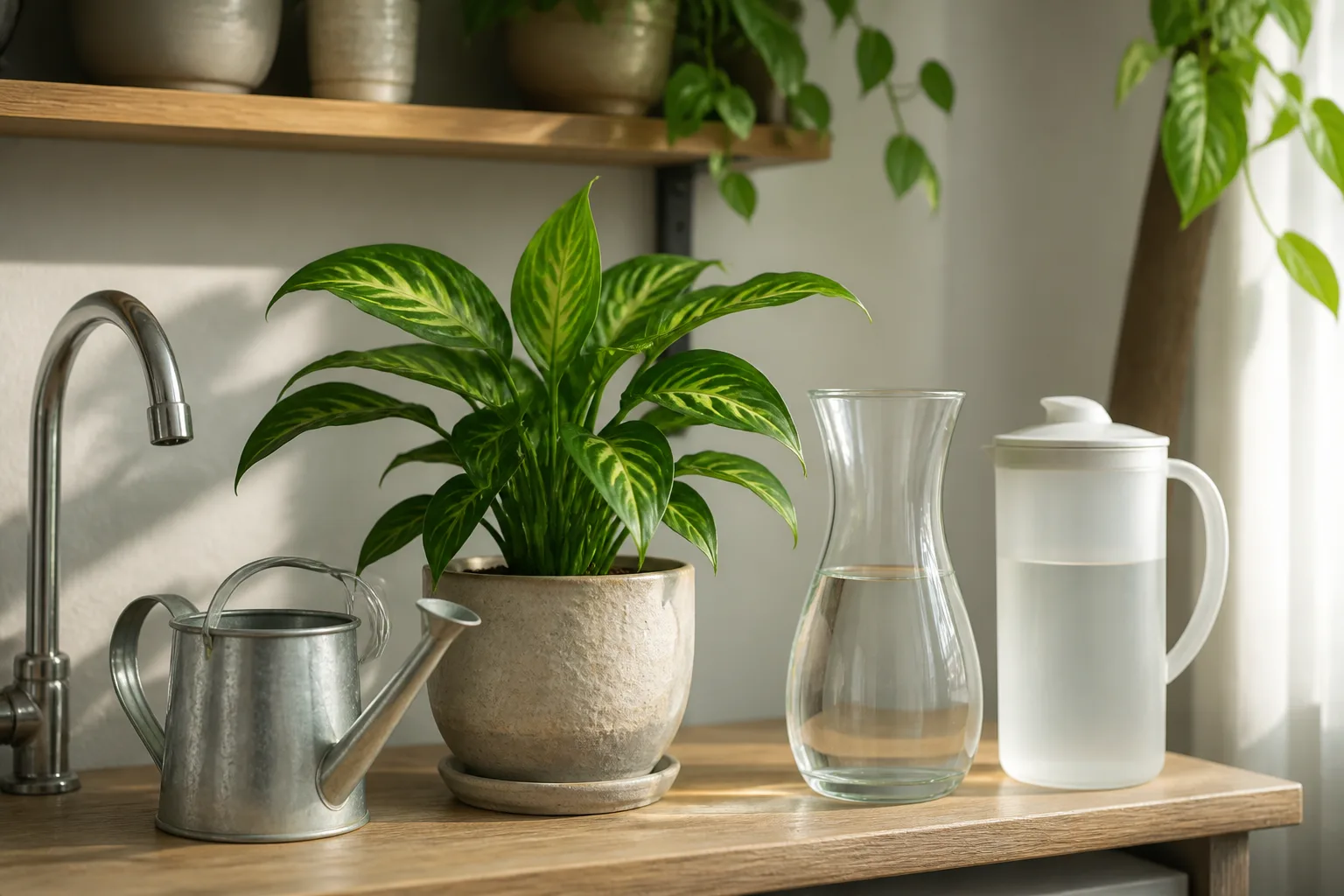
Filtered blends work well in hard-water cities: water most hardy plants with rested or carbon-filtered tap, and reserve rainwater or RO blends for the sensitive shelf. That split routine is cheaper than purifying every liter for snake plants that do not need it.
RO and Distilled Water — Mineral Caveats
Reverse osmosis and distilled water strip nearly all dissolved minerals. That is excellent for stopping hard-water crust and for fluoride-sensitive foliage. It creates a second problem if you never fertilize: the water no longer contributes calcium or magnesium, so nutrition must come from the potting mix and your fertilizer program. Penn State notes that extremely soft irrigation water may require calcium and magnesium fertilization.
Use RO or distilled water well by:
- feeding lightly on a regular schedule during active growth
- blending RO with a fraction of filtered tap if you want some buffering minerals back
- watching for pale new growth after a full switch, which can signal you removed minerals without replacing nutrition
- reading the dedicated RO water for indoor plants guide before you commit a whole collection to pure RO
Why Softener Water Is Usually Worse
Skip sodium ion-exchange softener water for plants. Those systems swap hardness minerals for sodium. Soft hands in the shower do not equal soft, plant-safe irrigation water.
Penn State Extension explains the ion-exchange chemistry: resin loaded with sodium trades for calcium and magnesium, so the water leaving the unit is “soft” but higher in sodium. For irrigation, the same extension service warns that removing hardness with a sodium-chloride softener often creates elevated sodium problems, and that softening intended for irrigation should use potassium regeneration rather than sodium — impractical for most apartment softeners. University of Arizona’s irrigation tips make the landscape point bluntly: the common misconception that you need a softener because “hard water is bad for plants” confuses hardness with salinity; salty irrigation water makes water uptake harder and needs leaching, not sodium softener brine.
Practical rule: water plants from an unsoftened tap, rainwater, or RO/distilled blend. If the whole building softens every line, treat softener water as a reason to change source for the sensitive shelf, not as a plant upgrade.
Flushing Salts With Occasional Top Watering
Even after you improve source water, existing pots may already be salty. Leaching is the reset.
Clemson’s watering guidance is direct: when you water, water thoroughly until runoff leaves the drainage holes so excess salts are washed out, then empty the saucer. Colorado State adds the bottom-watering caveat: if you usually subirrigate, periodically water from the top to leach soluble salts that accumulate at the surface.
A practical flush for hard-water homes:
- Take the plant to a sink or balcony where runoff can drain freely.
- Use room-temperature low-mineral or plain water.
- Water slowly from the top until a generous volume exits the drainage holes — often about two to three times the pot’s volume over several minutes, not one harsh blast that channels down the side.
- Let the pot finish draining. Empty any saucer or cachepot.
- Resume normal watering only when the mix needs it. Do not keep the plant sitting wet “to leach more.”
How often? In hard-water apartments with regular fertilizer, a thorough flush every four to eight weeks during active growth is a workable default. In winter, flush less often and reduce feeding first. If the pot cannot drain, fix drainage or repot before you try to leach anything. Flushing a clogged pot only creates a swamp.
Top watering also pairs with better everyday technique. The how to water indoor plants the right way guide covers soil checks and thorough watering. If you like bottom watering, keep it, but schedule top flushes so salts do not stack at the surface.
A Practical Routine for Hard-Water Homes
Use this as a default if you live with hard municipal or borewell water and grow a mixed shelf:
- Sort plants. Sensitive shelf: calathea, maranta, ferns, peace lily, spider plant, dracaena. Tolerant shelf: snake plant, ZZ, many pothos and philodendrons.
- Upgrade water for the sensitive shelf. Rainwater first if available; otherwise carbon-filtered tap, distilled, or RO with light feeding.
- Never use softener water as the “fix.” Choose an unsoftened or purified source instead.
- Rest all water to room temperature. Keep this habit even when water is already soft.
- Water thoroughly, then dump runoff. Everyday watering should produce some drainage, not endless sips.
- Flush on a calendar. Monthly to bimonthly top flushes for hard-water pots in active growth.
- Feed gently. Lower dose, consistent schedule, pause if crust returns quickly.
- Recheck after one new leaf cycle. New growth is the report card. Old tips are history.
Common mistakes that reverse progress: scraping crust without flushing; treating chalky salt as mold; running pure RO with no fertilizer; fertilizing to “fix” tip burn; bottom watering forever with hard tap; expecting old brown tips to green up.
If you only change one thing this week, stop exclusive bottom watering with untreated hard tap on your calatheas and give those pots a deep top flush with the best water you can source.
Related Guides
Use these when the next question is clearer than “is my tap too hard?”:
- How to water indoor plants the right way — thorough watering, drainage, and empty-saucer habits that also leach salts
- Mold on houseplant soil — when white growth is fuzzy fungus, not chalky mineral crust
- Salt build-up in plant soil — flush, repot, and fertilizer timing when deposits keep returning
- RO water for indoor plants — mineral caveats, blending, and when pure RO needs feeding
- Brown tips on houseplants and crispy leaves — tip burn triage beyond water hardness alone
- Houseplant humidity guide — when prayer plants need softer water and higher humidity together
- Indoor plants for India — climate-aware picks for hard-water and hot-season homes
- Monsoon houseplant care in India — seasonal watering and fungus shifts that interact with salt load
- Balcony plants for Indian summers — heat-tolerant balcony picks when outdoor irrigation water is also hard
Species pages for common hard-water complainers: calathea brown tips, peace lily brown tips, spider plant brown tips, and maidenhair fern salt build-up.
Conclusion
Hard water is measurable chemistry, not bad luck. Calcium and magnesium leave crust where water evaporates, push tip burn on soft-water preferring plants, and stack with fertilizer salts until roots struggle. Resting tap water still helps with temperature and free chlorine, but it does not soften hard water. Rainwater, thoughtful filtration, and RO used with mineral-aware feeding are the real levers — especially in Indian homes where borewell backup, storage tanks, and RO-reject taps change what plants actually drink. Flush pots from the top on purpose, protect calatheas, marantas, ferns, and peace lilies first, skip softener water, and let the next clean leaf tell you the water change worked.