Monsoon Houseplant Care in India
Monsoon houseplant care for Indian homes: shift watering, cut fungus risk, fix low light, and stop mold, gnats, and balcony slugs.
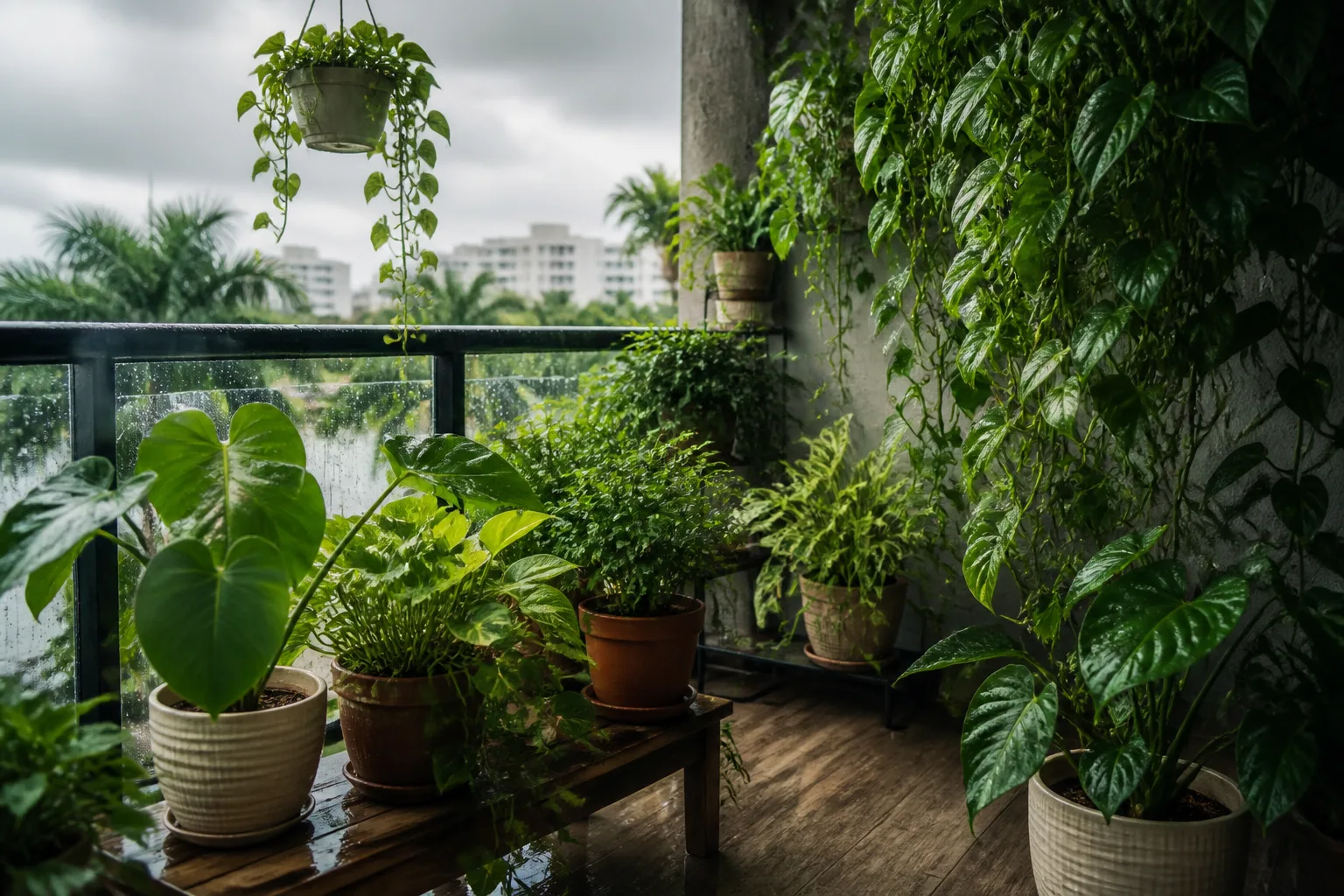
Indian monsoon does not kill houseplants with rain alone. It kills them with a stack: humid air that slows drying, cloudy light that slows water use, and the same summer watering habit you used in May. The mix turns potting mix into a wet sponge, then invites fungal leaf spot, white mold on the soil surface, fungus gnats, and — on balconies — snails and slugs after every shower.
This is a season playbook for apartments and balconies across India. You will get a watering calendar shift (not a fixed “water every X days” myth), coastal vs inland timing cues, balcony in/out rules, airflow fixes, fungicide caution, first-hand dry-down notes from real pots, and a short weekly routine. For plant picks that already handle Indian rooms, start with indoor plants for Indian homes. For a quick interactive checklist, use the monsoon plant care tool.
Why Monsoon Changes Care in Indian Homes
Most generic houseplant advice is written for dry heated rooms in temperate winters. Indian monsoon is the opposite problem. Relative humidity often stays high for days. Windows stay shut against rain and mosquitoes. Balcony pots catch splash and overnight damp. Growth may continue, but evaporation from soil and leaves drops hard.
Clemson Extension’s watering factsheet is blunt: overwatering is the main cause of death in potted plants because roots need oxygen as well as water; when the mix stays saturated, roots decline and the plant can die even while the soil looks “nicely moist.” Missouri Botanical Garden’s overwatering guidance makes the same point from the root side — soggy media starve roots of oxygen and set up rot. In monsoon, that failure mode shows up earlier because the environment helps the pot stay wet.
So monsoon care is not “more love.” It is less water, drier foliage, better airflow, and honest light management until skies clear.
How Long the Wet Season Lasts (IMD Timing + Local Dry-Down)
For plant care, treat the southwest monsoon as a multi-week regime, not a single rainy weekend. The India Meteorological Department notes that southwest monsoon normally sets in over Kerala around 1 June, advances in surges, and typically covers the entire country around mid-July. Withdrawal from extreme northwestern India is not attempted before 1 September, and withdrawal from the southern peninsula and the country as a whole is declared only after 1 October when circulation shifts away from the southwesterly regime (IMD withdrawal criteria).
That calendar matters because your watering and balcony rules should flip when local skies go persistently cloudy and humid — often weeks after “official” onset in inland cities, and weeks longer on the west coast. East and south India also deal with northeast monsoon rains later in the year; use the same wet-soil logic whenever humidity stays high and light stays dull, even if the calendar says “post-monsoon.”
Local dry-down signal beats national onset dates: if pots that used to dry in one day now take three or more, you are already in monsoon care mode.
Coastal vs Inland vs Hill City Notes
| Setting | What usually changes first | Practical plant move |
|---|---|---|
| Coastal west (Mumbai, Konkan, Goa) | Early, prolonged RH + splash; trays fill overnight | Covered balcony or indoors for soft tropicals; empty trays after every storm |
| Inland plateau (Pune, Bengaluru, Hyderabad) | Cloudy weeks + closed windows; dry-down slows before heavy rain days | Stretch watering early; keep airflow even when it is not pouring |
| North plains (Delhi NCR and similar) | Patchy rain with humid nights; AC rooms stay damp after watering | Check pot weight twice a week; do not water on a May schedule |
| East / southeast (Kolkata, Chennai stretch) | SW wetness plus later NE rains in some years | Keep monsoon mode until local dry-down returns — not only until “September” |
| Hill cities | Cooler nights + continuous wet foliage | Bring soft plants under cover sooner; watch for soft stems after cold wet nights |
These are placement heuristics, not weather forecasts. Track your own pots: dry-down days are the real monsoon meter for houseplants.
The Problem Stack: Humidity, Low Light, and Wet Soil
Monsoon problems rarely arrive alone. High humidity slows leaf drying after misting or splash. Low light slows photosynthesis and water uptake. Wet soil then becomes the shared cause behind yellow leaves, wilting, mold, gnats, and soft roots.
Humidity Without Matching Light
Penn State Extension notes that most indoor plants benefit from humidity higher than a dry heated winter home, with ASHRAE’s general indoor comfort band often cited around 30–60% relative humidity. Monsoon India often sits at the top of that range or above it for long stretches — which is great for tropical foliage if light and airflow are adequate.
The catch: high humidity does not replace light. When days are grey and plants sit deeper inside rooms with closed curtains, water stays in the pot longer while growth softens. Peace lilies and ferns may look happier on leaf feel, while snake plants and ZZ plants quietly sit in wet media they never asked for.
Skip misting as a “humidity treat” in monsoon. Penn State’s humidity guidance is clear that misting’s humidity bump lasts only until droplets evaporate — often minutes — and in rainy season those droplets mainly extend leaf wetness that fungal pathogens love. For year-round humidity strategy (more relevant after monsoon withdrawal), see the houseplant humidity guide.
Overwatering Disguised as a Summer Schedule
If you watered every three to four days in peak summer heat, that schedule is usually wrong by mid-monsoon. Clemson’s watering guidance stresses there is no universal frequency: species, pot material, mix, plant size, and weather all change the answer. Monsoon weather is the variable that changes fastest.
Watch for the classic wet-wilt trap Wisconsin Horticulture describes for root rot: the plant wilts even though the soil is wet, leaves yellow or look nutrient-starved, and roots are soft and brown. That is not a cue to water more. It is a cue to stop watering, check drainage, and diagnose roots.
Monsoon Watering Calendar Shift
Replace calendar watering with a monsoon dry-down rule:
- Check soil twice a week for thirsty plants; once a week for thick-leaved or drought-tolerant plants.
- Water only when the top layer has dried to the depth that species prefers.
- Water thoroughly at the soil line, then empty saucers within 30 minutes.
- Pause fertilizer on plants that have slowed or show wet stress; resume only when growth and dry-down look normal.
As a rough shift from summer habits in typical Indian apartments: stretch intervals by about 50–100% for tropical foliage, and by more for snake plant, ZZ plant, jade plant, and other plants that hate wet feet. Attach that stretch to what you observe — plastic pots in west-facing humid rooms often stay heavy far longer than terracotta in a breezy covered balcony.
For general technique beyond monsoon, see how to water indoor plants the right way. If your tap leaves white crust on rims and dry-down is already slow, mineral load compounds stress — see hard water for houseplants after you fix wetness first.
Soil Checks and Species Dry-Down Depth
Use one of these before every watering:
- Finger test: Push a clean finger 2–5 cm into the mix. If it feels cool and damp, wait.
- Skewer/chopstick test: Insert a wooden skewer for a minute. Damp wood darkens; dry wood stays light.
- Pot weight: Learn the “just watered” vs “ready” weight of your common pots. Monsoon pots stay heavy longer.
- Surface color alone is not enough: Top crust can look dry while the core is still saturated, especially in plastic pots.
| Plant type | Typical monsoon dry-down depth before watering | Extra trap |
|---|---|---|
| Snake plant, ZZ plant, jade | Most of the pot dry | Cachepot rainwater = fast rot |
| Golden pothos, syngonium, aglaonema | Top few centimetres dry | Peat-rich mix stays wet at the core |
| Peace lily, ferns | Even moisture — never saucer-sitting | Soft leaves + wet media invite rot |
| Succulents on balconies | Deep dry-down; often better under cover | Splash keeps crowns wet overnight |
Drainage holes are not optional. Wisconsin Horticulture warns against putting rocks or gravel in the bottom of pots as a “drainage layer” — that setup can impede drainage — and against letting plants sit in drainage water.
Monsoon-specific Indian apartment traps: decorative ceramic cachepots that hide nursery pots and collect runoff; balcony trays that fill during storms; closed bathrooms and kitchens with zero airflow after watering. Fix: lift pots onto feet or a rack, empty trays daily during active rain spells, and move sensitive plants under cover if splash soaks the mix.
Balcony Decision Rules: In, Under Cover, or Out
| Situation | Move |
|---|---|
| Soft tropicals, cuttings, or pots sitting in puddles | Bring under cover or indoors |
| Fresh snail trails, chewed leaves, or spreading spots after each rain | Under cover until the wet spell eases |
| Hardy, free-draining balcony staples with emptyable trays | Leave out with overhang protection |
| Daily bounce between deep indoor shade and harsh post-rain sun | Stop — pick one stable bright-indirect spot |
Bring under cover or indoors when soft tropicals (calathea, ferns, peace lily, young cuttings) get repeatedly soaked and stay wet overnight; pots sit in puddles or blocked balcony drains; night temperatures drop sharply with continuous wet foliage (more relevant in hill cities and some northern stretches late in the season).
Leave outdoors with protection when plants are sun-hardened balcony staples in pots with free drainage; you can tilt pots or place them under a roof overhang so rain does not fill the crown; you check saucers after every storm.
Do not bounce plants daily between deep shade indoors and harsh post-rain sun. Move once to a stable bright-indirect indoor spot, or to a covered balcony corner, and keep them there through the wettest weeks. Sudden light swings cause leaf drop and stress that look like disease.
For heat-season balcony plant selection that hands off into these wet weeks, see balcony plants for Indian summers.
Fix Low Light Before You Blame the Plant
Cloudy monsoon weeks cut usable window light hard, especially in dense apartment corridors and north-facing rooms. Plants respond with stretched stems, smaller new leaves, pale color, and slower water use — which feeds the overwatering cycle.
Practical fixes that work in Indian flats:
- Clean window glass and pull sheer curtains during daylight hours when rain is not blowing in.
- Cluster plants closer to the brightest safe window; rotate weekly so one side does not stretch.
- Avoid deep interior shelves for anything but true low-light survivors during peak cloudy stretches.
- Use a simple LED grow light on a timer (for example 10–12 hours) for collections that must stay away from windows — especially variegated plants that fade fast in gloom. One cloudy month of timer light is usually enough to break the stretch-and-wet cycle without buying a full grow tent.
If legginess and pale growth are already obvious, follow the diagnostic path in not enough light for houseplants instead of fertilizing. Fertilizer on a light-starved, wet plant often makes soft growth that spots and collapses faster.
Moisture Triage: Leaf Spot, Mold, Gnats, and Slugs
True leaf-spot disease is less common in dry indoor air than people think, but monsoon India creates outdoor-like wetness indoors: wet leaves, crowded shelves, and splash from watering. Clemson HGIC describes fungal leaf spots as small brown lesions with yellowish margins that may show concentric rings or tiny black fruiting bodies in dead tissue. Anthracnose can brown tips and margins. Powdery mildew is favored by humid conditions with inadequate ventilation.
Do this first, before buying a spray: isolate the plant; remove badly spotted leaves with clean tools and bag trash; stop misting and overhead watering; increase spacing and airflow; keep leaves dry overnight. For a full fungal-vs-bacterial-vs-edema differential, use houseplant leaf spot disease when spots keep spreading after you dry the foliage.
Edema lookalike caution: corky underside scars from uneven watering in low light are not infection. Fungicides will not erase them.
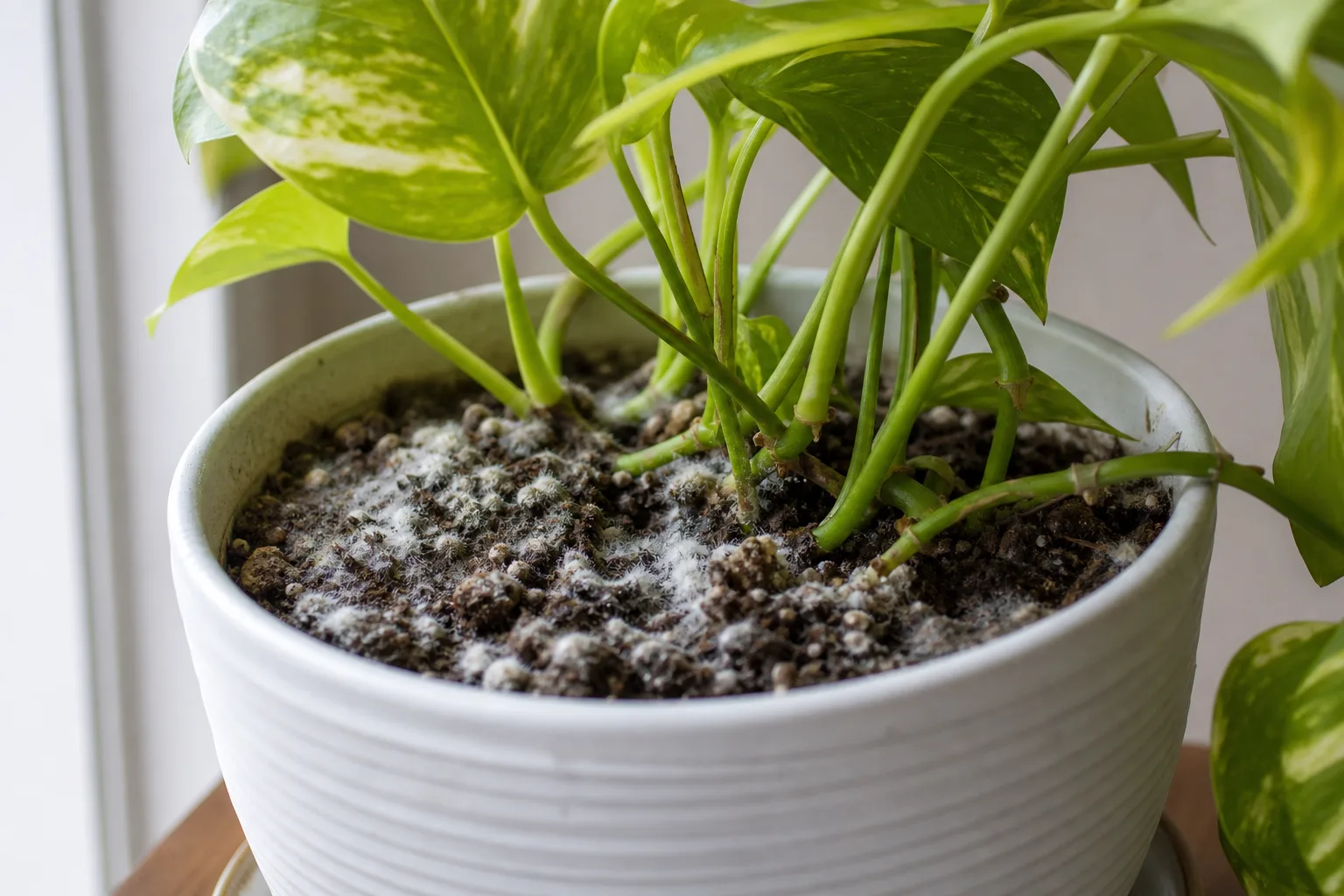
Fuzzy white or grey growth on potting mix during monsoon is usually saprophytic fungus feeding on organic matter in damp media — a moisture signal more than a primary leaf pathogen. The RHS describes saprotrophic fungi as decomposers of dead organic matter. Clemson also notes that white or yellow mold-like growth of saprophytic soil fungi should not be confused with white-grey salt crusts on the soil surface or pot rim.
Response: scrape off the top centimetre of colonized mix once the surface is no longer soggy; let the top layer dry between waterings; check that the plant is not sitting in a wet cachepot; watch for fungus gnats. Deep dive: mold on houseplant soil.
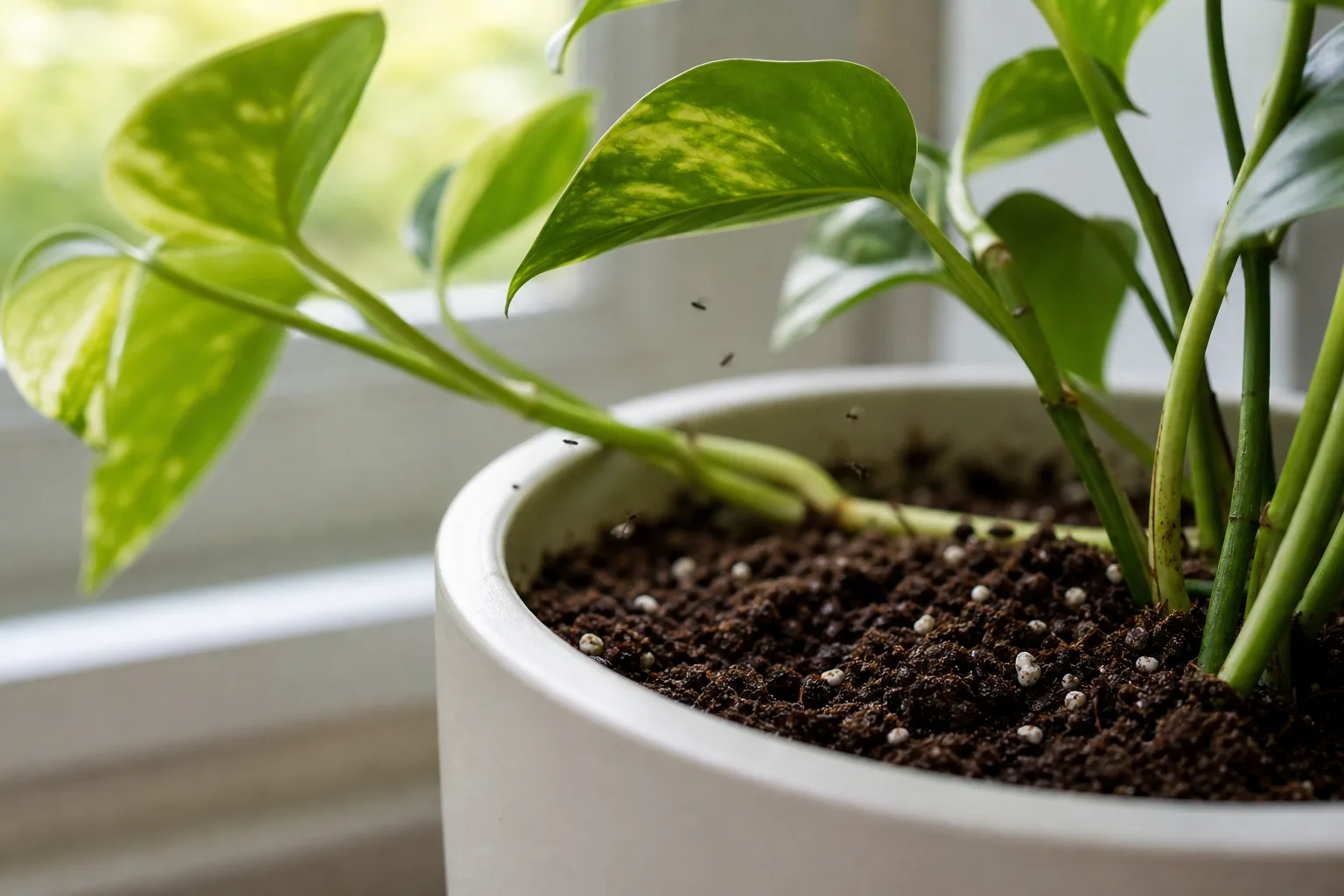
Fungus gnats thrive in monsoon pots. Colorado State Extension describes adults as small mosquito-like flies that do not bite; larvae live in the top few inches of moist media, especially peat-rich mixes. At typical room temperatures, the life cycle can complete in about three to four weeks.
Monsoon control order: dry the top 2–5 cm between waterings; yellow sticky traps at pot level; potato slice test for larvae (CSU); biological larval control where available with Bacillus thuringiensis subsp. israelensis (Bti) or Steinernema feltiae nematodes per label. UC IPM notes Bti for fungus gnats is not the same Bt used for caterpillars. Full protocol: houseplant fungus gnats.
After rains, balcony trays and damp corners attract snails and slugs that rasp soft leaves overnight. RHS advice frames them as moisture-loving gastropods; changing growing conditions beats chasing every individual with harsh baits. Empty water-filled trays; lift pots and check undersides at night with a torch; use copper tape where practical; move damaged soft plants under cover. If you use iron phosphate baits or other mollusc products, keep them away from pets and children, and never improvise with salt on plant roots.
Airflow, Spacing, and Mist Mistakes
Stagnant monsoon air is a disease multiplier. Give each plant a gap so leaves do not stay pressed together. Run a ceiling fan on low or a small USB fan across — not blasting directly on — the collection for a few hours when windows must stay shut against rain and mosquitoes. That ventilation tradeoff is real: closed rooms protect from insects but slow leaf drying. A low fan is usually safer than sealing wet plants in a cabinet.
Stop these monsoon habits: daily misting “for humidity”; grouping pots in a closed glass cabinet without ventilation; watering in the evening so pots and leaves stay wet all night; leaving dead leaves on the soil surface (gnat and fungus food).
Powdery mildew and leaf-spot pressure drop when foliage dries quickly and plants are not overcrowded — Clemson lists proper ventilation and avoiding overwatering among cultural controls.
A dehumidifier is optional, not required for most apartment collections. Plants usually need honest dry-down and airflow more than a machine chasing a humidity number. Use a dehumidifier only if your room stays saturated and mold spreads on walls or soil despite empty saucers — and still water by soil check, not by the machine’s RH display.
Fungicide Caution for Indian Apartments
Fungicides are a last step after dry foliage, sanitation, and watering fixes — not a monsoon spray ritual.
Clemson lists options such as copper soap, chlorothalonil, myclobutanil, or tebuconazole for certain fungal leaf diseases after infected tissue is removed, and reminds home growers to follow labels and note that many products are intended to be sprayed outdoors. That outdoor-spray caution matters in Indian apartments: do not fog bedrooms or kitchens with garden fungicides.
Practical caution list:
- Identify the problem category first (fungal leaf spot vs bacterial soft rot vs edema vs root rot). Sprays will not fix edema or advanced root rot.
- Read the Indian-market label in your hand. Active ingredients and legal uses vary by product.
- Prefer removing infected leaves and fixing wetness before chemicals.
- Keep pets and children away from treated plants until sprays dry, per label.
- If stems are soft, foul-smelling, and collapsing, discard the plant and sanitize the pot — chemicals rarely save systemic rot.
When in doubt, cultural control first; escalate only for valuable plants with clear fungal foliar disease after cleanup.
Plants That Struggle vs Plants That Cope
Often struggle in monsoon wetness + low light: ferns in closed corners, calathea in cachepots, peace lily left in trays, succulents and jade on rainy balconies, variegated plants starved of light, any plant in a pot without drainage.
Usually cope better if you do not overwater: snake plant, ZZ plant, golden pothos, many aglaonema and syngonium cultivars, rubber plant in bright rooms with disciplined watering.
Coping still requires the calendar shift. A ZZ plant in a decorative pot full of monsoon rainwater will rot as reliably as a fern. Match plant choice to your real light and your willingness to empty saucers — the India indoor plant guide is built around that reality.
First-Hand Notes From Monsoon Weeks
These are LeafyPixels editorial observations from Indian apartment pots during active wet weeks — not lab trials. Use them as calibration, then trust your own pot weight.
- Mumbai west-balcony, plastic 15 cm pot (golden pothos in peat-leaning mix): After a May schedule of watering every 3–4 days, the same pot stayed heavy for 5–6 days once humid overcast weeks set in. Emptying the tray each evening stopped overnight re-wetting; surface mold disappeared within about 10 days after the top 3 cm were allowed to dry and scraped once.
- Bengaluru covered balcony vs living-room shelf (same snake plant clone in terracotta vs plastic): Terracotta under a roof overhang reached “ready to water” in roughly 8–10 days; the plastic pot on an interior shelf was still cool and damp at 12–14 days. Same plant type, different pot and airflow — the calendar was useless.
- Delhi apartment, AC room (peace lily vs snake plant on one windowsill): Peace lily flagged when the top 2 cm dried; snake plant in the same RH still needed a deep dry-down. Watering both on the peace lily’s cue pushed the snake plant toward wet-wilt. Splitting the check habit by species fixed it without any spray.
- Cachepot rot save: A syngonium “decorative ceramic” set stayed wet after showers because the inner nursery pot sat in a hidden water reservoir. Lifting the nursery pot out nightly for a week, then switching to a footed cachepot, stopped the soft lower stem within two weeks. The plant did not need fungicide; it needed air under the pot.
Weekly Monsoon Check Routine
Run this 10-minute Sunday check through the wet months:
- Lift each pot: still heavy from last watering? Skip.
- Empty every saucer and cachepot.
- Scan leaves for new spots, soft stems, or slime trails.
- Check soil surface for mold and flying gnats; set or replace sticky traps if needed.
- Feel airflow: overcrowded shelf? Spread plants.
- Note light: move one step closer to the brightest safe window if new growth looks thin.
- Water only the plants that failed the dry-down test, at the soil line, morning preferred.
- Log anything declining — then open the matching hub only for that symptom (links in Related Guides below).
After Withdrawal: How to Ramp Watering Back Up
When IMD withdrawal advances and your pots start drying like early summer again, do not swing overnight into drought stress or a May flood schedule.
Week-by-week ramp (adjust to your city):
- Week 1 after local dry-down returns: Keep soil checks; shorten intervals only if pots are light and leaves look firm. Increase light exposure gradually — uncovered balcony sun can scorch soft indoor-held leaves.
- Week 2: Resume light feeding only on plants that are actively pushing new growth and drying on a predictable cycle.
- Week 3–4: Reintroduce full balcony intensity for sun-hardened plants; keep soft tropicals on a covered transition if September–October sun is still harsh between showers.
Northeast monsoon regions: if local rains return later, flip back into monsoon mode using the same dry-down signal — do not wait for a national label. When northern homes later flip to dry indoor air and weak winter light, pair this page with winter houseplant care as a next-season handoff, not a monsoon duplicate.
Author: Sai Ananth, LeafyPixels lead content writer. Reviewer: Dr. Priya Menon, botanist and indoor plant specialist on the LeafyPixels Editorial Review Board. Dry-down day ranges in the first-hand section are apartment observations; IMD timing and moisture science are tied to the cited primary sources.
Related Guides
Use these when a single problem takes over — each link has a monsoon trigger:
- Mold on soil — fuzzy white/grey surface growth after humid weeks
- Fungus gnats — tiny flies when the top layer never dries
- Leaf spot disease — spreading brown lesions after splash or misting
- Not enough light — stretch and pale growth in cloudy flats
- Wilting — limp plant while soil stays wet (wet-wilt / root check)
- Balcony plants for Indian summers — heat-season picks that must survive these wet weeks next
- Indoor plants for India — species that match real Indian rooms
- Monsoon plant care tool — interactive checklist for the same season
Conclusion
Monsoon houseplant care in India is a dry-down season, not a misting season. Flip to soil checks when pots stay heavy, empty saucers and cachepots, protect balcony pots from constant splash, add light and airflow where windows stay grey, and treat mold, gnats, leaf spot, and snails as moisture-management problems first. Use fungicides only with a clear fungal foliar diagnosis and a label you can follow safely outdoors. Keep the weekly routine until local withdrawal brings brighter, drier weeks — then ramp watering back up gradually instead of swinging from swamp to drought overnight.



