Java Fern Care: Attach Rhizome, Light & Water
Attach Java fern’s rhizome (never bury it), set low–moderate light, hold stable water, and tell melt from rot.
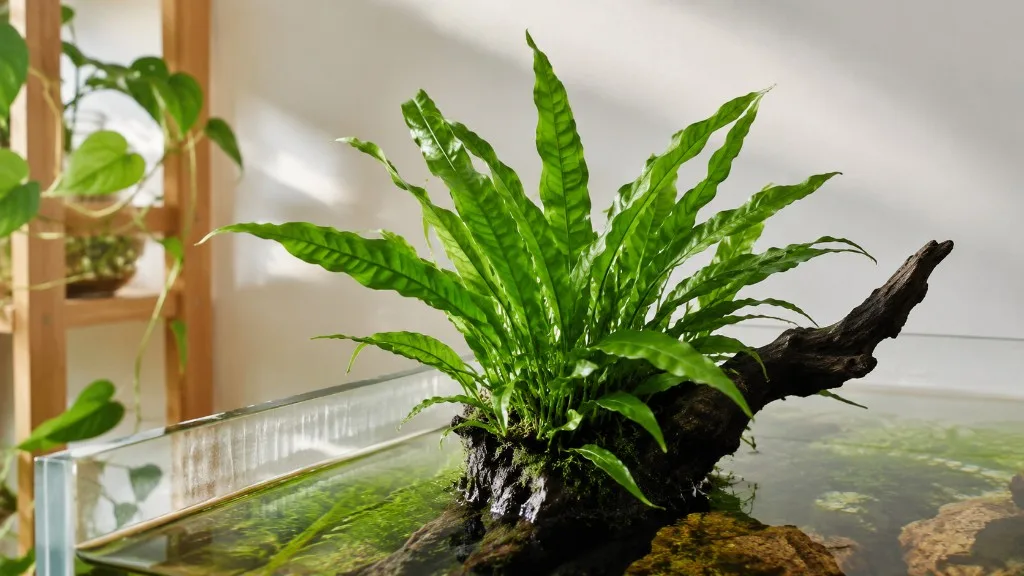
Java fern (Microsorum pteropus) is one of the easiest freshwater aquarium plants—until someone treats it like a potted houseplant. Care succeeds when you attach the rhizome to driftwood or rock and leave it exposed, give low to moderate light on a timer, keep stable tropical water, and read melting leaves and black spots correctly. If you searched for soil moisture, pebble trays, or windowsill watering, pause: that advice belongs to terrestrial ferns, not this Asian water fern.
Written by Sai Ananth and reviewed by Dr. Ananya Rao (horticulture; tropical ornamentals and plant nutrition) on 2026-08-02. Aquarium culture notes were cross-checked against Tropica grower sheets and Kew taxonomy before publication.
Java Fern Is an Aquarium Epiphyte (Not a Houseplant Fern)
In the hobby, Java fern is an epiphyte: leaves and thin holdfast roots grow from a thick horizontal rhizome that must stay in open, oxygenated water. Nutrients move mostly through fronds and the exposed rhizome from the water column, not from gravel packed around a buried crown. That ecology is why burying the plant “like an Amazon sword” is the classic beginner kill—and why terrestrial potting mix has no place in a fish or turtle tank.
Plants of the World Online describes Microsorum pteropus as a helophyte or lithophyte native to tropical and subtropical Asia, growing in wet tropical biomes on rocks and wet margins—not as a windowsill houseplant. Tropica’s culture sheet is equally direct: grow it on a root or stone, and do not cover the rhizome or it will rot.
This page is the consolidated aquarium on-ramp. For step-by-step topic depth and symptom triage, use the Java fern care hub. If you actually wanted a potted indoor fern, switch to the indoor fern plant care guide instead of forcing houseplant habits onto an aquatic rhizome.
Botanical Profile, Synonyms, and Common Cultivars
Family Polypodiaceae. Trade labels almost always say Microsorum pteropus. Kew lists Leptochilus pteropus among homotypic synonyms, and some checklists prefer that name; fish-store tags and Tropica pots still use Microsorum pteropus, so that is the name you will see on bags and pots.
Tropica rates the species Easy, slow-growing, typically 15–30+ cm tall, with low light and low CO2 demand. Fronds are leathery and long-lived. When you buy, inspect the rhizome: firm green-to-brown tissue with growing tips is healthy; soft black mush means rot has already started.
Windeløv, Narrow Leaf, and Trident Placement
Cultivars share the same rhizome rule and water-column feeding. Placement differs by height and leaf shape:
| Cultivar (trade spelling) | Look | Best placement |
|---|---|---|
| Standard / broad leaf | Sword-like midground fronds | Midground wood or rock |
| Narrow Leaf / Needle Leaf | Slimmer blades, often taller silhouette | Mid–background hardscape |
| Trident | Forked tips | Focal midground accents |
| Windeløv (often sold as “Windelov”) | Finely branched lace tips | Fore–midground; avoid blasting with intense center LEDs |
Aquarium Co-Op notes Trident, Needle Leaf, Windelov, and Narrow Leaf share the same growth requirements. Standardize Windeløv once in labels when you can; shops often drop the ø.
Quick Care Snapshot
| Care factor | Baseline target | Deeper guide |
|---|---|---|
| Mount | Rhizome fully exposed on wood/rock | Soil / attachment |
| Light | Low–moderate; 6–8 h timer in low-tech tanks | Light |
| Water | Stable ~68–82°F, ~pH 6.0–7.5, regular partial changes | Watering / parameters |
| Feed | Liquid all-in-one in the water column; CO2 optional | Fertilizer |
| Watch-outs | Burial, acclimation melt, high-light algae, copper meds | Problems via hub |
For healthy Java fern: attach the rhizome, keep it exposed, run restrained light on a timer, hold stable tropical parameters with gentle flow, and dose liquid fertilizer only when the tank is lean. Expect slow growth. Treat sudden translucent melt on a new emersed-grown plant as acclimation until the rhizome softens.
Tank Notes From Our Editorial Setups
These are LeafyPixels editorial aquarium notes from mounts we documented while building the Java fern cluster—not lab trials. Your stocking, volume, and fixture will differ; use them as failure patterns, not guarantees.
20 June 2026 — burial fail (10-gal shrimp nano). A Narrow Leaf piece was wedged under gravel “so it would not float.” Within 10 days the rhizome went soft and black while fronds still looked mostly green. Unburying and remounting on spiderwood stopped further spread on the firm tip; the buried half was discarded. Lesson: green leaves can lag behind a dying crown.
3–24 July 2026 — emersed-to-submersed melt (20-gal community). A Tropica-style basket plant floated for two days, then gel-glued to Malaysian driftwood under a dimmable LED at ~40% with a 7-hour photoperiod. Old emersed fronds turned translucent over about 12–18 days; new submerged leaves appeared from a firm rhizome by week three. We removed only fully dissolved tissue.
28 July 2026 — mount durability. Cotton thread cut into a soft rhizome after three weeks of growth; gel cyanoacrylate beads on dry contact points held the same clump after a hardscape rearrange. Prefer gel glue or loose fishing-line spirals over tight cotton on fragile tissue.
Algae after light bump. Raising the same 20-gal fixture to 100% for carpet plants coated older Java fern fronds with green spot algae within two weeks. Dimmed to 50% and shaded with floaters; new fronds stayed clean while we trimmed the worst old leaves later.
How to Attach Java Fern to Driftwood and Rock
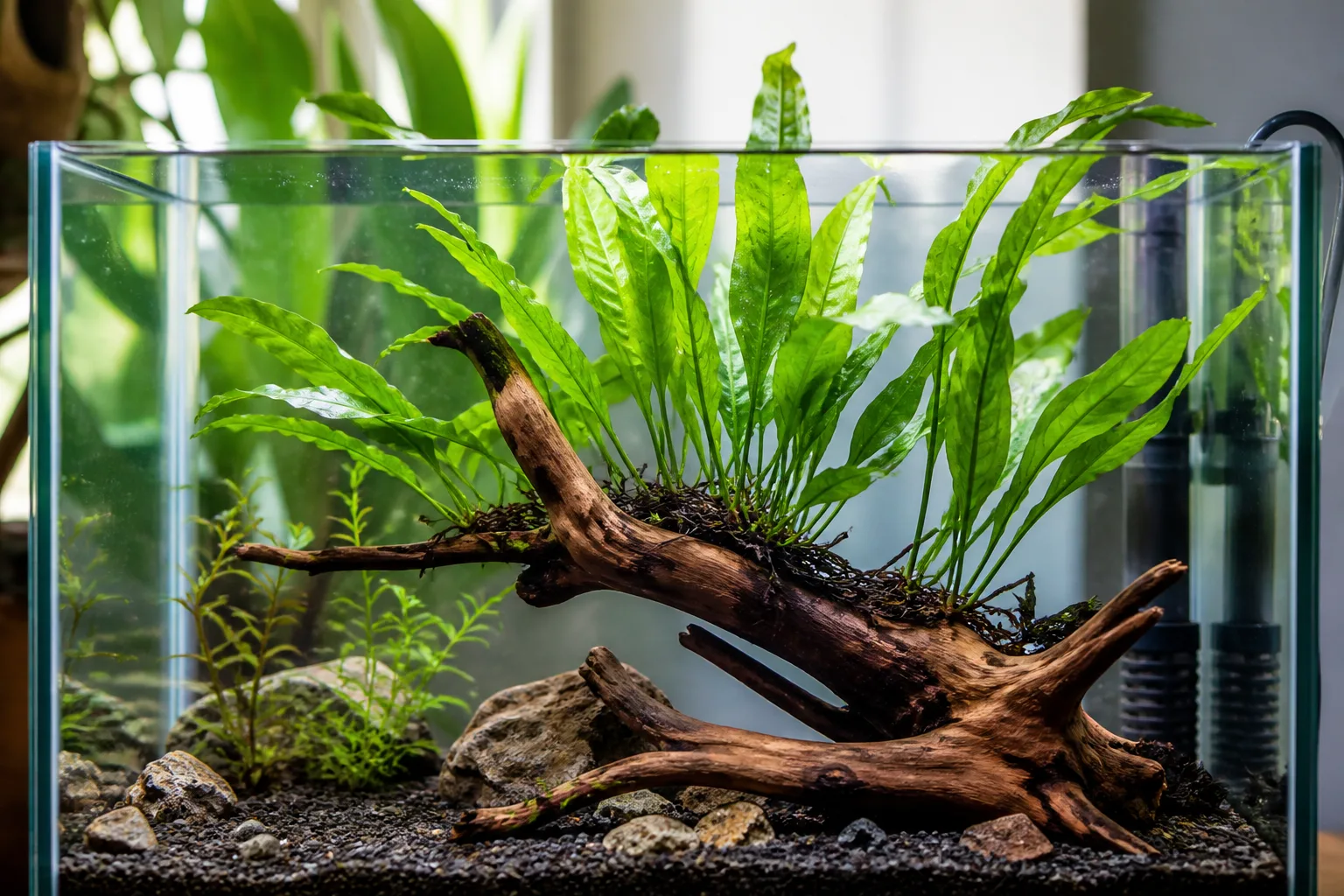
“Soil” is the wrong mental model. The correct substrate is hardscape. Tropica states the plant should be grown on a root or stone and attached until it gains a hold. Aquarium Store Depot is blunt: burying the rhizome in sand or gravel causes rot every time.
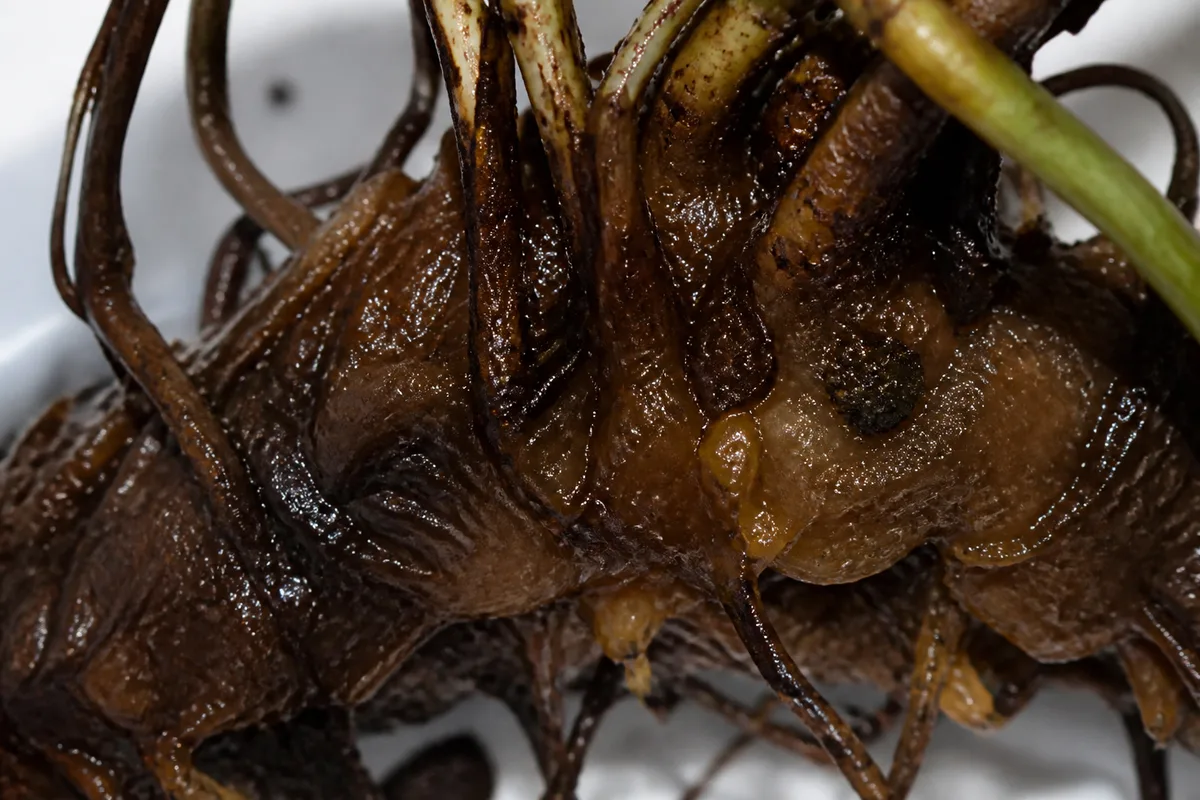
Holdfast roots may trail into crevices. The thick rhizome where leaves emerge must stay exposed. Free rock-wool basket plants, rinse, and remount before they spend another week half-buried. Recovery details live in the soil guide and root rot page.
Gel Glue, Thread, and Wedging Compared
- Gel cyanoacrylate (aquarium-safe super glue): Dry the contact point, apply small beads under the rhizome (do not encase it), press 15–30 seconds, optionally air-dry briefly, then submerge. Aquarium Co-Op favors this gel-bead method.
- Fishing line or cotton thread: Wrap loose spirals every couple of centimeters—snug, not cutting. Remove ties after holdfasts grip. Avoid harsh cotton on soft tissue (see editorial note above).
- Wedging: Seat the rhizome in a wood fork or lava pocket so current cannot lift it without burying it under gravel.
Floating works for quarantine. Long-term display tanks are easier to inspect when the plant is deliberately mounted. Never treat plant weights as permission to bury the rhizome.
Light and Photoperiod for Low-Tech Tanks
Java fern earns its low-light reputation. Tropica lists low light demand. Aquarium Co-Op notes it tolerates a wide brightness range but can burn or melt at the very high end. Practical low-tech target: low to moderate intensity—enough for slow new fronds, not enough to paint old leaves with algae.
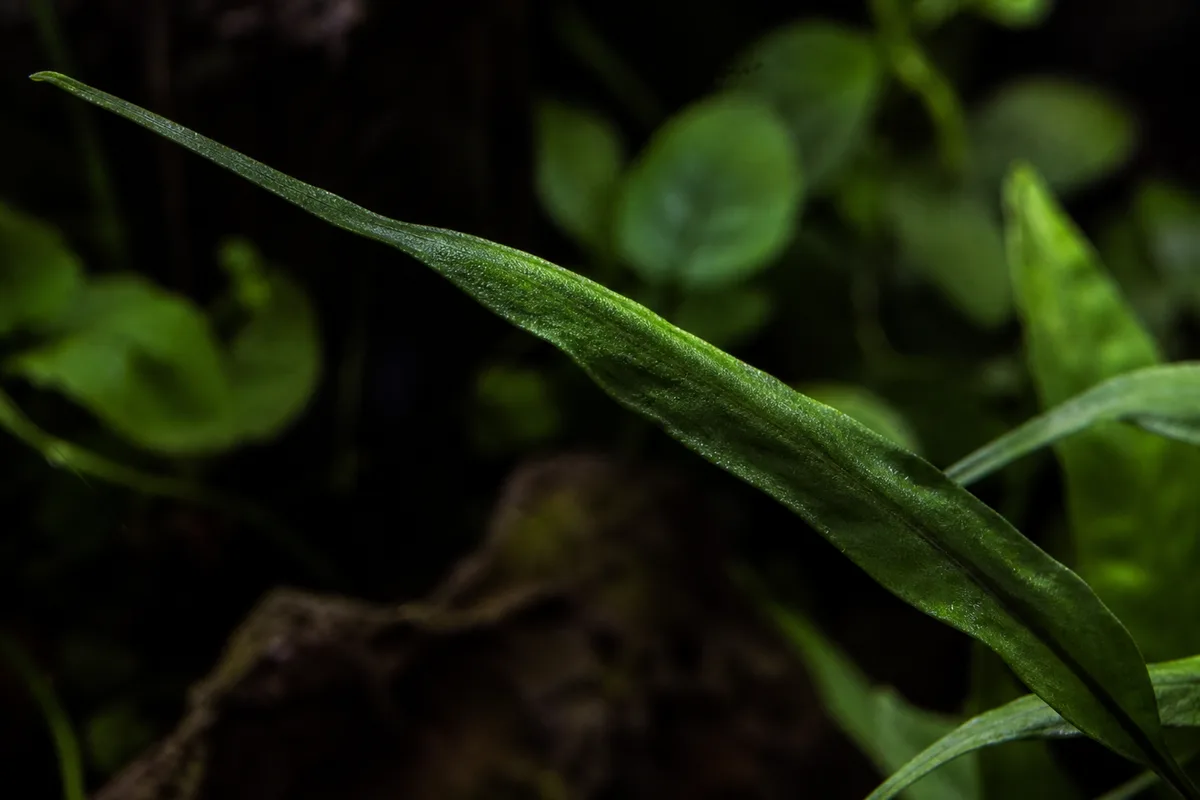
Tropica’s Easy-plant lighting guide recommends roughly 10–20 lumen per litre for tanks stocked only with Easy plants, and notes light falls off sharply toward tank corners and distance from the fixture—useful for placing Microsorum on shaded hardscape rather than under a center spotlight.
Run a full-spectrum LED on a timer. Window sun through glass swings intensity and temperature; slow fronds cannot outpace the algae that follow. For PAR dial-in, use the Java fern light guide.
When High Light Backfires
Under intense, unshaded LEDs you often see tip burn, bleaching, transparent patches, and algae on long-lived fronds. Because leaves persist for months, damage becomes a landing pad.
In most low-tech tanks without CO2, start at 6–8 hours daily. Consistency beats longer days. Shade with hardscape or floaters if green spot algae coats glass and fronds within weeks—reduce intensity before raising fertilizer. Pale stalled growth with a firm rhizome may simply be the plant’s slow nature; confirm with not enough light only after burial and ammonia are ruled out.
Water Parameters, Flow, and Water Changes
Java fern is not “watered” with a can. Watering means keeping aquarium water clean, stable, and gently moving across the rhizome.
Consensus comfort bands from grower and hobby references:
| Parameter | Practical target | Notes |
|---|---|---|
| Temperature | 68–82°F (20–28°C); mid-70s°F ideal | Avoid large cold water dumps |
| pH | About 6.0–7.5 | Wider tolerance exists; stability wins |
| Hardness | Moderate community values (often ~3–12 dGH) | Soft blackwater and harder tap both work if stable |
Aquarium Source cites 68–82°F and pH 6.0–7.5. Aquaterra Obsession echoes 20–28°C (68–82°F) with slightly acidic to neutral water and suggests 20–30% partial changes every 1–2 weeks as a baseline. You do not need a perfect single number; you do need to avoid swinging chemistry after big untreated tap changes.
Aim gentle to moderate current across the rhizome so detritus does not settle in leaf axils. Match change-water temperature within a couple of degrees. Ammonia and nitrite from an uncycled tank burn fronds quickly. Deeper parameter logic sits in the watering guide.
Feeding the Water Column (Fertilizer and Optional CO2)
Java fern is a water-column feeder. Root tabs under gravel do little for an epiphyte whose rhizome never enters the substrate. In stocked tanks, fish waste often supplies baseline nitrogen; lean or heavily filtered tanks benefit from a modest liquid all-in-one matched to plant mass and water-change rhythm—typically once or twice weekly at label rates, then reassess after three to four weeks because this plant responds slowly.
Tropica lists low CO2 demand. Injected carbon dioxide can speed growth in high-light aquascapes; it is optional for healthy Java fern in a low-tech community tank. Pinholes with yellow halos on older leaves often point to potassium shortfalls. Overfeeding without water changes fuels algae on fronds the fern will not quickly replace. See the fertilizer guide when holes or necrosis dominate.
Melting Leaves: Acclimation vs Real Trouble
Most emergencies sort into four buckets: buried rhizome, transition melt, water-quality or nutrient stress, and misread sporangia. Check placement first, then ammonia/nitrite and recent water changes, then light, then fertilizer.
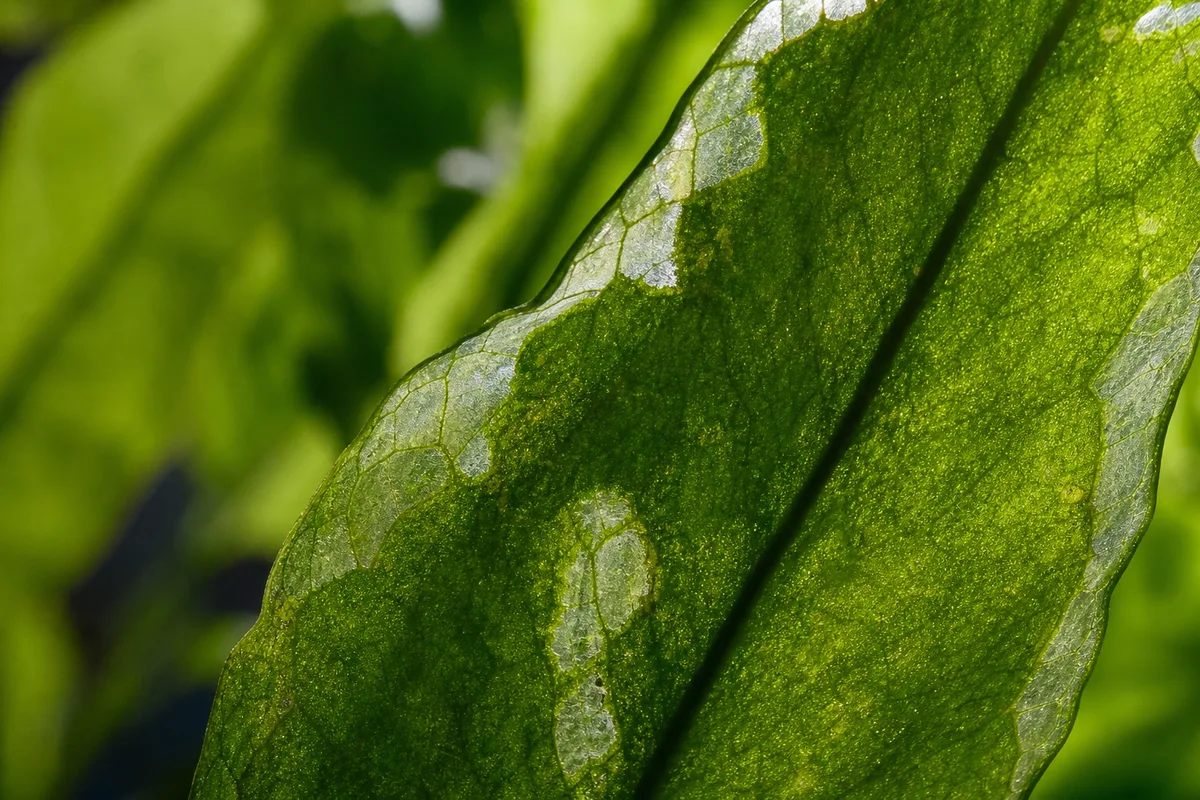
Most shop and mail-order Java fern is grown emersed. After submersion, old emersed fronds often turn translucent and dissolve over one to three weeks while the rhizome pushes new underwater leaves. That melt is acclimation, not automatic failure—matching what we saw in the July 2026 editorial mount.
Keep the rhizome attached and exposed. Remove only fully dissolved slime. Look for new submerged fronds within two to four weeks. If nothing emerges and the rhizome softens, burial, ammonia, or cold shock is more likely than “normal melt.” Transparent tissue under intense light is also covered on transparent leaves.
Firm Rhizome, Soft Rhizome, or Underside Bumps
Use this quick decision tree:
- Firm rhizome + translucent old fronds after a move or unboxing → wait; trim only mush; watch for new submerged leaves.
- Soft, black, foul rhizome (often after burial) → lift, cut to firm tissue, remount, fix water quality; see root rot.
- Firm, organized dark bumps on frond undersides → usually healthy sporangia, not disease.
- Algae-coated old leaves + clean new growth → fix light/organics, then trim old fronds.
Black Spots: Sporangia vs Rot
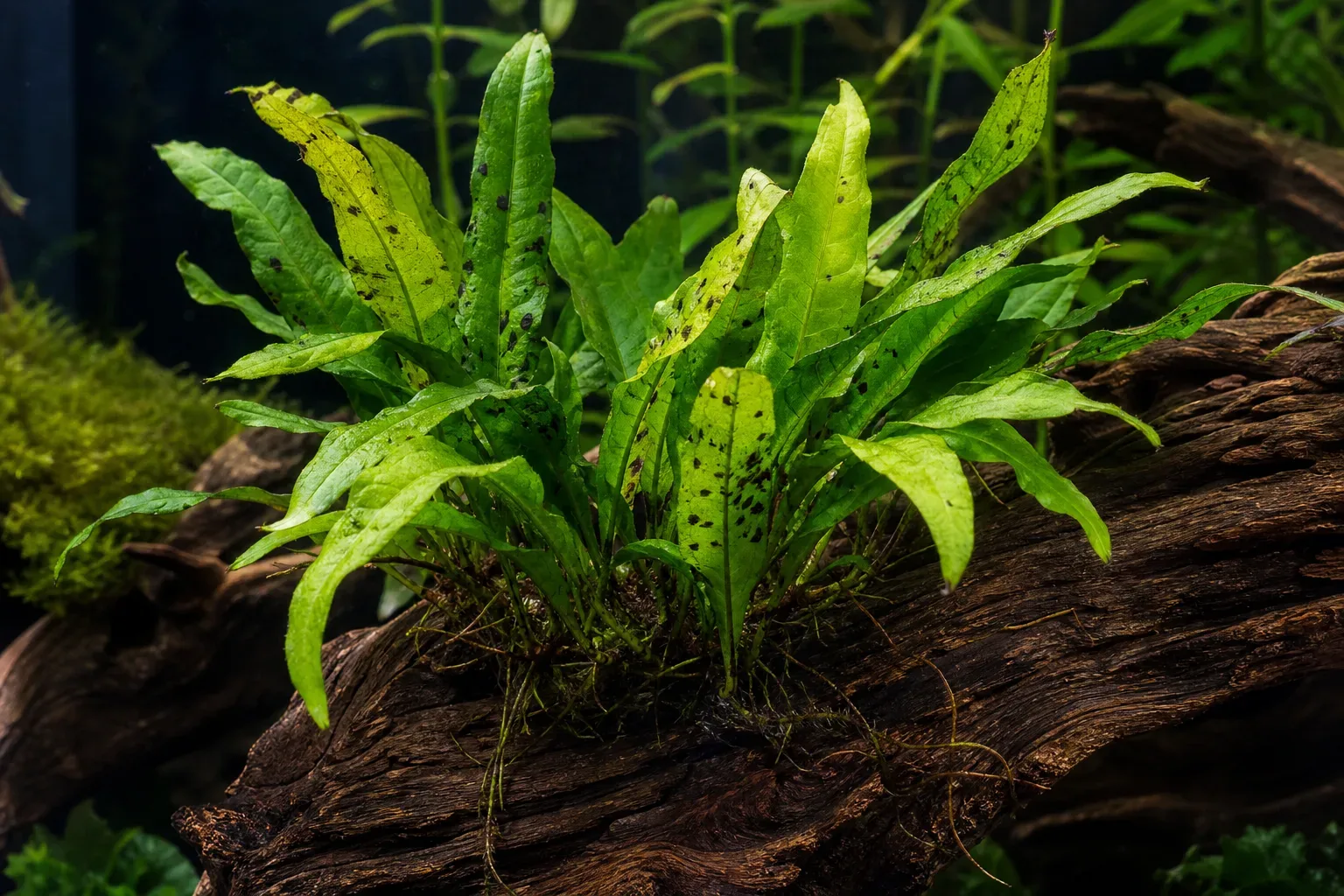
Firm, organized dark bumps on the undersides of mature fronds are usually sporangia (sori)—reproductive organs. Tropica explicitly notes these black spots are not disease. Fuzzy, spreading spots on mushy tissue, or a soft black rhizome, are different: trim dead material, confirm exposure, and treat water quality.
| Sign | Likely meaning | Action |
|---|---|---|
| Organized underside bumps, firm tissue | Sporangia | Leave alone |
| Soft rhizome, base blackening | Rot / burial | Unbury, trim, remount |
| Translucent dissolving fronds, firm rhizome | Acclimation or light shock | Stabilize; trim slime only |
| Green spot algae on old leaves | Excess light / organics | Dim/shade; trim later |
Photo-led differentials continue on black spots.
Propagation: Division and Leaf Plantlets
Two reliable methods:
- Rhizome division: Cut a healthy rhizome into sections with at least one frond and several holdfasts, then mount each piece (Tropica’s standard advice).
- Adventitious plantlets: Tiny ferns form on mature frond edges or near sori. Aquarium Co-Op describes plantlets along leaf edges and notes stressed leaves may produce many babies—useful for a second tank, not a reason to keep rotting tissue in the display. Wait until small roots appear, then detach and attach to new hardscape.
Do not divide a melting or rotting plant until firm green rhizome remains. Full methods sit in the propagation guide.
First 30 Days Checklist
Print or skim this after planting:
- Day 0: Free rock wool; rinse; mount with gel glue, loose line, or a true wedge—rhizome fully exposed.
- Day 0: Set LED timer to 6–8 hours; place the mount in shade of hardscape if the fixture is strong.
- Week 1: Confirm no gravel is creeping over the rhizome after fish digging; check ammonia/nitrite if the tank is new.
- Weeks 1–3: Expect some emersed-leaf melt; do not uproot a firm rhizome; remove only dissolved tissue.
- Week 2–4: Look for new submerged fronds; start lean liquid fertilizer only if the tank is sparsely stocked and leaves pale without melt.
- Day 30: Soft ties removable if holdfasts grip; trim algae-coated old leaves if new growth is clean; open the hub only if a single symptom dominates.
Safety Notes (Copper, Stocking, Turtle Tanks)
Copper and algaecides. Copper-based products are used as broad-spectrum aquatic herbicides and algaecides; UF/IFAS notes copper kills a wide range of algae and aquatic plants by disrupting plant metabolism, and that formulations can be highly toxic to mollusks and some fish—especially in soft water. Treat aquarium ich/algae “cures” that list copper the same way: remove Java fern to a matched-water tub before dosing, or choose plant-safe alternatives when the stand matters. Chemical injury patterns are documented on chemical damage.
Stocking. Thick, leathery fronds often shrug off goldfish and many cichlids better than soft stem plants (a point Aquarium Co-Op and Store Depot both emphasize), but no plant is chew-proof against determined diggers that bury the rhizome under substrate.
Turtle tanks. Java fern is commonly used in aquatic turtle setups. LeafyPixels does not treat that husbandry pattern as species-wide veterinary clearance that every turtle can eat or live with every cultivar safely. Match temperature and water quality to the turtle species, quarantine new plants, avoid terrestrial fertilizers and copper in turtle water, and ask a qualified reptile veterinarian when diet or enclosure safety is uncertain. See the Java fern hub pet-safety notes for the cautious baseline we publish.
Where to Go Next
One short handoff—not a full sitemap:
- Java fern hub — overview, cultivars, and problem index
- Light — PAR, photoperiod, algae-prone LEDs
- Soil / attachment — mount methods and burial recovery
- Root rot and black spots — when one symptom needs a full diagnostic path
- Indoor fern care — terrestrial ferns that do want potting mix (contrast only)
Supporting topics (watering, fertilizer, propagation) stay one click from the hub when you need them.
Conclusion
Java fern care is simple when you treat Microsorum pteropus as a riverbank epiphyte in an aquarium, not as a potted houseplant. Attach the rhizome and keep it exposed, run low to moderate light on a steady timer, hold stable tropical water with gentle flow, feed the water column lightly when the tank is lean, expect acclimation melt on new emersed stock, and read firm underside black spots as healthy sporangia.
If you remember one rule: never bury the rhizome. Use the 30-day checklist above for the first month, then open the Java fern hub when a single symptom needs more than this on-ramp.