Philodendron Pink Princess Care: Light, Pink & Pruning
Grow Philodendron Pink Princess indoors: bright indirect light for pink variegation, soil-check watering, chunky soil, pruning balance, and White Knight differences.
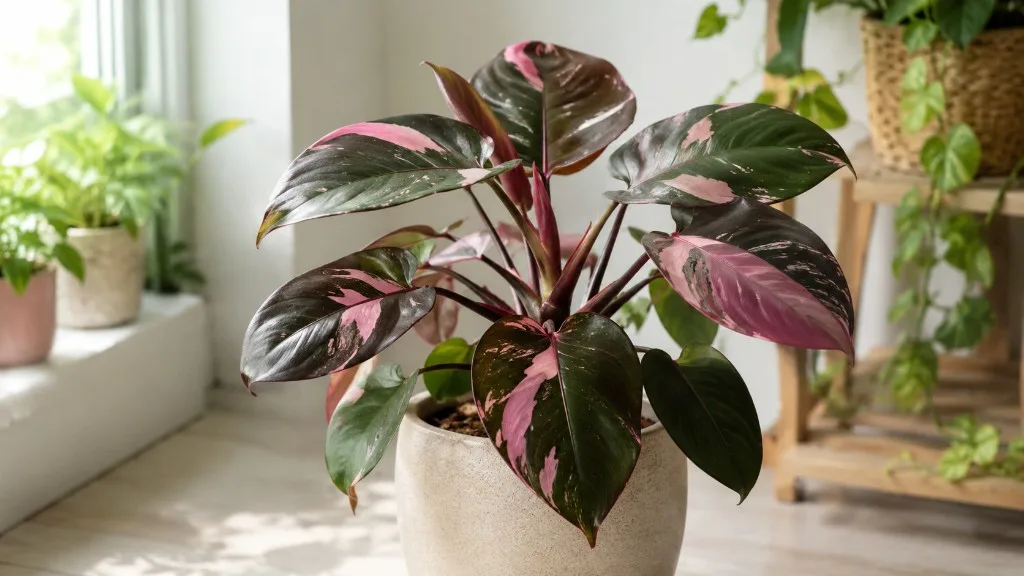
Philodendron Pink Princess is bought for bubblegum-pink splashes on dark leaves — and lost when those new leaves arrive mostly green, or so pink they brown and collapse. The two biggest failures are the same ones we see at home: a green takeover after weeks of dim light, and fragile all-pink tissue that crisps under hot sun or cannot feed itself. Good care is not a secret fertilizer. It is bright indirect light for patterned tissue, watering only after the mix partly dries, chunky soil in a draining pot, a climbing support, and pruning decisions based on the stem pattern, not panic after one green leaf.
Written by Sai Ananth (B.Pharmacy, pharmacognosy background; LeafyPixels lead writer and indoor grower of variegated aroids) and reviewed by Dr. Priya Menon (botanist and indoor plant specialist) on the LeafyPixels Review Board. Observations below come from three Philodendron erubescens ‘Pink Princess’ plants grown in a north-central Ohio apartment (USDA zone 6a): one on a coir pole two feet from a sheer-filtered south window, one at an east window without support, and one recovery plant moved from a dim hallway back to bright light. Your rooms will differ — treat intervals as lived-in benchmarks, not rules.
Philodendron Pink Princess — look for pink sectors on newest leaves and pink streaking on the stem between nodes.
Quick Care Snapshot
For healthy indoor Pink Princess, place the plant in bright indirect light, water when the upper 3–5 cm (about 1–2 inches) of potting mix have dried, use a chunky aroid mix in a pot with drainage holes, give it a moss pole or trellis, and fertilize lightly during active growth. Pink tissue needs more usable light than solid-green philodendron to keep producing patterned leaves, but it burns faster in harsh sun. Watering by soil condition beats watering by calendar every time. (RHS)
| Care factor | Baseline target | Deeper guide |
|---|---|---|
| Light | Bright indirect; protect pink from hot direct sun | Light |
| Water | Top 3–5 cm dry, then soak and drain | Watering |
| Soil | Potting mix + perlite + orchid bark; pH ~5.5–6.5 | Soil |
| Feed | Half-strength liquid monthly in active growth | Fertilizer |
| Support | Moss pole or trellis for larger leaves | Pruning |
| Repot | Every 1–2 years, or when roots circle and mix stays wet too long | Repotting |
A Pink Princess in bright east light, a dim hallway, and a humid bathroom will not dry at the same speed. Pot material, root mass, leaf area, and season all change the interval.
What Philodendron Pink Princess Is
Philodendron Pink Princess is a cultivated form of Philodendron erubescens, the blushing or red-leaf philodendron — a climbing tropical aroid in the Araceae family. Kew Plants of the World Online accepts the species and lists its native range as Colombia, where it grows as a climber in the wet tropical biome. NC State Extension describes P. erubescens as a climbing tropical herbaceous perennial that can scramble up to about 60 feet in rainforest conditions, while indoor plants typically stay around 3 feet tall and 16 inches wide, with glossy foliage, reddish undersides, and purplish-red petioles.
Botanically, Pink Princess is not a separate species. It is Philodendron erubescens ‘Pink Princess’ — a selected cultivar NC State lists with an upright, vining habit and heart-shaped dark purplish-green leaves with pink variegation. Clemson HGIC describes red-leaf philodendron (P. erubescens) as a sturdy climber with 10- to 16-inch dark green leaves that are red to copper underneath and reddish-purple young stems. Pink Princess inherits that climbing architecture, then layers unstable pink patterning on top.
Why Chimeric Pink Changes Everyday Care
Variegation in Pink Princess is chimeric — the plant contains both normal green cells and mutated pink tissue, and the balance shifts as it grows. One leaf may be heavily marbled; the next mostly green; occasionally a leaf emerges nearly all pink. Pink sectors contain little chlorophyll, so they cannot carry the photosynthetic load. Green sectors do the work.
That biology drives every practical decision. Dim light pushes the plant toward greener, more efficient foliage. Harsh direct sun browns fragile pink first. An all-pink leaf looks spectacular in photos, but it is often functionally weak and may brown or abort because it cannot sustain itself. The long-term goal is balanced variegation across several nodes, not one half-moon leaf followed by a green takeover.
What we see: on our sheer-south pole plant, newest leaves held clean pink sectors when the pot sat within about two feet of filtered glass. After we parked a second plant in a dim hallway for five weeks (same watering habit), three successive leaves arrived greener with longer internodes before we moved it back. Fertilizer did not restore pink; brighter placement did.
Pink Congo Trap and Nursery Tag Mistakes
Do not confuse real Pink Princess with Philodendron ‘Pink Congo’, which has circulated with temporarily pinked foliage from chemical treatment rather than stable genetic variegation. Real Pink Princess variegation emerges from the growth point and repeats irregularly on new leaves when light supports it. Congo pink typically fades as new leaves mature. When buying, inspect the stem and several new leaves — not just one photogenic mature leaf.
Nursery tag mistake we still see: a plant sold as “high variegation” because one show leaf is half pink, while the active growth point and the next two nodes are solid green. That plant is priced on a leaf you will never get again unless the stem still carries pink cells. Walk away — or buy it only as a green climber you plan to prune hard later.
Pink Princess sits in the same collector conversation as White Knight, White Princess, and other variegated erubescens types, but its care profile is still a vigorous climbing philodendron: moderate growth when healthy, faster when heavily green, slower when heavily pink.
Pink Princess vs White Knight
Both are variegated climbers sold as Philodendron erubescens types, and both need bright indirect light plus chunky, free-draining mix. The difference that matters day to day is color tissue and how fragile it is.
| Trait | Pink Princess | White Knight |
|---|---|---|
| Signature color | Pink splash/marbling on dark green | White patches, often with darker stems |
| Fragile tissue risk | Scorch and collapse on heavy pink sectors | Browning on white sectors in hot sun |
| Low-light response | Greener new leaves, longer internodes | Greener new leaves; white contrast fades |
| Pruning goal | Balance pink and green along the stem | Keep usable green with stable white sectors |
| Growth feel | Moderate climber when well lit | Often slower when heavily variegated |
Choose Pink Princess if you want warm pink contrast and will prune for balance. Choose Philodendron White Knight if you prefer cooler white variegation and accept a steadier, often slower climber. Neither is a low-light bargain plant — solid-green heartleaf philodendron tolerates darker rooms far better than either cultivar. (Clemson HGIC)
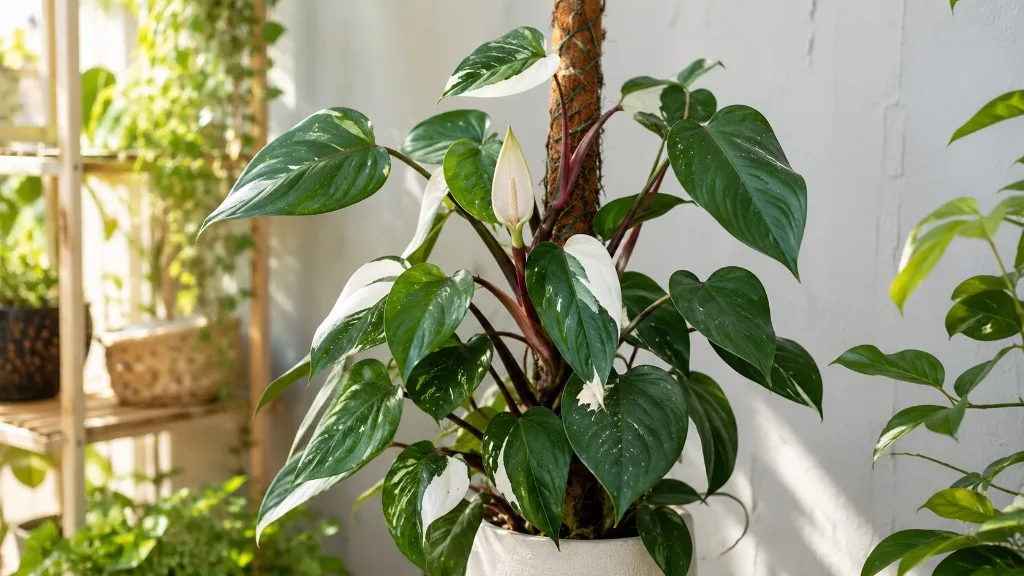
Philodendron White Knight — same bright-indirect climber care skeleton, cooler white variegation instead of pink.
Best Light for Stable Pink
If you remember one rule, make it this: bright, indirect light is non-negotiable for maintaining Pink Princess variegation. Dim light does not usually kill the plant quickly — erubescens is a tough climber — but it reliably produces longer internodes, smaller leaves, and greener new growth. The plant is choosing survival over pink because green leaves capture more light per square inch.
Place it where usable brightness lasts most of the day, and keep hot midday or afternoon sun off pink sectors. NC State lists dappled sunlight to partial shade outdoors and says direct sunlight should be avoided indoors, with a preference for warm temperatures and high humidity. (NC State Extension) The RHS positions philodendrons in bright but indirect light, out of direct summer sun that can scorch leaves, and notes that insufficient light produces leggy growth with fewer, smaller leaves. (RHS)
Window Placement and Grow Lights
Practical placement often means an east window, or 2–3 feet back from a filtered south or west window behind a sheer curtain. Gentle morning sun is often fine; harsh midday or afternoon sun is not, especially on pink sections that lack chlorophyll to dissipate heat. Rotate the pot a quarter turn weekly so the plant does not lean hard toward one side — erubescens stems twist toward light, and uneven exposure makes variegation harder to read.
If natural light is weak, use a full-spectrum grow light for roughly 8–10 hours daily in winter. Start around 30–45 cm below a quality LED and adjust based on leaf response. Artificial light works when intensity and duration are real; a plant across the room from a weak lamp is not receiving the same usable light as one under a proper fixture. UConn likewise recommends bright, indirect sunlight and warns that full sun causes yellowish color or sunburn spots. (UConn)
What we see: our east-window plant (no pole, 6-inch plastic pot) kept usable pink when tips faced the glass. The sheer-south pole plant produced larger leaves but needed weekly rotation so the back of the column did not go green. The hallway plant stayed alive with almost no scorch risk — and steadily greener new growth until we moved it.
Fade vs Reversion vs Too Much Pink
Use this checklist on the newest leaf and the node that produced it — not on old leaves that already finished expanding.
- Phenotypic fade: Newest leaves still show some pink, but contrast is weak and internodes may lengthen. After you brighten exposure, the next 2–4 leaves usually regain patterning. Old faded leaves will not recolor.
- True revert shoot: A stem keeps producing fully green leaves from a green node after light has already improved for several weeks. Prune back to the last node that still shows pink on leaf or stem. Bright light alone will not recolor that shoot.
- Too much pink: Nearly all-pink leaves brown, crisp, or stall. That is weak tissue, not a trophy. Improve overall plant vigor and keep some green photosynthetic area; do not chase maximum pink with more fertilizer.
What we see on recovery: after returning the hallway plant to the east window in late spring, the first new leaf was still muted; the third and fourth leaves regained clearer pink sectors over about three to four weeks of active growth. The same move in winter (shorter days) took longer — closer to five to six weeks before the fourth leaf showed useful pink. Extra fertilizer during that move did nothing useful.
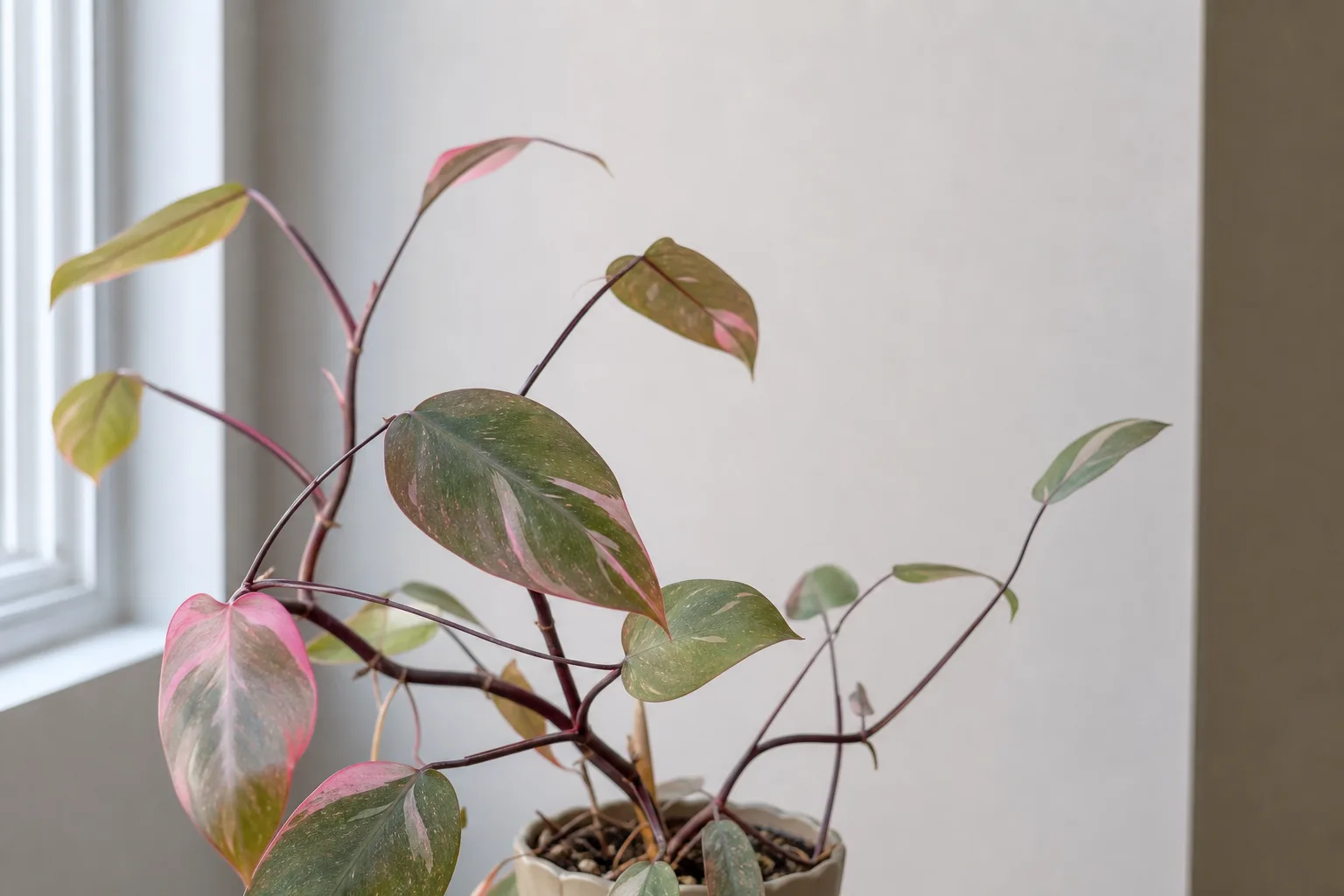
Low-light Pink Princess (hallway phase) — greener new growth and longer internodes before the east-window recovery move. Use this look when checking the fade-vs-reversion checklist on the newest leaf.
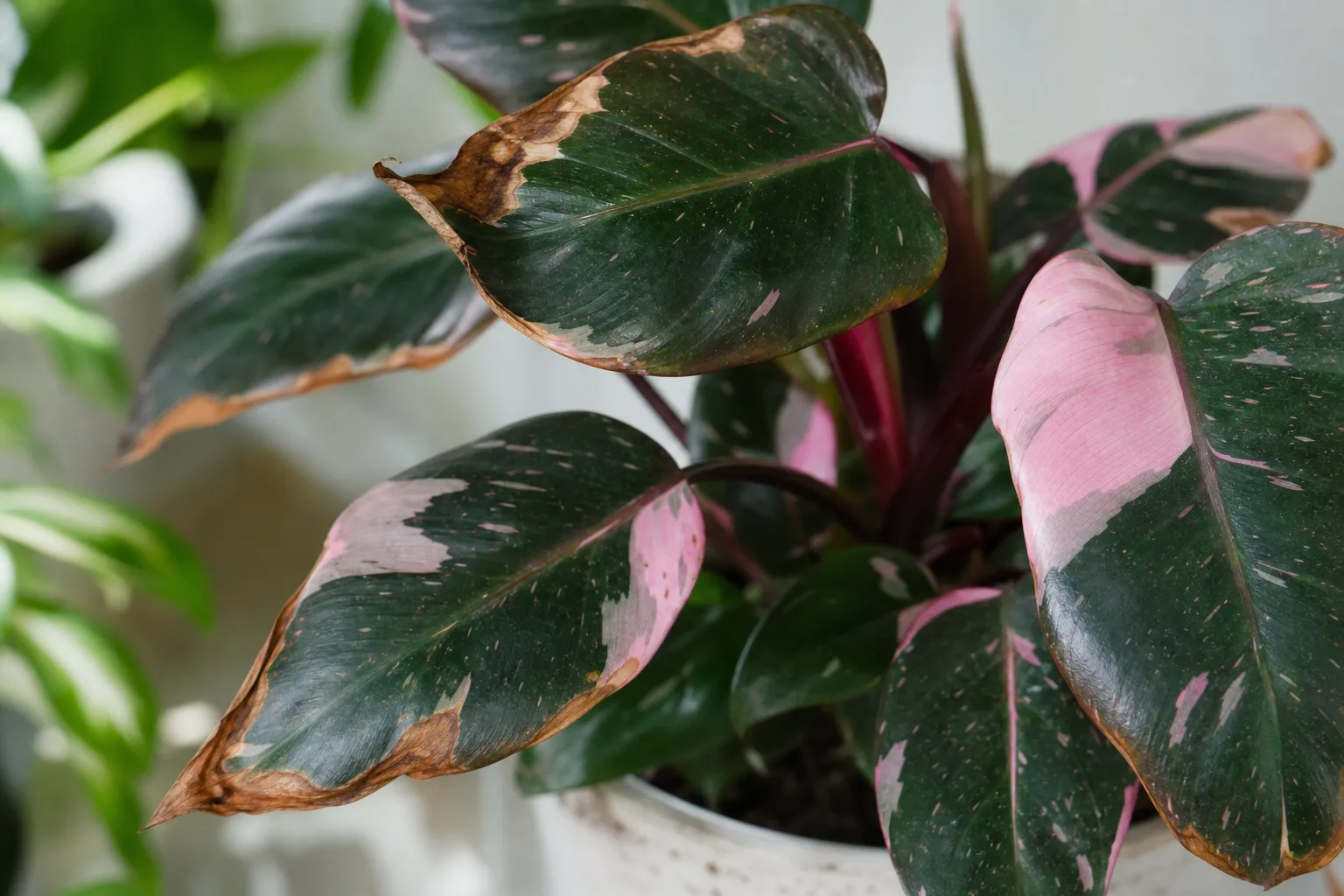
Fragile pink tissue after hot exposure or an all-pink leaf that could not sustain itself — filter harsh sun and keep enough green area for photosynthesis.
Dig into window-by-window detail on the Philodendron Pink Princess light guide when you need more placement bands. For stretch and weak color, also see not enough light and leggy growth.
Watering by Soil Check
Pink Princess wants the same watering philosophy as most climbing aroids: let the mix approach dryness, then water thoroughly — never sit the roots in stale water. Heavily variegated plants often use water more slowly than all-green siblings because they have less photosynthetic tissue. Overwatering is the more common killer.
Water when the top 3–5 cm of mix is dry, roughly every 7–10 days in active summer growth and every 10–14 days in cooler, dimmer winter as a starting rhythm — then confirm with your finger or pot weight before you pour. RHS guidance for philodendrons is to wait until the top of the compost dries slightly between waterings and never leave plants standing in water. (RHS) Clemson recommends keeping soil evenly moist but not soggy, and never letting plants stand in water. (Clemson HGIC) Missouri Botanical Garden explains that waterlogged roots cannot get oxygen and that overwatering damage is a common houseplant failure mode. (Missouri Botanical Garden)
Seasonal Dry-Down We Measured
Insert your index finger to the second knuckle — about 3–5 cm — or push a dry bamboo chopstick into the mix and leave it ten seconds. Cool, damp stick means wait. Dry, crumbly surface with cool-damp deeper mix means you are approaching the right window. Lift the pot occasionally; a dry pot is noticeably lighter. When you water, soak until excess runs from the drainage holes, then empty the saucer within thirty minutes.
Avoid the two classic mistakes: daily dribbles that keep the surface wet but never hydrate roots deeply, and watering on a calendar while the plant sits in a cold, dim room using almost no moisture. Pink Princess will tolerate a brief dry spell better than chronic soggy roots. Root rot on Philodendron Pink Princess shows up as yellowing leaves on wet mix, soft petioles, and a sour smell — not as a problem you can fix by giving it more water. For symptom workflows, use overwatering, underwatering, and yellow leaves. Clemson’s indoor watering factsheet reinforces checking the actual pot rather than guessing from a calendar. (Clemson HGIC watering)
What we see on dry-down in our equal-parts potting mix + perlite + orchid bark (finger + pot-weight checks, same apartment):
| Setup | Typical warm-season interval | Cooler/darker months |
|---|---|---|
| East window, 6-inch plastic, no pole | 7–9 days | 10–14 days |
| Sheer-south, 6-inch on coir pole | 6–8 days | 9–12 days |
| Dim hallway recovery plant | Mix stayed wet 12+ days | Do not water on a summer calendar |
Colorado State Extension PlantTalk summarizes the genus habit as moist but not soggy soil, with excess drainage discarded. (Colorado State Extension PlantTalk)
Soil, Pots, and Climbing Support
Use a chunky, well-draining aroid mix, not straight peat-heavy bagged soil that compacts into a wet brick. Our tested home recipe under the three setups above: potting mix + perlite + orchid bark, roughly in equal parts by volume, adjusted toward more bark if you tend to overwater. LeafyPixels plant data targets pH 5.5–6.5. The RHS prefers a loose, free-draining, slightly acidic compost (about pH 5–6) and suggests mixes such as two parts orchid compost to one part peat-free ericaceous compost. (RHS) UConn recommends loose, well-drained soil high in organic matter. (UConn)
Drainage holes are mandatory. Decorative cache pots without drainage are where Pink Princess goes to rot quietly. Terracotta dries faster and forgives heavy-handed waterers; plastic holds moisture longer and suits attentive underwaterers in bright light. Choose based on your habits, not aesthetics alone. RHS notes philodendrons can often stay in the original container for a couple of years until roots get densely packed, and spring is the best time to repot — avoid jumping to a much larger pot that keeps compost wet for too long.
Pink Princess is a climber. NC State notes it can grow on a moss pole or trellis indoors, or spread outward if unsupported. (NC State Extension) Train the stem upright with soft ties and keep aerial roots against a dampable pole if you want larger leaves. A flopping unsupported vine often produces smaller, greener foliage even when the window is bright. Full mix and pot detail lives on the soil and repotting pages; for a pole build, see our DIY moss pole guide.
Pruning for Color Balance
Pruning Pink Princess is how you protect the pink you paid for. Variegation is carried through nodes, not guaranteed on every leaf. Balanced pink-and-green color along several consecutive nodes beats one spectacular half-moon leaf followed by all-green growth. Pruning serves four jobs: remove fully reverted green stems, shorten leggy vines above nodes, trim failing all-pink tissue, and harvest cuttings with usable variegation.
Pruning does not fix chronic under-lighting. If new leaves unfurl mostly green with long internodes, improve placement before expecting pink to return from shears alone. Late spring through summer is the best window for shaping cuts, when new shoots emerge from nodes within a few weeks. Emergency removal of mushy or dead tissue can happen any time. Wear gloves — sap can irritate skin, and the plant is toxic if chewed. (Clemson HGIC) (ASPCA)
After dead and damaged tissue is gone, trace any stem producing three or more consecutive all-green leaves. Follow it back to the last node that still shows variegation on the stem or on a nearby leaf. Cut 6–10 mm (about ¼ inch) above that node with sterilized shears. Limit routine removal to no more than one-third of total vine length or foliage per session on small plants. Do not strip a plant to bare stubs hoping pink will “reset.” Leave enough green photosynthetic area for recovery.
What we see: on the hallway recovery plant, one runner produced four solid-green leaves after the move back to light. We cut just above the last pink-streaked node (visible pink flecks on the stem, not only on an old leaf); a lateral shoot with mixed variegation emerged about three weeks later in late spring. Leaving that green runner would have outgrown the patterned stems. For step-by-step technique, use the dedicated Philodendron Pink Princess pruning guide.
Fertilizer, Humidity, and Temperature
Feed during active growth, not as a substitute for light. UConn calls philodendrons relatively heavy feeders and recommends fertilizing more frequently at half strength than applying one strong dose, always onto already-moist soil. (UConn) Clemson recommends dilute water-soluble fertilizer or a time-release product; excess can curl and brown leaf tips. (Clemson HGIC) Do not chase maximum pink with more fertilizer — pink is a light and genetics problem first. If you feed monthly in active growth, flush the pot with plain water every few months to limit salt buildup at the leaf tips.
Humidity helps leaf quality but will not create pink by itself. NC State prefers high humidity for P. erubescens; RHS notes philodendrons prefer moderately humid air but tolerate typical room humidity. (NC State) (RHS) A practical indoor target is roughly 55–70% if you can manage it with a humidifier or plant grouping — especially in dry winter heating — but treat that band as a comfort range, not a hard requirement.
Temperature comfort matches the species profile: NC State cites 65–85°F (18–29°C) and protection from cold drafts; RHS says keep above 15°C (59°F) and away from hot radiators and cold draughts. (NC State) (RHS) University of Minnesota Extension’s houseplant care overview stresses matching water and light to real indoor conditions rather than outdoor garden habits. (UMN Extension)
Propagation Basics
Propagate from stem cuttings that include at least one node and preferably a leaf with visible variegation on the stem, not only a pink leaf blade. Clemson notes philodendrons can be propagated any season from stem cuttings or air layering. (Clemson HGIC) RHS describes stripping lower leaves, rooting in water for a couple of weeks, then potting into a free-draining mix. (RHS)
For Pink Princess specifically, choose cuttings from stems that still show pink streaking at the node. An all-green cutting will grow an all-green plant. An all-pink cutting may root poorly because it lacks photosynthetic tissue — skip “established” all-pink cuttings sold without roots unless you accept high failure risk. Root in water or directly in chunky mix; transplant water-rooted cuttings once roots are a few centimetres long. Full workflows live on the propagation page.
Common Problems and First Fixes
Most Pink Princess problems are cultural before they are mysterious diseases. Clemson notes that in the home, diseases are rarely the main issue — too much or too little water plus insects and mites dominate, and root rot usually comes from poorly draining mix or overly frequent watering. (Clemson HGIC) NC State lists spider mites, mealybugs, aphids, and scale as pests to monitor, with overwatering causing root rot and leaf spots reduced by watering at the base. (NC State)
| Symptom | Likely first cause | First move |
|---|---|---|
| New leaves mostly green | Low light or reverted stem | Brighten light; prune green runners |
| Pink sectors brown/crisp | Hot direct sun or weak all-pink tissue | Filter light; keep green balance |
| Yellow leaves + wet mix | Overwatering / poor drainage | Dry-down; check roots; refresh mix |
| Long internodes, small leaves | Insufficient light | Move closer to bright indirect light |
| Sticky residue / white fluff | Mealybugs or related pests | Isolate; wipe; treat promptly |
| Fungus gnats | Chronically wet surface | Let mix dry deeper; improve airflow |
For dedicated workflows, start with yellow leaves, brown tips, spider mites, mealybugs, fungus gnats, and root rot. Broader houseplant context for yellowing and watering mistakes also appears in our indoor plant yellow leaves and how to water indoor plants guides when the issue is not species-specific.
Pet Toxicity and Safety
Philodendrons are toxic to cats and dogs. They contain calcium oxalate crystals that can cause burning and irritation of the mouth, lips, and tongue, along with drooling, vomiting, and difficulty swallowing. (Clemson HGIC) The ASPCA lists philodendron among toxic plants for pets. NC State also flags the species as a problem for cats and dogs, with calcium oxalate as the toxic principle. (NC State)
Keep Pink Princess out of reach — climbing vines grow into pet access over time if you train them on low furniture. Wear gloves when pruning. If ingestion is suspected, contact a veterinarian or ASPCA Animal Poison Control at (888) 426-4435. Pink Princess is not a pet-safe substitute for a non-toxic plant; if you need safer options, start with our pet-safe houseplants guide and toxic plants for cats overview, then choose different species. Genus-wide safety notes also live in philodendron toxicity.
Buying and Quarantine Checklist
Inspect the stem, not only the most photogenic leaf. Variegation is carried through nodes, so a plant with balanced color along several nodes is a better bet than a cheap cutting with one pink leaf and a plain green growth point.
- Look for pink streaking or mottling on the stem between nodes
- Check that newest leaves still show some pink, not only old show leaves
- Avoid mushy petioles, sour-smelling wet moss, or soft nodes
- Prefer rooted plants in chunky mix over freshly stuck unrooted cuttings sold as established plants
- Skip “too pink to photosynthesize” specimens unless you accept high failure risk
- Confirm you are not buying chemically pinked Pink Congo marketed as Pink Princess
Shipping and quarantine aftercare: Keep a new plant isolated from the rest of your collection for two to three weeks. Unpack immediately, inspect leaf undersides and nodes for mealybugs, scale, and webbing, and wipe dust or packing debris before it joins other pots. Water only when the mix needs it — shipping stress plus a wet, dark box is a common start for fungus gnats and soft roots. Do not repot on day one unless the mix is failing or pests are obvious; learn how fast the pot dries in your light first. If the plant arrived leggy from transit, stabilize light and moisture for a week before any hard prune.
When you want symptom-specific depth after the plant settles, use the canonical Philodendron Pink Princess care hub for topic and problem workflows.
Related Guides
- Philodendron Pink Princess care hub — topic pages and problem index
- Philodendron White Knight — cooler white variegation on a similar climber
- Philodendron White Princess — white-splashed erubescens-type comparison
- How to water indoor plants the right way — the dry-check habit that prevents rot
- Houseplant humidity guide — when dry air limits growth
- DIY moss pole — support for climbing Pink Princess
- Philodendron toxicity — pet and human safety across the genus
- Pet-safe houseplants — non-toxic alternatives if pets chew
- Philodendron Brasil care guide — trailing lime-stripe philodendron with different habit cues
- Indoor plant yellow leaves — genus-wide yellowing triage when the issue is not species-specific
Conclusion
Pink Princess rewards the grower who treats pink as a balance problem, not a decoration guarantee. Give it bright indirect light, water only after the upper mix dries, keep roots in chunky draining soil on a climbing support, and prune reverted green stems back to variegated nodes. Compare it with White Knight if you want cooler white variegation instead of pink — the shared care skeleton is similar, but fragile tissue color differs. Keep pets away, judge success by the newest leaves and stem pattern, and use the Philodendron Pink Princess hub when a single symptom needs a deeper workflow.