How to Keep Raised Beds Growing Through Winter
Keep raised beds productive through winter with cold-hardy crops, row covers, mulch, bulbs, herbs, cover crops, and cold-zone timing rules.

If a raised bed is empty after the last tomato or bean comes out, do not cover it automatically and forget it. First decide whether the space should produce food, shelter a plant, hold spring bulbs, raise perennial seedlings, or protect soil until the next growing season. The right winter plan depends less on the word “winter” than on your first hard freeze, winter light, drainage, wind exposure, and how much work you can do before spring.
In a mild climate, a well-timed raised bed may keep producing greens for months. In a cold Zone 3, 4, or 5 garden, the realistic goal is to establish hardy plants before growth slows, harvest during thaws, and protect roots and soil until spring. A cover extends the harvest window; it cannot create sunlight or turn a late-sown carrot into a mature crop overnight.
Start by deciding what the bed should do this winter
Walk the bed once before buying seed or mulch. Remove dead fruit, fallen leaves that show disease, weeds with seed heads, and any stems that are clearly carrying insects or infection. Healthy, pest-free plant material can usually go into a well-managed compost pile; suspicious material belongs in the appropriate waste stream for your area, not back into the bed as “free organic matter.”
Next, inspect the soil and the frame. A bed that drains in a few hours after rain is a candidate for winter crops or bulbs; a bed that stays muddy or ponded needs drainage work before insulation. Check loose boards, sharp fasteners, hoop sockets, and the path around the bed now; a row cover that cannot be anchored is a sail waiting for the first winter wind.
Choose one primary job for each bed. Use this quick decision rule:
- You want food soon: plant or protect cool-season greens, roots, and alliums.
- You want an early spring display: plant bulbs or sow perennial seeds that require outdoor cold.
- You need temporary holding space: heel in dormant bare-root plants.
- You want soil protection: grow a cover crop if there is enough time, or mulch the empty surface if there is not.
This approach lets you leave one bed open for garlic, one under a low tunnel for greens, and one resting under a cover crop instead of forcing every crop into one schedule.
Read your raised bed’s winter microclimate
Raised beds usually drain and warm earlier than flat ground because their soil is above grade and their sides receive more exposure. That is useful in late fall and early spring, but it comes with a cost: exposed sides can lose heat quickly, and a tall or metal bed can dry out faster during a windy winter thaw. Harvest to Table’s winter raised-bed guide makes the same practical distinction between faster drainage and the need to manage winter exposure.
Look at the bed at midwinter, not only in July. The sun sits lower, shadows stretch farther, and a fence or evergreen that barely mattered in summer may block most of the short winter day. A south-facing wall can provide reflected warmth and wind shelter, while a low pocket can collect cold air. The best site for a winter crop is usually sunny, reasonably sheltered, and high enough that melting snow and rain do not drain into it.
Pick the job before you plant
Winter has two different gardening seasons hiding inside it. The first runs from late summer through the first hard freezes, when plants can still grow and put on size. The second is the cold, short-day period when hardy crops may sit nearly still but remain harvestable. Confusing those phases is why gardeners sow too late and blame the cover when the plant never matures.
Harvest goals matter. Baby greens can be planted later than full heads or mature Brussels sprouts, while roots can be harvested small or left to size up. Garlic and spring bulbs use winter to establish roots and pay you back later rather than providing a winter harvest.
Keep harvesting cold-season vegetables
Cool-season vegetables are the most direct way to keep a raised bed productive. Start them early enough to reach a useful size before day length collapses, then protect them according to their tolerance. Garden.org’s season-extension guidance separates a light frost near 32°F from a hard freeze below about 28°F and notes that kale, collards, and Brussels sprouts can tolerate conditions that finish tender crops. Use those numbers as planning categories, not guarantees for every cultivar or site. The National Gardening Association’s frost and season-extension guide is a useful reference for the distinction.
Match crops to their cold tolerance
For the most forgiving winter bed, choose plants that can be harvested at several sizes. Spinach, kale, collards, mustard greens, arugula, mâche, and Swiss chard give you leaves before deep winter and can hold under protection. Kale and collards are strongest where hard freezes are common; spinach may pause until longer days return.
Lettuce, bok choy, mizuna, and other tender greens are better for fall harvest or a protected bed than for an exposed northern winter. They can survive light frost, especially when established, but a long freeze or repeated ice formation can destroy the leaves. Grow them under a floating row cover or low tunnel, and sow quick varieties rather than assuming every packet labeled “winter” performs the same way.
Roots give a different kind of winter harvest. Carrots, beets, turnips, radishes, and parsnips tolerate cool soil, but the tops and roots do not all have the same hardiness. In a region where the soil freezes solid, cover mature roots with a deep, loose layer of leaves or straw and harvest during thaws. Keep enough of the bed accessible that you can lift the covering without turning every winter harvest into a digging project.
The allium group is ideal when you want to plant once and wait. Garlic and shallots planted in fall develop roots before winter and resume growth in spring; scallions and some overwintering onions can be harvested earlier. Do not treat garlic cloves like a crop that must be large before snow. Their winter job is establishment, not rapid top growth.
Large, slow brassicas such as broccoli, cauliflower, cabbage, and Brussels sprouts need the most planning. A low tunnel can protect a sizable plant, but it cannot compensate for a seedling started two months too late. In cold zones, start these in summer for fall harvest; kale and spinach are better true-overwintering candidates.
Work backward from the first hard freeze
Do not count backward from the average first frost as if one date marks the end of every crop. Use the first hard freeze or the temperature that your chosen crop cannot tolerate, then account for the seed packet’s days to maturity, the harvest period you want, and the slower growth that arrives with shorter days.
For example, suppose a cold-zone gardener wants useful baby spinach before a likely late-October hard freeze. A packet might suggest about 30 days, but adding two weeks for repeated harvests and another one to two weeks for cooling soil creates a safer six- to eight-week window. That puts sowing in late August or early September in many regions—not in October because the bed happens to be empty then.
For a slower crop, start earlier still. A kale variety that needs roughly 50 days to reach harvest size may need another two weeks for a harvest window and another two weeks for fall slowdown. Count back about 10 weeks from the hard-freeze target, then shorten the plan to baby leaves if you have already missed the date. A cover can extend survival; it should not be your excuse to ignore maturity.
Use your local frost dates as averages, not promises. A sheltered wall, a south-facing bed, and a low tunnel can buy time, while an exposed bed at the bottom of a slope can lose it. When the calendar says “maybe,” the plant’s current size and the upcoming forecast should decide whether you sow, transplant, cover, or switch to mulch.
Protect crops with covers that fit the weather
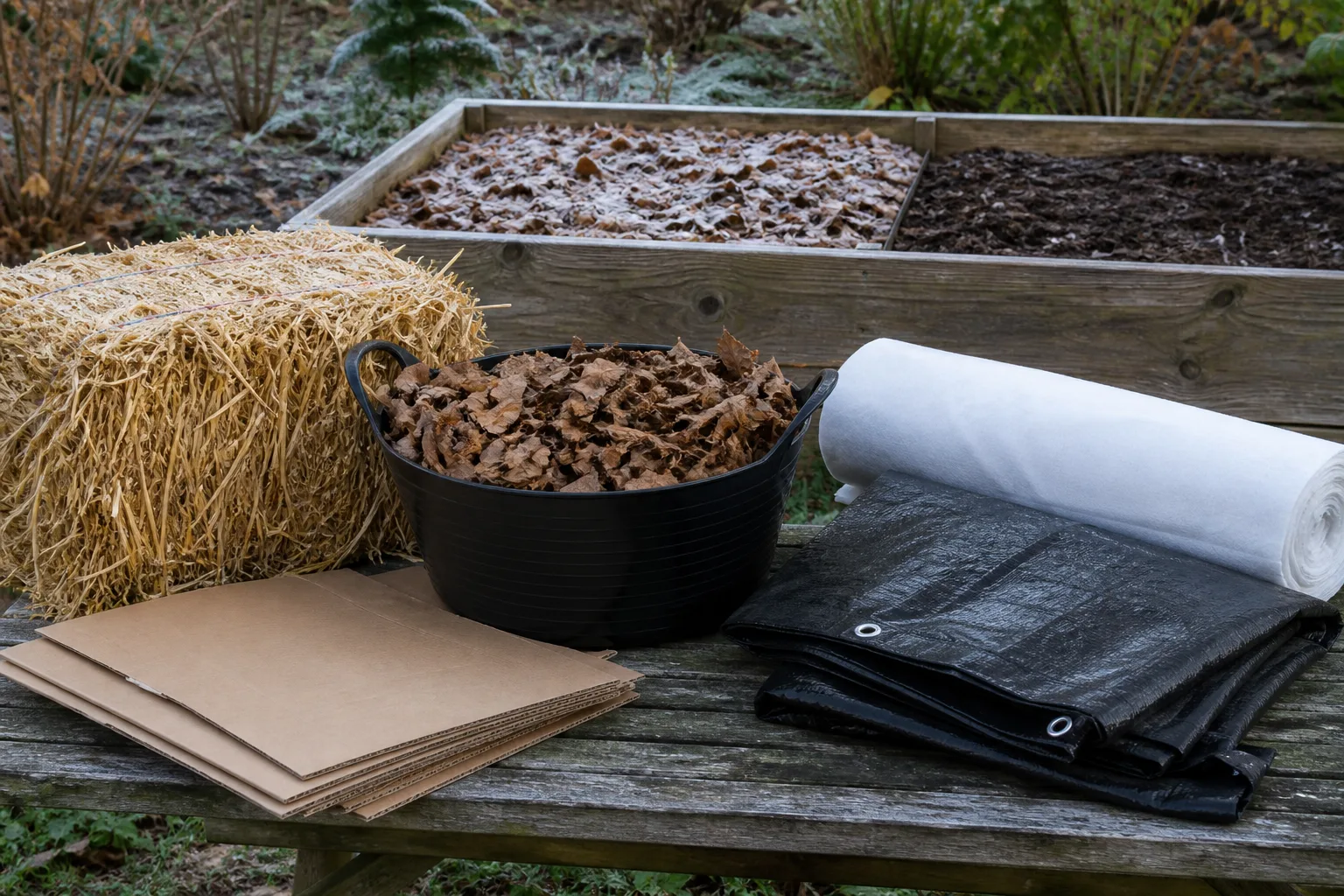
For a light frost, a floating row cover is often the simplest tool. Lay breathable fabric over hoops or directly over low crops, extend it to the ground, and anchor every edge so wind cannot lift the warm air out. Support the fabric above leaves when possible; frozen fabric pressed against tender foliage can cause more damage than a properly suspended cover.
Use a low tunnel when the bed contains taller plants or when wind, rain, and repeated frosts are the problem. Hoops support a heavier frost fabric or clear plastic, but plastic must not touch the leaves and must be vented whenever the sun warms the tunnel. Garden.org recommends covering before sunset to capture soil heat and opening protection as temperatures rise; a sealed plastic tunnel can overheat or condense water even on a cold day.
Fabric protection buys a few degrees, not an unlimited climate shift. The exact result depends on fabric weight, wind, soil moisture, crop size, and how tightly the cover reaches the ground. For a severe arctic outbreak in a cold zone, harvest what you can, add a second layer over hoops if safe, and accept that some crops are finished. A low tunnel is a season extender, not a heated greenhouse.
Ventilate more as winter turns into spring: open clear plastic during sunny thaws, check for standing water and mildew, and close the tunnel before sunset. Breathable row covers are more forgiving but still need inspection after snow or heavy rain.
Use the bed for cool-season herbs
Herbs can fill the gap between summer and spring, but “herb” is not a hardiness rating. Cilantro, parsley, chervil, chives, and some fennel prefer cool weather and are useful fall crops. Sow small batches in late summer so one missed germination does not end the entire harvest, and cover them when a hard freeze threatens.
Rosemary, thyme, sage, mint, and oregano need a more careful decision. Thyme, sage, and oregano may overwinter in a well-drained bed in climates where they are hardy, while rosemary is often damaged by cold, wet roots even when the air temperature is not extreme. Mint is hardy in many regions but spreads aggressively, so a potted plant set into the bed with its rim above soil can be easier to control.
If you want to protect a potted rosemary or other borderline herb, bury the pot up to its rim in the raised bed after the soil has cooled. The surrounding soil buffers rapid temperature changes better than an exposed container, but the bed must drain freely and the pot still needs occasional inspection during a dry thaw. In a reliably cold or wet site, bringing the herb into a bright, cool indoor location is safer than pretending mulch can make a tender plant hardy.
Plant spring-blooming bulbs for an early payoff
An empty fall bed is prime real estate for daffodils, tulips, crocuses, and other spring-blooming bulbs. Raised beds are convenient because you can control depth and soil texture, but their drainage advantage only helps if the bed actually drains. Bulbs sitting in saturated winter soil are more likely to rot than bulbs in evenly moist, oxygenated soil.
Plant each bulb at the depth and spacing on its package, with the pointed end up and the basal plate down. If the bed is unusually loose or exposed, firm the soil gently around the bulb so air pockets do not dry the roots. Daffodils are generally more dependable for repeat performance than many tulips, which may flower best as a one- or two-season display unless you choose perennializing types and give them the conditions they need.
Add a light mulch after the soil has cooled if the bed is exposed to repeated freeze-thaw cycles. Do not bury emerging shoots under a heavy winter layer, and do not use fresh manure or a nitrogen-heavy amendment in the planting hole. If rodents are a serious problem, protect the bed with hardware cloth or choose less appealing bulb types rather than poisoning the soil around a future food crop.
Garlic and shallots can share this winter use, but keep them in a section you can access for spring feeding and weed removal. A bed that holds bulbs can still look empty for months; that is not wasted space if the roots are quietly establishing below the surface.

Turn the bed into a perennial seed nursery
Some perennial seeds need a period of moist, cold conditions before they germinate. If the seed packet specifies outdoor fall sowing or cold stratification, an unused raised bed can act as a simple nursery where winter provides the temperature cycle naturally. This is not the same as scattering a packet and hoping; you still need a fine surface, reliable moisture, labels, and protection from birds and rodents.
Clear the bed, level the top few inches, and sow each species in a marked patch. Follow the packet’s planting depth exactly—many perennial seeds need light and should only be pressed into the surface. Water the seedbed before the ground freezes if autumn is dry, then use a very thin layer of clean leaf litter or fine straw if wind could expose the seed.
Choose this option when you can wait for the result. Perennial seedlings may emerge in spring but remain too small to flower that year. The payoff is a group of acclimated young plants that can be transplanted after they develop sturdy roots. Keep a map of the bed; seedlings and weeds are nearly indistinguishable when labels blow away.
Do not cold-stratify every seed outdoors. Tender annuals, seeds prone to rot in wet soil, and species whose packets call for warm indoor germination need a different method. If you are unsure, sow a small test patch and reserve the rest of the seed for the recommended treatment.
Grow cold-hardy annuals for winter color
A raised bed can stay attractive even when vegetable production slows. Pansies, violas, snapdragons, ornamental kale, and ornamental cabbage can provide fall and early-winter color, especially when planted as healthy nursery starts with enough time to root before the first hard freeze. In a mild climate, some will flower repeatedly through winter; in a cold zone, they may hold their foliage and resume in early spring.
Treat “hardy” as local shorthand, not a guarantee. A winter annual may survive a light frost but fail when the root zone freezes repeatedly or snow crushes its crown. Snapdragons can be tender perennials in mild climates and annuals in colder ones. Mums also vary by cultivar and planting date, so a label is not a promise that the plant will return.
Give annuals the same drainage and protection you would give food crops. Keep mulch away from the crown, water deeply while the plants establish, and use fabric during an early freeze if the plants are still actively blooming. If the forecast turns severe, enjoy the display while it lasts and convert the bed to mulch afterward instead of forcing a failed overwintering experiment.
Heel in bare-root trees and shrubs until spring
Bare-root trees, berry bushes, and shrubs are often shipped during dormancy, but the ground, weather, or your schedule may prevent immediate planting. A raised bed can serve as temporary holding space through winter if it drains well and you protect the roots from drying and freezing.
To heel in a plant, dig a shallow trench on one side of the bed, lay the roots into it, and angle the top above the soil. Cover every root with moist, crumbly soil and firm it gently so there are no air pockets. The roots—not just the trunk base—must be buried; leaves alone can leave fine roots exposed to drying wind.
Label each plant and keep the bed watered when the soil is workable and dry, but never leave it saturated. A wind-exposed site may need a temporary stake or a deeper layer of loose mulch over the root zone. Plant the stock in its permanent location as soon as the ground can be worked in spring, before the buds break if possible.
Heeling in is a holding pattern, not a substitute for proper planting. Do not use a bed with standing water, diseased soil, or a crop rotation problem that could affect the woody plants. If bare-root plants arrive while the soil is frozen, keep roots cool and moist according to the nursery’s instructions until you can heel them in safely.
Sow a cover crop when the bed will rest
A cover crop is a plant grown mainly to protect and improve soil rather than to provide the main harvest. It can slow erosion, compete with weeds, capture leftover nutrients, add organic matter, and support soil biology. SARE’s cover-crop resource emphasizes that the best choice starts with the job you want the cover crop to do and with a plan for seeding, termination, and the next crop—not with whichever seed is cheapest.
For a small raised bed, keep the mix simple. Crimson clover, field peas, or hairy vetch are legume options when nitrogen contribution and living cover are priorities, although performance depends on climate, inoculation, and timing. Winter rye, winter wheat, oats, or barley produce fibrous residue and protect bare soil. Daikon radish or mustard can add deep roots and quick coverage, but avoid a brassica-heavy cover crop immediately before a brassica rotation if disease or pest carryover is a concern.
The National Garden Bureau recommends choosing cover crops by soil need, cleaning out diseased material, sowing roughly six weeks before the first frost when possible, and cutting before seed forms. The exact window varies by species and region. Its cover-crop guidance also advises waiting several weeks after incorporation before planting the spring garden so the residue has time to break down.
Prepare the bed with a shallow rake rather than deep tillage. Broadcast seed evenly, press or rake it into good soil contact, and water gently. The Midwest Cover Crops Council notes that broadcast seed establishes best with adequate moisture and good seed-to-soil contact; its cover-crop planting guidance is written for larger systems but the same principle applies to a hand-sown raised bed. Use the packet rate, and do not bury small seed deeply just because the surface looks rough. Epic Gardening’s raised-bed winter preparation guide likewise treats cover crops, mulch, and season extension as separate tools with different jobs.
Termination is where many home beds go wrong. Cut a living cover crop before mature seed forms, then leave the chopped material as surface mulch or incorporate it shallowly. Vigorous rye or vetch needs extra breakdown time before small spring seedlings. If the crop is already too late to establish, skip the seed and mulch the bed; a weak stand that becomes spring weeds is not a soil-health win.
Mulch and cover a truly empty bed properly
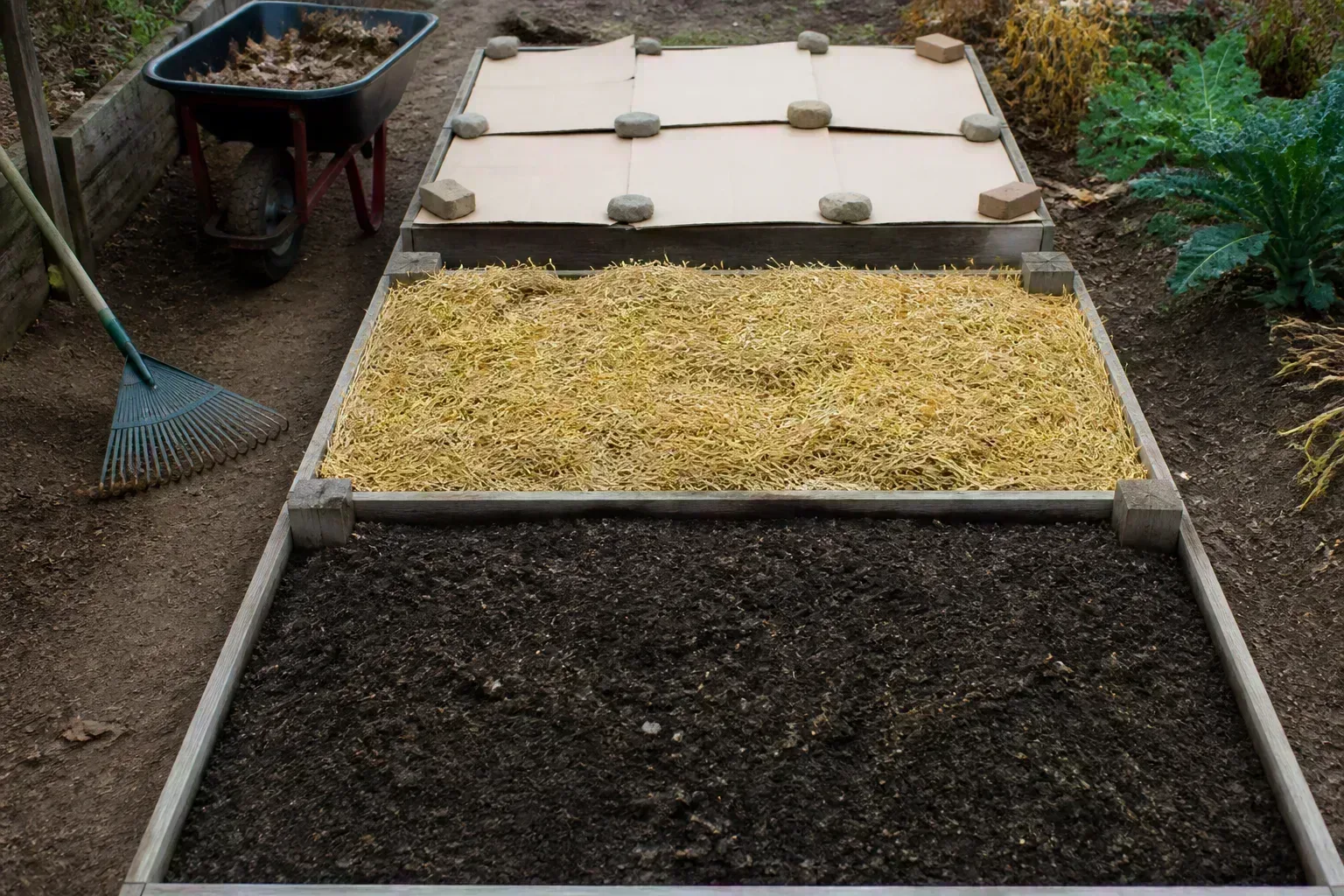
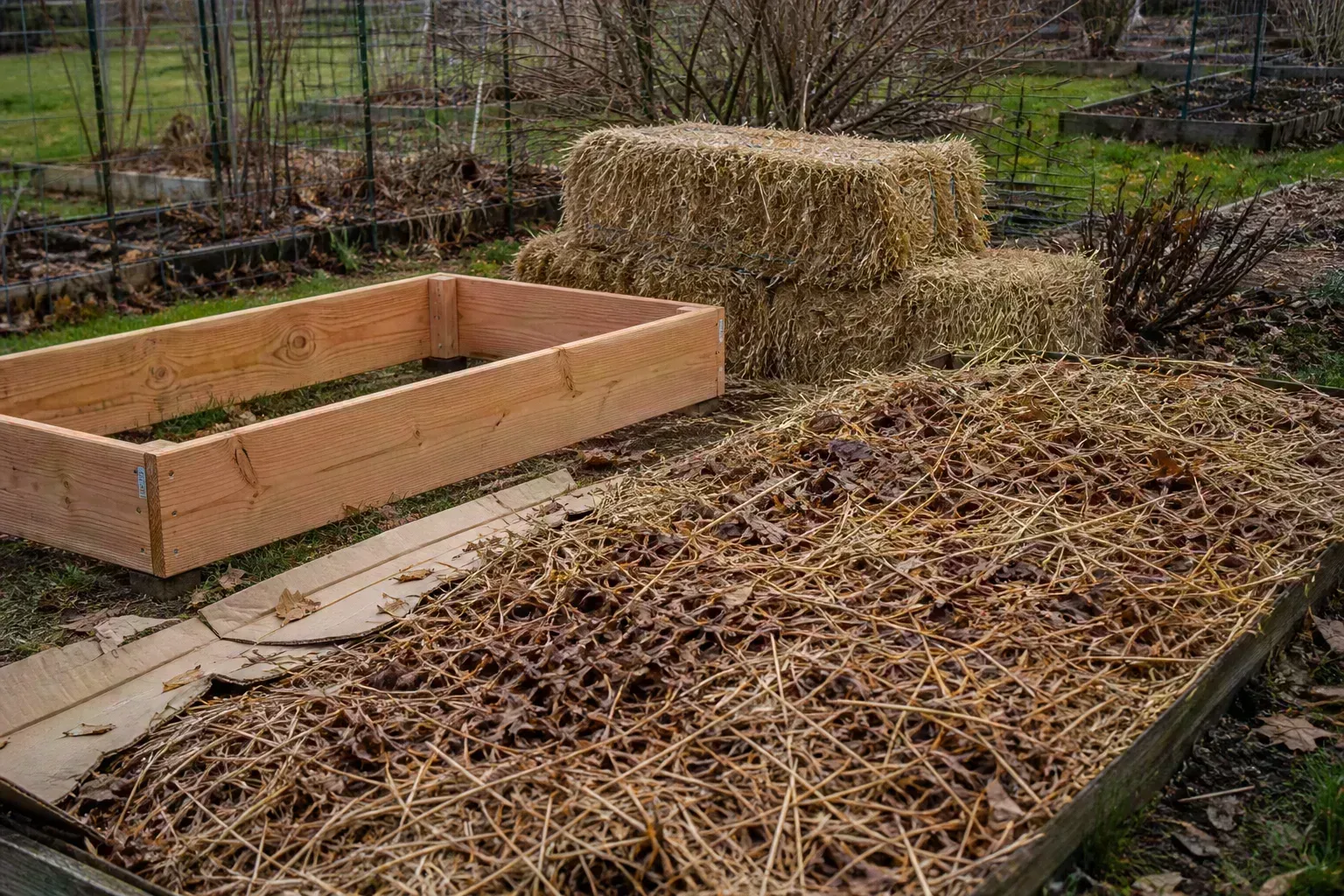
If the bed is empty and it is too late to start a crop, protect the soil rather than planting a token handful of seed. Spread a moderate layer of clean shredded leaves, straw, or finished compost over the surface. Shredded leaves are less likely to form a dense mat than whole leaves; clean straw is useful where you want air space and easy spring removal. Hay may contain weed seed, so do not use it casually in a small bed.
An empty bed has no living crown to smother, so you can cover the surface more evenly than a perennial bed. Still, do not bury garlic shoots, bulb tips, seedling crowns, or herb stems under a thick, wet blanket. A loose three- to four-inch layer is a reasonable starting point for bare soil in many climates; use less in a mild, wet site and add only where the material remains airy.
You can also use cardboard under mulch for short-term weed suppression, provided it is plain, uncoated cardboard with tape and labels removed. A secured opaque cover can suppress winter weeds on a completely empty bed, but it should not become a sealed roof over dry soil. If winter rain is your main source of moisture, let water reach the bed or remove the cover periodically to inspect the soil.
Avoid the wet-bed trap
Never use mulch or a tarp to hide a drainage problem. If water remains in the bed after a normal rain, first clear blocked outlets, lower the surrounding path if runoff is entering, or rebuild the soil structure when conditions are dry enough to work. Adding another layer on top of saturated soil reduces evaporation and keeps roots in an oxygen-poor environment.
Time winter mulch by the soil and plant, not by the first cool evening. Apply it after the soil has cooled and plants are dormant if the goal is freeze-thaw protection. Putting a heavy insulating layer on warm fall soil can delay dormancy; putting it on frozen soil after repeated hard freezes may offer less help. Check the bed during thaws and pull mulch away from emerging spring shoots before they stretch into a wet, airless layer.
Mistakes that waste an entire winter
The first mistake is planting by the empty-bed date instead of the crop’s usable growing window. A bed cleared in November may be ready to use, but most cold-zone vegetables needed sowing in August or September. At that point, choose baby greens under cover, garlic or bulbs, a short-lived cover crop if your local window allows it, or mulch.
The second is assuming all frost protection is equal. A breathable row cover helps with a light frost and a low tunnel gives more control, but neither stops every prolonged freeze. Support and vent clear plastic, brush heavy snow off hoops, and anchor fabric along every edge.
The third is covering plants so thoroughly that they cannot breathe or be checked. Keep fabric off foliage when practical, leave room for growth, ventilate plastic on sunny days, and inspect under cover for slugs, rot, and dry soil. Winter crops still need water during an extended dry thaw, but watering a frozen or waterlogged bed is not helpful.
The fourth is treating compost as a cure-all. Finished compost improves structure and organic matter, but it cannot fix blocked drainage or make tender rosemary hardy. Avoid fresh manure or strong nitrogen fertilizer on a dormant bed; lush late growth is more vulnerable to cold and can create spring nutrient problems.
Finally, do not remove every standing stem just because the vegetable harvest is over. Clean diseased plants, yes, but healthy perennial stalks can provide winter structure and habitat. Leave them only when they fit your pest and disease plan, and keep the bed readable so spring seedlings, bulbs, and weeds do not become one mystery patch.
Conclusion
An empty raised bed is not a single problem with a single winter fix. In a cold zone, it can still produce spinach, kale, roots, herbs, or garlic; protect bulbs and perennial seedlings; hold a dormant bare-root plant; or spend the season building soil under a cover crop or airy mulch.
Start with drainage, winter sun, bed exposure, and the time left before a hard freeze. Then choose the job that fits: plant early enough for maturity, cover established crops before frost, mulch after the soil cools, and switch to a simple soil-protection plan when the season has already passed. That small amount of judgment is what turns winter from a dead stop into the first stage of next year’s garden.



