Houseplant Powdery Mildew: Causes, Diagnosis and Fixes
Diagnose houseplant powdery mildew vs dust and salt, then isolate, prune, improve airflow, and treat infections that keep returning.
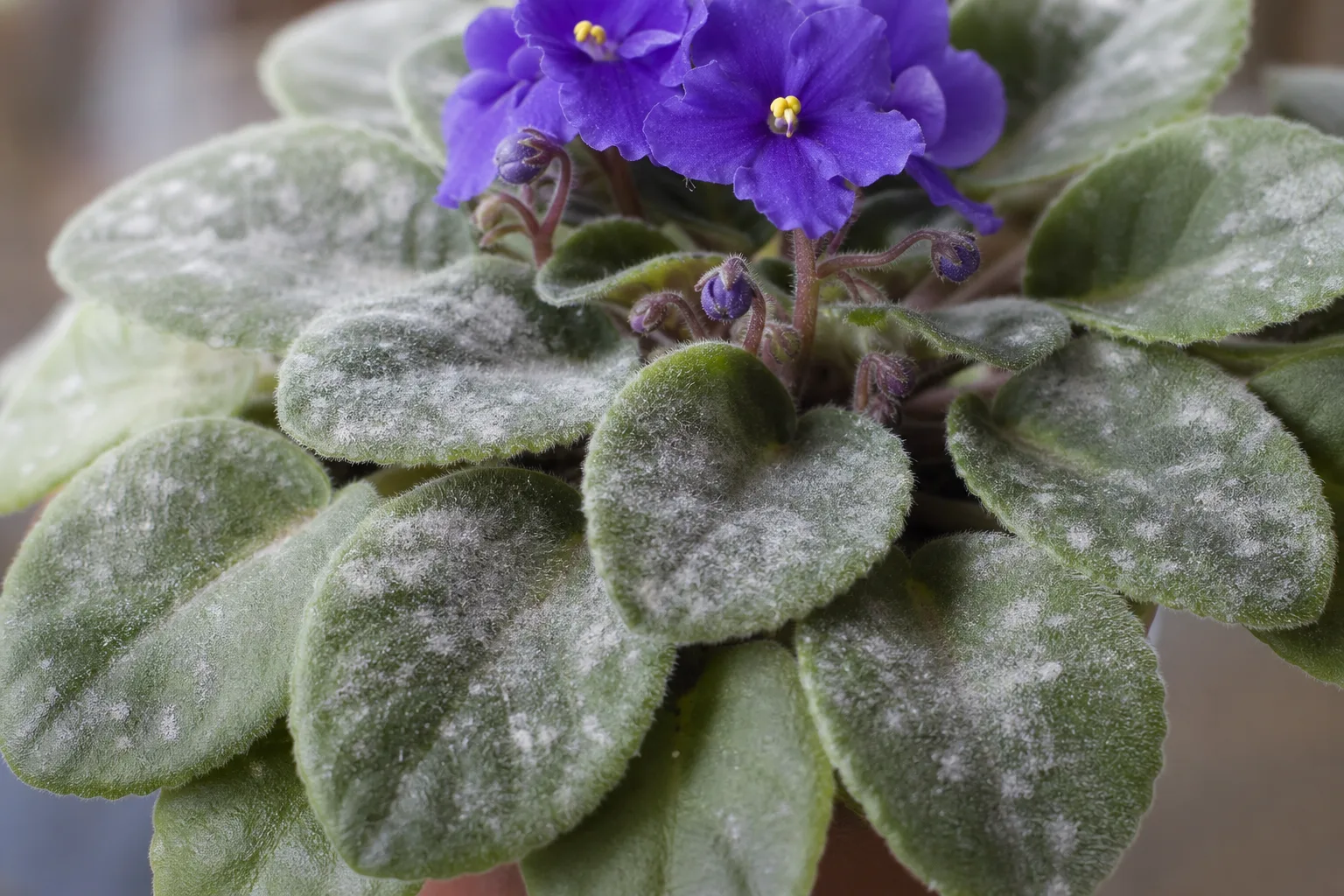
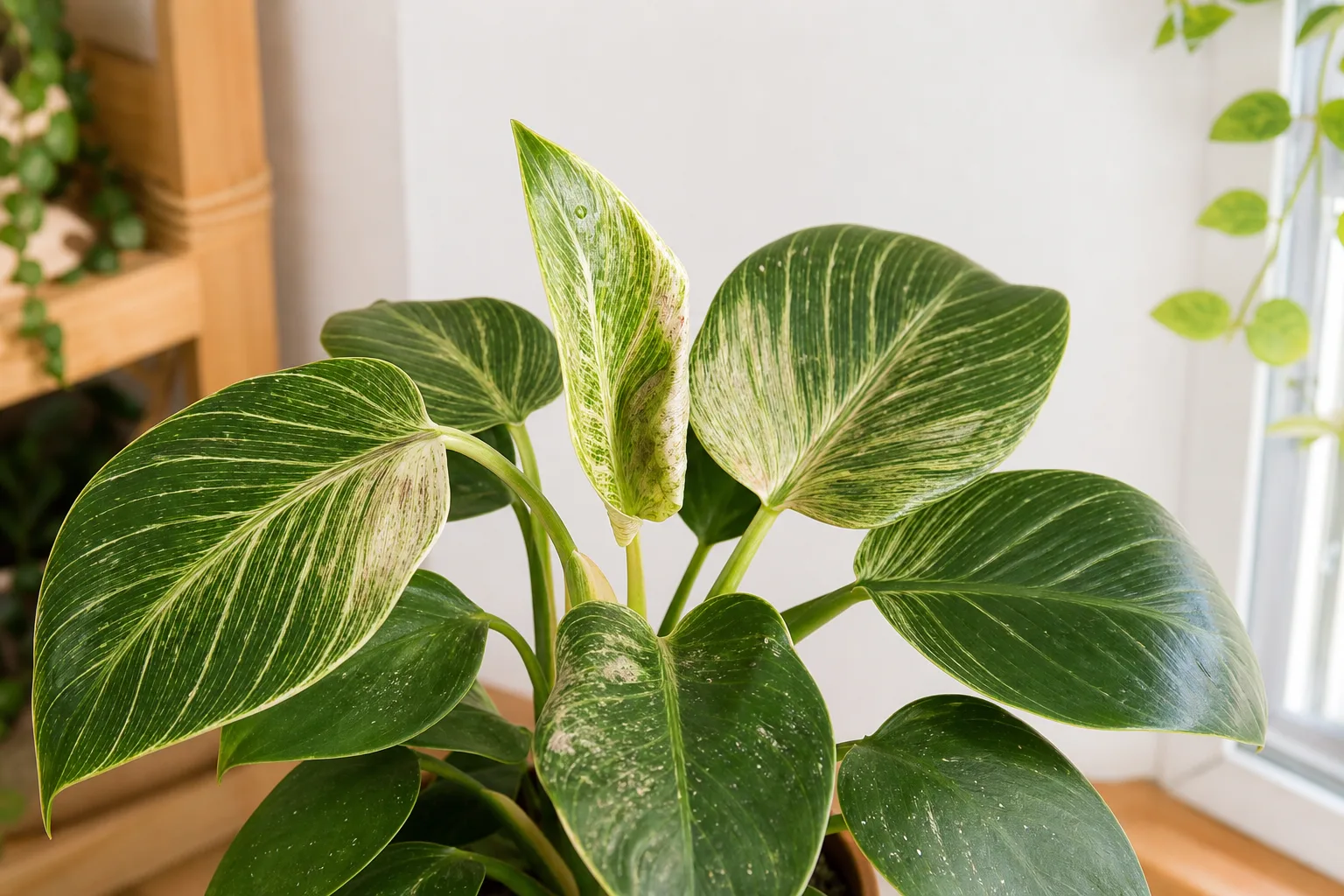
White flour that will not wipe clean like ordinary dust. Circular patches that expand into a continuous film. Leaves that look dirty even after you clean the windowsill. That pattern is usually powdery mildew on houseplants — a real fungal infection, not a coating of household dust or fertilizer salt.
This guide is a diagnostic and fix path: how to tell mildew from lookalikes, why still humid air fuels outbreaks indoors, and which cultural steps beat sprays for most home collections. Infected tissue does not “heal” back to a perfect leaf. Success means new growth stays clean and existing patches stop spreading.
What Powdery Mildew Is on Indoor Plants
Powdery mildew is a group of related fungi that live as obligate parasites on living plant tissue. They produce a superficial white-to-gray powdery growth on leaves, stems, buds, and flowers, then send feeding structures (haustoria) into epidermal cells to steal nutrients. (Penn State Extension; UC IPM)
On houseplants, infections often start as discrete circular white spots that expand and coalesce into a continuous mat. Purdue’s plant disease clinic notes that this film is frequently mistaken for dirt or dust on indoor plants, and that severely infected leaves and flowers may eventually brown and die. (Purdue PPDL)
Clemson HGIC adds an important houseplant wrinkle: powdery mildew can appear as classic white powder or as dry, brown, papery leaf spots when fungal growth is less obvious. (Clemson HGIC — Houseplant diseases) If you only look for floury white fuzz, you can miss mildew on plants like kalanchoe that present more as corky or scabby spots. (Penn State Extension)
Most powdery mildew species have relatively narrow host ranges — the fungus on your begonia is not automatically the same species attacking a neighbor’s rose outdoors — but spores still move on air currents between susceptible plants in a crowded room. (RHS; Penn State Extension) From germination to new spores can take as little as about 48 hours when conditions favor the fungus, which is why a clean wipe without an environment change rarely holds. (Penn State Extension)
How to Confirm It Is Powdery Mildew (Not Dust or Salt)
Wrong ID wastes weeks. Before you reach for a fungicide, run a 60-second confirmation so you do not treat dust like a disease or ignore salt burn that needs leaching instead.
Dust and Dirt on Leaves
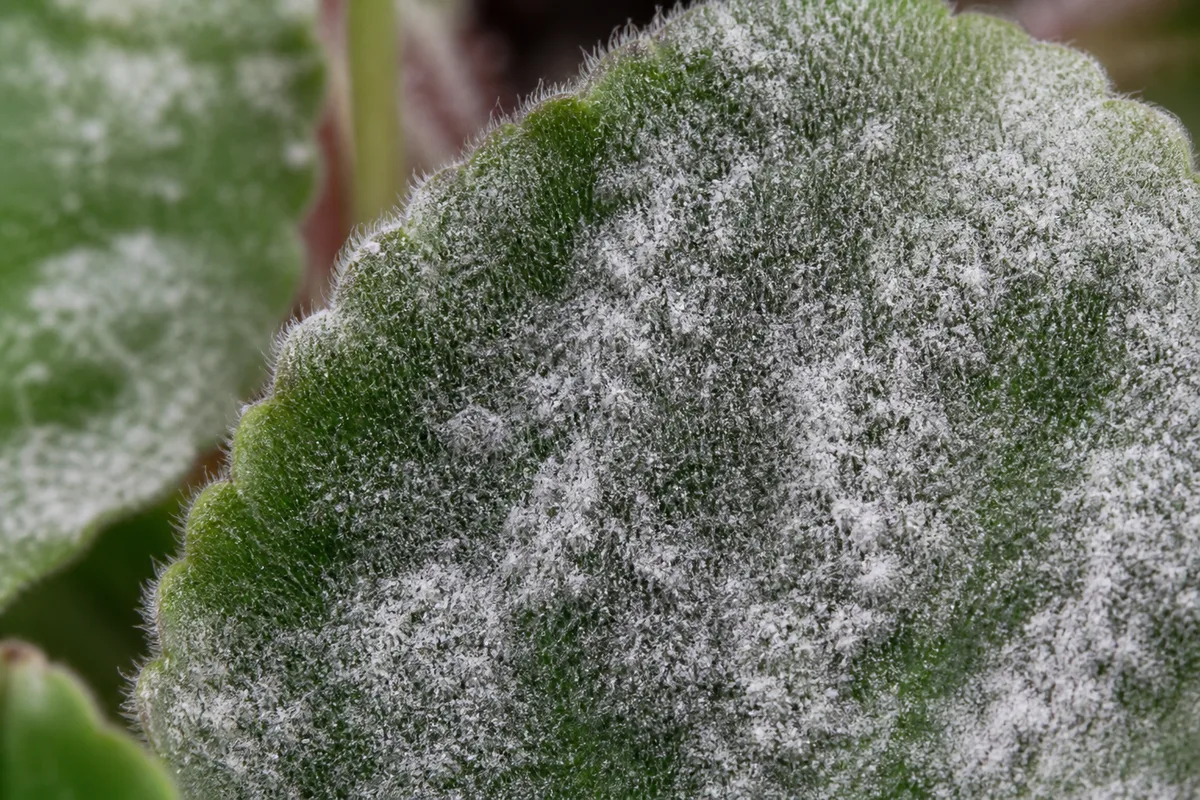
Ordinary dust sits loosely on the leaf cuticle. It wipes away with a damp cloth and does not return in the same circular patches within days. Powdery mildew feels more like a fine coating bonded to the surface; wiping smears a white film and often leaves a pale or slightly scarred area underneath where the fungus fed. New spots appear in similar shapes after cleaning if spores and conditions remain.
Dust also does not distort new leaves. Mildew frequently twists, dwarfs, or yellows young growth as infection progresses. (UC IPM; RHS)
Fertilizer Salt Crusts and Hard-Water Residue
Salt and mineral crusts are usually hard, crystalline, or chalky, not soft and floury. They concentrate on pot rims, the soil surface, and sometimes leaf margins after water evaporates. Clemson explicitly separates white-to-gray salt crusts on soil or pot rims from mold-like growth and notes salt injury as a cultural problem, not a fungal leaf disease. (Clemson HGIC — Houseplant diseases)
If the white material is mostly on the pot rim or soil surface and scrapes off as brittle flakes, treat it as salt or hard-water residue: leach the pot thoroughly, empty the saucer, and ease fertilizer. Do not spray a fungicide at salt.
Soil-Surface Mold vs Leaf Powder
Fuzzy white growth on the potting mix is usually saprophytic mold feeding on organic debris in damp media — a moisture and airflow story at the soil line, not powdery mildew on foliage. Powdery mildew colonizes living leaves and stems. If the white fluff is only on the soil and leaves look clean, open the mold on soil houseplants guide and dry the top layer instead of treating “mildew.”
When both appear together, separate the problems: soil mold points to chronically wet media; leaf powder points to a foliar fungus that likes stagnant humid air around the canopy.
For a short cross-plant symptom checklist after you confirm living-leaf powder, see the powdery mildew symptom hub.
Use this lookalike table as a side-by-side decision aid before you buy a spray. Match texture and location first; then take the first move in the right-hand column.
| Lookalike | Where you see it | Texture / pattern | First move |
|---|---|---|---|
| Powdery mildew | Living leaves, stems, flowers | Soft white/gray powder; may distort new growth | Isolate, prune, airflow, stop misting |
| Dust | Upper leaf surfaces | Wipes clean, no new circular patches | Wipe leaves; no fungicide |
| Salt / mineral crust | Pot rim, soil surface, sometimes margins | Hard, chalky crystals | Leach pot; cut fertilizer |
| Soil mold | Top of potting mix | Fuzzy white on media, not living leaf tissue | Dry surface; see mold-on-soil guide |
| Fungal leaf spot | Leaf blade lesions | Tan/brown spots ± yellow halo; little or no flour | Dry canopy; leaf-spot guide |
Why Humidity and Airflow Matter Indoors
Powdery mildew breaks the mental model many indoor growers have about “wet diseases.” Most foliar fungi need free water on the leaf for long infection windows. Powdery mildew is different: high relative humidity favors spore production and infection, but free water on the leaf surface often inhibits germination for many powdery mildew fungi. (Penn State Extension; Colorado State University Extension; Clemson HGIC; UC IPM; RHS)
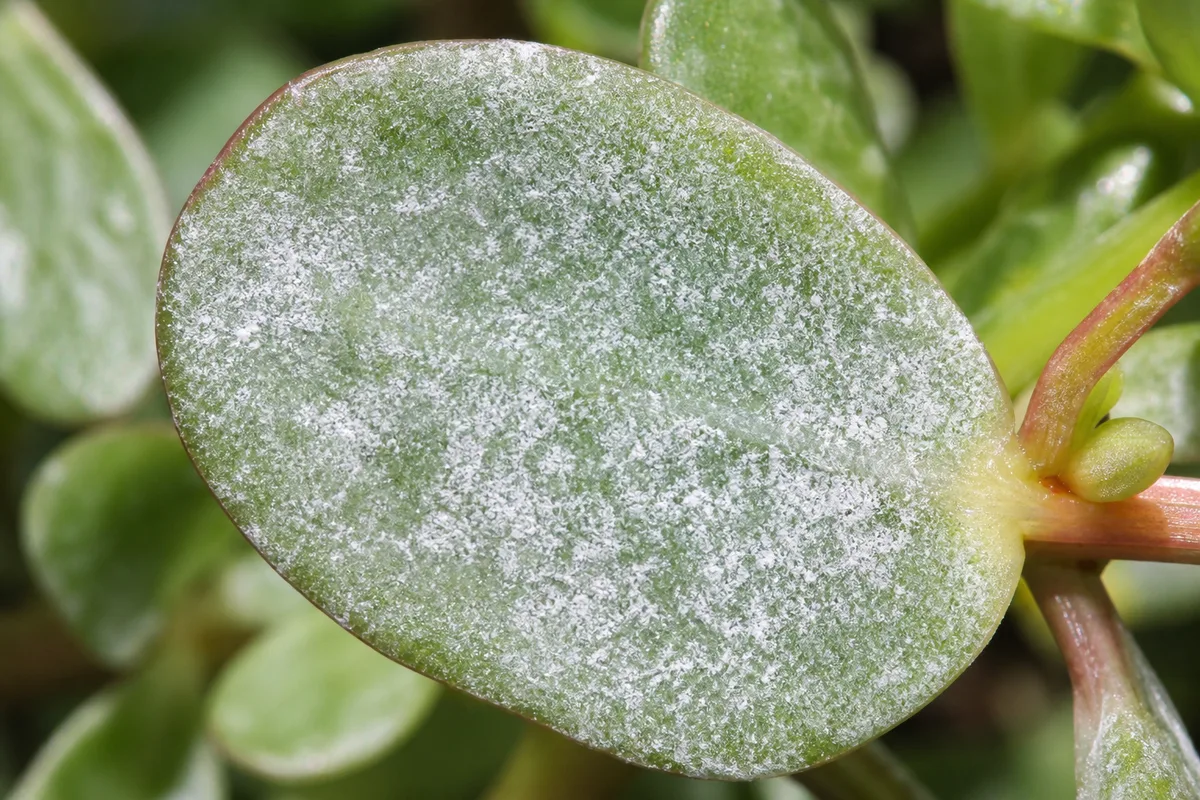
That is why bathrooms, tight plant shelves, and winter rooms with cool nights can explode with mildew even when you never splash the leaves.
High Night Humidity, Dry Days, and Still Air
Penn State and Colorado State both describe a classic humidity swing: high relative humidity at night favors spore formation, while lower humidity during the day favors spore dispersal. Temperatures around 70–80°F (roughly 22–27°C) are especially favorable. (Penn State Extension; Colorado State University Extension)
RHS notes that powdery mildew spores carry unusually high water content, so they can infect under drier surface conditions than most pathogens — but stagnant humid air still stacks the odds heavily toward infection. (RHS)
Indoors, that maps to: plants jammed against walls, closed cabinets, dense canopies with no fan, and cool nights near windows paired with daytime heating. Purdue flags poor air circulation, low light, and temperatures near 70°F as indoor risk factors, with winter months a common observation window for African violet, begonia, ivy, jade, and kalanchoe. (Purdue PPDL)
Raising humidity for tropicals is still valid for many species — the goal is humid air with movement, not a foggy, still pocket. For balanced humidity tactics without trapping stagnant air, see high humidity for houseplants and the houseplant humidity guide.
Crowding, Cabinets, Grow Tents, and Misting Mistakes
Crowding raises canopy humidity and blocks airflow. Low light keeps leaves softer and slows drying of any surface moisture you do add. Closed cabinets and grow tents amplify both problems: humidity climbs overnight, air barely moves, and overlapping leaves create spore highways. A bathroom plant can stay healthy if the door stays open and foliage is spaced; the same plant mildews when it lives in a steamy, closed corner with no fan.
Misting feels helpful for humidity-loving plants, but it is a poor humidity strategy and a bad mildew response: Purdue advises not misting and avoiding wetting leaves when watering, and Clemson’s houseplant powdery mildew guidance emphasizes ventilation and not overwatering. (Purdue PPDL; Clemson HGIC — Houseplant diseases)
Greenhouse managers sometimes syringe leaves midday to wash spores because liquid water can inhibit powdery mildew — but that tactic only works when leaves dry fast and other wetness-loving diseases are not a risk. (Penn State Extension; UC IPM) In a typical home with overlapping foliage and cool nights, routine misting is more likely to create leaf spot and soft-rot problems than to cure mildew. Prefer spacing and gentle air movement over mist schedules.
Which Houseplants Get Powdery Mildew Most Often
Purdue repeatedly sees powdery mildew indoors on African violet, begonia, ivy, jade, and kalanchoe, especially in winter. (Purdue PPDL) Start species-specific recovery with African violet powdery mildew — fuzzy leaves need a gentle wipe, not hard rubbing. Check jade plant white spots when chalky marks could be mildew, salt, or edema lookalikes. Broader ornamental lists from UC IPM include begonia, chrysanthemum, hydrangea, rose, and many daisy-family plants among outdoor and greenhouse hosts — useful when you move patio plants indoors for winter. (UC IPM) Patio mint and adenium also carry dedicated mildew pages when those plants winter indoors.
Host specificity still matters. A heavy outbreak on kalanchoe does not prove every nearby monstera will catch it, but shared still air and overlapping leaves raise risk for any susceptible species on the same shelf. Isolate first; do not wait to see which neighbors are genetically compatible hosts.
Severity Ladder: Light Film to Discard
Scan the canopy once, then place the case on this ladder before you open a bottle:
- Light film (early): A few circular white patches on one or two leaves; new growth still clean. Isolate, prune the worst leaves, space and fan, stop misting. Recheck in 48 hours.
- Spreading: Patches coalescing across multiple leaves or stems; new leaves twisting or looking dusty as they unfurl. Cultural cleanup is mandatory; plan a labeled product if clean leaves keep picking up new powder after about a week.
- Canopy-ruined (discard threshold): Most leaves coated, flowers and tips collapsing, or cultural fixes plus a labeled treatment cannot stop new infections for two to three weeks on a plant that is not worth the spore load. Bag and trash rather than “saving” a spore factory. (Purdue PPDL)
Step-by-Step Treatment Plan
Cultural control is usually enough indoors and is preferable to chemicals in the home. (Purdue PPDL) Use sprays as a follow-up after cleanup, not as a substitute for airflow and sanitation.
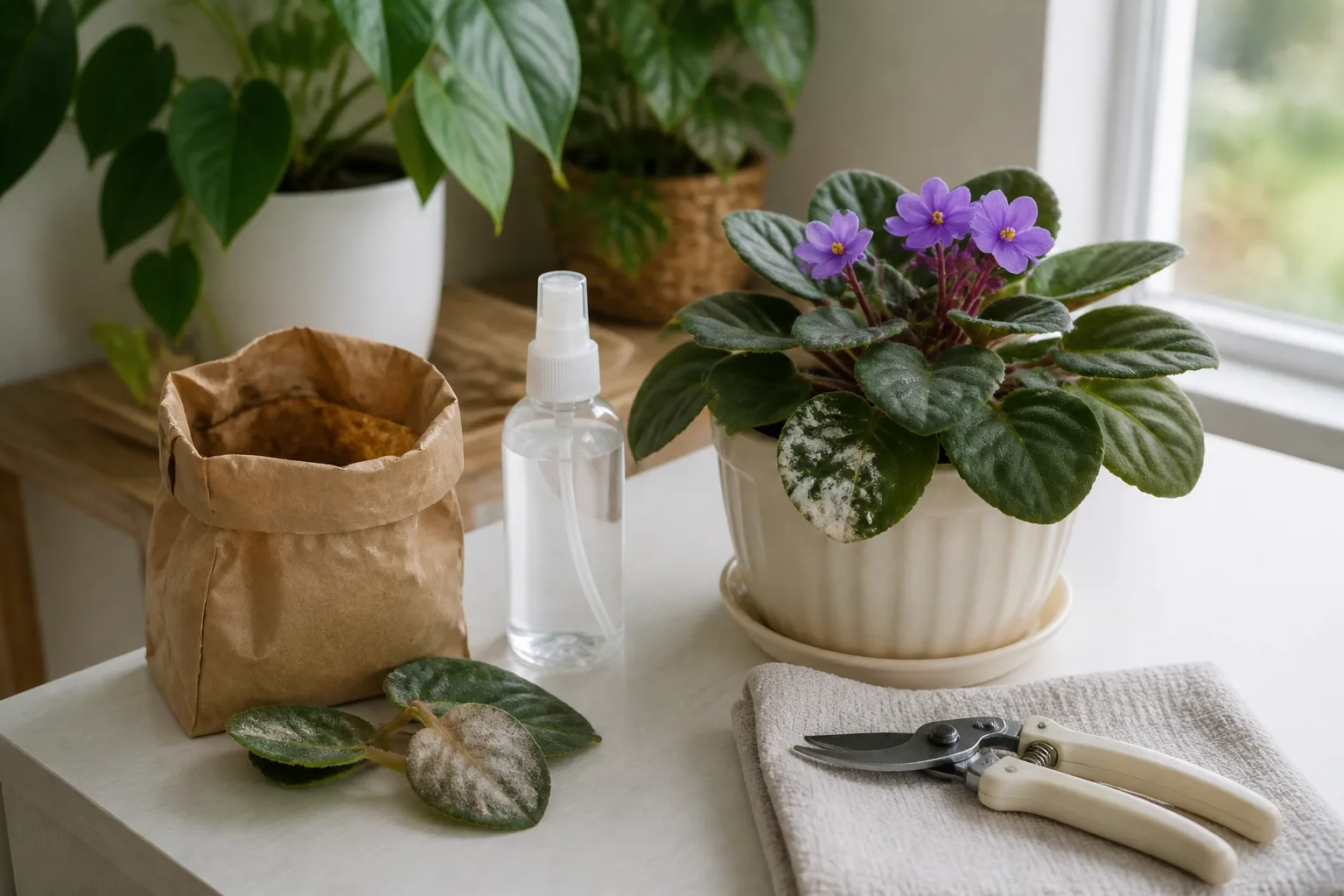
Isolate, Prune, and Dispose
Move the plant away from the collection the same day you confirm mildew. Spores travel on air currents; isolation reduces the spore load hitting clean neighbors. (Penn State Extension)
Remove heavily infected leaves, flowers, and soft tips with clean shears. Bag debris and trash it — do not leave infected tissue in an open compost pile that never heats thoroughly. Colorado State notes infected debris can harbor the fungus and that home compost piles often are not hot enough to kill it. (Colorado State University Extension) Clemson and Purdue both emphasize removing severely infected parts early. (Clemson HGIC — Houseplant diseases; Purdue PPDL)
Disinfect blades between plants with 70% alcohol or a fresh dilute bleach rinse if you are working a multi-plant outbreak. If only a few leaves are spotted, pruning plus environment changes may be the entire cure. Never bleach living foliage as a “cure.”
Improve Airflow, Wipe Light Coatings, Then Recheck
Give the canopy space. Pull plants a few inches apart so leaves do not form a closed humid tent. Add gentle room air movement — a small oscillating fan on low across the room, not a blast aimed at one pot. Keep plants in brighter indirect light appropriate to the species; Purdue links low light with indoor mildew pressure. (Purdue PPDL)
Stop misting. Water at the soil line. Empty saucers so the root zone is not feeding a constant vapor bath under the foliage. Clemson ties rapid mildew development to humid conditions and recommends proper ventilation plus avoiding overwatering. (Clemson HGIC — Houseplant diseases)
If you use a humidifier for tropicals, place it so air still moves through the grouping, and avoid aiming a cool mist stream directly into a dense shelf of susceptible plants. Pair humidity goals with the guidance in high humidity for houseplants.
For light infections on sturdy leaves, carefully wiping with a soft damp cloth can remove much of the surface mycelium and spore load before you change the environment. Work gently — rubbing thin African violet leaves hard can do more damage than the fungus.
A mid-morning rinse can wash spores off some ornamentals when foliage will dry within an hour or two, which is why UC IPM and Penn State discuss overhead sprinkling as a cultural tool outdoors and in greenhouses. (UC IPM; Penn State Extension) Indoors, only use a rinse if you can dry the plant thoroughly afterward and you are not fighting concurrent leaf-spot disease. If leaves stay wet overnight, skip rinsing and stick to wipe-plus-airflow.
Recheck on a 48-hour cadence after cleanup: Penn State notes the spore-to-spore cycle can complete in about two days under favorable conditions. (Penn State Extension) Day 0 is isolate/prune/airflow. Day 2 and day 7 ask whether previously clean leaves stayed clean.
When to Use Oils, Bicarbonates, Sulfur, or Labeled Fungicides
Reach for a product only after isolation, pruning, and airflow changes — or when a valuable plant is still throwing new mildew patches on previously clean leaves after a week of cultural cleanup.
Less-toxic options commonly listed for powdery mildew include horticultural oils, neem oil, potassium bicarbonate, sulfur, and biological products such as Bacillus-based biofungicides. (UC IPM; Colorado State University Extension; Clemson HGIC) Clemson’s houseplant factsheet specifically lists sulfur, chlorothalonil, myclobutanil, tebuconazole, or Bacillus amyloliquefaciens after removing infected parts. (Clemson HGIC — Houseplant diseases)
Critical safety gates indoors:
- Read the label for the exact plant, indoor/outdoor use, rate, and re-entry notes. Prefer spraying outdoors or in a well-ventilated area when labels allow. Product rates always defer to the label on the package in hand.
- Never mix oil and sulfur closely in time. UC IPM and Clemson warn against applying oil within two weeks of sulfur (and vice versa) because the combination can injure plants; also avoid oils above about 90°F or on drought-stressed plants. (UC IPM; Clemson HGIC)
- Sulfur is mainly protectant — best before or at early symptom stages, not a late-stage eraser. (UC IPM)
- Potassium bicarbonate products can eradicate early mildew but may injure tissue if disease is advanced; use caution and label rates. (UC IPM)
- Homemade baking-soda or milk mixes are experimental and unregulated; RHS advises against homemade fungicides, and Colorado State frames baking soda plus oil as use-at-your-own-risk research context. (RHS; Colorado State University Extension) Prefer a labeled potassium bicarbonate product if you choose that chemistry.
RHS prefers cultural control and generally recommends against routine fungicide use for gardeners when biodiversity and environmental impacts are considered. (RHS) That stance is a useful indoor bias too: fix air and humidity first; spray second.
Powdery Mildew vs Leaf Spot and Other Lookalikes
Powdery mildew is a surface coating disease. Classic fungal leaf spots are discrete tan, brown, or black lesions that may show yellow halos or target rings, often without a floury film. Bacterial spots start greasy or water-soaked. Edema creates corky blisters, usually on undersides. If your problem is sunken necrotic spots without white powder, switch to the leaf spot disease houseplants workflow instead of mildew sprays. Orange or rusty pustules belong in the rust disease houseplants path, not this one.
Downy mildew is a different disease that can also look powdery, but it usually favors free moisture and cooler conditions, with spore structures more often on leaf undersides. (UC IPM) True downy mildew is uncommon on typical indoor foliage plants compared with powdery mildew and cultural spots, but the free-water preference is another reason not to keep leaves wet overnight.
First-Hand Notes From Indoor Outbreaks
These are single-setup LeafyPixels collection notes from winter–spring 2026 indoor shelves — observational, not controlled trials.
African violet winter shelf (January 2026): Three African violets sat shoulder-to-shoulder on a north windowsill after a cold-week humidifier run. Soft white circular patches appeared first on lower leaves, then on flower stems. Wipe-only on day 0 removed the flour look, but matching patches returned on nearby clean leaves within about 48–72 hours. Spacing pots 8–10 cm apart, stopping mist, and running a low oscillating fan across the room (not at the crowns) stopped new patches by day 7; scarred older leaves stayed marked. Fuzzy leaves that were rubbed hard browned at the margins — gentle wipe or prune only.
Salt-crust misID on jade (February 2026): A jade on the same shelf showed hard white flakes on the pot rim and a few leaf margins. A neighbor assumed mildew and asked about neem. The flakes scraped brittle off the rim; leaves had no soft flour film and no distorted new growth. One thorough leach and a fertilizer pause cleared the look without any fungicide — a reminder that chalky salt is not soft mildew.
Kalanchoe corky presentation (March 2026): A kalanchoe arrived from a crowded nursery tray with dry, scabby leaf marks and almost no visible powder. Classic “white flour” search would have missed it. Isolation, removal of the worst leaves, and brighter placement with airflow stopped spread; remaining corky scars did not reverse. Penn State’s kalanchoe corky note matched what we saw in the hand. (Penn State Extension)
Oil-after-sulfur caution (April 2026, one plant): A patio begonia brought indoors had been dusted with a sulfur product outdoors two days earlier. An indoor oil spray on day 3 left blotchy leaf burn. That single plant reinforced the label rule we already cite from UC IPM and Clemson: keep oil and sulfur at least two weeks apart. (UC IPM; Clemson HGIC)
Prevention That Actually Holds Indoors
Buy and quarantine new plants for one to two weeks before they join a tight shelf. Inspect for white patches on young leaves and flower buds. Space pots so air can move between canopies. Prefer brighter placements that still match the species — shade plus stillness is a mildew invitation. (UC IPM; Purdue PPDL)
Water the soil, not the leaves. Avoid chronic overwatering that keeps the whole microclimate humid. (Clemson HGIC — Houseplant diseases) Do not over-fertilize into soft, succulent flushes that mildew prefers; Colorado State notes young succulent growth is usually more susceptible than older tissue. (Colorado State University Extension)
In winter, when windows chill at night and heaters dry the room by day, check susceptible plants weekly. That humidity swing is exactly when Purdue sees indoor outbreaks spike. (Purdue PPDL)
Discard when mildew covers most of the canopy, flowers and growing tips keep collapsing, or cultural cleanup plus a labeled product still cannot stop new patches for two to three weeks on a low-value plant. Purdue notes severely infected plants may need to be discarded, with the option to take a cutting from healthy tissue if any remains. (Purdue PPDL) Throw the plant out rather than “saving” a skeleton that sheds spores onto every neighbor. Clean the shelf, wipe cachepots, and wash your hands before handling clean plants. For a valuable collection plant with ambiguous corky marks that keep spreading after two weeks of cultural cleanup, contact cooperative extension or a plant diagnostic clinic rather than stacking random household chemicals.
Related Guides
- Mold on soil houseplants — white fuzz on the potting mix, not on living leaves
- Leaf spot disease houseplants — discrete necrotic spots without a floury film
- Rust disease houseplants — rusty pustules, not soft white flour
- High humidity houseplants — raise humidity without trapping stagnant air that favors mildew
- Houseplant humidity guide — broader humidity methods and limits
- Houseplant diseases identification and treatment — wider disease context when symptoms overlap
- Integrated pest management indoors — inspect-before-treat order before any spray
- African violet powdery mildew — fuzzy-leaf host: wipe gently, avoid harsh rub
Conclusion
Confirm soft white film on living tissue, rule out salt and soil mold, then isolate and prune. Fix spacing, airflow, light, and misting before you spray. Use labeled oils, bicarbonates, sulfur, or other fungicides only as a second line, with oil–sulfur timing and heat caveats respected. Measure recovery by clean new growth — not by wishing old patches vanish.
7-day fix checklist
- Day 0: Confirm mildew vs dust/salt/soil mold; isolate the plant.
- Day 0: Prune heavily infected leaves into the trash; disinfect tools.
- Day 0–1: Space the canopy; add gentle room airflow; stop misting; water at the soil line.
- Day 0–1: Gently wipe light coatings on sturdy leaves only; skip hard rubs on fuzzy foliage.
- Day 2: 48-hour recheck — are previously clean leaves still clean?
- Day 7: If new patches keep appearing on clean tissue, apply a product labeled for powdery mildew on ornamentals (never oil within two weeks of sulfur).
- Day 14–21: If the canopy is mostly ruined or new infections will not stop, discard and sanitize the shelf — or take a cutting from remaining healthy tissue.