Low Humidity on Guava: Causes, Checks & Fixes
Quick answer
Low humidity can contribute to crispy Guava leaf edges, especially indoors or near dry airflow, but it is not confirmed by brown tips alone. First move the tree out of direct heater, air-conditioner, or hot-wind exposure while preserving its bright light. Then measure humidity at canopy height and check the root zone before changing watering or adding a humidifier.
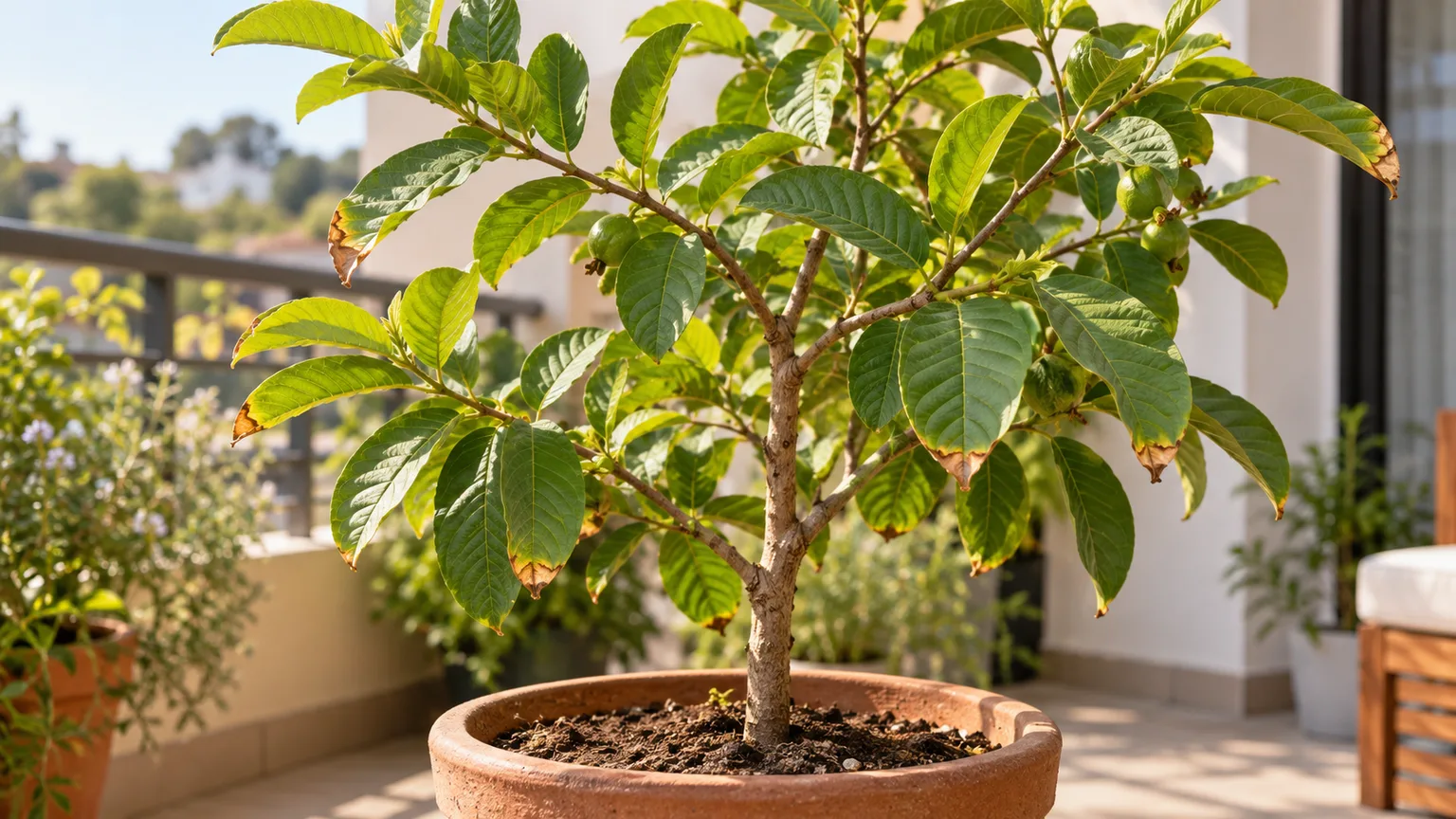
Low Humidity on Guava: Causes, Checks & Fixes
This guide covers low humidity on Guava. See also the general Low Humidity guide, watering, and light pages for this plant.
Low Humidity on Guava: Causes, Checks & Fixes
Quick answer
Low humidity can contribute to crispy Guava leaf edges, especially when a container tree spends winter indoors or sits near a heater, air-conditioner, or hot dry wind. It is a possibility to test, not a diagnosis to make from one brown tip. First, move the tree out of direct hot or cold airflow while keeping it in the brightest suitable spot. Then measure humidity near the canopy and check the root zone before you water more or buy a humidifier.
Common guava (Psidium guajava) is a warm-climate fruit tree, so the indoor humidity question often overlaps with light, temperature, wind, and container watering. For the broader symptoms associated with low humidity in plants, see the general guide; this page focuses on how to sort those clues on Guava. Start with the Guava care guide if you are also deciding whether the tree can stay indoors long term.
What low humidity may look like on Guava
A Guava with dry-air stress may develop crisp tips or narrow brown margins, sometimes with slight curling at the edge. Brown tips and curled edges can accompany dry indoor air on some houseplants, as Healthy Houseplants explains, but those signs do not confirm humidity as the cause on Guava. The rest of a leaf can remain green, and an established tree may look mostly healthy while a few exposed leaves show damage. The symptom is most suggestive when it appears after a heating season, a move indoors, or a change in ventilation and repeats across leaves that share the same exposure.
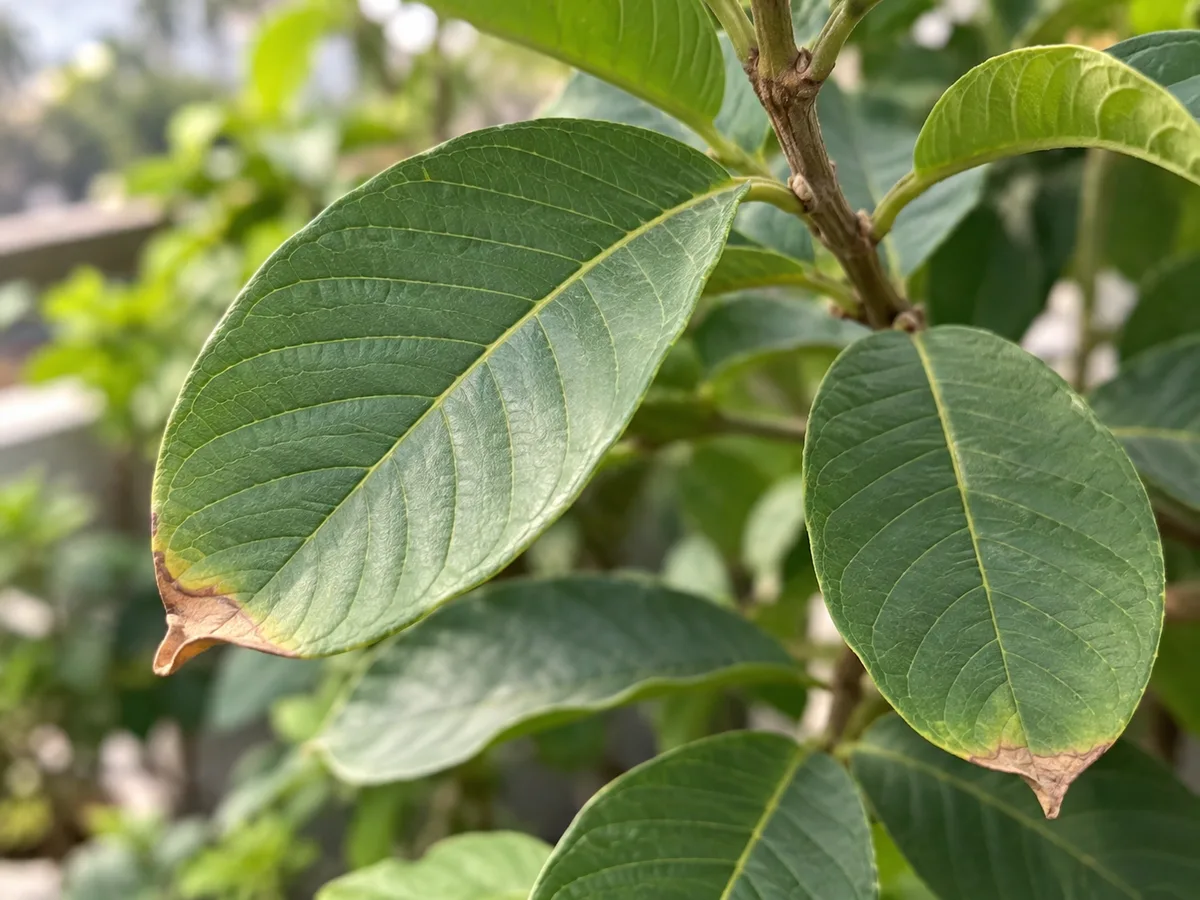
On Guava, a small dry margin is a clue to investigate, not proof that the room needs more humidity.
Guava’s leaves are oblong to oval and have prominent feather-like veins, which makes the difference between a dry margin and a scattered surface lesion easier to see when you examine a whole leaf rather than just its tip. The University of Hawai‘i’s guava profile describes this recognizable leaf form and the tree’s broad, spreading habit. University of Hawai‘i CTAHR’s description of Guava leaves is useful when confirming that the plant is common guava rather than a different plant sold under a similar common name.
Do not expect every low-humidity case to look the same. Some trees show no visible leaf-edge damage even when the air is dry; others have browned margins because wind, salts, or root stress are acting at the same time. If all the new leaves are distorted, if the damage forms spots, or if the whole tree wilts, widen the diagnosis instead of treating the air as the only cause.
Why Guava’s climate and growth habit change the diagnosis
Guava is a fruit tree, not a humidity-sensitive foliage plant
Guava is adapted to warm subtropical and tropical conditions. UF/IFAS places its ideal growth and production temperatures around 23–28°C, notes that growth slows or stops below about 16°C or during drought, and recommends full sun for the home landscape. Its growing guidance does not set a specific indoor relative-humidity target for Guava. That is useful: avoid assuming that a generic houseplant percentage is a proven requirement for this tree. UF/IFAS Guava guidance emphasizes temperature, sun, drought, wind, and root-zone conditions.
Tamil Nadu Agricultural University notes that Guava grows in wet and dry regions, performs better under irrigation in dry tracts, and does best in well-drained soil. That broad tolerance does not mean a potted tree cannot be stressed by a dry room; it means you should look for the combination of heat, airflow, watering, and humidity rather than treating a single dry-air reading as the cause. A healthy outdoor tree in a warm, breezy garden and a small Guava held inside through winter are not experiencing the same conditions. TNAU’s Guava cultivation notes provide that wet-versus-dry context.
Soft new growth is more vulnerable than mature leaves
Pay special attention to the newest shoots. UF/IFAS reports that hot, dry wind during a Guava leaf flush can distort and damage leaves, and that soft immature wood and leaves may wilt under drought stress. If only the tender growth at the exposed side of the canopy is marked, wind or a sudden heat-and-dry spell may fit better than low room humidity by itself. This is one reason Guava can look fine for weeks and then show damage after a move to a sunny but unprotected balcony or beside an open window.
Older leaves provide a second comparison. If only the youngest leaves are affected, ask what changed while they were unfolding: a sharp temperature swing, dry wind, missed watering, or an abrupt move into full sun. If the older and newer foliage show similar damage on all sides of the tree, record humidity and root-zone moisture together before choosing a fix. The plant’s growth stage and exposure make the pattern more informative than the appearance of one leaf.
A small pot magnifies root-zone swings
A container-grown Guava has a confined root ball. In hot weather, direct sun and moving air can make the pot lose water quickly; in cool weather or a dense mix, the same pot may stay damp for much longer. Either extreme can weaken leaf margins. A dry root ball can mimic or amplify dry-air stress, while repeatedly watering a damp pot in response to crispy tips can leave the roots short of air.
Use the Guava watering guide to check the tree’s own watering rhythm, and the Guava soil guide if the mix stays wet or dries unevenly. A Guava that is watered by calendar rather than by its upper soil layer can swing between drought and excess water even when the room humidity has not changed.
How to confirm low humidity before changing care
Make the diagnosis from three observations: actual air readings, the leaf pattern, and the root zone. A single cue is weak evidence because Guava leaf browning has several plausible causes.
- Measure at the canopy. Put a simple hygrometer close to the leaves, away from direct sun, a windowpane, or the humidifier outlet. Record the reading at roughly the same times for several days, including when heating or air-conditioning is running. A handheld reading beside the plant is more useful than relying on how dry the room feels. Gardening Know How also recommends using a hygrometer to measure indoor humidity, rather than inferring it from leaf symptoms alone.
- Check the Guava mix before watering. Press a finger 3–5 cm into the soil and compare that result with the pot’s weight. NC State Extension’s container watering guidance likewise recommends checking the mix below the surface and watering when it is dry. If the upper layer is dry and the pot is light, water thoroughly and let excess drain. If the soil is still damp and the pot feels heavy, wait and inspect drainage instead of adding water. Note whether the saucer or cachepot holds standing water.
- Read the damage across the tree. Look at new and mature leaves on the windward side, the sheltered side, and the interior of the canopy. Dry-air stress becomes more plausible when several leaves exposed to the same indoor microclimate develop similar crisp edges while the root zone is stable. Damage concentrated on the side facing hot wind or intense afternoon sun points elsewhere.
- Review recent changes. Write down whether the tree was brought indoors, moved beside a heater or AC vent, exposed to a dry wind, repotted, or allowed to dry more than usual. For Guava, a change in warmth and light often arrives with a change in indoor humidity, so compare all three rather than crediting the last one you noticed.
If humidity readings stay steady and the root ball is either too dry or too wet, address that condition first. If the air is persistently dry and the plant’s other care conditions are stable, low humidity may be contributing. The useful result is a pattern that agrees with the measurement and the timing, not a precise universal percentage; the consulted Guava extension guidance does not specify one.
Lookalikes that matter on a container Guava
| What you notice | More likely direction | What to check next |
|---|---|---|
| Brown tips or margins after a dry spell; pot is light and upper soil is dry | Root-zone drought, possibly intensified by warm air or wind | Water only if the upper 3–5 cm has dried, then adjust the interval to the Guava pot’s actual dry-down. |
| Damage is worst on the exposed side or on soft new leaves after a hot, dry gust | Wind or heat injury during a leaf flush | Move the tree to a sheltered position without putting it in shade. RHS notes that drought and wind can worsen brown tips and margins on woody plants, particularly on exposed growth. |
| Tips and margins brown alongside leaf drop or dieback, especially after heavy feeding or mineral-rich water | Salt stress is a stronger possibility than dry air alone | Review fertilizer and irrigation-water history; UF/IFAS lists marginal and tip browning, leaf drop, and stem dieback among Guava salinity symptoms. Do not flush a pot until you have confirmed that it drains freely. |
| Leaves pale or fall while the pot stays heavy and slow to dry | Poor drainage or an over-wet root zone | Check drainage holes, mix structure, and whether water is standing in a cachepot. Guava grows in varied soils, but the container mix still needs reliable drainage. |
| New growth stays weak or sparse after a move into a dim room | Insufficient light or cool conditions may be limiting growth | Guava is a full-sun tree outdoors; a bright room can still provide far less usable light than an open balcony. Compare placement with the Guava light guide. |
| Speckling, lesions, insects, or damage that does not follow the leaf edge | Pest or disease damage needs a separate check | Examine both surfaces and the tender shoot tips; do not respond with humidity changes alone. |
Brown tips on Guava deserve their own differential because humidity is only one possible explanation. The Guava brown-tips guide covers how to separate wind, drought, salt, and root-zone problems when the damaged margins persist.
The first fix: shelter the canopy from direct dry airflow
Move the Guava out of a heater or air-conditioner stream, or away from a hot, drying gust, while keeping it in its brightest practical position. Do not move it into a dark corner just to make the air feel more humid. Guava needs full sun for strong growth and fruit production, and an abrupt drop in light can slow growth enough to make recovery harder to judge.
If the tree is already in a sheltered position, do not move it simply because one reading is low. Keep the setup steady while you record humidity and check the mix. That gives you a cleaner comparison and prevents a chain of simultaneous changes from masking the real cause.
Raise humidity only when the readings support it
If repeated readings near the leaves are low and the root zone, light, and exposure are otherwise appropriate, run a clean room humidifier near the Guava. Keep the humidifier close enough to affect the air around the canopy but not aimed directly at the leaves, and keep the potting mix from becoming continuously wet. Follow the device’s cleaning instructions so it does not become a source of residue or stale water.
Avoid chasing a number meant for a different plant group. Guava extension sources describe its climate and production conditions but do not prescribe a narrow indoor humidity band. Raise humidity gradually, then use the same hygrometer location and schedule to see whether the air has actually changed. If the reading improves but new damage continues, revisit root moisture, salts, wind, temperature, and pests.
Daily misting is a poor substitute for a stable room reading. Gardening Know How explains that misting can briefly raise nearby humidity, but its effect is temporary. Grouping containers may help create a small shared microclimate, yet it will not remove a heater draft or fix a dry Guava root ball. A humidifier with measured placement is easier to evaluate than repeated spraying.
Do not put the pot in a tray of water or leave its drainage holes submerged. Humidity belongs in the air around the leaves; it does not require saturating the roots. If the soil is wet after each watering or slow to dry, correct drainage and the watering interval instead of adding more moisture in another form.
What recovery looks like on Guava
The damaged brown parts will remain brown. You can trim a dead tip with clean scissors if its appearance bothers you, but removing every marked leaf is unnecessary and can reduce the tree’s remaining canopy. Keep the focus on new leaves and whether the damage is still spreading.
During warm active growth, look for the next flush to open without fresh crisp edges, distortion, or a wave of leaf drop. Guava growth slows below about 16°C, so a tree brought indoors for winter may not produce a quick test leaf (UF/IFAS climate guidance). In that case, stable leaves, normal soil dry-down, and no progressive dieback are better short-term signs than expecting new growth on a calendar schedule.
A first improvement should be modest: fewer newly affected leaves, no advancing browning on the same shoot, and new growth that remains firm as it hardens. If the same pattern returns whenever the heater runs, keep the plant sheltered and continue measuring. If symptoms spread despite a stable humidity reading, treat the dry-air theory as unconfirmed and move to the lookalikes above.
Mistakes that prolong Guava humidity problems
Watering more because the leaves look dry is the most costly shortcut. Dry air and dry soil can occur together, but one does not prove the other. Guava’s container mix should be watered when its upper layer has dried, then allowed to drain; a pot that stays heavy needs less water, not more.
Moving Guava away from sun can trade one possible stress for a more predictable one. The goal is shelter from direct hot or cold airflow, not prolonged shade. If the only sunny place is windy, add a windbreak or shift the pot behind a railing or wall that still allows bright exposure and gentle air movement.
Misting repeatedly makes the leaves wet without providing a lasting, measurable change in room humidity. It can also make symptom tracking confusing: a temporary cool, wet leaf is not evidence that the surrounding air is now suitable. Use a hygrometer and a humidifier if the room stays dry.
Fertilizing or repotting immediately does not correct air moisture. Fertilizer salts can themselves contribute to brown margins, while repotting can disturb roots and change how quickly the mix dries. Make one environmental correction at a time, and repot only when the mix, drainage, or root condition gives you a separate reason.
Cutting back every affected branch removes healthy foliage along with damaged edges. Prune only tissue that is dead or structurally damaged; wait to see whether the next Guava flush is healthy before making cosmetic cuts. A small brown margin is not a reason to reshape a fruit tree.
Prevent repeat damage through the season
Keep a small container Guava in a bright, sheltered spot where the canopy is not directly in the path of a heater, AC vent, or hot wind. If you move it indoors for cold weather, choose the brightest available location and check both temperature and humidity near the leaves. Do not assume outdoor humidity reports describe the air next to an indoor tree.
Use the soil surface and pot weight to adjust watering through summer, monsoon, and winter. Heat and wind can shorten the dry-down interval; cooler, dimmer conditions can lengthen it. The Guava watering and soil guides explain those adjustments in more detail, including what to do when a mix alternates between waterlogging and rapid drying.
Inspect the tender Guava flush after a major weather change or a move between indoors and outdoors. If the soft leaves distort, check whether wind, intense sun, dry soil, or a temperature drop coincided with the flush. Acclimate the tree to stronger outdoor sun over several days rather than moving shaded leaves straight into harsh afternoon exposure. For general root-zone and seasonal care, return to the Guava care overview.
When to worry
Treat the issue as more than low humidity if Guava leaves keep falling, young stems wilt, or dieback advances along a branch. Check the soil first: a sour smell, persistently wet mix, or a pot that remains heavy can point to root trouble. Conversely, a very light pot with a dry root ball after hot weather suggests drought. If the trunk or main branches soften, the whole canopy collapses, or the cause remains unclear after correcting exposure and watering, ask a local extension office or experienced fruit-tree grower to inspect it in person.
A few brown tips on otherwise stable mature leaves are usually a monitoring issue, not an emergency. Do not let that mild symptom distract you from a more important pattern such as widespread leaf drop or failure of the newest shoots. If the plant is declining quickly, diagnose the root zone and growing conditions before deciding whether a humidifier will help.
Related tool
Use the Humidity Calculator to compare measured room humidity with the conditions around your Guava before adjusting its setup.
Related Guava guides
Use this page when measured dry air may be contributing to crisp Guava margins. Use the Guava watering guide for dry or waterlogged mix, the Guava light guide for weak growth after an indoor move, the Guava soil guide for drainage problems, and the Guava brown-tips guide when salt, drought, or wind remains a better fit. The Guava care overview puts those checks into the tree’s full seasonal routine. For other Guava problems, see the Guava problems hub.