Overwatering on Kale: Causes, Checks & Fixes
Quick answer
Overwatered kale shows yellowing lower leaves, wilting even though the mix is wet, and soft stems at the soil line. First step: stop watering, empty the saucer, and let the top 2-3 cm of mix dry before the next drink.
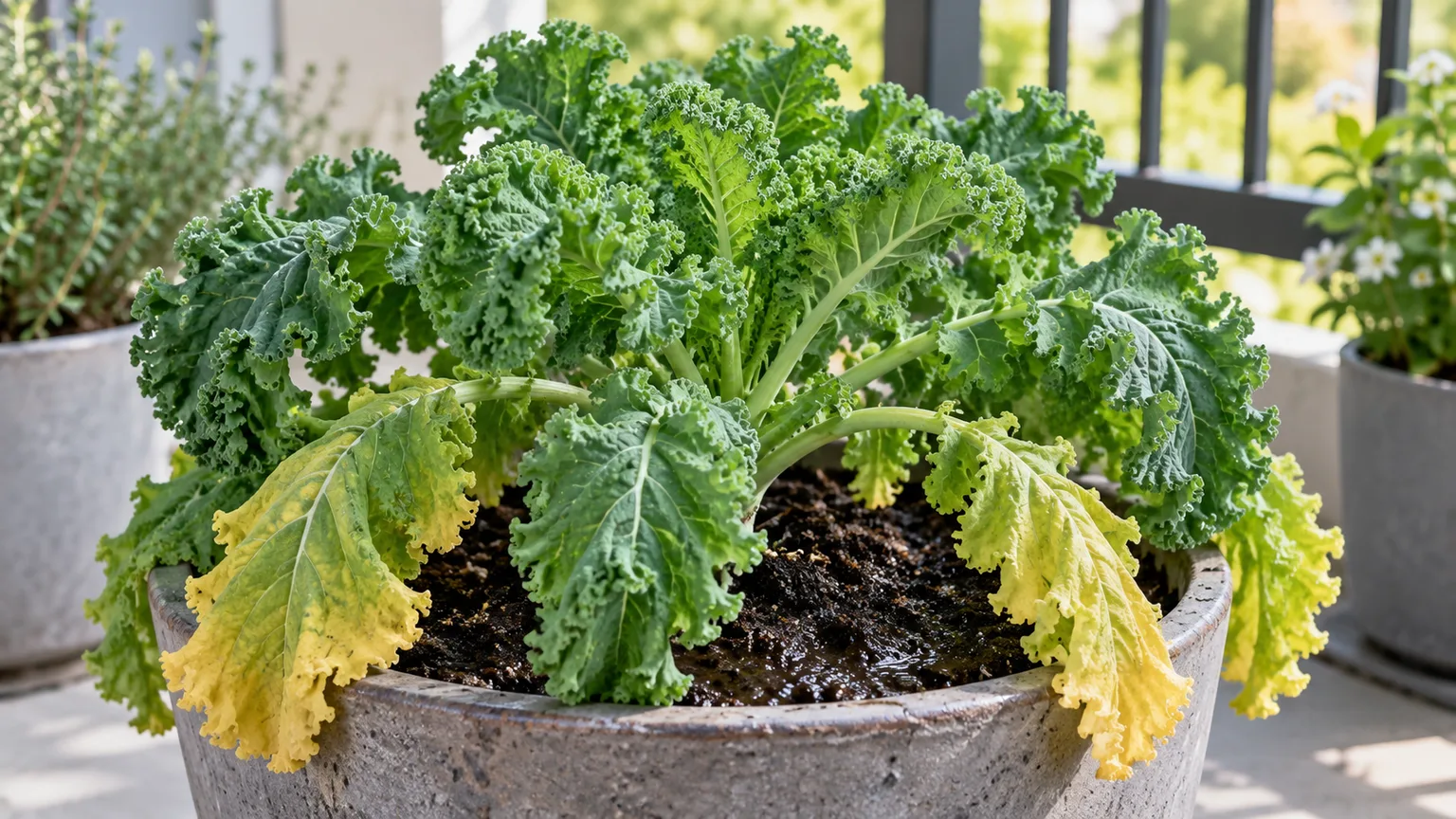
Overwatering on Kale: Causes, Checks & Fixes
This guide covers overwatering on Kale. See also the general Overwatering guide, watering, and light pages for this plant.
Overwatering on Kale: Causes, Checks & Fixes
Quick answer
Your kale looks sad — yellowing lower leaves, drooping foliage — and your instinct says to water it. On kale, that instinct is the trap: this is a fast-growing, cool-season leafy green that produces maximum yields in early spring or fall, raised in rich, moisture-holding mix that stays wet far longer than it looks. Wilting in wet soil means the roots are drowning, not thirsty.
First step: stop watering, empty the saucer, and let the top 2-3 cm of mix dry out before the next drink. Do not repot, feed, or spray anything yet. For how chronic wet mix damages roots in general, see our overwatering guide. On kale, the pattern usually shows up as yellow lower leaves plus wet-soil wilting in a heavy pot during cool, cloudy weather.
When to use this page vs other kale guides
This page is the water-excess entry for kale: leaves flagging or yellowing while the mix stays moist. Use it to confirm the pot is too wet and run the dry-down.
- Root rot — go here when stems soften at the base, roots turn brown and mushy, or soil smells sour
- Yellow leaves — go here when yellowing continues after the mix has dried normally
- Wilting — go here when you cannot tell whether the cause is too much or too little water
- Drooping leaves — go here for soft, limp foliage from causes beyond watering
- Underwatering — go here when the finger check finds dry mix and crispy leaf margins instead
- Mold on soil — go here when white fuzz coats the surface of the same wet pot
- Fungus gnats — go here when small flies rise from the damp mix after watering
- Watering — go here for the long-term 2-3 cm finger-check rhythm after recovery
- Soil — go here when the mix itself stays soggy between waterings
- All kale problems — go here when you are unsure which symptom page matches
What overwatering looks like on kale
Kale does not flag overwatering the way a succulent does. Because it is grown for rapid leaf output in fertile mix, the first signs appear on the oldest, lowest leaves while the central bud can look fine for days.
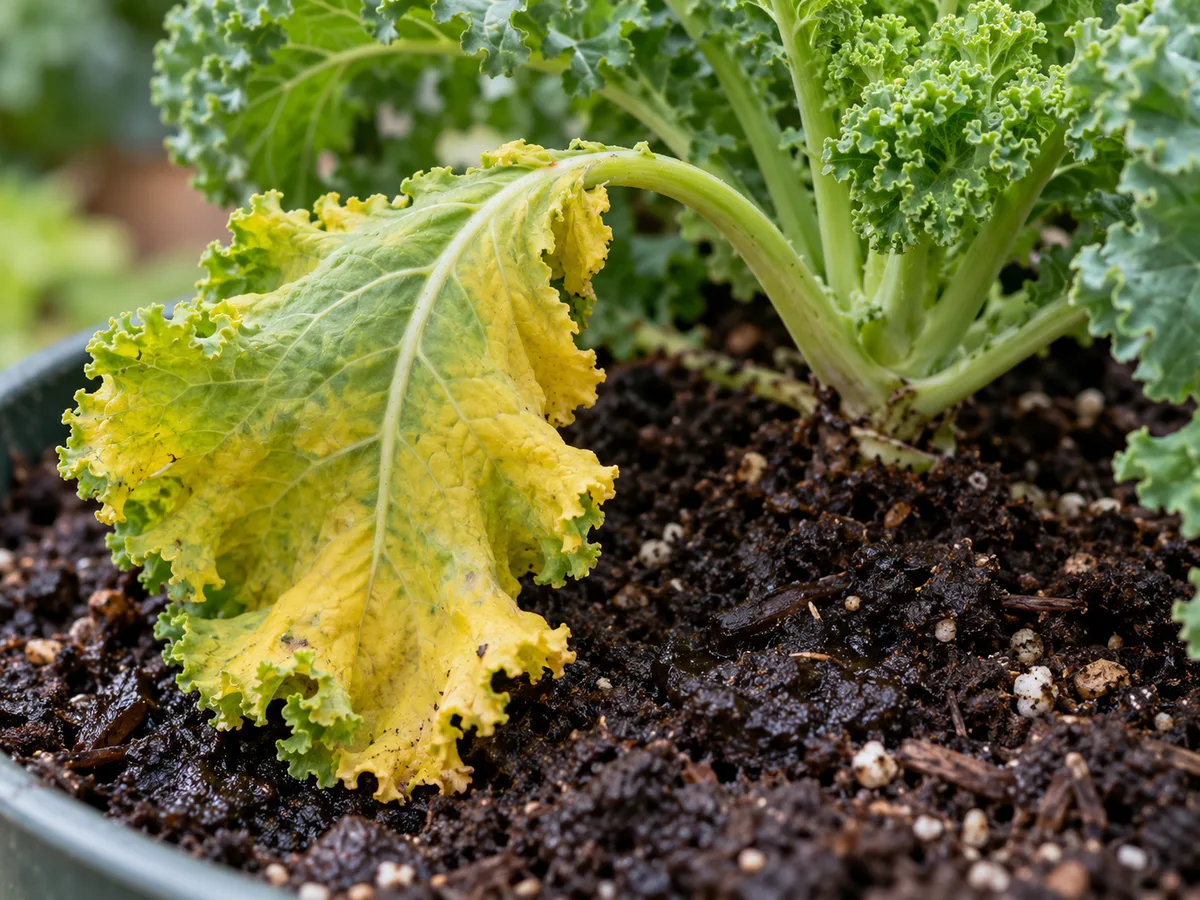
Overwatering on kale — yellowing lower leaves and limp foliage on a plant sitting in persistently damp mix; compare with fresh growth from the central bud.
Typical overwatered-kale pattern:
- Lower, outer leaves yellow first, sometimes with soft, waterlogged-feeling tissue rather than crisp edges
- Whole plant wilts or sags even though the mix feels damp 2-3 cm down — wilting despite wet soil is one of the most confusing overwatering symptoms because damaged roots cannot move water upward
- Stems feel soft near the soil line instead of firm and sturdy
- Growth stalls: no new leaves unfolding from the central bud despite weeks passing
- Pot stays heavy for days after watering; saucer holds standing water
- White surface fuzz or tiny dark flies appear, since the same wet layer feeds both — compare with the mold on soil guide and the fungus gnats guide
What it is not: dry-soil wilting rebounds within hours of a deep drink and comes with light pots and dry, crumbly mix. Crisp brown leaf margins with dry soil point to underwatering, not excess. Kale naturally sheds its oldest outer leaves over time — one yellow bottom leaf on an otherwise vigorous plant with correctly drying mix is normal harvest aging, not overwatering.
Why kale pots get overwatered
Kale invites overwatering for reasons tied directly to how it is grown. It wants plentiful, consistent moisture in well-drained, fertile soil high in organic matter at pH 6.0 to 7.5 — and growers hear “consistent moisture” as “keep it wet.” Those are different things, and the gap between them is where kale drowns.
Compost-rich mix that holds too much. Kale feeds heavily, so containers get generous compost. That organic matter is exactly what young leaves want, but fine, dense compost holds water around kale’s shallow roots long after the surface looks ready. Brassica oleracea performs best in nitrogen-rich soil with good drainage — fertility without drainage is a swamp, not a feast. When roots sit in saturated mix, they cannot access the oxygen they need, which is why wet-soil wilting happens.
The cool-season watering trap. Kale grows through winter, when evaporation is slow and growth stalls during prolonged cold, cloudy spells. A daily drink that suited a sunny October week keeps the pot saturated through a gray fortnight in December. Plants need less water during cooler weather and slower growth, yet many growers never adjust the routine. The RHS notes kale prefers rich, well-drained, firm soil and containers that drain freely — a winter pot watered on autopilot violates both conditions.
Saucer water wicking back up. A saucer left full after watering feeds moisture straight back into the shallow root zone. Empty it the same day, every time.
Oversized or hole-less containers. A small seedling in a huge pot sits in a reservoir of wet mix its roots cannot yet reach, and a decorative pot without drainage turns every watering into a flood. The RHS recommends a large container at least 30 cm wide and deep for a mature plant — roomy, but always with open drainage. Small containers with soggy anaerobic conditions can develop root rot fast because excess water has nowhere to go.
Mulch and crowding sealing the surface. Thick mulch plus pots packed leaf-to-leaf keeps every surface damp and still. Wide spacing gives plants light and air, which deters fungal disease — the same airflow logic applies to containers on a balcony.
How to confirm the cause
Work through these checks before changing anything. They take five minutes and separate overwatering from every lookalike:
- Finger check at 2-3 cm — Push a finger into the mix to the second knuckle, the standard kale test. Cool, clinging, soggy soil days after watering confirms excess. Dry and crumbly points to underwatering instead.
- Pot weight — Lift the container. Heavy long after the last drink means saturation through the whole profile, not just the surface.
- Saucer and hole audit — Look under the pot. Standing water, blocked holes, or no drainage at all explains everything else.
- Wilt-versus-moisture pairing — Wilting plus wet mix is the overwatering signature; wilting plus dry mix is thirst. This single pairing prevents the classic mistake of watering a drowning plant.
- Stem-base inspection — Part the lowest leaves and press the stem where it meets the soil. Firm and green means early-stage excess; dark, soft, or sour-smelling tissue means rot has started — switch to the root rot guide.
- Newest-growth read — Check the central bud. Clean new leaves unfolding means the plant can recover on its own schedule; a stalled or blackened bud means the problem has reached the growing point.
- Seedling stem check — In trays, look for pinched, thread-thin stems at the soil line. That is damping-off disease in constantly wet compost, not simple overwatering, and collapsed seedlings will not recover.
If the mix is wet, the pot is heavy, and leaves wilt anyway, you have confirmed overwatering. Do not water “just a little” to test — that resets the clock on drying.
First fix for kale
Stop watering, empty the saucer completely, and move the pot where air circulates — then wait until the top 2-3 cm tests dry before the next drink.
Waterlogged mix harms kale because the water has nowhere to go and accumulates in the bottom of the pot, so drainage and time are the entire treatment at this stage. Established kale draws from deeper in the pot and tolerates a dry top layer well. Most mild cases need nothing more than this pause: no repotting, no fertilizer, no sprays. Repot only when the mix stays soggy after a full dry-down attempt or the stem base softens.
Step-by-step recovery
After the first dry-down begins, branch based on what you found:
If stems are firm and the central bud is clean:
- Wait for the 2-3 cm finger check to read dry, then water deeply in the morning so the surface dries in daylight.
- Empty the saucer the same day, every time.
- Strip only fully yellow, mushy outer leaves; leave anything partly green, and never touch the central bud.
- Resume the container rhythm in the watering guide once two normal wet-dry cycles pass without new yellowing.
If the pot stays heavy and wet after a week of no watering:
- Check drainage holes for blockage and confirm the pot actually has them — a hole-less decorative pot needs the plant moved.
- If holes are open but mix stays soggy, the mix itself has failed: unpot, shake off the sludge, and repot into fresh fertile but free-draining mix per the soil guide.
- Water once lightly to settle, then restart the dry-down.
If the stem base is soft or smells sour:
- Stop dry-down treatment — this is now rot, not simple excess.
- Unpot, trim brown mushy roots with clean shears, and repot into fresh mix following the root rot guide.
- Expect to lose the outer leaves; recovery is judged by the central bud alone.
If seedlings are damping off:
Pull and discard collapsed seedlings immediately so the disease does not run along the damp row, thin survivors for airflow, and resow into fresh mix if a whole section has fallen. Standing seedlings usually grow on once the surface dries.
Recovery vignette: winter balcony container
A mature curly kale in a 25-litre balcony pot yellowed from the bottom up through a cloudy December fortnight. The grower had kept a daily 500 ml evening routine from sunnier weeks; the saucer held water each morning and the pot felt heavy. Finger check read soggy at 3 cm, but stems were firm with no sour smell. The fix: watering stopped, saucer emptied, and morning-only drinks resumed only when the top 2-3 cm tested dry. New leaves from the central bud appeared within twelve days; the yellowed lowers never greened again and were harvested off. No repotting was needed — drainage and timing were the whole cure.
Mistakes to avoid
- Watering a wilting plant without checking the mix — Wet-soil wilting plus more water is how mild excess becomes rot.
- Watering on a calendar instead of the finger check — A fixed schedule cannot track cold snaps, cloudy weeks, or growth stalls. Check soil moisture rather than watering on a schedule, every time.
- Leaving the saucer full — Standing water wicks back into shallow kale roots within hours.
- Feeding a drowning plant — Fertilizer does not fix oxygen-starved roots and excess nitrogen in already-rich mix makes things worse. Feed only on the normal schedule once clean new growth resumes — see the fertilizer guide.
- Repotting on day one — Mild overwatering resolves with dry-down. Unpot only when mix stays soggy, stems soften, or rot is confirmed.
- Misting or overhead-wetting the foliage to “help” — Wet leaves in still air invite the fungal problems wide spacing is meant to prevent. Water the mix, in the morning.
- Removing the central bud — Outer yellowed leaves are expendable; the growing point is the plant’s future. Harvest around it, never through it.
- Ignoring light — A kale stuck in dim shade drinks slower and stays wet longer. Confirm placement meets the light guide while the pot dries.
Recovery timeline
Mild overwatering usually turns within one to two care cycles once the mix dries properly:
- Days 1-4: surface lightens, pot grows lighter, no new yellowing appears
- Week 1-2: wilting eases without any new watering; central bud pushes fresh leaves
- Week 2-3: two normal wet-dry cycles complete; outer-leaf harvests resume
Yellowed lower leaves will not green again — harvest them off and judge by new growth. Escalate if yellowing spreads after the mix has dried, stems soften, or the bud stalls, using the yellow leaves and root rot guides above.
How to prevent it next time
Build the routine around kale’s cool-season rhythm:
- Check moisture 2-3 cm deep — not surface color — before every watering, and water deeply only when that layer tests dry.
- Water in the morning and empty saucers the same day so pots never stand in water.
- Cut volume (not just frequency) during prolonged cold, cloudy spells when growth stalls — kale still wants even moisture, just less of it.
- Keep mulch thin in containers and pulled back from stem bases during damp weather.
- Space containers for airflow rather than packing them leaf-to-leaf; removing faded lower leaves maintains airflow between plants.
- Give full winter sun where possible and confirm drainage holes stay open each season.
- Sow trays thinly, ventilate after germination, and never reuse suspect mix — kale shares soil-borne problems with other brassicas.
Follow the watering guide and soil guide for the full long-term routine.
When to worry
Act the same day when:
- Stems soften or smell sour at the base in wet mix
- Several leaves yellow within days despite no new watering
- The central bud stalls, darkens, or stops producing
- Seedlings topple with pinched stems at the soil line
- Dry-down plus drainage fixes fail twice in a row
Those signs mean rot or seedling disease, not simple excess — unpot and inspect per the rot guide linked above. A single yellow outer leaf on a firm plant with a drying pot is low urgency: correct the habit and move on.
FAQs
How can I confirm overwatering on kale?
Push a finger 2-3 cm into the mix and lift the pot: soggy soil plus a heavy pot plus wilting leaves confirms it. Wilting with dry, light mix means thirst instead. Check the stem base too — firm means early excess, soft means rot.
What should I check first for overwatering on kale?
Check the top 2-3 cm layer, standing water in the saucer, and whether drainage holes are open or blocked. Then inspect the stem base and central bud — those two tell you whether dry-down alone will work or rot treatment is needed.
Will overwatered kale leaves recover?
Yellowed lower leaves will not green again, so harvest them off once they are fully spent. Recovery shows in the central bud: clean new leaves unfolding within one to two weeks of correct drying means the plant has turned the corner.
When is overwatering on kale urgent?
It is urgent when stems soften at the soil line, the mix smells sour, multiple leaves yellow within days, or seedlings collapse at the surface. Those signal rot or damping-off rather than simple excess — unpot and treat the same day.
How do I prevent overwatering kale long term?
Water only when the top 2-3 cm tests dry, empty saucers same-day, and reduce volume during cold cloudy spells when growth stalls. Thin mulch, space pots for airflow, and keep drainage holes open each season.
Related kale guides
- Kale overview — cool-season growing basics and cultivar differences
- Watering — the 2-3 cm finger-check rhythm and seasonal adjustments
- Soil — fertile but free-draining mix that protects shallow roots
- Root rot — surgery steps when stems soften in wet mix
- Yellow leaves — when foliage keeps yellowing after drying
- Wilting — sorting wet-soil flagging from true thirst
- Drooping leaves — limp foliage from causes beyond water
- Underwatering — the dry-side mirror image with crispy margins
- Mold on soil — surface fuzz on the same wet compost-rich mix
- Fungus gnats — companion pest breeding in damp top layers
- All kale problems
Related tool
Use the Plant Watering Calculator to narrow causes for overwatering on this plant before changing multiple variables at once.