Underwatering on Kale: Causes, Checks & Fixes
Quick answer
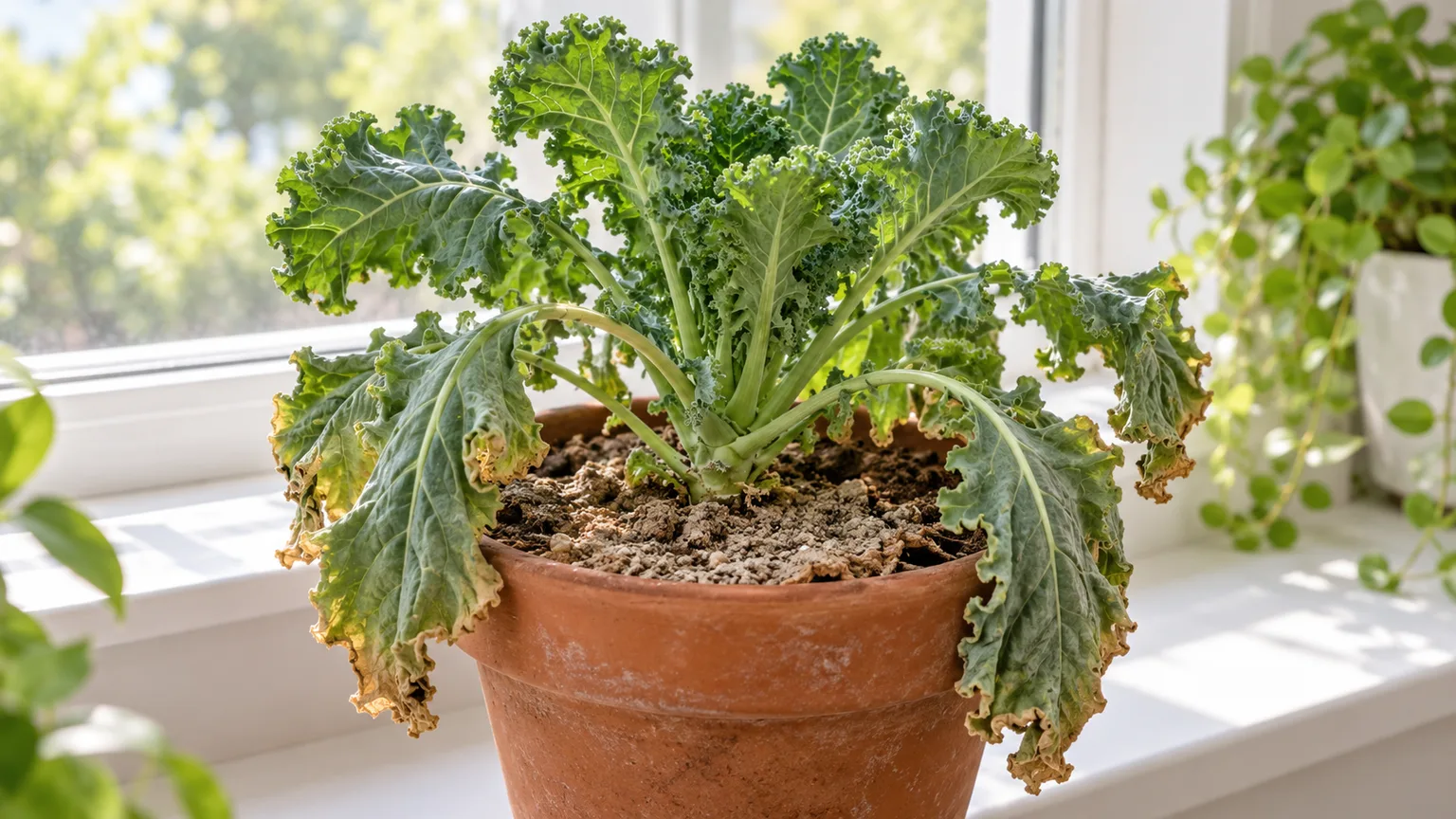
Limp kale leaves on light, dry mix usually mean true thirst. Confirm the top 2-3 cm is dry and the pot feels light, then give one deep soil-level soak until water drains freely.
Underwatering on Kale: Causes, Checks & Fixes
This guide covers underwatering on Kale. See also the general Underwatering guide, watering, and light pages for this plant.
Underwatering on Kale: Causes, Checks & Fixes
Quick answer
If your kale is limp on dry, light mix, it is thirsty. Confirm the top 2–3 cm feels dry and the pot has noticeably lightened, then give one deep watering at soil level until excess drains freely and empty the saucer. Most merely limp leaves regain turgor within hours.
Kale (Brassica oleracea var. acephala) is a fast-growing leafy brassica with shallow, fibrous roots, and it produces its best leaves on steady, even moisture — not on soak-and-forget drought cycles. The Royal Horticultural Society advises watering young kale regularly so soil does not dry out, and notes container kale still needs regular watering because compost dries quickly. For how dry-down damages roots in general, see our underwatering guide. On kale, the pattern usually shows up as whole-plant limpness on visibly dry mix, crisping outer-leaf margins, and growth that stalls until moisture returns.
What underwatering looks like on kale
Thirsty kale wilts from the outside in. Outer, older leaves go limp first and feel soft and papery rather than crisp; leaf margins may yellow, then brown and crisp while the central bud still looks alive. Growth stalls — no new leaf unfurling from the crown for days — and harvested plants may taste tougher and more bitter, since drought stress cuts biomass and leaf quality. The mix pulls slightly away from the pot wall, the surface looks pale and dusty, and the container feels strikingly light when lifted.
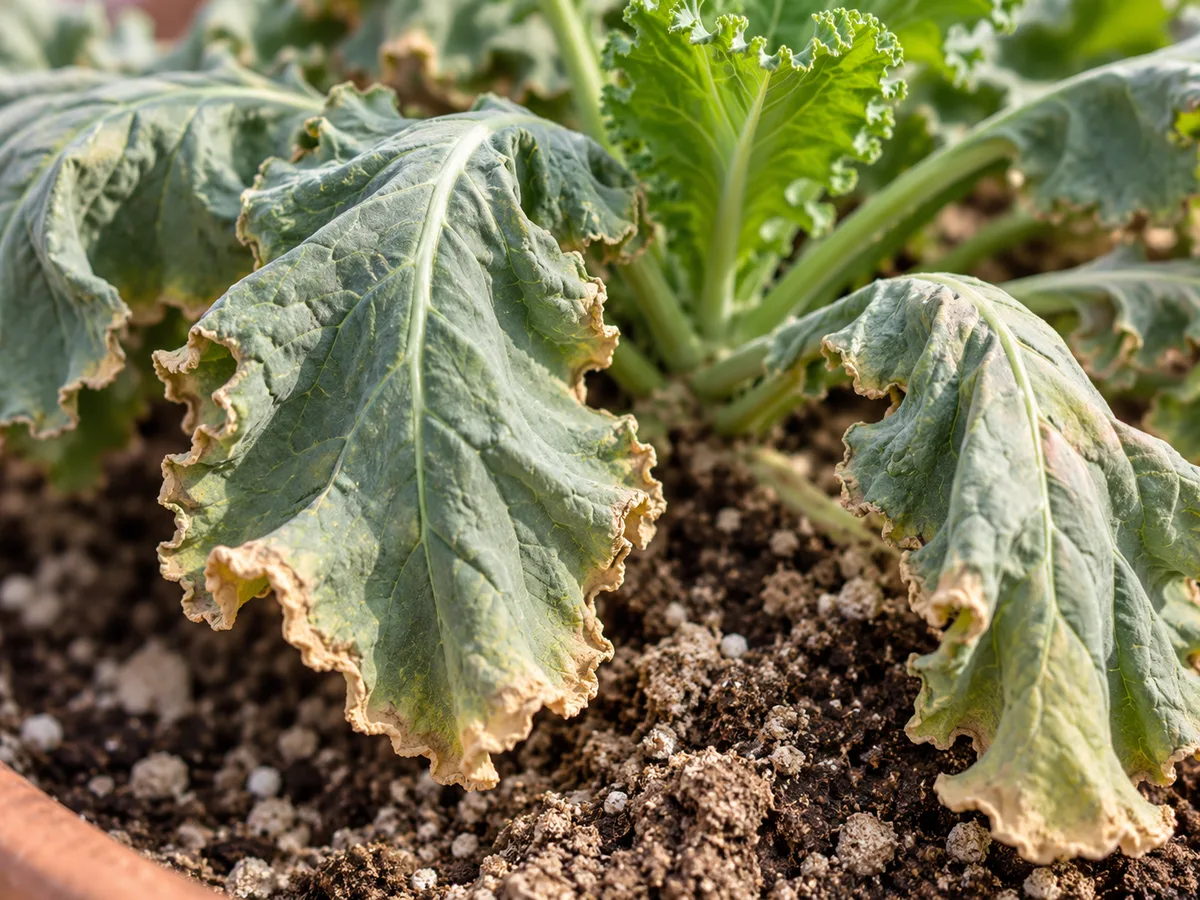
Limp kale blades with soft, dull tissue and browning outer margins on dry mix — compare with firm new growth at the crown.
Seedlings show it fastest: small cells can collapse within hours of drying in direct sun. On mature plants, underwatering rarely kills outright at first — it just stops the cut-and-come-again engine. If the central growing point is still firm and green, the plant can resume production once watering stabilizes.
Why kale dries out fast in pots
Kale is not a succulent, and its root system explains most thirst episodes. A fibrous, shallow root ball occupies only the container you gave it, and a large leafy canopy transpires heavily on sunny, breezy winter days. UF/IFAS notes kale performs best with direct sun, moisture, and slow-release fertility — the moisture half of that equation is non-negotiable for a leaf crop.
Three kale-specific drying traps:
- Undersized or gritty containers. A mature standard plant wants at least a 20–30 litre pot with compost-rich mix. Small nursery pots and excessively gritty blends can swing from soaked to dust-dry within a day, which kale’s roots cannot buffer. If every check finds dry mix 24 hours after a soak, the container — not your diligence — is the problem.
- Big canopy, same old rhythm. Each outer-leaf harvest leaves a plant that keeps transpiring through its remaining foliage, and a large Lacinato or tall Scotch type drinks faster than the seedling you transplanted months ago. Watering frequency has to rise as the plant sizes up.
- Wind and winter sun. An east-facing terrace with steady breeze dries the top centimetres far faster than a sheltered balcony. Vegetables are largely made up of water and therefore very vulnerable in dry soil, so exposed pots need checking every two to three days, not weekly.
The October–March rhythm: thirst versus heat wilt
Most Indian plains growers run kale as an October–March crop, and watering must follow that season. Cool months slow evaporation, so an established pot may coast for several days between drinks. But an unseasonably warm afternoon can make leaves flop even when the root zone is adequately moist, because transpiration temporarily outpaces uptake. That is heat wilt, not thirst — and pouring on extra water will not fix it.
Tell them apart by timing and recovery. True underwatering looks worst in the morning on dry mix and improves a few hours after a deep soak. Heat wilt appears in the afternoon on moist mix and resolves overnight on its own. Underwatering tops the list for wilting leafy greens, but when soil is demonstrably moist, move the pot off a heat-radiating wall, improve airflow, or add light afternoon shade per the Kale light guide instead of reaching for the can again.
Repeated drought–heat cycling also degrades eating quality. Leaves that keep wilting and recovering turn leathery and bitter, and sustained heat pushes the plant toward bolting — at which point no watering schedule restores tender leaf texture.
Confirm it is underwatering, not overwatering or pests
Underwatering and overwatering both cause limp leaves, so confirm with the root zone before acting. Work through these checks in order:
- Finger test, 2–3 cm deep. Push a finger into the mix away from the stem. Dry and crumbly at depth means thirst; cool and damp means hold off. Editorial kale guides describe exactly this fingertip test: water when roughly the top inch is dry, skip when it feels moist.
- Pot weight. Lift the container. A sharply lighter pot corroborates dry mix; a heavy pot with limp leaves points toward overwatering on kale or root rot on kale.
- Saucer and drainage check. Standing water in the saucer with wilted leaves means oxygen-starved roots, not thirst. Empty it and let the mix aerate.
- Leaf texture. Soft, dull, papery limpness suggests underwatering; yellowing lower leaves on wet mix suggest overwatering. Crispy brown tips on otherwise firm leaves may belong to the brown tips on kale path instead.
- Timing test. Water deeply once if the mix is dry. Visible perk-up within a few hours confirms the diagnosis. No improvement after 24 hours on moist mix means look elsewhere — persistent wilt with wet soil belongs to the wilting on kale guide.
Lookalike comparison
| What you see | Likely cause | Key check |
|---|---|---|
| Whole plant limp, dry light mix, perks up after watering | Underwatering | 2–3 cm finger test dry; pot light |
| Limp on heavy wet mix, yellowing lower leaves | Overwatering | Soggy soil; saucer water; sour smell |
| Afternoon flop on moist mix, recovers overnight | Heat stress | Morning soil moist; hot wall or still air |
| Drooping with soft dark stem base, foul mix | Root rot | Stem soft at soil line |
| Uneven yellowing, sticky residue, visible insects | Aphids or spider mites | Leaf undersides and buds |
| Lower leaves yellowing one by one on moist, fed soil | Yellow leaves or nutrition | Moisture stable; check feed history |
Drought stress begins when the plant loses water faster than its roots can pull it in, halting growth and photosynthesis before leaves visibly wilt — so stalled growth on dry mix counts as an early signal, not just dramatic collapse.
First fix: one deep recovery watering
Water deeply once, at soil level, until excess drains freely — then stop and empty the saucer. Morning is ideal so foliage dries before cool nights. This single thorough soak rehydrates the whole root ball; repeated light sprinkles only wet the surface while the centre stays dry.
Do not feed, repot, prune heavily, or spray anything on the same day. A thirsty plant needs water first; stacking interventions masks whether moisture was ever the problem and stresses tissue that is already struggling to transpire.
Step-by-step recovery over the next two weeks
After the recovery soak, watch and adjust rather than watering on autopilot:
- Hours 2–6: Limp but living leaves should visibly firm up. Leaves that stay flat and papery after six hours on moist mix were already too far gone — leave them; the crown matters more.
- Days 2–3: Recheck 2–3 cm deep and rewater only when that layer has dried again. In sunny, breezy weather this may be every two to three days; in cool, cloudy spells, longer.
- Days 4–7: Look for the central bud pushing a fresh leaf. New growth from the crown is the recovery signal; old crisped margins will not heal, so trim only fully brown, dry edges and keep any partially green blade photosynthesizing.
- Week 2: Growth should resume its normal pace for the season. Vegetable guides often cite 1–1.5 inches of water per week as a planning benchmark for in-ground kale including rain — use it as background orientation, but let container checks, not the calendar, trigger each watering.
- If nothing improves: No new crown growth after two weeks of correct moisture means roots were damaged or the plant has bolted. Inspect roots for a dense circling mat (repot per the Kale repotting guide) or accept that a flower-stalked plant has finished its productive season.
What not to do
- Do not flood a bone-dry pot repeatedly. One deep soak, then normal checks. Back-to-back drenchings on consecutive days swing the root zone from drought to waterlogging.
- Do not fertilize a wilted plant. Stressed roots cannot use feed, and salts in dry mix concentrate around them. Resume feeding only after new growth looks healthy, following the Kale fertilizer guide.
- Do not mist leaves as the fix. Wet foliage does not hydrate roots, and kale sitting damp in still air invites foliar trouble. Water the soil.
- Do not repot on day one. Repotting is for root-bound or drainage-failed pots confirmed over several checks, not a first response to one wilt episode.
- Do not strip all damaged leaves at once. Partially green blades still feed the crown. Remove only fully crisped tissue.
Kale care cross-check
Thirst often exposes a second weakness. Run through these once watering stabilizes:
- Soil: An extremely gritty mix dries too fast for shallow brassica roots, while dense airless mix swings to rot. Compare yours with the Kale soil guide — compost-rich, moisture-retentive but free-draining loam around pH 6.0–7.5.
- Light: Pale, stretched plants with thin leaves drink and transpire erratically. Confirm winter sun exposure in the Kale light guide.
- Containers: If the final pot dries within a day, review sizing and transplant handling in the Kale repotting guide.
- Pests and surface mold: Chronic wet–dry swings and damp surfaces can invite fungus gnats on kale or mold on soil on kale — fix the moisture rhythm first, then treat residents if they persist.
How to prevent it next time
Prevention is a checking habit plus a forgiving setup:
- Check, don’t schedule. Finger-test 2–3 cm deep every two to three days in sunny weather; water only when dry. Pot weight becomes second nature within a fortnight.
- Mulch the surface. A centimetre or two of mature compost slows surface evaporation and feeds the soil, echoing RHS guidance to mulch established kale to reduce watering need. IFAS similarly notes that mulch helps plants retain water while moderating root-zone temperature.
- Size pots generously. One mature plant in 20–30 litres of compost-rich mix forgives a missed day; a seedling cell does not.
- Build organic matter. Digging compost into beds improves water-holding capacity, holding up to two weeks of moisture for subsequent crops — the same principle steadies containers.
- Harvest with the canopy in mind. After heavy outer-leaf picks, the remaining leaves transpire on; check a day sooner during the regrowth push, as described in the Kale pruning guide.
When to worry
Escalate when limpness comes with warning signs beyond simple thirst: stems softening at the soil line, spreading yellowing with foul-smelling mix, or whole-plant collapse that does not respond to a deep soak within a day. Those point to stem or root trouble rather than an empty reservoir. A plant whose central bud has turned brown and mushy, or that has sent up a flower stalk with small bitter leaves, has finished — compost it and sow fresh for the next cool window rather than nursing it.
When to use this page vs other kale guides
- Kale watering — routine moisture rhythm, seasonal checks, and how much to water when nothing is wrong.
- Kale overview — cultivar choice, sowing windows, and whole-plant care.
- Wilting on kale — wilt from any cause when the soil check is inconclusive.
- Overwatering on kale — limp leaves on heavy, wet mix with saucer water.
- Drooping leaves on kale — posture problems where dryness is only one suspect.
- Kale problems hub — browse every documented issue on this crop.
Related kale guides
- Kale overview — cool-season identity, cultivars, and whole-plant care
- Kale watering — even-moisture rhythm and the 2–3 cm check
- Kale soil — moisture retention, drainage, and pH for brassicas
- Kale light — winter sun, heat wilt, and leggy growth
- Kale fertilizer — feeding only after moisture is stable
- Kale repotting — final pot size for thirst-proof root balls
- Kale pruning — outer-leaf harvest without damaging the crown
- Overwatering on kale — the mirror image: wilt on wet mix
- Wilting on kale — multi-cause wilt diagnosis
- Drooping leaves on kale — posture symptoms beyond thirst
- Kale problems — full issue index for this plant