Mealybugs on Money Tree: Causes, Checks & Fixes
Quick answer
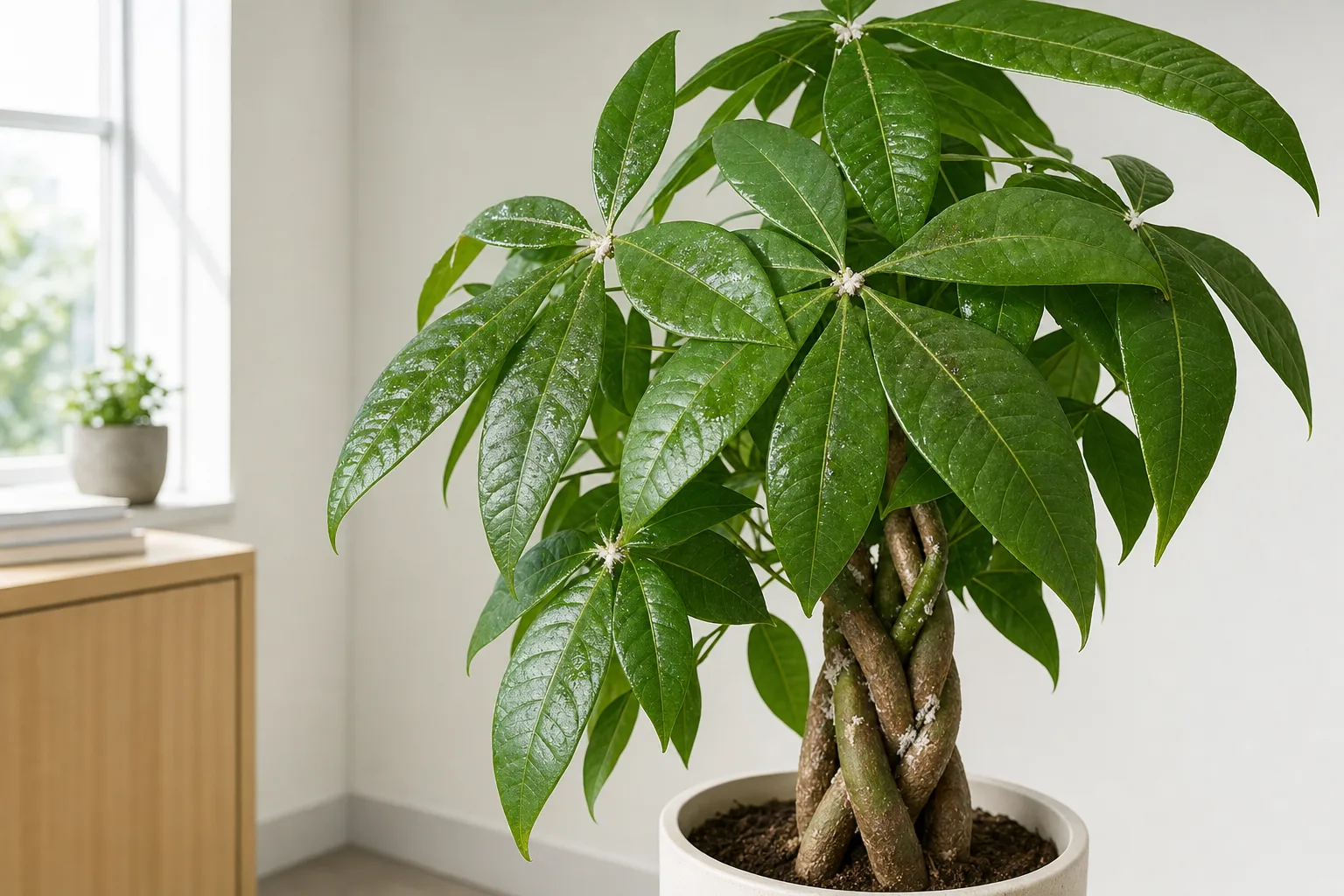
Mealybugs on Money Tree (*Pachira aquatica*) show as white cottony clusters tucked into palmate leaflet axils where five to seven glossy leaflets meet the central petiole, along braided-stem crotches, and at the crown center-often with sticky honeydew on leaflets or the desk below. First step: isolate the plant and dab every visible wax cluster with a cotton swab dipped in 70% isopropyl alcohol.
Mealybugs on Money Tree: Causes, Checks & Fixes
This guide covers mealybugs on Money Tree. See also the general Mealybugs guide, watering, and light pages for this plant.
Mealybugs on Money Tree: Causes, Checks & Fixes
Quick answer
Mealybugs on Money Tree (Pachira aquatica) show up as white cottony clusters tucked into palmate leaflet axils where five to seven glossy leaflets meet the central petiole, along braided-stem crotches, at the crown center, and sometimes on undersides of older leaflets near the trunk. They suck sap and excrete sticky honeydew that can coat leaflets, drip onto pot rims, and support black sooty mold on nearby surfaces.
First step: isolate the plant the same day you spot cottony wax. Move it away from office desk mates, shared plant shelves, and newly purchased nursery stock before you dab, rinse, or spray anything. Once isolated, dab every visible wax cluster with a cotton swab dipped in 70% isopropyl alcohol, touching the pest directly-not pooling liquid across glossy leaflets.
Money Tree grows palmately compound leaves with five to nine shiny green leaflets on a often braided multi-stem trunk-architecture that hides colonies from casual top-down watering glances. Judge recovery by clean new palmate flush at the crown, not by expecting old yellowed leaflets to reopen perfectly. Full species context: Money Tree overview.
What mealybugs look like on Money Tree
Early infestations concentrate where leaflets clasp the petiole, so check these patterns together-not just the upper leaf surface facing the window:

Mealybugs symptoms on Money Tree - compare with healthy tissue on the same plant.
- White or gray cottony ovals in leaflet axils at the crown where glossy leaflets fan from the central petiole
- Waxy tufts along braided-stem crotches where flexible nursery stems were fused-tight folds that stay dry and sheltered
- Cottony patches on petiole bases and undersides of older leaflets when honeydew and crawlers spread downward
- Sticky, shiny honeydew on leaflets, the pot rim, or the desk surface below active colonies
- Black sooty mold on honeydew-coated tissue once mold spores colonize the sugar residue
- Ants on the saucer or pot rim farming honeydew from crown colonies
- Yellowing or distorted new leaflets emerging from an infested crown while neighboring leaflet clusters still look partially clean
Do not mistake normal aging for pest damage. Money Tree naturally drops older lower leaflets as the canopy grows taller-senescence shows uniform yellowing on one leaflet without cottony wax at multiple axil points. Mealybug stress shows white tufts at several leaflet junctions, stickiness, and stalled clean new palmate growth at the crown.
Why Money Tree gets mealybugs
Mealybugs are common sap-sucking pests on houseplants that usually arrive on new nursery stock, shared tools, or nearby infested pots-not because Pachira aquatica is uniquely prone, but because its growth form gives pests protected hiding spots.
A Money Tree carries palmately compound leaves-each petiole ending in a fan of five to seven (sometimes up to nine) elliptic, glossy green leaflets. The junction where those leaflets meet the petiole is a maze of tight axils where mealybugs hide in crevices where leaves attach to stems. Casual glances from above miss wax buried inside the crown, along overlapping petioles, or in the braided multi-stem crotches that define most store-bought specimens.
Most indoor Money Trees are sold with hand-braided trunks-three to five saplings fused at the base-which creates additional bark crevices where cottony colonies persist while neighboring stems look clean. NC State Extension notes the braid is a decorative nursery form, not a natural swamp habit; those fused stems share one root system, so sap loss at one crotch can stress the whole canopy.
Warm, stable indoor rooms suit mealybugs year-round. Indoor ornamentals are especially vulnerable because mild temperatures favor populations and natural enemies are absent. Common entry points include a recent gift-tree purchase, summer patio time beside companion plants, or a specimen kept in dim office light with heavy nitrogen feeding that pushes soft tender shoots mealybugs prefer.
Money Tree stress factors that follow outbreaks: chronically overwatered soft braided trunks (see overwatering and root rot), low-light legginess that opens sparse crowns to inspection gaps, and dry heated air near HVAC vents that weakens leaflet edges without directly causing mealybugs-but slows recovery once sap loss begins. Mealybugs on a firm-trunk specimen in bright indirect light are manageable; the same colony on an underlit desk tree with a mushy braid base can push decline faster.
How to confirm the cause
Do not treat from one white speck on a glossy leaflet. Use this inspection order:
- Isolate first - Move the Money Tree away from other plants before handling so crawlers do not walk to neighboring pots on a shared shelf.
- Crown and leaflet axils - Part the palmate leaves gently with bright light and inspect every fold where leaflets meet the central petiole. Most Money Tree mealybugs concentrate here before they spread to braided stems.
- Braided-stem crotches - Trace each fused stem from soil line upward and check where stems cross; wax often sits in bark crevices invisible from the front of the braid.
- Petiole bases and leaflet undersides - Follow each petiole to the crown and flip older leaflets to check lower surfaces, especially on the side facing the wall.
- Honeydew trail - Look for sticky residue on leaflets, the pot rim, saucer, or desk below the crown; follow stickiness upward to the active colony.
- Disturbance test - Touch a white patch with a dry cotton swab. Mealybugs smear pinkish or yellowish body fluid when crushed; mineral dust, dried water spots, or natural glossy leaflet sheen do not.
- Neighbor check - Inspect plants that shared a windowsill, office cluster, or nursery shipment for crown wax, honeydew, or ants.
If the braided trunk feels firm, soil smells neutral, and the only issue is cottony wax with stickiness, mealybugs fit. If one stem in the braid is soft and dark while soil stays saturated, rule out root rot and hidden nursery bindings (see Money Tree overview) before aggressive foliar spraying.
Lookalike symptoms to rule out
| What you see | Likely cause | Key difference |
|---|---|---|
| White cottony tufts in leaflet axils | Mealybugs | Waxy filaments; pink smear when crushed; honeydew |
| Fixed brown/tan bumps on braided stems | Scale insects | Smooth armored shells glued to bark; no fluffy wax |
| Fine webbing and yellow stippling | Spider mites | No cotton clusters; webbing in dry heated air |
| Soft green/black pear-shaped insects on new shoots | Aphids | No fluffy wax coat; clusters on tender new growth |
| White crust on glossy leaflet surface | Mineral deposits from hard water | Wipes dry; no live insects beneath |
| Uniform yellowing on one old lower leaflet | Natural senescence | No wax at multiple axils; no stickiness |
First fix for Money Tree
Isolate the plant and dab every visible cottony cluster with a cotton swab dipped in 70% isopropyl alcohol.
That single action removes adults you can reach, dissolves the wax coating, and confirms the pest is alive-not dust or water spots-before you commit to sprays. UC IPM recommends dabbing small houseplant infestations with 70% or less isopropyl alcohol; test on one leaflet first if the plant sits in hot direct sun. Touch only the pest-do not pool alcohol across glossy leaflets or run it down the braided trunk into the soil line.
Once isolated and dabbed:
- Work leaflet axil by axil and braided crotch by crotch rather than spraying the whole canopy on day one
- Wipe honeydew from leaflets and the pot rim with a lightly moist cloth
- Check neighboring desk plants and recent nursery purchases you have not yet isolated
Do not apply systemic pesticides or heavy oil sprays on day one without a spot test-glossy leaflets in bright office light can scorch. Do not repot unless root-zone mealybugs are confirmed at drainage holes. Do not fertilize a pest-hit Money Tree; excess nitrogen stimulates soft new growth that mealybugs prefer once the immediate colony is knocked back.
Pet-aware households: Pachira aquatica is non-toxic to cats, dogs, and horses per the ASPCA, so alcohol dabs on pests are not a plant-toxicity emergency-but keep swabs and wet leaflets away from curious chewers and verify you have true Pachira, not toxic jade sold as money plant.
Step-by-step recovery
After the initial alcohol dab:
Light infestation (few axil clusters, firm trunk)
- Repeat alcohol dabs every five to seven days for at least three cycles on every visible wax patch.
- Wipe honeydew from leaflets and saucers so sooty mold does not spread.
- Resume normal watering rhythm once treatment starts-do not keep soil soggy hoping to “wash out” pests.
Moderate infestation (multiple axils, honeydew on several leaflets)
- Continue weekly alcohol dabs on all visible colonies in crown and braided crotches.
- Apply insecticidal soap on leaflet undersides only if colonies persist after two alcohol rounds-soap and horticultural oil help suppress younger nymphs with less wax. Spot-test one leaflet; keep the plant out of direct sun for 24 hours.
- Manage ants on saucers if they protect colonies-ant barriers help you reach mealybugs.
- Wash sooty mold off leaflets with a damp cloth once honeydew production stops.
Heavy infestation (wax throughout crown, ants, stalled new growth)
- Continue weekly alcohol passes on every reachable cluster while accepting that braided crotches and inner axils may need a fine artist’s brush dipped in alcohol.
- Consider discarding the plant if colonies cover most of the crown, one braid stem is already soft, or treatment fails after four weekly cycles-UC IPM notes severely infested houseplants may be better replaced than repeatedly treated with incomplete control.
- Repot only if root mealybugs are confirmed at drainage holes-unpot, inspect roots, trim badly infested sections, and repot into fresh well-draining mix per repotting guidance.
Keep the Money Tree isolated until you see no new cottony clusters for at least two weeks after the last treatment.
Recovery timeline
Alcohol dabs show results within a few days when colonies are moderate. A full course with weekly repeats typically takes three to four weeks across one pest generation-matching extension guidance to repeat treatment every week until the infestation is gone. Sooty mold fades as honeydew dries up; expect cleaner new palmate leaflets within four to six weeks once insects stay gone, often aligning with spring or summer active flush.
Old yellowed or distorted leaflets rarely reopen perfectly-judge recovery by a firm braided trunk, new crown flush without wax, and no fresh stickiness on petioles. Money Trees rebound faster in bright indirect light than in dim corners where new growth stays slow.
Mistakes to avoid
Do not ignore a few white specks at one leaflet axil-they multiply into crown-wide colonies within weeks. Do not pour undiluted alcohol over the whole canopy or braided trunk. Do not return an isolated plant to a shared office cluster after one dab round-crawlers hide in axils you missed.
Do not overwater during recovery hoping to rinse pests away-that softens braided trunks and invites root rot. Do not confuse scale bumps on braided bark with mealybugs and keep dabbing smooth armored shells that need scraping or oil instead. Do not apply neem or horticultural oil without a spot test on glossy leaflets in direct afternoon sun.
Do not fertilize until new growth emerges clean for several weeks-nitrogen pushes tender shoots before the pest cycle ends. Heavy mealybug infestations may require discarding the plant to protect a large collection-gift-store Money Trees are replaceable once neighbors are safe.
Money Tree care cross-check after treatment
Once wax stays gone for two weeks, stabilize the conditions that slow recovery:
- Watering: Resume flood-and-dry rhythm-water when the top 5 cm of mix is dry, never on a fixed calendar. See Money Tree watering.
- Light: Place in bright indirect light so new palmate flush stays vigorous; dim offices slow rebound and widen inspection gaps.
- Humidity: Office HVAC can crisp leaflet edges; moderate humidity helps but is secondary to pest clearance-compare low humidity if edges brown after treatment.
- Braid inspection: Check the root flare for hidden rubber bands or tape that weaken stems during recovery (detailed on Money Tree overview).
- Scout schedule: Inspect leaflet axils and braided crotches during weekly care, especially during spring and summer active growth when new palmate leaves emerge.
How to prevent mealybugs on Money Tree
Scout leaflet axils and braided crotches during weekly watering, rotating the pot so you see the crown from multiple angles-not only the front facing the room. Quarantine new Money Trees-and any desk plants from the same shipment-for two to three weeks before clustering them with established specimens.
Keep the tree in bright indirect light so the canopy stays dense enough to notice wax early, and avoid heavy nitrogen feeding that produces soft shoots pests prefer. Inspect for common houseplant insects when bringing outdoor patio plants indoors or mixing new nursery stock into an office display.
Sterilize pruning shears with rubbing alcohol between plants when trimming multiple specimens. Keep saucers and shelves clean of fallen honeydew so ants do not farm new colonies at the pot base.
When to worry
Treat as urgent when cottony wax encircles multiple crown axils, ants swarm the saucer, new palmate leaflets stall for more than two weeks during active growth, or white material appears at drainage holes suggesting root infestation. Mealybug feeding can weaken plants and cause leaf drop even on otherwise forgiving Pachira when sap loss continues unchecked.
Replace severely declining plants-with a soft dark stem in the braid, wax throughout the root zone, and no clean new flush-rather than fighting endless reinfestation on a stressed specimen. A single small cluster on one petiole base with a firm trunk elsewhere is manageable with isolation and dabs; act within days before crawlers spread to neighboring leaflet clusters or desk mates.
Conclusion
Mealybugs on Money Tree hide in palmate leaflet axils and braided-stem crotches that top-down watering misses, so checking glossy upper surfaces alone is not enough. Isolate first, dab visible wax with alcohol while protecting leaflets, repeat on a weekly schedule until crawlers stop hatching, and judge recovery by clean new palmate flush-not old yellowed leaflets. That path respects Pachira aquatica’s crown architecture while protecting neighboring plants from a pest that spreads quietly through leaflet junctions you cannot see from across the room.
Related Money Tree guides: overview · watering · light · aphids · spider mites · overwatering · root rot
When to use this page vs other Money Tree guides
- Money Tree watering guide - Use for routine moisture checks before assuming mealybugs is the main issue.
- Money Tree problems hub - Browse all 4 common issues on this species.
- Yellow Leaves on Money Tree - Different entry point when symptoms overlap with mealybugs.