Not Enough Light on Money Tree: Causes, Checks & Fixes
Quick answer
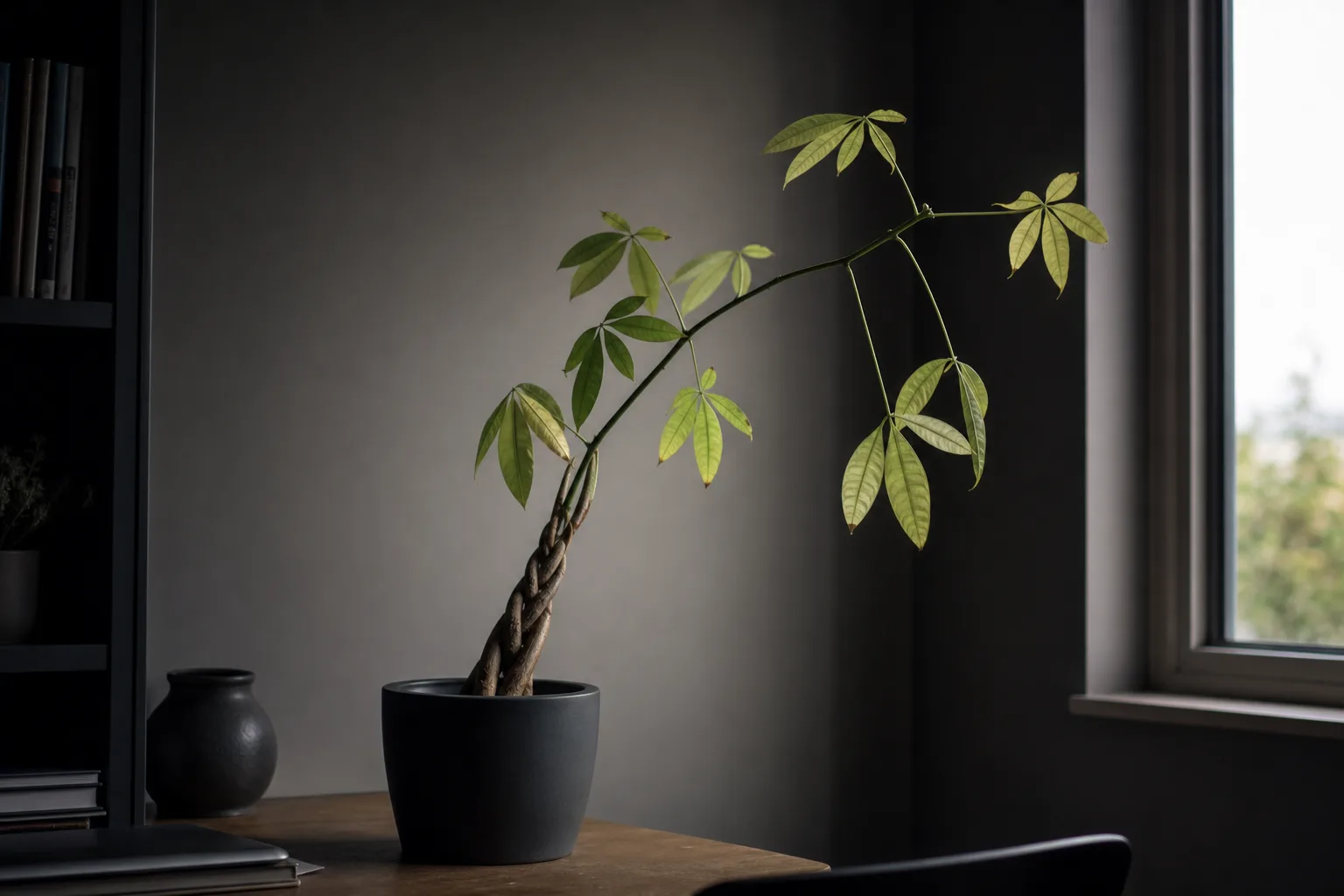
Money Tree (*Pachira aquatica*) in too little light stretches between whorls, produces smaller compound leaflets, and leans toward windows. First step: move to bright indirect light-east or filtered south/west-not a dim desk or north room alone.
Not Enough Light on Money Tree: Causes, Checks & Fixes
This guide covers not enough light on Money Tree. See also the general Not Enough Light guide, watering, and light pages for this plant.
Not Enough Light on Money Tree: Causes, Checks & Fixes
Quick answer
Not enough light on Money Tree (Pachira aquatica) causes pale, sparse growth, long gaps between palmately compound leaf whorls, and lean toward the brightest window. A braided specimen on a feng-shui desk or lobby console may look fine for months while internodes stretch and lower whorls drop.
First step: move the pot to bright indirect light-within about 0.6–0.9 m (2–3 ft) of an east window, or a filtered south or west exposure-not a north room alone or an interior table with no plant-facing window. Wait two weeks and read the newest whorl before changing fertilizer, pot size, or watering volume.
This page is the reactive troubleshooting guide for confirmed or suspected light deficit. For proactive window placement, grow-light setup, and acclimation timelines, start with Money Tree light needs. If stretch geometry-long petioles and top-heavy lean-is your main concern after light improves, see leggy growth on Money Tree.
What not enough light looks like on Money Tree
Low light on Pachira aquatica shows as a pattern over weeks, not one yellow leaflet.
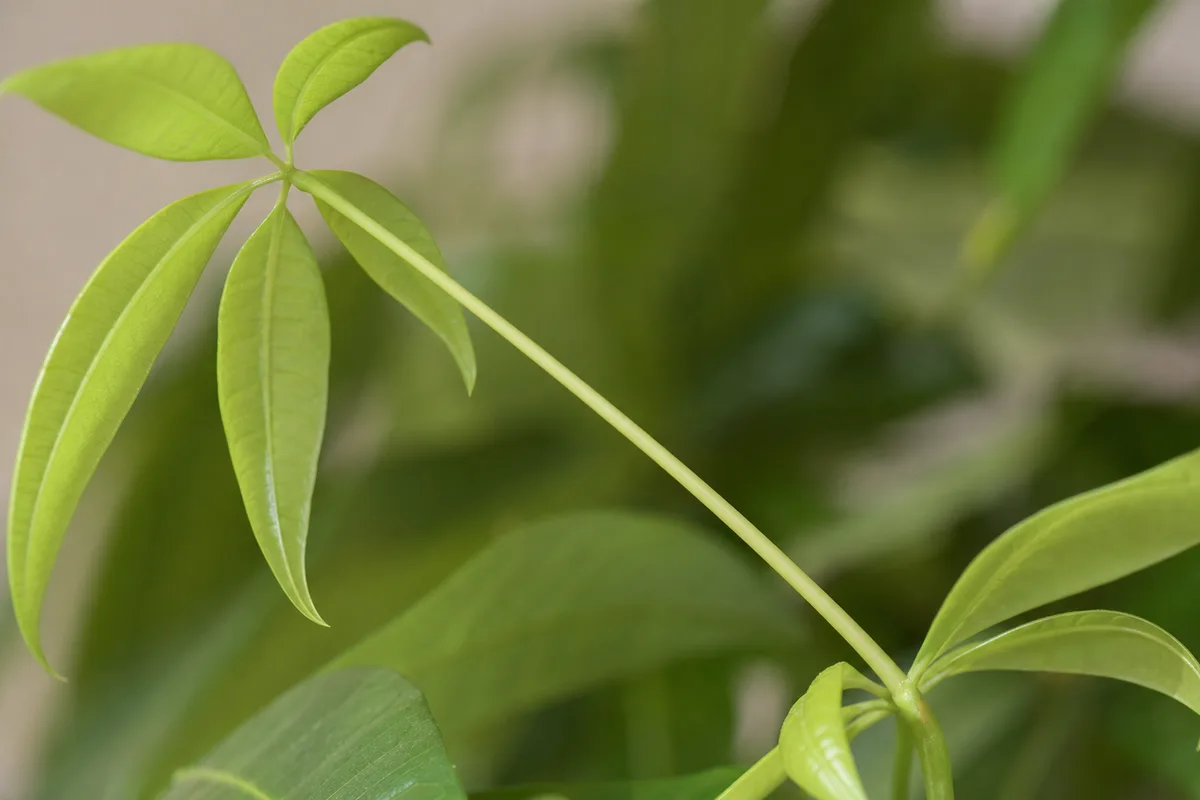
Not Enough Light symptoms on Money Tree - compare with healthy tissue on the same plant.
Early signs:
- Longer gaps between new leaf whorls on free stems above the braided base-internodes stretch as the tree reaches for photons
- Smaller leaflets on the same compound, palmately arranged leaves compared with older whorls formed in brighter light
- Dull or flat green color on new growth instead of the glossy deep green of a well-lit canopy
- One-sided lean or all new whorls oriented toward a window or lamp-plants stretch or lean toward light when intensity is weak
- Slow or stalled whorl production during warm months when the plant should be pushing leaves
Advanced low light:
- Lower whorl yellowing and drop as the canopy opens and shade-induced senescence takes over
- Soil that stays moist for two weeks or more because transpiration drops in dim corners
- Minimal flowering indoors-even healthy specimens rarely bloom as houseplants; chronic shade stops any realistic bud development
- Whole-plant thinning from the bottom up while the top whorl races toward glass
Money Tree is a woody tree-like houseplant with palmately compound leaves of five to nine leaflets on long petioles-not velvety single leaves like some Ficus species. In good light, each whorl feels firm and evenly colored. In chronic shade, compound leaves may stay attached but look thin, and the braided silhouette loses the compact tree form you saw at the nursery.
What low light is not: crisp bleached or brown patches on sun-facing leaflets-that pattern points to sun scorch after an unacclimated bright move, the opposite problem. Sudden mass leaf drop right after relocation is often shock; gradual stretch over months fits insufficient light better.
Why Money Tree gets not enough light
In native range, Pachira grows in freshwater swamps and river banks in Mexico and northern South America-bright tropical habitat where juvenile plants sit under taller canopy with filtered brightness, not all-day deep shade indoors. Missouri Botanical Garden notes that houseplants perform best in bright light with moderate, even moisture. The photosynthetic appetite of a tree-form specimen does not shrink because it was braided for a desk.
Several home situations starve it:
Feng-shui and desk marketing. Money Tree is sold as a prosperity symbol for reception desks, lobby consoles, and interior office tables-spots that look “bright” to human eyes but receive fractional window light compared with a sill placement. Ambient ceiling glow is not plant-facing photons.
Distance from windows. Light intensity decreases rapidly with distance from glass. A money tree on a coffee table across the room may land below the growth threshold even when the room feels well lit. Interior hallways, bathroom counters away from frosted glass, and shelves behind furniture are frequent culprits.
North-facing windows alone. In the Northern Hemisphere, north exposures often provide 25–100 foot-candles-classified as low light for foliage houseplants. Money Tree may persist but slowly decline and lose attractive form there, especially through winter.
Winter daylight. Shorter days and weaker sun reduce effective hours even if you never moved the pot. Stretch and lower leaf drop that begin every November through February in the same corner often trace to seasonal light drop, not a sudden watering mistake.
Blocked or tinted glass. Neighboring buildings, tree shade outside, privacy film, and cubicle walls all cut intensity at the leaf surface.
Light-water coupling that mimics overwatering. In low light, Money Tree uses water slowly. If you keep a summer watering schedule in a dim corner, soil stays wet longer, roots lose oxygen, and leaflets yellow or drop-wilted leaves may indicate soil is too wet when rotting roots cannot take up water-looking like a watering error when light was the root cause. See overwatering on Money Tree when wet soil and decline dominate.
Braided form and uneven exposure. Multiple stems fused at the base cannot twist toward light; individual free stems above the braid arc, and outer stems may outgrow inner ones when only one side receives usable brightness. Rotation fixes lean only when total light is adequate-see Money Tree light needs for window-by-direction targets.
How to confirm the cause
Work through these checks before treating pests, repotting, or feeding:
- Window direction and distance - Stand where the pot sits. Is the only exposure north-facing? Is the plant more than 1.5–2 m (5–6 ft) from any pane? Can you read comfortably without a lamp at that spot all day?
- Growth direction - Are newest whorls and stems oriented toward one light source? That lean confirms active light-seeking.
- Whorl spacing trend - Compare the gap between the two newest whorls to a section from six months ago. Lengthening internodes with smaller leaflets confirms etiolation from low light.
- Season - Did symptoms begin or worsen as days shortened? Seasonal light drop alone can push a borderline placement into deficiency.
- Soil moisture rhythm - Insert a finger 2–3 cm into the mix. If it stays damp for two weeks while growth is weak, low light may be slowing uptake. Note the pattern; do not water on calendar autopilot until you understand light and moisture together.
- Root sniff test - If soil is chronically wet with sour smell or soft trunk base, unpot a corner and check root color. Firm white roots with stretch symptoms point to light first; brown mushy roots need root rot investigation alongside light correction.
- Pest scan - Spider mites exploit stressed plants. Check leaflet undersides for stippling. Mites cause speckling; they do not cause long internodes by themselves.
If stretch, lean, smaller new leaflets, and a dim placement align-and roots are not mushy-not enough light is confirmed. If soil is sour-smelling and roots are brown and soft, treat root decline and light together.
Symptom lookalike table
| What you see | Often confused with | How to tell them apart |
|---|---|---|
| Long whorl gaps, lean toward window, smaller new leaflets | Leggy growth | Overlap-leggy page focuses on stretch geometry and pruning after light; this page covers broader dim-room deficit |
| Yellow leaflets, wet soil for weeks, soft base | Overwatering / root rot | Wet mix in a dark corner-low light slowed water use; fix light and dry-down, inspect roots if sour |
| Sudden leaf drop after move | Relocation shock | Happens within days of a room change; gradual stretch over months fits low light |
| Bleached crisp patches on sun-facing leaflets | Too much light | Permanent cosmetic scorch on tissue formed in shade; opposite of etiolation |
| No new leaves for months in warm weather | Slow growth | Stall without obvious stretch-may be roots, temperature, or still-too-dim “upgrade” |
First fix for Money Tree
Move the pot to the brightest location that still avoids harsh unfiltered midday sun on leaflets formed in shade.
Practical targets:
- East window: Often the safest default-gentle morning direct sun plus bright indirect day length keeps whorls compact without constant scorch monitoring
- South or west window: Brightest exposure; place the pot 0.9–1.5 m (3–5 ft) back or behind a sheer curtain so hot afternoon rays do not scorch compound leaves
- North window only: Treat as survival mode-move as close to glass as possible and add a full-spectrum LED grow light 12–14 hours daily; north alone rarely supports vigorous tree form
- No usable window: Set a full-spectrum LED 30–60 cm (12–24 in) above the top whorl for 12–14 hours on a timer-supplement for no more than 16 hours total light per day
Make one placement move, then wait. Keep watering only when the top 2–3 cm of soil dries-the same baseline as normal Money Tree care-but expect the interval to shorten in brighter light. Check soil every few days for the first two weeks rather than assuming the old calendar still applies.
Do not jump straight to an unfiltered south sill if the plant lived in deep shade for months. Increase exposure over 7–14 days-details on the Money Tree light guide-so leaflets acclimate without bleaching.
Step-by-step recovery
Once the plant is in better light:
- Hold fertilizer until fresh whorls open with normal color. Feeding a light-starved tree does not replace photons.
- Rotate the pot a quarter turn weekly so all sides of the braided canopy receive similar exposure and lean does not freeze in place. NYBG recommends rotating each time you water for balanced development.
- Dust compound leaflets with a damp cloth. Dust blocks light; clean leaf surfaces photosynthesize more efficiently.
- Recalibrate watering to new dry-down speed. Brighter light increases transpiration; dim-corner schedules will overwater in a better spot.
- Prune only after new growth proves the spot works. Shorten the longest free stems above a node once two to three compact whorls appear-never cut into the braided trunk base. Pruning in shade produces weak shoots that stretch again.
- Add grow light if the best window is still marginal through winter-mediocre north glass plus supplemental LED often outperforms either source alone.
If wet soil and yellowing dominated the picture, let the mix dry to appropriate depth before the next soak and inspect roots if decline continues-see root rot on Money Tree.
Recovery timeline
Expect visible improvement in new growth within two to three weeks after a meaningful light increase during the active season. The first new whorl should sit closer to the previous one, feel firmer, and show deeper green leaflets.
Older stretched petioles and internodes will not compact. They remain long even when conditions improve-the same plant in brighter light would be more compact with normal-size leaves, but existing etiolated tissue does not shrink back. Evaluate success on the next two to three whorls, not on branches that formed in the dark.
Full silhouette recovery-a bushier braided tree-can take several months of consistent bright indirect light and may require selective pruning of the worst etiolated stems once replacement growth is established.
If nothing new appears after four to six weeks in a clearly brighter spot during warm weather, reassess: roots may be damaged, pests may be present, or the “upgrade” may still be too dim (common with north windows in winter). Compare placement against the Money Tree light guide foot-candle and distance notes.
What not to do
Do not jump straight to unfiltered south or west glass after months in deep shade-leaf scorch can occur from direct sunlight on tissue formed under dim store lighting. Acclimate over 7–14 days.
Do not over-fertilize to compensate for low light-soft weak growth and salt buildup follow.
Do not keep calendar watering from the dim-corner era after moving brighter without checking dry-down.
Do not assume north window alone fixes a desk plant-ambient room brightness is not the same as plant-facing window light.
Do not repot and fertilize the same week you make a major light jump-change light first; let new growth confirm success.
How to prevent not enough light next time
Default placement: bright indirect light within reach of appropriate glass-east as first choice, filtered south or west as strong alternatives. For feng-shui or design placements far from windows, commit to a grow light rather than expecting the braid to stay full on ambient brightness alone.
Rotate the pot weekly, clean windows seasonally, and match placement to photon needs-not décor alone. When buying, note whether nursery stock already shows stretch; reject extreme etiolation unless you plan to relight and prune immediately.
In short winter days, move closer to glass or extend supplemental lighting rather than leaving the tree in a hallway or interior room. Cross-check ongoing routines on Money Tree watering whenever light changes-metabolism and dry-down move together.
When to worry
Chronic insufficient light is gradual, not an emergency. Escalate when:
- Soil stays soggy for weeks with yellow leaflets and soft trunk base-combine light increase with corrected dry-down and root inspection
- No new whorl in nine or more months during warm weather despite a placement change-roots, pests, or still-inadequate light may need deeper diagnosis
- Complete collapse in a dark room with wet mix-treat as rot urgency, not “wait for spring”
Stretch and lean alone are cosmetic until paired with wet-root decline. Link photons before reaching for scissors-see leggy growth when form correction is the next step after light stabilizes.
Related Money Tree guides
- Money Tree light needs - proactive window placement, grow lights, and acclimation
- Leggy growth on Money Tree - stretch geometry and pruning after light improves
- Overwatering on Money Tree - when wet soil in dim corners mimics thirst
- Root rot on Money Tree - when low light plus soggy mix damages roots
- Slow growth on Money Tree - when almost no new leaves appear for weeks
- Money Tree overview - hub for habit, size, and quick reference
Conclusion
Not enough light makes Money Tree stretch, lean, and thin from the bottom up while soil stays wet too long in dim corners. Move to bright indirect exposure proven by compact new whorls-not by how bright the room looks-recalibrate watering to match, and judge recovery on the next two to three leaf sets rather than old elongated petioles. When windows fall short, a full-spectrum grow light 12–14 hours daily beats years on a prosperity desk with no plant-facing glass. For placement baselines and seasonal adjustments, keep Money Tree light needs bookmarked alongside this troubleshooting guide.