Not Enough Light on Neon Pothos: Causes, Checks & Fixes
Quick answer
Not enough light on Neon Pothos shows first on new leaves-they dull from chartreuse toward olive or forest green as the plant makes more chlorophyll. First step: move the pot within 12–36 inches of your brightest suitable window, or add a full-spectrum grow light for 12–14 hours daily.
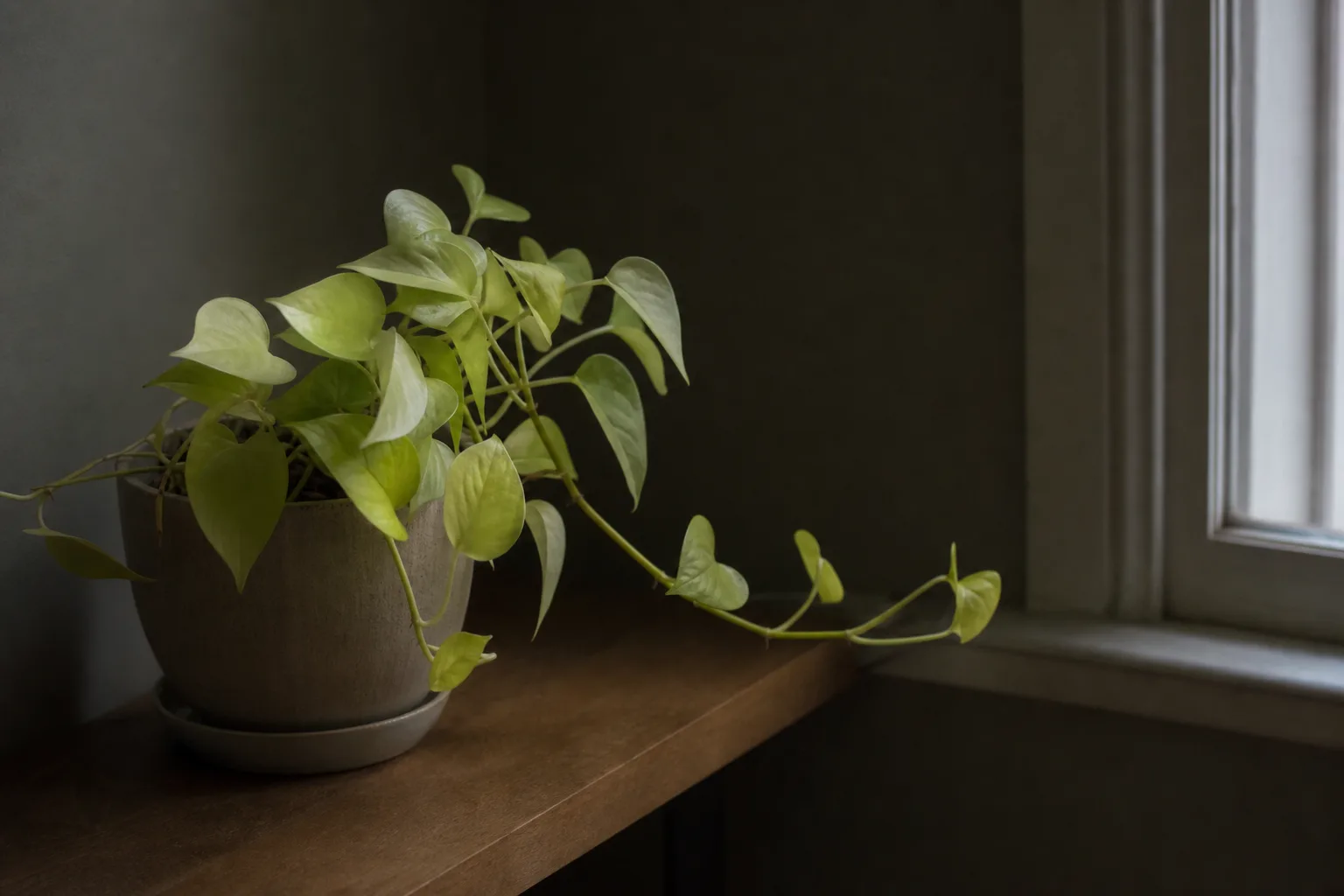
Not Enough Light on Neon Pothos: Causes, Checks & Fixes
This guide covers not enough light on Neon Pothos. See also the general Not Enough Light guide, watering, and light pages for this plant.
Not Enough Light on Neon Pothos: Causes, Checks & Fixes
Quick answer
Neon Pothos (Epipremnum aureum ‘Neon’) is sold for one visual trait: electric chartreuse new leaves that look lit from within. In dim rooms, that color is the first thing to go-not because the plant is dying, but because it upregulates chlorophyll to capture scarce photons. New foliage shifts from lime-yellow green toward olive or forest green while older chartreuse leaves on the same vine can linger as ghosts of better light.
First step: move the pot within 12–36 inches of your brightest suitable window-usually east, or north/northeast with open sky, or south/west behind a sheer curtain-where leaves receive strong indirect brightness without hot afternoon sunbeams sitting on the tissue. No window passes the test? Add a full-spectrum LED grow light 12–18 inches above the top leaves for 12–14 hours daily on a timer. Do not fertilize, repot, or increase watering on the same day. Our Neon Pothos light guide covers window maps and acclimation; this page diagnoses insufficient light and separates it from leggy growth on the same vine.
What insufficient light looks like on Neon Pothos
Low light on Neon reads differently than on Jade or Golden Pothos because the entire leaf surface is the color feature at risk-not a patch of variegation on an otherwise green blade.
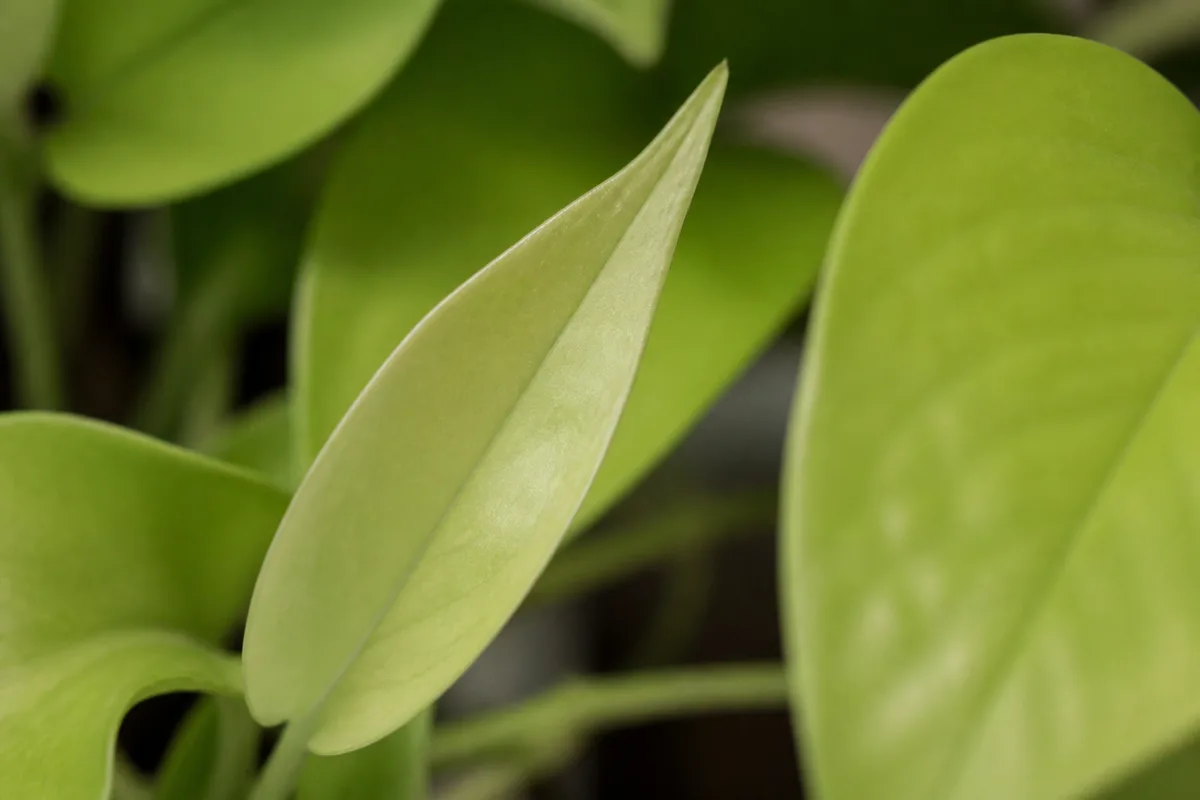
Not Enough Light symptoms on Neon Pothos - compare with healthy tissue on the same plant.
Primary Neon-specific signals:
- New leaves unfurl greenish-olive, yellow-green, or forest green-instead of bright chartreuse
- Two-tone vines-older chartreuse leaves above, progressively greener new growth below the tip
- Smaller new leaf blades than leaves formed in brighter months
- Visible lean toward the brightest window or lamp
- Slow push of the growing tip; long gaps between nodes often appear at the same time (see leggy growth when stretch is your main concern)
What adequate light looks like for comparison:
- New leaves emerge bright yellow-green, often lighter than mature tissue, then settle slightly as they harden-normal for Neon
- Relatively short gaps between nodes on fresh growth
- Firm heart-shaped leaves with steady vine extension through spring and summer
What too much direct sun looks like-opposite fix:
- Bleached white or tan patches, crisp brown edges on the sun-facing side, or a washed-out lime fade from photobleaching-not the dark-green low-light pattern
Pothos rarely flowers indoors; rebloom language does not apply here. Judge this problem on new-leaf color and growth pace, not on bloom failure.
Chartreuse fade on new leaves
Clemson Cooperative Extension notes that pothos prefers bright, indirect light indoors and that lower light can cause variegated and specialty cultivars to lose their distinctive coloring. Neon fits that higher-demand group: the cultivar’s glow depends on pigment balance that favors chartreuse when photons are abundant. In shade, the plant cannot maintain that balance and produces more chlorophyll across the full leaf-new growth greens first.
UF IFAS Extension reports that pothos tolerates light as low as 50 foot-candles but that variegated cultivars lose color below roughly 150 foot-candles, with 150 foot-candles or more needed to maintain color and leaf size. For home Neon Pothos, translate that into a practical band: bright indirect around 200–800 foot-candles for vivid chartreuse; moderate indirect around 100–200 for progressive greening; below roughly 100 for long-term survival with dull foliage and stretch.
Old leaves lie. They show past conditions and will not re-chartreuse after you fix light. Recovery appears only on the youngest leaf and the next node back.
Not enough light vs leggy growth on Neon Pothos
Both problems share the same root cause-too few photons-but owners search them for different reasons. Use this page when color loss or placement doubt is the headline: “Why is my neon pothos turning green?” Use the leggy growth guide when long bare stems, widely spaced leaves, or pruning and support are the headline.
| Your main question | Start here | Also check |
|---|---|---|
| New leaves look like Jade Pothos instead of Neon | This page - chartreuse fade | Light guide for foot-candle targets |
| Vines are long, thin, and sparse with small leaves | Leggy growth - internode stretch | This page if new leaves also greened |
| Plant barely grows anywhere | Slow growth | Light and fertilizer limits |
| Wet soil + droop in a dim corner | Overwatering | Low light slows dry-down-fix both |
Improving light addresses both color and stretch. Prune elongated stems after brightness increases, not before-you need compact new growth to judge success.
Why Neon Pothos struggles in dim rooms
Neon Pothos shares tropical understory biology with other pothos cultivars-a climbing vine native to the Solomon Islands that scales toward broken canopy light rather than open midday sun. Indoors, the target is filtered brightness on the leaves. Neon is more light-demanding than Jade or Golden Pothos for display quality: solid-green Jade tolerates dim offices; Golden loses yellow sectors but still reads as pothos. Neon in the same hall becomes ordinary green devil’s ivy within weeks to months because chlorophyll rises across the whole blade.
Common home triggers:
Distance from glass. A plant on a table six feet from a south window is not getting south-window light; intensity drops sharply with distance. Hanging baskets above the window frame often sit in a wall-shadow zone.
Interior “bright rooms.” Human eyes adapt to dimness. A hallway that feels acceptable may deliver less than 150 foot-candles at leaf height-below the threshold where variegated cultivars lose color.
Winter daylight loss. Shorter days and lower sun angle reduce exposure even when the pot never moved. Chartreuse new growth from summer may give way to green winter leaves on the same sill.
Office and back-shelf placement. Neon survives low light longer than many houseplants-which is why it lingers in dim cubicles-but Penn State Extension warns that prolonged low light eventually strips away the leaf qualities that define each cultivar.
The low-light overwatering trap. A dim Neon Pothos transpires slowly. Owners who keep a bright-window watering rhythm on a back-shelf plant see yellow leaves and sour soil-symptoms labeled overwatering that start when light slows metabolism. Brighter light increases water use; dim light demands patience before the next drink. Cross-check overwatering if mix stays wet for weeks.
How to confirm insufficient light
Work through these checks before assuming fertilizer, Neon Pothos repotting guide, or pest treatment is needed:
-
New-leaf color benchmark - Compare the youngest unfurling leaf to chartreuse nursery stock. Olive or forest green at unfurling strongly suggests low light. Bleached or crisp patches suggest too much direct sun instead.
-
Hand-shadow test - On a clear day, hold your open hand above the leaves at the plant’s height. Bright indirect light usually casts a soft, fuzzy shadow. No meaningful shadow means you are likely below what Neon needs for chartreuse new growth. Sharp, dark shadows with hot leaf surfaces mean direct sun-different problem.
-
Two-week window move - Shift the pot closer to the brightest suitable glass (or add a grow light) and change nothing else. If the next one to two leaves emerge brighter and more compact, light was the limiter.
-
Lean direction - Consistent tilt toward one window or lamp confirms the plant is actively seeking photons.
-
Water-use check - Press the top 1–2 inches of mix. If soil stays damp ten days or more in normal room temperatures and growth is stalled, low light may be slowing metabolism. Confirm roots are still firm-not a rot issue masked as thirst.
-
Rule out lookalikes - Yellow lower leaves on wet, heavy mix point to overwatering. Uniform pale yellowing on a bright windowsill may be sun stress or nitrogen issues. Only when green new foliage, slow growth, and failed shadow test cluster together should you confirm low light.
First fix for Neon Pothos
Move the pot within 12–36 inches of your brightest suitable window-or add a full-spectrum grow light 12–18 inches above the top leaves for 12–14 hours daily-and leave watering, fertilizer, and pot size alone for two weeks.
Concrete placements that often restore chartreuse:
- East windowsill or table within 12 inches of east glass - morning sun may touch leaves briefly; afternoon stays bright and indirect
- North or northeast window with unobstructed outdoor view - consistent soft light; high-latitude summer north can be excellent for color without bleaching
- South or west window with a sheer curtain, pot one to three feet back from the pane so intensity diffuses before it hits leaves
If the plant lived in a very dim interior room for months, acclimate over 7–14 days: move six inches closer every two to three days, or add a sheer curtain if bleached patches appear. Neon coming from moderate shade can usually take one deliberate step to a brighter east or filtered south spot.
Grow-light setup when windows fall short: Mount a full-spectrum LED fixture 12–18 inches above the top of the vine, timer set for 12–14 hours daily. Combine with weak natural light if available; avoid running lights more than 16 hours total so the plant still receives a dark period. Details on spectrum and seasonal supplementation live in the light guide.
After moving:
- Do not fertilize until new growth looks firm and chartreuse for two weeks
- Do not repot unless mix is clearly failing
- Recheck soil moisture every few days-brighter light usually means faster dry-down
Step-by-step recovery
Once exposure improves, support color recovery in this order:
-
Hold position for two weeks - One deliberate placement change beats daily shuffling. Read the next leaf before adjusting again.
-
Rotate weekly - A quarter turn every few days keeps the vine from leaning permanently to one side, as Penn State Extension recommends for balanced pothos foliage.
-
Match watering to new light - Brighter exposure dries the pot faster. Water when the soil is dry-typically when the top 1–2 inches of mix feel dry-not on the old dim-corner calendar. Wet soil plus weak light invites root stress; see the watering guide.
-
Prune only after compact new growth appears - Old stretched stems and greened leaves will not re-chartreuse. Trim long bare vines back to nodes after two to three chartreuse new leaves confirm the brighter spot works. Step-by-step pruning lives in the leggy growth guide.
-
Hold fertilizer - Extra nitrogen pushes soft stretch when light was the limiter. Feed only after color and growth rate stabilize.
Pet note: Neon Pothos contains insoluble calcium oxalate crystals toxic to cats and dogs if chewed. Wear gloves or wash hands after handling vines during relocation and pruning if pets may contact cut stems.
Recovery timeline
| Stage | What to expect |
|---|---|
| 1–2 weeks | Lean may reduce slightly; next leaf color is the first real signal |
| 2–4 weeks | New leaves emerge brighter yellow-green with shorter internodes in warm bright conditions |
| 1–2 months | Steady vine extension; two-tone look fades as more chartreuse leaves accumulate at the tip |
| 3+ months | Display-quality color if foot-candles stay in the 200–800 band; old greened leaves remain unless pruned |
Judge success on new foliage, not nostalgia for older chartreuse blades. Winter recovery may take longer under short days even after a correct window move.
Lookalike symptoms
Leggy growth without color loss yet - Long internodes and small leaves but new foliage still chartreuse. Light is marginal but not yet below the color threshold. Brighter placement prevents greening; see leggy growth for pruning after the move.
Overwatering in a dim corner - Yellow lower leaves, sour soil, mushy roots on inspection. Leaf color may stay chartreuse briefly while roots fail. Fix drainage and dry-down-not just window placement. See overwatering.
Too much direct sun - Bleached white patches, crisp brown edges, or washed-out lime on leaves facing the glass. Move back, diffuse, or acclimate-opposite fix from low light.
Nitrogen excess - Dark green, soft, fast growth on a bright windowsill with no color fade pattern. Review fertilizer timing before blaming shade.
Normal aging - Older chartreuse leaves naturally deepen slightly as they mature. Concern is warranted when new unfurling leaves are green while the plant sits far from windows.
Mistakes to avoid
- Jumping from deep shade to unfiltered south or west sun in one day - Photobleaching can appear within hours on Neon leaves. Acclimate gradually.
- Fertilizing a greening, stalled plant - Nutrients cannot replace photons. Fertilizer on a stressed dim-corner pothos can salt-burn roots.
- Repotting to “fix” dull color - Fresh mix does not substitute for brightness. Repot only on the normal schedule or when roots outgrow the container.
- Watering on the old calendar after a window upgrade - Brighter light increases transpiration. Stale wet-soil habits cause yellow leaves misread as continued low light.
- Expecting old leaves to re-chartreuse - Only new growth shows recovery. Prune or accept a two-tone vine until new chartreuse foliage dominates.
- Rotating without adding brightness - Rotation balances lean but cannot create photons. A dim spot stays dim after a quarter turn.
How to prevent low light next time
- Default placement: Within 12–36 inches of the brightest suitable window-east first, or filtered south/west, or strong north/northeast with open sky
- Seasonal check: Retest the hand-shadow test in late November; add a grow light before winter greening sets in
- Clean windows at least twice a year-film and screens cut more light than owners expect
- Rotate weekly during active growth for even exposure
- Track new-leaf color monthly - Green shift at the growing tip means reassess light before changing fertilizer or pot size
- Match watering to season and placement - Dim winter rooms need longer dry-down intervals; see the watering guide
Neon Pothos is tough enough to survive dim offices-but survival is not the neon look. Treat it like a color cultivar, not like indestructible Jade Pothos, if chartreuse matters to you.
When to worry
Low light alone is rarely fatal on pothos. Worry when low light pairs with other stress:
- Mix wet for two weeks or more with yellow lower leaves and soft roots-rot risk needs immediate watering correction, not only relocation
- Rapid collapse with sour soil in a dark room-confirm roots before assuming more light alone will save the plant
- No chartreuse new growth after six weeks in a spot that passes the hand-shadow test-verify with a light meter or try a grow light; the window may still be too dim for this cultivar
A healthy Neon Pothos with firm stems and green-but dull-new leaves is recoverable. Move it to brighter indirect light, adjust watering to match the new growth rate, and read the next two leaves.
When to use this page vs other Neon Pothos guides
- Neon Pothos watering guide - Use for routine moisture checks before assuming not enough light is the main issue.
- Neon Pothos problems hub - Browse all 5 common issues on this species.
- Leggy Growth on Neon Pothos - Different entry point when symptoms overlap with not enough light.
- Yellow Leaves on Neon Pothos - Different entry point when symptoms overlap with not enough light.