Parijat Fertilizer Guide: Timing, Type and Dose
Parijat Fertilizer Guide: Timing, Type and Dose
Parijat Fertilizer Guide: Timing, Type and Dose
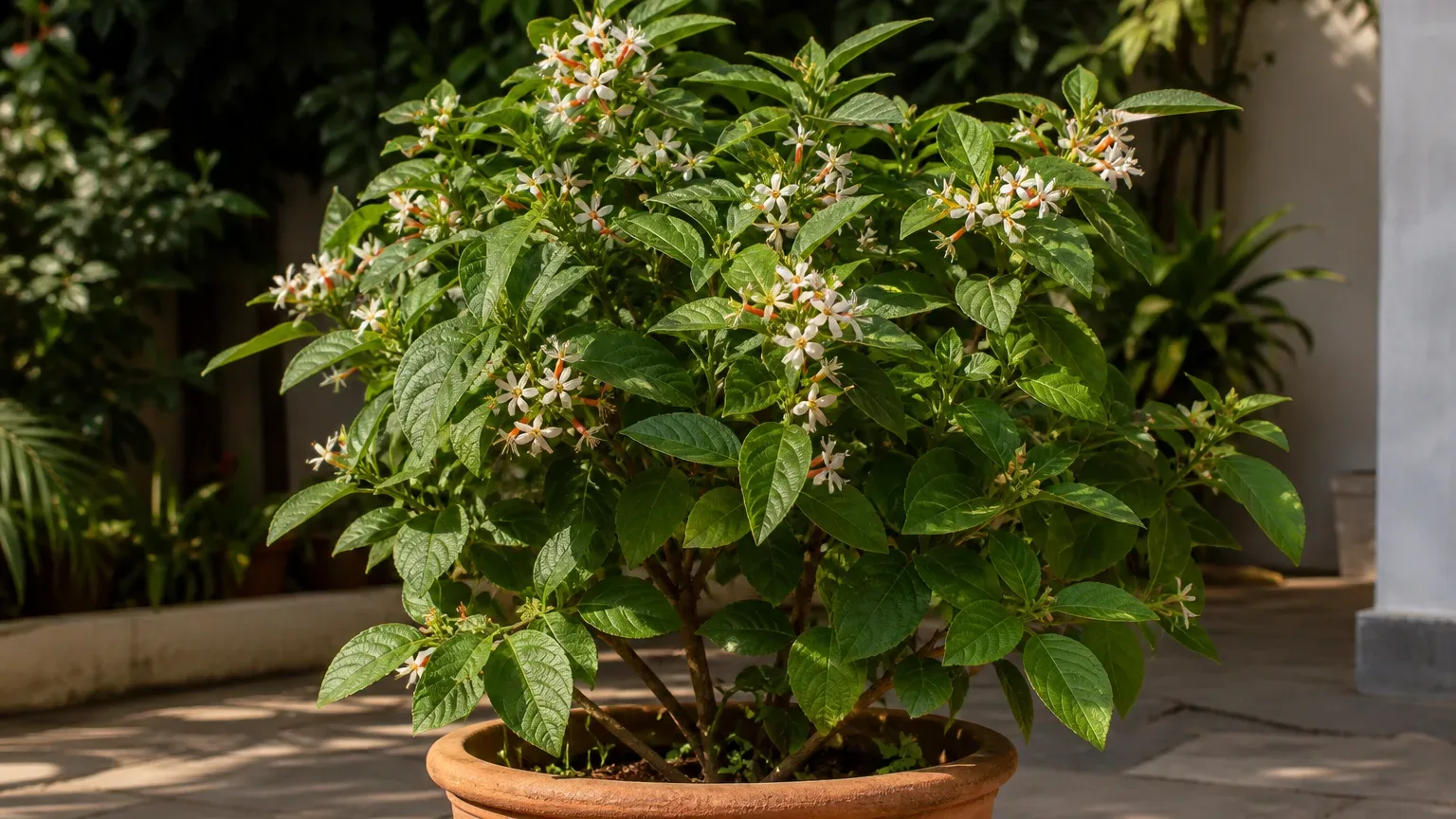
Parijat (Nyctanthes arbor-tristis) is a woody shrub or small tree, not a hungry seasonal bedding plant. Kew records its genus as native from the Himalaya through Indo-China and into parts of Indonesia, while Pha Tad Ke Botanical Garden describes the species as a small tree cultivated in tropical regions. That growth habit matters: feed to support steady shoots and flowering wood, not to force rapid, soft growth.
The short answer
For a healthy potted Parijat, use a complete fertilizer with micronutrients at one-half the label rate about every four to six weeks during obvious active growth. A balanced analysis is a workable default for a soilless container mix, but it is not a species-specific prescription. Stop or delay feeding when the mix is dry, roots are waterlogged, the plant has just been repotted, or growth has paused.
Apply liquid fertilizer to moist soil and let the solution drain through the root zone. RHS container guidance advises feeding when compost is moist and notes that long-term shrubs in pots can receive controlled-release fertilizer at planting, topdressing, or repotting. An established garden Parijat in fertile soil may need only recycled organic matter and no routine packaged fertilizer.
Why Parijat needs restrained feeding
Parijat can reach small-tree proportions; Pha Tad Ke records a height around 10 m in suitable climates. A confined specimen still behaves like a woody perennial, storing resources and responding to season, root space, water, and sun. Fertilizer cannot compensate for a shaded balcony, compacted mix, or chronically wet roots.
Clemson Extension explains that mature trees and shrubs in favorable soil may need little or no fertilizer and that weak growth should not automatically be diagnosed as hunger. Root damage, drought, excess water, and unsuitable pH can limit nutrient uptake even when nutrients are present. The safest Parijat plan therefore starts with observation rather than a calendar.
Best fertilizer for Parijat
For a container filled with soilless mix, choose a complete liquid or controlled-release product labeled for shrubs or container plants. There is no research-backed “perfect Parijat NPK.” A moderate balanced analysis such as 10-10-10 can be a practical default when no test is available, but garden soil may already contain enough phosphorus and potassium, so do not treat equal numbers as inherently superior.
The three prominent numbers are percentages by weight of nitrogen, phosphate, and potash; Clemson’s fertilizer-label explanation also notes that fast-draining soilless mixes can benefit from all three nutrients. Read the guaranteed analysis for micronutrients and release type, then follow the product label. Reducing the liquid dose for a container is safer than copying field rates intended for open soil.
Balanced fertilizer or bloom booster?
Start with plant condition, not the flower pictured on the bottle. A high-phosphorus “bloom booster” is not a reliable answer when the soil already contains enough phosphorus. Clemson warns that excessive nitrogen stimulates leafy shoot growth at the expense of flowers in woody plants, but that does not make extra phosphorus an automatic cure.
If a soil test identifies a deficiency, follow that recommendation rather than changing NPK by guesswork. The UF/IFAS fertilizer guide likewise notes that plants differ in nutrient demand and that fertilizer may not be necessary. For a Parijat growing strongly but flowering poorly, review sunlight, pruning, and root health before buying a stronger feed.
Compost, vermicompost and organic inputs
Mature compost can return nutrients gradually and improve the surface of garden soil. In a large container, use a thin topdressing—about 1–2 cm—without burying the trunk flare, then water normally. Vermicompost can be used similarly, but it is still a nutrient input, and repeated heavy layers can make the upper mix dense.
Do not combine compost, manure, oilcake, liquid feed, and slow-release granules in the same week. “Organic” does not mean impossible to overapply, and unfinished manure or concentrated cakes can injure roots or change drainage. Choose one primary feeding method and judge the resulting growth before adding another.
How to read NPK for Parijat
Nitrogen supports leafy and shoot growth, phosphorus participates in energy transfer and reproductive processes, and potassium supports many aspects of plant function. Those roles do not mean that more of one number produces a matching plant part. Fertilizer works only where moisture, oxygen, pH, and living roots permit uptake.
Clemson’s tree and shrub guidance explains that woody-plant recommendations are commonly based on nitrogen and that slowly available forms reduce loss risk. The practical home-growing rule is simpler: compare analyses, follow the label, and use the lowest effective dose. A soil test is more useful than copying a fixed NPK from a nursery seller.
A seasonal feeding schedule for India
Begin when warm weather brings expanding leaves and firm new shoots. Give a half-strength liquid feed, then reassess after four to six weeks. If growth remains compact and normally green, repeat; if the plant makes long weak shoots, reduce feeding and check whether it receives enough direct sun.
For a controlled-release product, make one measured, label-directed application near the start of active growth instead of stacking liquid fertilizer on top. Split liquid applications are safer than one heavy dose because smaller supplies are easier for actively growing roots to use. Never assume an all-India month: Bengaluru, Delhi, Kolkata, and coastal Kerala do not share the same rainfall or winter slowdown.
Before and during flowering
Do not make a sudden heavy application when buds appear. Continue the restrained program that supported healthy growth, with adequate sun and even root-zone moisture. Excess nitrogen near flowering can create vigorous foliage without correcting a light or pruning problem.
If flowering has been poor for a full season, first review the Parijat light guide and whether budding shoots were cut. Feed only after confirming that the plant is actively growing and that its soil drains correctly.
Monsoon and cool-season rules
During sustained monsoon rain, pause liquid feeding if the pot remains saturated or the next downpour would immediately carry nutrients away. Clemson’s environmental fertilizer guidance recommends applying fertilizer during active growth and postponing it before heavy rainfall because nutrients can leach or run off.
Reduce or stop feeding when cool weather or seasonal stress slows growth. RHS guidance generally suspends container feeding after late summer until active growth resumes, but Indian timing should follow the plant rather than a European month. In a warm tropical location where Parijat keeps making firm new leaves, use a lighter, less frequent application and reassess before repeating.
How much and how to apply
For an established container plant, one-half the label rate is a conservative starting point for liquid fertilizer. Water first if the upper mix is dry, apply the diluted solution evenly, and allow unrestricted drainage. Never pour concentrate against the trunk or leave fertilizer solution standing in a saucer.
For granules, measure rather than estimate and spread them over the root-zone surface away from the stem. Water afterward as the label directs so nutrients begin moving toward absorbing roots. Never fertilize a drought-wilted Parijat; rehydrate it, wait for normal leaf posture, and feed only after active growth is evident.
Containers versus plants in the ground
Containers lose nutrients as roots use them and water drains through, so regular but dilute feeding may help. They can also accumulate salts under repeated fertilizer use, especially with poor drainage. UF/IFAS notes that excess fertilizer salts in container media can cause stunting, leaf browning, or plant death.
In open ground, first ask whether the plant already receives compost, fallen organic matter, or fertilizer from nearby lawn care. A vigorous established Parijat with normal foliage and flowers does not need feeding simply because another month has passed. If performance declines, a local soil test is more informative than another scoop of fertilizer.
Signs Parijat may need nutrients
Possible clues include unusually pale new growth, reduced shoot extension, smaller leaves, or declining flowering after light, water, pests, and roots have been checked. These symptoms are not diagnoses. Uniform yellowing can also follow saturated soil, while interveinal yellowing can reflect pH-related nutrient unavailability rather than an empty pot.
Compare old and new leaves, inspect drainage, and review recent feeding. For a garden plant that remains abnormal, obtain a soil test; Clemson’s soil-testing guidance explains that results report pH and available nutrients and recommend amendments. For a long-used soilless container mix, repotting or a laboratory media test may be more informative than a garden-soil kit.
Signs of excess fertilizer
Watch for brown leaf tips or margins appearing after feeding, white crust on the mix or pot, sudden wilt despite moist soil, and overly lush weak shoots. Salt buildup is especially relevant to balcony pots given repeated liquid feeds, particularly where drainage is slow or irrigation water already contains dissolved minerals. Stop feeding immediately and remove any visible granules.
Check whether symptoms instead began with waterlogging, intense reflected heat, or a pesticide spray, because all can scorch foliage. Do not add another product marketed as a tonic. The first useful action is to stabilize the root zone.
What to do after overfertilizing
- Remove visible granules without disturbing shallow roots.
- If the pot drains freely, run plain water slowly through the mix several times and let it drain completely.
- Empty the saucer and return the plant to its normal suitable light rather than moving it into darkness.
- Resume ordinary Parijat watering only as the root zone dries.
- Wait for clear healthy new growth before feeding again, usually several weeks.
Do not flush a pot that is already waterlogged or has blocked drainage. Address that root problem through the Parijat soil guide and consider whether repotting is necessary.
Why fertilizer may not produce flowers
Parijat needs strong outdoor light to build and maintain flowering growth. Shade, recent hard pruning, a cramped or damaged root system, erratic moisture, and excessive nitrogen can all leave a plant leafy but flower-poor. Fertilizer is only one variable and often not the limiting one.
Use this order of diagnosis: sunlight, drainage, stable watering, appropriate pruning, then restrained nutrition. If new leaves look healthy and the plant is already growing strongly, adding more fertilizer is unlikely to be the first useful change.
When to use this page vs other Parijat guides
Use this page to choose a fertilizer, set timing, and respond to nutrient or salt symptoms. Use the Parijat overview for the complete growing framework, the light guide for sparse flowering, the watering guide for wilt or wet soil, and the soil guide when drainage or pH may be limiting uptake.
Related Parijat guides
- Parijat repotting explains when depleted or compacted potting mix needs replacement rather than more feed.
- Parijat pruning covers timing cuts without sacrificing flowering growth.
- Parijat propagation covers young plants, which should establish roots before routine feeding.
- Parijat care overview connects fertilizer with sun, water, soil, and seasonal growth.
Conclusion
Feed Parijat lightly while it is actively growing, using a complete product at reduced strength or one correctly measured controlled-release application. Pause during waterlogging, heavy monsoon rain, drought stress, cool-season slowdown, or immediately after repotting. Most importantly, treat fertilizer as support for a sun-grown, well-rooted woody plant—not as a cure for every yellow leaf or a switch that forces flowers.