How to Prune Parijat: Timing, Cuts & Recovery
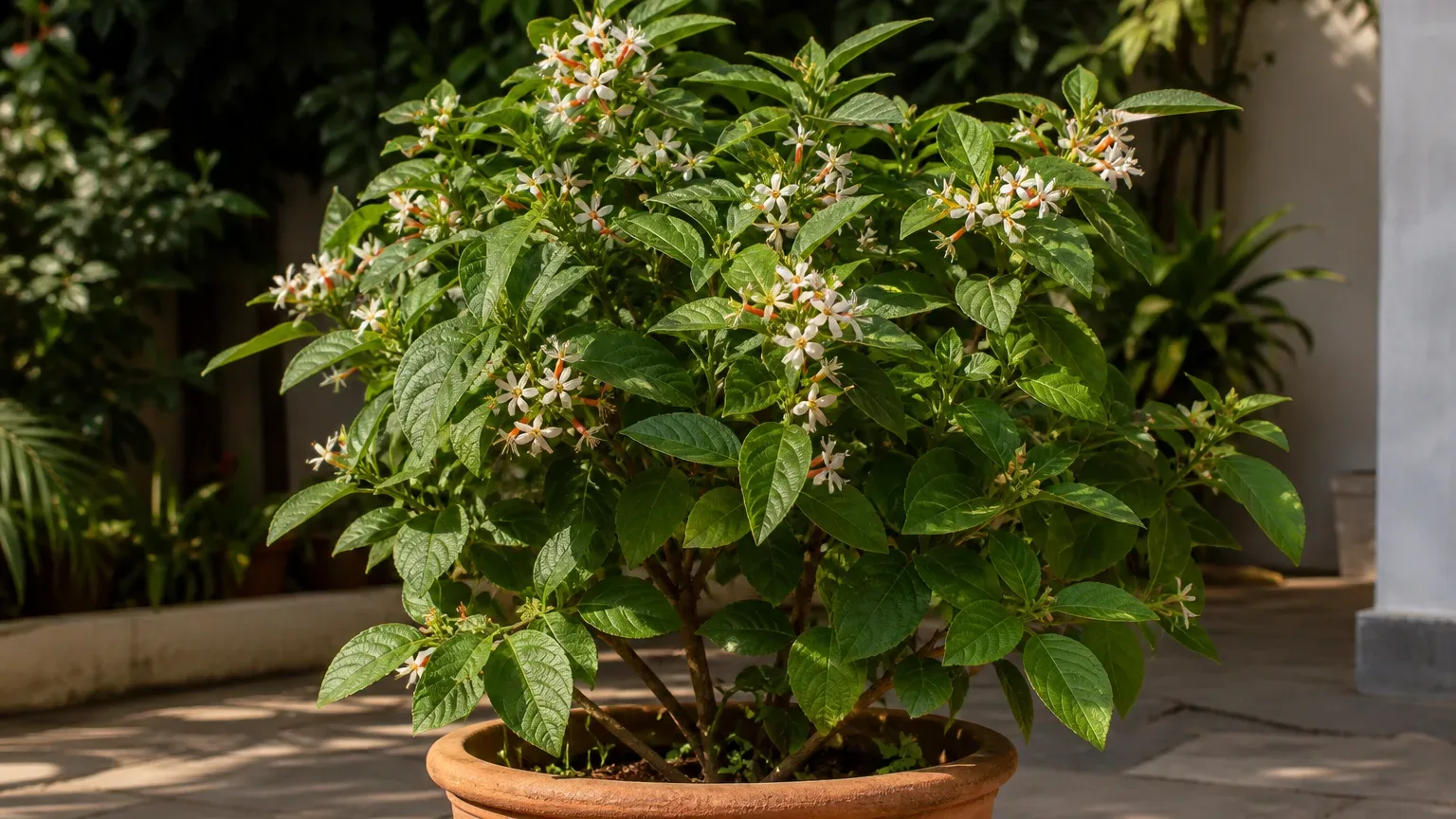
Parijat Pruning Guide: When, Where, and How Much to Cut
Parijat Pruning Guide: When, Where, and How Much to Cut
Quick answer: prune after flowering, not before it
First, remove one dead, broken, or clearly diseased branch back to healthy wood or its point of origin. That cleanup cut reveals the crown without committing you to a major reshape. Once you can see the remaining framework, thin crossing branches and shorten only the shoots that make the plant too tall, one-sided, or crowded.
Schedule the main shaping prune after Parijat’s strongest local flowering flush, while the weather is still warm enough for active recovery. Avoid a hard cut immediately before bloom: Nyctanthes arbor-tristis carries flower clusters at or near shoot tips, so shortening budded ends can remove much of the coming display. Routine pruning should be selective, usually taking no more than about one-quarter to one-third of the leafy crown at once.
Understand the plant before making cuts
Parijat is a woody shrub or small tree, not a true jasmine vine. It naturally develops several spreading branches and can become open or lanky when crowded or short of sun. Kew Plants of the World Online records the species as a shrub or tree with flowers in small terminal clusters.
That flowering position matters. A branch tip may look excessively long but still carry the buds you are waiting for. Check the Parijat light guide before blaming every long shoot on pruning: a deeply shaded plant needs better light as well as a lighter hand, because cutting alone cannot make weak replacement growth sturdy.
What pruning can and cannot fix
Selective cuts can keep a container plant within reach, reduce rubbing growth, open congested sections, and encourage branching below a shortened tip. They cannot correct root rot, chronic shade, or a failed watering routine. If the whole plant is wilting or yellowing while the mix stays wet, use the Parijat watering guide and soil guide before removing healthy foliage.
When to prune Parijat
Use the end of the main flowering flush as your practical calendar. Flowering time varies with climate, rainfall, and temperature, so watch the plant rather than choosing one month for every garden. General extension guidance also times many flowering shrubs around their bloom cycle; Colorado State University Extension lists after-flowering pruning for shrubs whose display would otherwise be cut away.
There are three useful pruning windows:
- After the main bloom: make normal shaping, height-reduction, and thinning cuts.
- During active warm growth: pinch or shorten a few soft, overlong shoots if no flower buds are present.
- Any time safety is involved: remove split, hanging, dead, or diseased branches promptly.
Delay optional pruning when the plant is newly planted or repotted, badly dehydrated, waterlogged, frost-damaged, or dropping leaves after a sudden move. Correct the stress first. Do not combine a hard prune with routine repotting; if root work is genuinely needed, follow the Parijat repotting guide and allow the canopy to stabilize before reshaping it.
Inspect the crown and choose your goal
Stand back and decide whether you are cleaning, thinning, reducing height, or renovating. Do not start cutting simply because Parijat has finished flowering.
Trace each branch from its tip to its origin and mark:
- dead tips with dry, brittle wood;
- broken or split branches;
- stems that cross and rub;
- shoots growing sharply into the center;
- vigorous upright shoots that spoil the intended framework;
- flower-bearing ends that should remain until bloom finishes;
- the strongest outward-facing lateral branches that can take over after a reduction cut.
For a young Parijat being trained as a small tree, protect the chosen trunk and several well-spaced main branches. For a bushy container specimen, retain multiple sound stems but thin the weakest and most crowded ones at their origin.
Tools and safe setup
Use sharp bypass pruners for thin shoots and small branches. Use loppers or a pruning saw for wood too thick to cut cleanly with one comfortable squeeze; forcing small shears through a large branch crushes bark and invites a ragged cut. Clemson Cooperative Extension recommends bypass hand pruners for small twigs and explains why selective thinning is preferable to arbitrary heading.
Clean soil and sap from blades before disinfecting them. Sanitize tools before moving to another plant and after cutting suspicious tissue; Iowa State University Extension provides dedicated guidance for sanitizing pruning shears. Wear gloves and eye protection when working inside a dense crown, and use a qualified arborist for branches that require climbing, power tools, or work near utility lines.
How to prune Parijat step by step
1. Make the cleanup pass
Remove dead, broken, and diseased wood first. Cut a dead tip back until the exposed wood is sound, or remove the whole branch if damage reaches its base. Keep the healthy branch collar—the slight swelling where a branch joins a larger stem—and do not leave a long stub.
After each cut, step back. A few removals can change the balance of this naturally spreading plant more than expected.
2. Thin crossing and inward growth
Where two branches rub, retain the better-positioned, healthier branch and remove the other at its origin. Remove weak shoots directed into the center if they crowd flower-bearing tips or prevent air movement. Avoid stripping every inner twig: an empty interior with foliage only at the ends creates an unstable, artificial crown.
3. Reduce height without topping
To shorten an overlong stem, follow it down to a healthy outward- or sideways-growing lateral branch and cut just beyond that junction. The retained lateral should be substantial enough to continue the branch line. Penn State Extension describes a proper reduction cut as shortening to a lateral at least one-third the diameter of the stem being removed.
Do not saw every branch to the same height. Topping leaves blunt stubs, triggers clusters of weak shoots, and destroys Parijat’s natural outline. If the plant is much too large for its site, reduce it over more than one growing cycle or move the job to an arborist.
4. Shape a container plant lightly
Shorten the few shoots that project far beyond the desired outline, cutting just above an outward-facing node or back to a suitable lateral. Leave enough leafy growth to support recovery. Rotate the pot periodically after growth resumes instead of repeatedly cutting only the bright side.
For a fuller crown, tip-prune selected vigorous shoots after flowering rather than shearing every surface. Singapore’s NParks species profile reports that frequent pruning can stimulate a denser crown and that established Parijat tolerates removal of up to half its growth. Treat that half-growth figure as a renovation ceiling, not a routine target: a stressed pot-grown plant has less reserve than an established landscape shrub.
How much is safe to remove
For normal annual shaping, aim to leave at least two-thirds to three-quarters of the leafy crown. This is consistent with the conservative one-third rule described by Rutgers NJAES for flowering-shrub renewal, although Parijat should be cut branch by branch rather than treated as a generic cane shrub. Stop sooner if the plant is young, recently transplanted, growing in marginal light, or recovering from root trouble.
Hard renovation is different from maintenance. An established, vigorously growing Parijat can resprout after a severe cut, but recovery may be coarse and uneven, and flowering can pause while the crown rebuilds. If renovation is necessary, preserve the main framework, remove no more than about half the growth, and avoid reducing every stem to identical bare stubs.
What not to cut
Avoid removing:
- shoot tips carrying developing flower clusters;
- the branch collar at a trunk or major-limb junction;
- every inner twig and leaf;
- the strongest framework branches merely to make the crown symmetrical;
- large high branches that cannot be reached safely from the ground.
Do not paint normal pruning wounds. Make clean cuts in the right place and let the plant seal them naturally. Do not take propagation material from diseased wood; if you want to reuse healthy trimmings, the Parijat propagation guide explains how to select suitable cuttings.
Aftercare and recovery
Return the plant to its normal bright outdoor position, but protect a heavily thinned container specimen from an abrupt jump into harsher afternoon sun if previously shaded. Water according to soil moisture, not as compensation for pruning. A smaller crown may use water more slowly for a while, so check the mix before each soak.
Do not fertilize immediately to force regrowth. Wait until healthy buds swell or new leaves begin expanding, then follow the Parijat fertilizer guide rather than applying a concentrated feed to stressed roots. Avoid repotting, relocating, and hard pruning in the same week unless damage makes one action unavoidable.
In warm active conditions, watch for swelling buds and new shoots during the weeks after pruning. Judge success by firm stems, stable leaves, well-placed new branching, and no continuing dieback below cuts. Slow or absent growth is not automatically failure during cool weather, but blackening wood, spreading lesions, persistent wilt in wet soil, or dieback moving past a cut calls for a fresh diagnosis.
Maintain the shape with smaller future cuts
Inspect Parijat after each main flowering flush. Remove one poorly placed shoot while it is thin rather than waiting until it becomes a large branch. Keep the crown open enough to inspect, preserve its natural spreading form, and let strong light do part of the work of producing compact replacement growth.
The best maintenance cycle is modest: clean damaged wood, thin one or two competing stems, reduce only the longest branches, then stop. That approach preserves more flowering tips and avoids the weak surge of shoots that follows indiscriminate shearing.
Related Parijat guides
- Parijat overview — growth habit, seasonal behavior, and complete care context.
- Parijat light guide — light levels that support compact growth and flowering.
- Parijat watering guide — moisture checks before and after pruning.
- Parijat soil guide — drainage and root-zone conditions that affect recovery.
- Parijat propagation guide — using suitable healthy cuttings from the pruning session.