How to Propagate Parijat from Cuttings and Seed
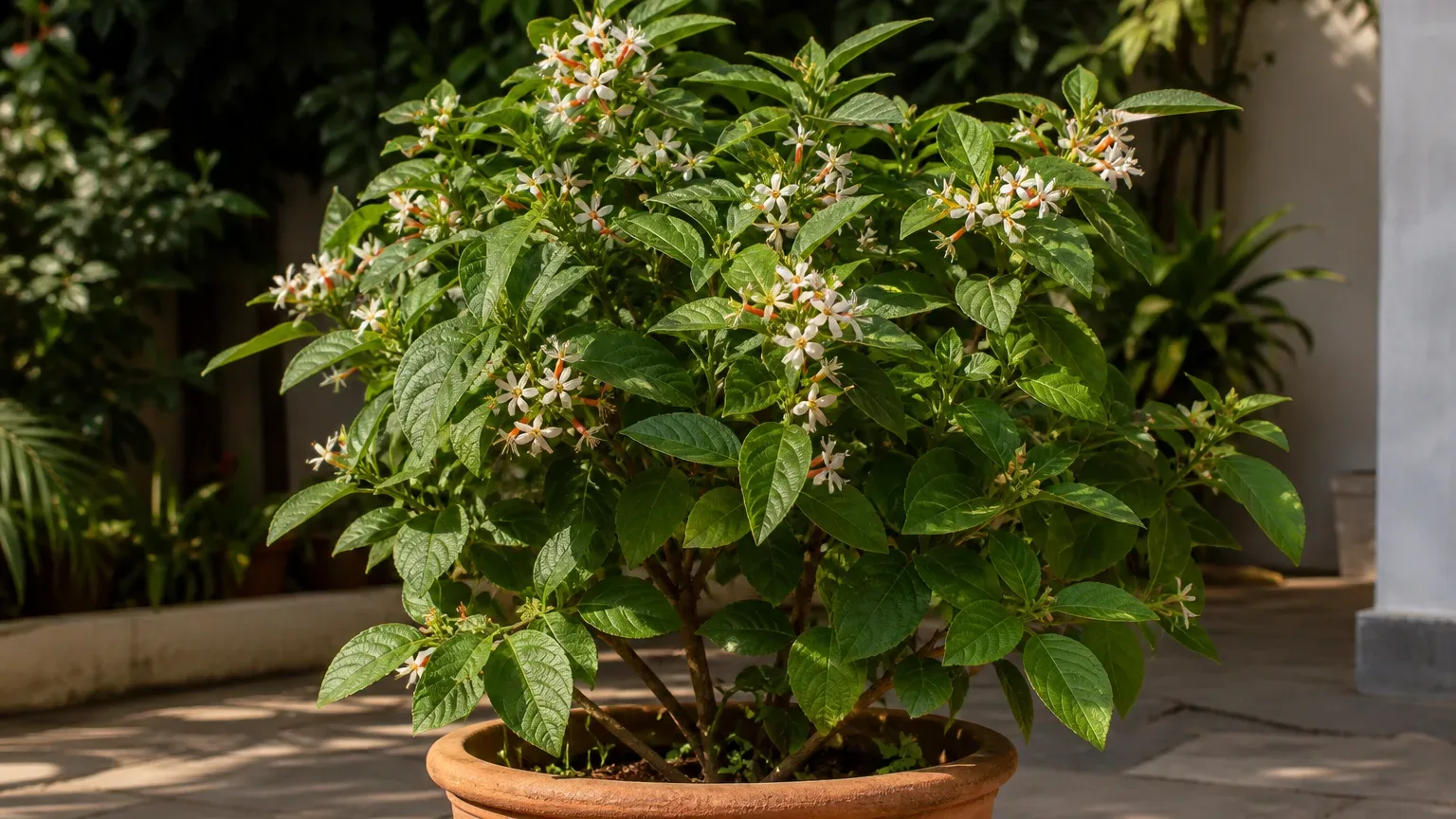
How to Propagate Parijat from Cuttings and Seed
How to Propagate Parijat from Cuttings and Seed
Parijat can be propagated at home, but the useful question is not simply whether a stem can root. It is whether you can keep a selected piece of Nyctanthes arbor-tristis alive long enough to form a working root system without letting humid conditions turn the buried node soft. For most home growers, a semi-hardwood stem cutting taken during warm active growth offers the clearest path because it produces a clone of a known flowering plant.
Seed remains worthwhile when you want several plants and accept variation among seedlings. Laboratory researchers have also regenerated Parijat through shoot-stem, nodal, axillary-bud, and shoot-tip cultures, confirming that the species has substantial regenerative capacity. Those protocols use sterile media and precisely measured plant-growth regulators, however, so they are evidence about the plant’s biology—not a home propagation recipe (Plant Cell, Tissue and Organ Culture).
Choose the best propagation method for Parijat
Choose a cutting when you have access to a healthy mature Parijat whose flower quality and growth habit you want to preserve. A cutting is genetically the same plant, while a seedling is a new individual. That makes cuttings the practical choice for reproducing a compact, floriferous garden specimen rather than waiting to see how a seedling develops.
Choose seed when you do not have suitable shoots, need multiple plants cheaply, or enjoy raising seedlings. Parijat research has used seedlings successfully as the source of axillary buds and shoot tips for further multiplication, so seed is a legitimate route; it is simply less predictable for copying one parent (Research Publish Journals).
Cutting versus seed: the practical trade-off
A cutting starts with mature tissue but has no roots. Its immediate risks are water loss through leaves and rot around the buried stem. A seed starts with no established canopy and can be slower to become a woody flowering shrub, but each seedling begins with a naturally formed root-shoot axis.
Do not treat published micropropagation percentages as expected home success rates. A recent Parijat study achieved high shoot multiplication and ex-vitro rooting under controlled treatments, while earlier work examined how preconditioning and acclimatization affect laboratory-raised plants (Applied Biochemistry and Biotechnology). A balcony propagator cannot reproduce those sterile conditions, and results will vary with shoot age, weather, sanitation, and moisture control.
Best time to take Parijat cuttings
Take cuttings when the parent is making firm new stems in warm weather, not while it is cold-stressed, leafless, severely wilted, or carrying a heavy flush of flowers. In much of India, late spring through the early warm rainy period can supply suitable growth. During a very wet monsoon spell, wait for a drier window or work under cover because saturated media and motionless humid air raise the chance of decay.
The ideal stem is semi-hardwood: the base has begun to firm and turn woody, but the tip is not an old, thick branch. The Royal Horticultural Society describes semi-ripe cuttings as current-season growth that is firm at the base and softer at the tip, a useful maturity test for woody shrubs (RHS). Water the parent normally the day before if its soil is dry, then collect material in the cool morning and pot it promptly.
Select and prepare a semi-hardwood cutting
Start with a clean, pest-free shoot about the thickness of a pencil or slightly thinner. Avoid stems with flower clusters, black lesions, scale insects, or a hollow, weak center. Cut a section roughly 10–15 cm long with at least two useful nodes, making the lower cut just below a node because this is where the buried portion will be prepared.
Remove flowers and the leaves from the lower half. Keep one or two leaves at the top; if they are large, reduce their area rather than stripping the cutting bare. Extension guidance for stem cuttings similarly recommends removing lower leaves and flowers while retaining enough foliage to support the cutting (NC State Extension).
Use clean secateurs or a sharp knife and do not crush the stem. Rooting powder containing IBA is optional, not a rescue for poor material. Species-specific research shows that auxins including IBA can influence Parijat rooting under laboratory and ex-vitro systems, but concentration and exposure matter; more product is not automatically better (Acta Biologica Hungarica). If you use a retail powder, follow its label and tap off the excess.
Build a rooting medium that stays airy
Use a small pot with unrestricted drainage and a fresh, low-nutrient medium. Equal parts coarse perlite and coco coir work, as do coarse sand and coir if the sand is washed and the blend drains quickly. Ordinary garden soil is too variable for this stage, and rich compost can hold excess water around a stem that has no roots to use it; extension guidance likewise recommends a clean, porous, low-fertilizer rooting medium.
Moisten the medium evenly, then let excess water drain before inserting the cutting. It should feel damp but release no stream of water when squeezed. The goal is close contact around the node plus enough air space for new roots; the University of Georgia’s propagation guidance likewise emphasizes a well-drained, moisture-retentive rooting medium rather than fertile field soil (University of Georgia Extension).
Step-by-step: root a Parijat cutting
- Fill a clean 8–10 cm pot with pre-moistened rooting mix and make a pilot hole with a pencil.
- Prepare the lower node, remove foliage that would sit below the surface, and apply a small amount of labeled rooting powder if using it.
- Insert the cutting so at least one node is below the surface, then press the mix gently around the stem.
- Water once to settle the medium and allow it to drain fully.
- Place the pot in bright shade with no hot midday sun. Cover loosely with a clear bag or ventilated propagator if the air is dry.
- Check the medium by touch every few days. Add water only when the upper layer begins to lose moisture; never keep a water-filled saucer below the pot.
Make several cuttings if the parent can spare them. This spreads risk without changing the care each one receives. Label the date and parent plant, then leave the stems largely undisturbed; repeatedly pulling them out to inspect the base breaks fragile root initials.
Humidity without stagnant air
A cutting loses water before roots can replace it, so moderate humidity helps. Yet Parijat’s rough leaves and woody stems are not a reason to seal the pot into permanently wet air. Vent the cover daily, keep leaves from touching plastic, and remove any fallen leaf immediately.
In a humid monsoon climate, a cover may be unnecessary. Use the leaves as the guide: persistent limpness in an airy medium suggests excessive water loss, while condensation all day, a musty smell, or a darkening stem base means the setup needs more ventilation. Wet media and poor airflow favor decay around vulnerable propagation material; NC State Extension emphasizes sanitation, drainage, suitable sowing density, and ventilation for preventing damping-off in seedlings.
How to tell whether roots have formed
Do not use the first small leaf movement as proof. A cutting can spend stored energy on a bud before it has enough roots to survive transplanting. Wait for two signs together: fresh growth that continues to expand and gentle resistance when you tug the stem very lightly.
Rooting may take several weeks and can take longer if the shoot was too old, temperatures fluctuate, or light is weak. Begin checking gently after about four weeks, but do not discard a firm green cutting merely because it has not moved. A soft black base, spreading discoloration, or a sour smell indicates failure; a firm stem with stable leaves still has a chance.
Pot up and harden the new plant
Once resistance is clear and new growth is sustained, slide the root ball out without pulling on the stem. Move it into a pot only one size larger with the porous, fertile mix described in the Parijat soil guide. Oversizing at this stage leaves a large wet volume around a small root system.
For the first week, keep the young plant in bright shade and maintain light, even moisture. Then increase morning sun gradually over one to two weeks, using the Parijat light guide to choose its long-term position. Research on micropropagated Parijat also treats acclimatization as a distinct stage because newly rooted plants must adjust to external conditions rather than moving abruptly from protected culture to full exposure (Springer Nature).
Do not fertilize at the moment of potting. Wait for active top growth after the transplant, then begin conservatively according to the Parijat fertilizer guide. If the plant droops, first check moisture and exposure instead of assuming it needs food.
Propagating Parijat from seed
Collect mature, dry fruits from a correctly identified Nyctanthes arbor-tristis, or use fresh seed from a reliable source. Sow in a clean, free-draining seed mix in warm conditions, cover lightly, and keep the medium evenly moist rather than soaked. Label each batch because germination can be uneven and because the common names “night jasmine” and “night-flowering jasmine” are also applied to unrelated plants.
Seed biology in Parijat deserves patience. A species-specific study germinated Parijat seed on hormone-free basal medium before using the seedlings’ axillary buds and shoot tips for tissue culture, which confirms seed as a viable starting route but does not establish a home germination timetable (Research Publish Journals). Avoid aggressive cutting unless you can distinguish the seed from the surrounding fruit tissue; deep damage can destroy the embryo. Nursery-scale or laboratory pretreatments should not be copied casually from an abstract without the full protocol.
After emergence, provide bright filtered light and airflow. Water from below or with a fine stream so seedlings are not flattened, then let the surface begin to dry between waterings. Thin crowded pots early; crowded, wet seedlings are more vulnerable to damping off. Move individuals only after they have several true leaves and a root ball that holds together.
Why Parijat cuttings fail
Failure usually traces to the condition of the cutting or the balance between moisture and oxygen, not to a missing secret ingredient. Use the symptom at the stem base and the state of the medium to decide what happened.
| What you see | Likely cause | Next action |
|---|---|---|
| Base turns dark and soft | Medium stayed wet, cutting was buried too deeply, or sanitation failed | Discard it, clean the pot, and restart in a fresher, airier mix |
| Leaves crisp while base stays firm | Humidity too low, cutting too leafy, or hot sun | Reduce leaf area, add light humidity, and move to bright shade |
| Bud opens, then collapses | Stored energy was used before roots established | Keep conditions stable; do not pot up on bud growth alone |
| No growth but stem remains green | Slow rooting, cool conditions, or mature wood | Wait and avoid repeated disturbance |
| New plant wilts after potting | Roots were too few or sun increased too fast | Return to bright shade and stabilize moisture |
Rot at the buried node
If one cutting rots, remove it immediately rather than leaving it beside healthy stems. Reusing the same saturated mix repeats the problem. Restart with a clean pot, a firmer shoot, and less water; sterilizing tools between diseased and healthy material also reduces mechanical transfer.
Do not try to save a cutting whose decay has crossed the only viable lower node. If the upper stem remains firm and enough length is available, recut well above discolored tissue with a clean blade and treat it as a new cutting. The new base must show clean, pale internal tissue.
Leaf loss and stalled cuttings
One dropped leaf does not automatically mean failure. The cutting may shed foliage while balancing water loss, especially after a sudden change in humidity. Check the stem: firm green tissue is worth keeping; shriveled tissue in dry mix needs humidity correction, while softness in wet mix needs air and usually a restart.
Avoid “helping” a stalled cutting with fertilizer. A rootless stem cannot use a normal feeding schedule, and dissolved salts add stress to a small volume of rooting medium. Stability—warmth, bright shade, damp-not-wet mix, and time—is more useful.
Can Parijat root in water?
A Parijat stem may form roots in water, but there is little species-specific evidence for treating water rooting as the standard home method for this woody shrub. Starting in an airy solid medium follows established woody-cutting practice and avoids moving a fragile new root system from water into potting mix.
If you are experimenting, keep only the lowest node submerged, change cloudy water, and move the cutting to mix while roots are still short rather than waiting for a tangled mass. Treat it as a trial, not the benchmark method. For a limited piece of valuable material, use the semi-hardwood method above.
When to use this page vs other Parijat guides
Use this page while creating a new plant and through its first stable growth after rooting. For routine moisture decisions once roots fill the starter pot, switch to the Parijat watering guide. If drainage, pH, or the permanent container blend is the problem, the soil guide covers established-root conditions rather than a low-nutrient propagation medium.
Use the Parijat repotting guide when an established plant has filled its container; moving a newly rooted cutting into its first small pot is a gentler transition. Use the pruning guide for shaping the mature parent and timing cuts around flowering, not for selecting every propagation shoot.
Related Parijat guides
The Parijat overview explains the species’ outdoor growth habit, seasonal flowering, and overall needs. Review Parijat light requirements before hardening a young plant, because a rooted cutting needs gradual exposure even though a mature Parijat flowers best with substantial sun.
For the parent plant, coordinate cutting collection with Parijat pruning rather than repeatedly shortening random shoots. Healthy stock material comes from a plant whose water, light, and root conditions are already stable.
Conclusion
For home Parijat propagation, begin with several clean semi-hardwood cuttings from a healthy, correctly identified parent during warm active growth. Root them in a small pot of airy, low-nutrient medium, provide bright shade and only as much humidity as the climate requires, and wait for both sustained growth and gentle resistance before potting up.
Seed is a valid alternative when variation and a longer juvenile phase are acceptable, while laboratory micropropagation belongs in controlled facilities. Whichever route you choose, the decisive work happens after the first root appears: protect drainage, increase sun gradually, and let the young Nyctanthes arbor-tristis establish before feeding or shifting it into a large container.