Parijat Light Guide: Sun, Shade and Best Placement
Parijat Light Guide: Sun, Shade and Best Placement
Parijat Light Guide: Sun, Shade and Best Placement
Parijat is often sold beside indoor “jasmine” plants, but its light needs are those of a woody outdoor shrub or small tree. Nyctanthes arbor-tristis is an accepted member of the Oleaceae family and a wet-tropical shrub or tree native from the Himalaya to Indo-China and parts of Malesia, according to Kew Plants of the World Online. For a healthy, flower-capable plant, start with outdoor sun rather than a decorative position deep inside a room.
The useful rule is at least four to six hours of direct sun on most days, followed by bright open-sky light. In very hot inland summers, morning sun plus light protection from the fiercest late-afternoon heat is a sensible adjustment. Shade can keep Parijat alive and leafy, but persistent deep shade usually produces a more open canopy and fewer flowers.
Confirm the plant before applying light advice
“Night jasmine” is not a dependable botanical identity. Parijat is Nyctanthes arbor-tristis in Oleaceae, but it is not a true jasmine in the genus Jasminum. NC State Extension describes common jasmine as a twining vine, whereas Parijat develops woody branches and a shrub-to-tree canopy. Both appreciate strong light, but advice about training a jasmine vine against a support does not describe Parijat.
Parijat is also different from raat rani or night-blooming jessamine, Cestrum nocturnum. The RHS profile for Cestrum nocturnum places that plant in Solanaceae and describes greenish-white tubular flowers; Parijat has rough opposite leaves and white flowers with a conspicuous orange-red tube. Check the scientific name before transferring care or safety advice among plants sold under these overlapping common names.
How much light Parijat needs
Parijat performs best in full sun. Singapore’s government-run NParks database lists its light preference as full sun and notes that it tolerates light shade, while best growth and most abundant blooming occur in full sun. That is stronger guidance than the vague “bright indirect light” label applied to many houseplants.
Full sun does not require an exposed rooftop from sunrise to sunset. A site with four to six hours of unobstructed morning or early-day sun, then bright sky exposure, is a practical minimum for a container. Open-ground plants can usually take longer exposure once established, provided their roots are watered appropriately and the soil drains.
A practical daily target
Watch the duration and continuity of useful light. One brief sunbeam crossing the pot is not equivalent to a sunny half-day. Buildings, balcony ceilings, shade cloth, grills, trees, and neighboring towers can reduce light even when the room looks bright to human eyes.
Use your phone’s compass and observe the site at 9 a.m., noon, and 3 p.m. for two clear days. If direct sun reaches most of the canopy for at least four hours and the plant remains brightly lit afterward, the position is workable. If only a few branch tips receive sun, move the whole pot into the light path rather than rotating one shaded plant indefinitely.
Why Parijat needs outdoor-level brightness
This species develops into a substantial shrub or small tree, not a shade-adapted tabletop plant. World Flora Online describes trees up to 10 metres with fragrant flowers in terminal clusters, while NParks records rocky ground, dry hillsides, and dry deciduous forest undergrowth among its habitats. Those records point to a plant accustomed to strong tropical daylight, even where some canopy filtering occurs.
Outdoor shade is also much brighter than the interior of a home. Clemson Extension explains that a well-lit home can measure under 100 foot-candles while clear outdoor sun may exceed 10,000 foot-candles, and identifies adequate light as the most important indoor growing factor. A Parijat beside glass may therefore receive a small fraction of the energy available on a balcony just outside it.
Best placement in Indian homes and gardens
Choose a place with an open view of the sky, good airflow, and enough room for a woody canopy. East and southeast exposures are reliable defaults because they supply several hours of direct light before surfaces become hottest. South-facing sites can be excellent when no building or deep overhang blocks the sun; west-facing terraces need closer heat and moisture monitoring in April–June.
Do not choose a spot only because fallen flowers will look attractive there. First confirm that the canopy receives sun, that the pot drains freely, and that you can water without leaving the root ball standing in a saucer. Light and root moisture interact: a shaded pot dries more slowly than the same pot in sun.
Balcony, terrace and open-ground positions
On a balcony, place the canopy near or beyond the outer light line rather than against the dim rear wall. A solid parapet can shade a low pot even while the upper branches are sunny, so elevate a young plant securely until its foliage clears the barrier. On a terrace, give the container enough mass and wind protection to stop the top-heavy canopy from falling.
In open ground, avoid planting directly under a dense evergreen canopy or on the permanently shaded north side of a tall wall. Allow for mature size: NParks classifies Parijat as a large shrub or small tree up to 9 m, though regular pruning keeps containers much smaller. Good spacing also lets light reach more than the outermost shoots.
Window direction and distance
If outdoor placement is temporarily impossible, use the sunniest unobstructed window, with the foliage close to the glass without touching a hot pane. An east window is the safest starting point. A south or west window gives more intensity but may need a sheer curtain during severe afternoon heat, especially for a plant newly moved from nursery shade.
North windows and positions several metres into a room are maintenance compromises, not flowering positions. Clemson Extension notes that light varies with season, outdoor tree shade, curtains, wall reflection, and exact location, so window direction alone does not determine intensity. Judge the plant-facing light, not the room’s apparent brightness.
Direct sun and hot-afternoon protection
Direct sun is normal for Parijat, but heat stress and sun acclimation still matter. Established plants in the ground generally cope better than recently purchased container plants because their roots have a larger, cooler moisture reserve. In very hot, dry inland conditions, four to six hours of morning sun with bright afternoon shade can preserve leaves without turning the plant into a shade specimen.
Protection means reducing the most punishing heat, not moving the pot into darkness. A 30–40% shade cloth during a heatwave, a site receiving sun until early afternoon, or a small increase in distance from west-facing glass is usually enough. Missouri Botanical Garden describes scorch as a noninfectious injury that can follow bright sun when roots cannot replace water lost from leaves; check root moisture and hot reflected surfaces before blaming light alone.
Acclimating Parijat to stronger sun
A nursery plant may have grown under shade net even though the species prefers full sun. Moving it straight to an exposed May terrace can scorch leaves before protective tissues adjust. Clemson Extension specifically advises that changes in light intensity should be gradual.
Start with two hours of gentle morning sun for three or four days. Increase exposure by roughly an hour every few days, pausing if the newest leaves bleach or develop papery patches. Reach the intended placement over about one to two weeks, and avoid combining the move with immediate Parijat repotting or hard pruning.
Can Parijat grow indoors?
Parijat may remain alive beside a very sunny window, but an ordinary indoor room is rarely bright enough for dense growth and dependable flowering. It is also a woody plant that naturally becomes several metres tall. Treat indoor culture as temporary shelter from cold, a seedling stage, or a compromise supported by artificial light.
If a plant stays indoors, place it at the brightest window, keep leaves free of dust, and rotate the pot a quarter turn weekly for balanced growth. Move it outdoors gradually when conditions allow. Do not compensate for weak light with extra fertilizer; reduced light means reduced growth and slower water use.
Using a grow light for Parijat
A grow light can support a young Parijat or bridge a cloudy or indoor period, but a small decorative bulb is unlikely to replace a sunny terrace for a mature flowering shrub. Use a full-spectrum LED panel that covers the whole canopy. Position it according to the maker’s intensity chart rather than using a universal distance.
Run the lamp for roughly 12–14 hours with a timer, keeping a dark night period. University of Minnesota Extension explains that light duration, quality, and intensity all affect indoor growth; artificial lighting can supplement natural light when those factors are sufficient, and timers provide a consistent daily cycle. If stems still stretch toward the fixture, increase usable intensity by moving the lamp safely closer or using a stronger, wider panel.
Signs Parijat needs more light
Too little light usually develops gradually. New internodes become longer, the canopy opens toward the brightest side, new leaves may be smaller, and flower clusters become sparse or absent. Soil also stays wet longer because the plant is using less water.
Do not diagnose light from one old yellow leaf. Look for a pattern across new growth over four to six weeks. If the plant is stretching and has no buds despite being mature and otherwise healthy, increase sun gradually, then reassess before changing Parijat fertilizer.
Signs of too much sun or heat
Sun or heat injury appears mainly on the exposed side as pale tan patches, crisp edges, or papery brown areas that do not recover. Sudden damage soon after a move is a stronger clue than damage on leaves formed months earlier. Wilting at midday can be temporary, but a plant that remains limp after evening cooling needs its root moisture checked.
Move a scorched plant out of harsh afternoon rays while keeping it in bright light. Do not strip every marked leaf or flood a still-wet pot. Stabilize placement and follow the moisture checks in the Parijat watering guide; clean new leaves are the evidence that the adjustment worked.
How light affects flowering
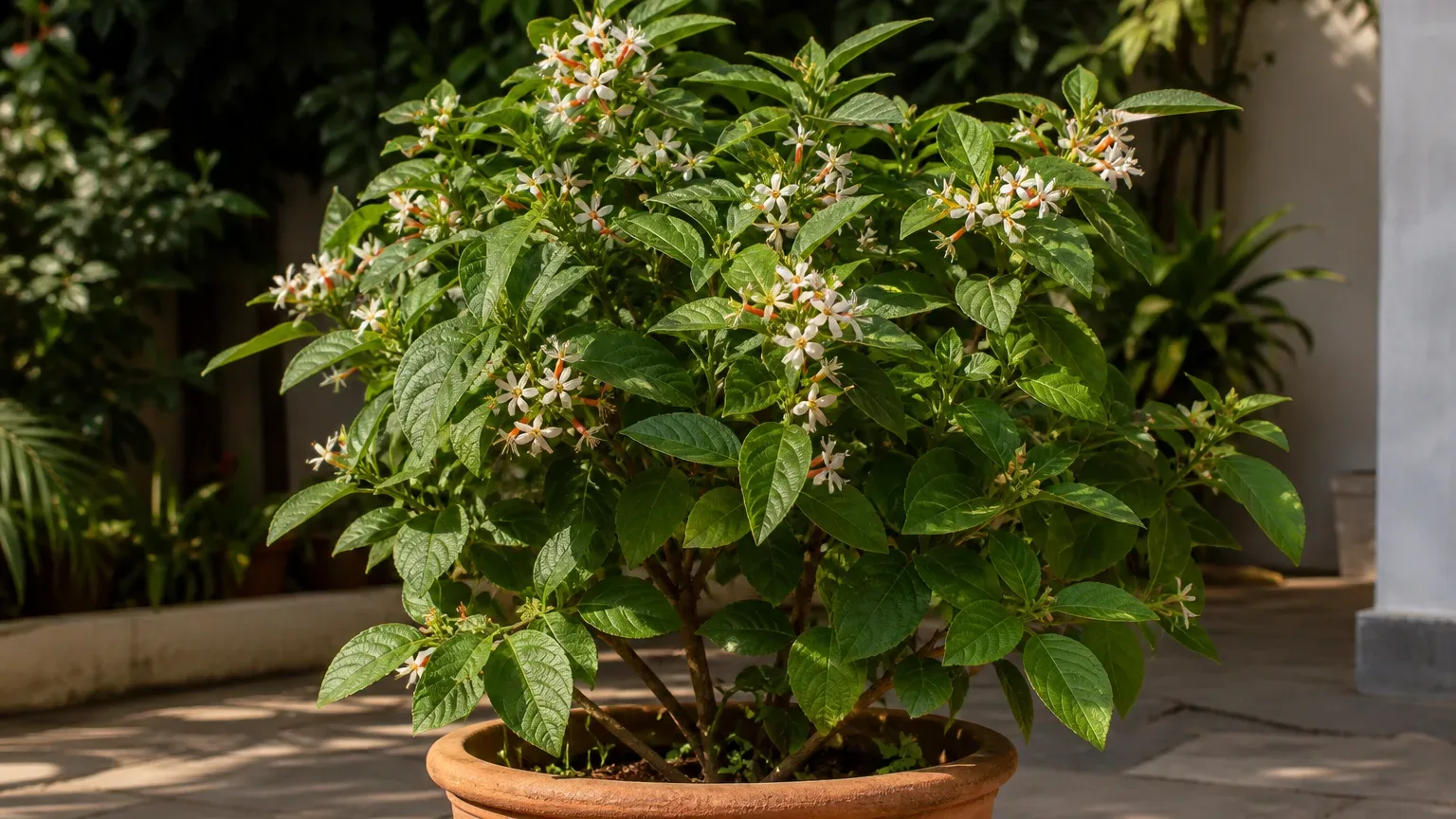
Parijat’s fragrant white flowers with orange-red centres are produced in clusters near branch tips. Pha Tad Ke Botanical Garden likewise describes the night opening and morning fall, while NParks records that they bloom profusely at night and drop in the morning. Strong daily light helps the plant build the carbohydrates needed to extend shoots and form those terminal clusters. Dim conditions can maintain foliage without supporting a satisfying display.
Sun is necessary but not sufficient. A sunny plant may still fail to flower if it is immature, recently transplanted, severely pruned at the wrong time, waterlogged, drought-stressed, or pushed into soft leafy growth by excessive nitrogen. Correct light first, then use the Parijat overview and sibling guides to check the rest of the growing system.
Seasonal light adjustments
During the Indian monsoon, cloud and rain reduce total usable light even if the pot remains in the same place. Keep Parijat in the most open safe position and avoid moving it under a deep roof merely to keep rain off the foliage. Instead, protect drainage and reduce watering when the mix stays wet.
In hot pre-monsoon months, watch western walls, stone floors, and metal railings that reflect heat onto leaves. In winter, shadows lengthen and a formerly sunny balcony may be blocked by a neighboring building; move containers to recover direct exposure. Where frost occurs, prioritize cold protection but return the plant to outdoor sun as temperatures permit.
A simple placement troubleshooting plan
First, measure or observe actual direct-sun hours for two clear days. Second, inspect whether symptoms occur on shaded growth, sun-facing growth, or the entire plant. Third, check root moisture before moving anything, because drought and waterlogging can imitate light stress.
Change one factor at a time. Move the pot by a small amount, hold that placement for two weeks, and judge fresh leaves and buds. This approach is slower than making several changes together, but it tells you whether light was actually the limiting factor.
When to use this page vs other Parijat guides
- Use this page for sun hours, window or balcony position, shade tolerance, grow lights, and scorch diagnosis.
- Use the Parijat watering guide when leaves droop and you need to check root-zone moisture.
- Use the Parijat soil guide when a bright pot remains wet or compacted.
- Use the Parijat fertilizer guide only after light and active growth are adequate.
- Use the Parijat pruning guide to manage size and flowering wood.
Related Parijat guides
- Parijat overview — whole-plant care and identity.
- Parijat watering — dry-down checks across seasons.
- Parijat soil — drainage and container mix.
- Parijat fertilizer — feeding during active growth.
- Parijat repotting — root space and post-move care.
- Parijat propagation — starting cuttings or seed.
Conclusion
Parijat needs outdoor-level brightness and several hours of direct sun, not the low light tolerated by many foliage houseplants. Begin with four to six hours of morning or early-day sun, keep the rest of the day bright, and reserve afternoon protection for exceptional heat or a plant still being acclimated.
Let new growth make the final decision. Compact shoots, normal leaf colour, reasonable dry-down, and increasing buds show the site works; stretching and sparse bloom call for more light, while sudden pale papery patches call for slower acclimation or heat relief. Adjust placement first, then coordinate water, soil, feeding, and pruning around the stronger light.