Parijat Watering Guide: Timing, Signs and Seasons
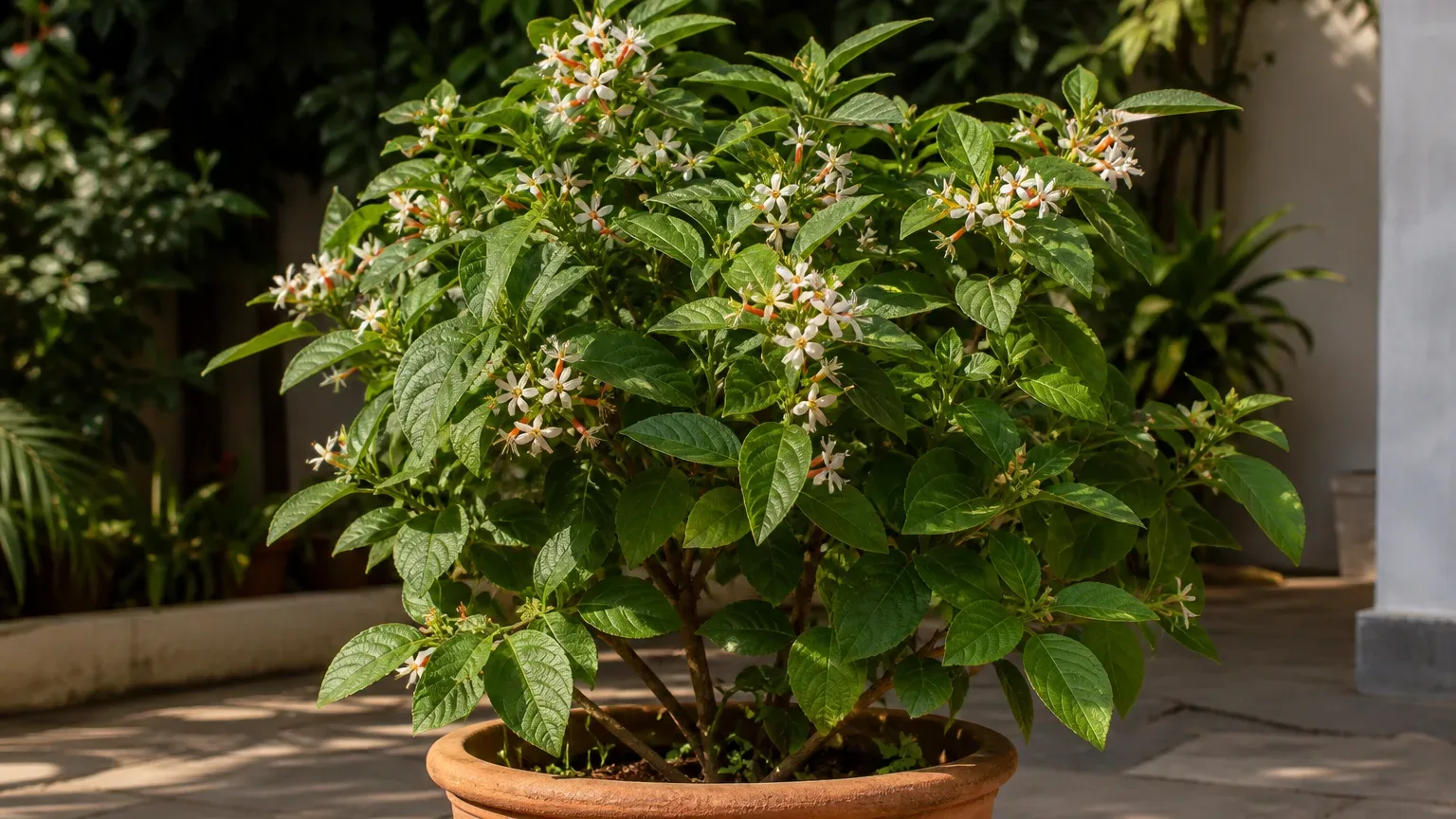
Parijat Watering Guide: Timing, Signs and Seasons
Parijat Watering Guide: Timing, Signs and Seasons
Parijat is not a plant to water by weekday. Nyctanthes arbor-tristis is a woody shrub or small tree, not a soft-stemmed true jasmine, and its root zone should move through a clear cycle: water thoroughly, drain promptly, then wait until the upper soil dries before watering again. Singapore’s NParks species record gives the plant a moderate water preference but specifically advises thorough watering followed by substantial drying, with well-drained soil to limit root rot.
The quick answer
For a potted Parijat, check 3–5 cm below the surface. Water when that layer feels dry and the pot is noticeably lighter, then soak the entire root ball until water exits the drainage holes. In hot, dry weather this may mean checking every two or three days and watering roughly every 3–5 days; in mild weather the interval may stretch to 7–10 days.
Those numbers are starting points, not instructions. Rain, pot size, sun, wind and soil texture can change the interval dramatically. An established plant in open ground usually needs less frequent irrigation than a small terrace pot, while a newly planted specimen needs steadier moisture until roots grow into the surrounding soil.
Why Parijat needs a wet-dry rhythm
Parijat comes from a broad Asian range; Kew records Nyctanthes from the Himalaya through Indo-China and into parts of Indonesia, while the Pha Tad Ke Botanical Garden species profile describes N. arbor-tristis as a small tree native to northern India. NParks describes the species on rocky dry hillsides and in dry deciduous forest, useful context for why constant saturation is a poor fit even though the plant is not a desert species.
Roots need both water and oxygen. When pores remain filled with water, roots lose access to air and begin to decline. The Missouri Botanical Garden’s overwatering guidance links waterlogged soil with root death, yellowing, weak growth and greater susceptibility to root-rotting organisms. Parijat therefore does best with a generous drink followed by drainage and partial dry-down, not daily splashes that keep the surface perpetually damp.
When to water Parijat
Use moisture, not elapsed days, as the deciding signal. Push a finger 3–5 cm into loose mix, or use a wooden skewer near the centre of the pot. If the soil at that depth feels cool and clings to your finger or darkens the skewer, wait. If it feels dry and the container has become lighter, water.
A dry-looking crust is not enough evidence. The surface loses water before the middle and bottom of a pot, and Missouri Botanical Garden recommends checking the root zone with a probe or trowel rather than judging only the top. This matters most in large glazed pots, where the top can look dusty while the lower third remains wet.
Check below the surface
Combine two checks when conditions are uncertain. First test 3–5 cm down; then lift or gently tilt the pot to judge weight. For a large container that cannot be lifted, insert a dry bamboo skewer deeper and inspect it after a minute. Damp soil stuck to the lower end means the root zone has not finished draining.
Do not wait for every leaf to collapse before watering. A Parijat can wilt temporarily during fierce afternoon heat even while soil remains moist, then recover after temperatures fall. Check again in the early morning. If the leaves are still limp and the soil is dry, water; if they are limp while the soil is wet, investigate drainage and roots instead.
How to water Parijat deeply
Apply water slowly over the whole surface rather than pouring at one point beside the stem. Pause if water races over a dry, shrunken root ball, then repeat until the mix accepts it evenly. Deep, less frequent irrigation is preferable to shallow sprinkling because it wets the active root zone and encourages roots beyond the surface layer.
Use room-temperature tap or stored rainwater when available, but do not let water-source refinements distract from the main risks. Correct timing, complete wetting and unrestricted drainage matter more than whether ordinary potable tap water rested overnight.
Watering a container
Water until a steady stream exits every drainage hole. Let the pot drain for 10–20 minutes, empty the saucer, and check an outer decorative pot for hidden runoff. Never leave the nursery pot standing in collected water.
If a bone-dry mix repels water and runoff appears instantly, soak in stages. Add a little water, wait several minutes, and water again. Bottom-soaking can rewet a severely hydrophobic root ball, but remove it once the mix is evenly damp and allow it to drain; do not leave Parijat soaking for hours.
Watering in the ground
Build a shallow watering basin over the root area of a young plant, keeping piled soil and mulch away from the trunk. Apply water slowly enough to soak rather than run away. Once established, water deeply during genuine dry spells instead of giving a small daily spray.
Check the actual soil before irrigating after rain. A brief shower may wet only the top centimetre, while sustained monsoon rain may leave heavy ground saturated for days. Nearby roof runoff, a leaking pipe or a low planting pocket can make one Parijat much wetter than the rest of the garden.
Seasonal watering in Indian climates
Parijat’s watering interval follows heat, rainfall, wind and active growth. The species is grown widely in South Asian homesteads; the University of Kerala records it as a South Asian garden plant. Treat local weather as the control, not a four-season calendar written for a temperate indoor plant.
Hot summer and dry pre-monsoon weather
Check pots frequently during hot, windy weather, especially on exposed terraces. A small terracotta pot may dry in a few days, whereas a large plastic pot may remain damp much longer. Morning watering gives the root ball time to absorb moisture before peak heat and lets wet foliage dry quickly.
New leaves, buds and active shoots increase demand, but flowering is not a reason to keep soil constantly wet. Water when the dryness test passes. A thin organic mulch can slow rapid moisture loss in ground-grown plants, provided it does not touch the trunk or conceal permanently soggy soil.
Monsoon, cool weather and winter slowdown
During sustained monsoon rain, stop automatic watering and inspect drainage after each heavy spell. Move a container out of a roof-drip line, clear blocked holes and raise the base slightly if runoff cannot escape. Wet soil plus repeated irrigation is the fastest route to yellow leaves and root decline.
Reduce frequency in cool or low-growth periods because soil dries more slowly. Vivekananda College notes that Parijat needs winter warmth and well-drained soil. In a warm, sunny region the plant may continue using water, but a cool container should never receive summer-frequency irrigation merely because a reminder appears.
Read the plant before adding water
Symptoms overlap, so pair the leaves with a soil check. Yellowing, droop and leaf fall can result from either damaged wet roots or prolonged dryness. The correct first action is diagnosis: feel the mix, check pot weight, smell the soil and inspect drainage.
Overwatering and root trouble
Warning signs include several lower leaves yellowing together, wilt that persists in wet soil, slowed growth, a sour smell, and a soft or dark stem base. Parijat is specifically listed by NParks as prone to root rot when overwatered. Stop watering, remove standing runoff and allow air to return to the mix.
If the pot remains wet for many days or smells rotten, slide out the root ball. Healthy roots should be firm; damaged roots are dark, soft or easily stripped. Trim clearly dead tissue with clean tools and repot only if drainage or decay demands it. Use the Parijat soil guide to correct a dense mix, and avoid fertilizer until new growth shows that roots are functioning.
Underwatering and heat wilt
Dryness is more likely when the pot feels very light, soil pulls from the rim, young shoots remain limp in the morning, and leaf edges turn crisp. Rehydrate with one slow, complete soaking. Do not compensate with repeated small cups, which wet only part of the root ball.
Premature bud or leaf drop can follow a severe dry spell, but it is not uniquely diagnostic. Check Parijat light needs and recent weather as well; intense reflected terrace heat can cause stress even when the normal watering interval has not elapsed.
How pots, soil and placement alter the interval
NC State Extension explains that porous pots lose moisture faster than nonporous containers, so terracotta generally needs more frequent checks than plastic or glazed ceramic. A root-filled small pot dries quickly; an oversized pot contains unused wet mix and can remain saturated. Every container needs open drainage holes, and the Parijat repotting guide can help if roots circle densely or drainage has slowed.
Soil should hold enough moisture for a warm-weather shrub without becoming airless. Dense garden clay in a pot stays wet too long, while an excessively sandy blend may dry before roots can use the water. For mix proportions and amendments, use the dedicated Parijat soil page.
Sun and airflow also change demand. A plant receiving the strong outdoor light required for reliable flowering uses water faster than one in shade, but low light is not solved by extra water. Review the complete Parijat care overview if weak growth, sparse bloom and slow drying occur together.
Newly planted and recently repotted Parijat
Keep a newly planted Parijat evenly moist, not saturated, while roots establish. Missouri Botanical Garden emphasizes that newly planted trees and shrubs depend on a limited root system and should be protected from both complete drying and saturation. Check the original root ball as well as the surrounding soil because the two may dry at different rates.
After repotting, water once to settle fresh mix unless it is already thoroughly damp, then resume moisture checks. Do not assume a larger pot needs the old schedule: extra soil usually lengthens dry-down. Pair watering with the aftercare in the Parijat repotting guide and delay feeding until the plant resumes active growth.
Common watering mistakes
The most damaging mistake is watering on a fixed schedule without touching the soil. Other common errors are leaving runoff in a cachepot, using a pot without holes, misting leaves instead of watering roots, and continuing summer frequency through prolonged rain.
Another mistake is diagnosing every droop as thirst. Wet-soil wilt points toward root stress, while dry-soil wilt calls for a thorough soak. Finally, do not change water frequency, pot size, soil and placement all at once; one measured correction makes the plant’s response easier to read.
When to use this page vs other Parijat guides
Use this page to decide when and how to irrigate. For mix structure and drainage amendments, use Parijat soil care. For container size, root checks and post-transplant care, use Parijat repotting. If the plant stays wet because it receives too little sun, start with Parijat light requirements.
For whole-plant context, begin at the Parijat overview. Feeding cannot repair water-damaged roots, so consult Parijat fertilizer care only after moisture and drainage are stable.
Related Parijat guides
- Parijat care overview
- Parijat light guide
- Parijat soil guide
- Parijat fertilizer guide
- Parijat repotting guide
- Parijat propagation guide
- Parijat pruning guide
Conclusion
Successful Parijat watering is a repeatable decision, not a calendar rule. Check 3–5 cm into the soil, confirm the pot has lightened, water the entire root zone, and let every drop of runoff escape. Increase checks during hot, windy growth and reduce irrigation sharply during sustained monsoon rain or cool weather.
When the plant droops, inspect soil before reaching for the watering can. Dry soil calls for a slow, deep soak; wet soil calls for patience, drainage checks and possibly a root inspection. That wet-dry rhythm suits Nyctanthes arbor-tristis far better than constant moisture and protects both roots and seasonal flowering.