Parijat Care Guide: Sun, Water, Soil & Flowers
Nyctanthes arbor-tristis
Grow Parijat in 4–6 hours of sun, fertile well-draining soil, and water when the top 3–5 cm dries. Learn pot care, pruning, flowering, and pet precautions.
Parijat Care Guide: Sun, Water, Soil & Flowers
Start with wateringThe most common care mistake for ParijatWatering guide →Parijat care essentials
Light
Water
Water deeply when the top 3–5 cm of soil feels dry. Keep newly planted Parijat evenly moist while roots establish, but let the upper layer dry between drinks. Established plants tolerate brief dry spells better than waterlogged soil.
Soil
Loose, fertile, well-draining soil that holds some moisture without staying soggy. Use loam enriched with compost and coarse material; aim for slightly acidic to neutral conditions around pH 6.0–7.0.
Humidity
Temperature
Fertilizer
During active growth, a light monthly application of compost or balanced fertilizer is enough; excessive nitrogen can favor shoots over flowers.
About Parijat
Parijat is native to South Asia to western Indo-China, including the Indian subcontinent, typically reaches 2–4 m in containers with pruning; 5–10 m (16–33 ft) as a garden shrub or small tree indoors, with moderate, becoming faster in warm weather once established growth. Parijat has a shrub growth habit and part of the Oleaceae family. It is also known as Harsingar, Night-Flowering Jasmine, Coral Jasmine, Shiuli, Shefali, and Tree of Sorrow.
| Detail | Information |
|---|---|
| Also known as | Harsingar, Night-Flowering Jasmine, Coral Jasmine, Shiuli, Shefali, Tree of Sorrow |
| Native region | South Asia to western Indo-China, including the Indian subcontinent |
| Mature size | 2–4 m in containers with pruning; 5–10 m (16–33 ft) as a garden shrub or small tree |
| Growth rate | Moderate, becoming faster in warm weather once established |
| Growth habit | Shrub |
| Scientific name | Nyctanthes arbor-tristis |
| Family | Oleaceae |
Parijat Care Guide: Sun, Water, Soil & Flowers
Parijat is best treated as a sun-loving outdoor shrub or small tree, not as a delicate indoor jasmine. Give it strong light, a root zone that drains promptly, and enough room for woody growth. Its fragrant white flowers with orange tubes open after dusk and usually fall by morning, so a healthy plant can look quiet by day and become the focus of a terrace or courtyard at night.
The botanical name is Nyctanthes arbor-tristis. The essentials are simple: place it outdoors, water deeply only after the upper soil begins to dry, protect container roots from stagnant monsoon water, and prune with its flowering cycle in mind. If your plant is struggling, check light and drainage before reaching for fertilizer.
Parijat care at a glance
Parijat performs best in full sun, although it tolerates light shade. Singapore’s government horticulture database records full sun, moderate water, well-drained soil, and a shrub-to-small-tree habit for the species; it also notes that the most abundant blooming occurs in full sun (NParks species record). In a hot Indian city, a position with reliable morning sun and some relief from the fiercest late-afternoon heat can be a sensible compromise for a young container plant.
Water the entire root ball, then wait until the upper 3–5 cm feels dry before watering again. Use a fertile but porous mix, feed lightly while the plant is actively growing, and expect its needs to change between hot dry weather, humid monsoon periods, and cooler months. A garden plant with an established root system will usually tolerate short dry spells better than a recently planted or root-bound specimen.
Parijat identity: a woody Nyctanthes, not true jasmine
Parijat belongs to the Oleaceae family, but it is not a member of the true-jasmine genus Jasminum. Kew Plants of the World Online accepts Nyctanthes arbor-tristis as a shrub or tree in Oleaceae, while NParks records a native distribution across parts of southern Asia, including India, Nepal, Pakistan, and Thailand. That woody habit explains why it needs more root space and direct outdoor light than many plants sold as compact flowering houseplants.
Its many names include Harsingar, Shiuli, Shefali, coral jasmine, and night-flowering jasmine. Confirm the scientific name on the label, because “night jasmine” is also used for Cestrum nocturnum, which NC State Extension places in the Solanaceae family, not Oleaceae. True jasmines belong to Jasminum; Parijat belongs to Nyctanthes; night-blooming Cestrum is a third, unrelated plant. Their care and safety information should not be transferred from one to another.
Common-name confusion and pet safety
There is no dedicated Nyctanthes arbor-tristis entry in the ASPCA’s searchable toxic and non-toxic plant database. Absence from that database is not proof that Parijat is safe, and the word “jasmine” does not settle the question. Keep leaves, seeds, fallen flowers, and concentrated herbal preparations away from pets, and contact a veterinarian or animal poison service if an animal eats the plant and becomes unwell.
This is a precaution, not a claim that Parijat has a particular veterinary toxicity. Avoid offering any part as pet forage. Place a container where fallen material can be swept up if a dog, cat, rabbit, or bird is likely to investigate it.
How Parijat grows and how large it gets
In the ground, Parijat develops branching woody stems and can become a substantial small tree. NParks records plants up to about 9 m, while Pha Tad Ke Botanical Garden describes a small tree of roughly 10 m with hanging branches (botanical garden profile). Regular pruning and restricted roots can hold a container specimen nearer 2–4 m, but it will never behave like a permanently miniature tabletop plant.
The leaves occur in opposite pairs and feel rough or hairy. New shoots should become firmer as they mature; a healthy established plant builds a branched crown rather than making only weak, stretched stems. If you need a compact balcony specimen, begin shaping while the plant is young instead of waiting until an oversized tree must be cut back severely.
What makes Parijat flowers unusual
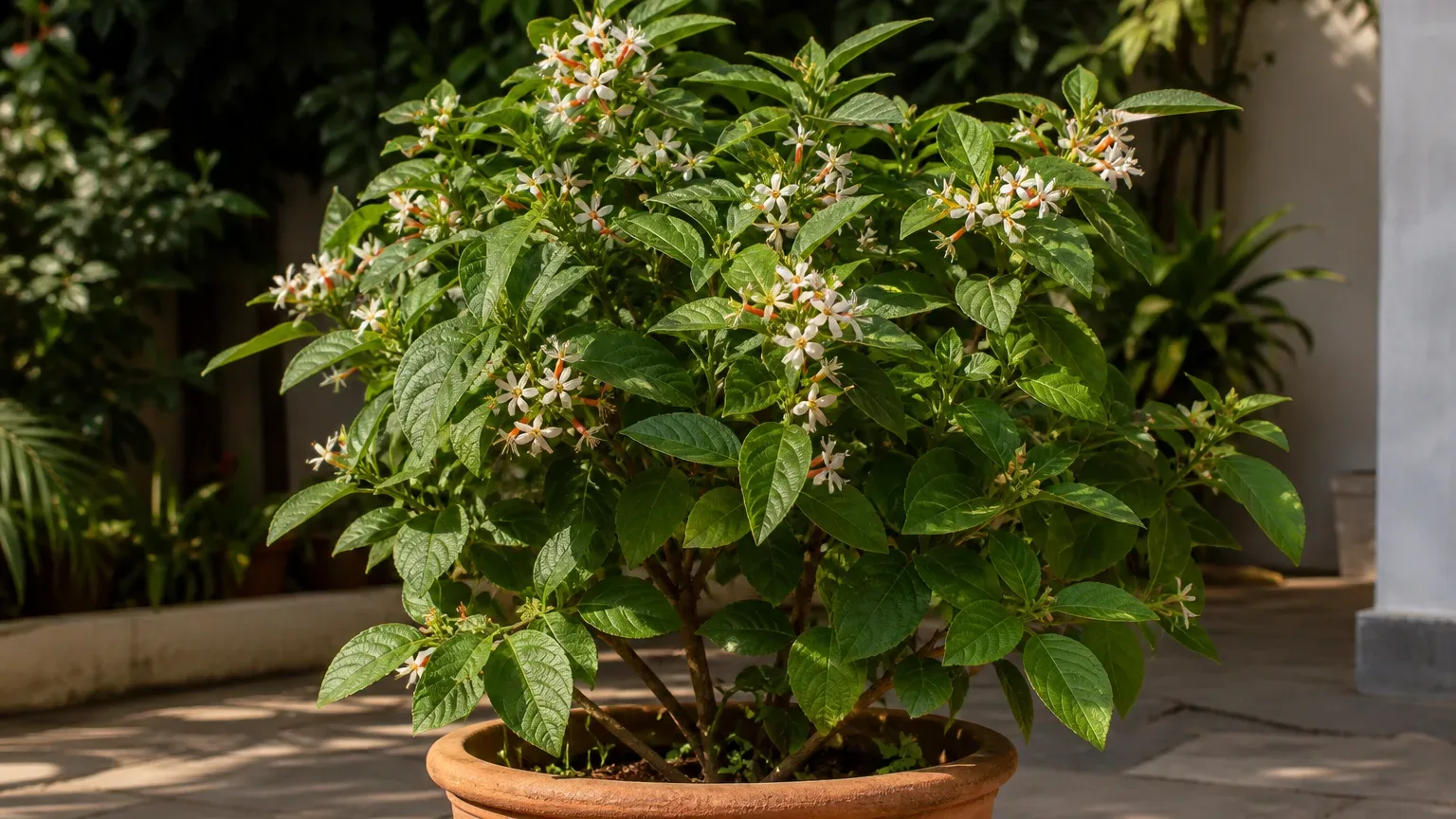
Parijat produces clusters of white, fragrant flowers with orange-red tubular centres. The flowers open at night, lose colour and fragrance as daylight approaches, and fall in the morning (NParks floral description). Pha Tad Ke Botanical Garden likewise documents the night opening and morning fall, an important distinction between normal flower behaviour and premature bud loss.
Flowering timing varies with climate, rainfall, pruning, and plant maturity. Do not judge performance from a nursery label promising a fixed month everywhere in India. Strong light, healthy roots, and mature branching create the conditions for bloom, but no fertilizer can force a shaded or waterlogged plant to flower well.
Light: choose an outdoor position first
Use a sunny balcony, terrace, courtyard, or garden bed. Aim for at least four to six hours of direct sun as a practical starting point, then watch the leaves. A mature plant in deep shade may remain green yet make sparse flowers and open growth because species-specific cultivation guidance places the best growth and flowering in full sun.
Acclimate a nursery plant over one to two weeks if it was kept under shade cloth. Begin with gentler morning sun and lengthen exposure rather than moving soft foliage directly into an exposed west-facing site; Clemson Extension likewise advises making changes in light intensity gradually. For window-by-window placement and grow-light limits, use the detailed Parijat light guide.
Watering: soak the root zone, then let it breathe
Check the soil rather than following a rigid calendar. Push a finger or wooden skewer 3–5 cm into the mix; if that layer is dry, water slowly until the whole root ball is wet and excess escapes. NParks specifically advises thorough watering followed by allowing the soil to become quite dry before rewatering and warns that overwatering readily leads to root rot (species cultivation guidance).
Newly planted Parijat needs steadier moisture while roots establish, whereas an established garden tree can handle a brief dry interval. Pots dry faster during hot, windy weather but much more slowly during humid rain. The Parijat watering guide explains how pot material, season, and root condition change the decision.
Soil and drainage for pots and ground
Use a loose, fertile medium that holds some moisture but releases surplus water. A practical container blend is roughly 40% quality potting soil or loam, 30% mature compost, and 30% coarse aeration material such as perlite, fine bark, or coarse sand. The exact recipe matters less than the result: water should soak through evenly and leave the root zone moist, not airless.
Never use a decorative container without an unrestricted drainage hole. In heavy garden clay, plant slightly high and improve a broad area rather than filling a narrow hole with soft compost, which can behave like a sump. See the Parijat soil guide for mix adjustments and signs that the root zone has compacted.
Feeding without sacrificing flowers
Feed during active shoot and root growth, not as a reflex whenever leaves look pale. A thin compost top-dressing or a balanced fertilizer at the label rate is usually enough for a container plant; established garden soil should ideally be tested before nutrients are added. Clemson Extension recommends choosing the material and amount from soil-test information where possible and fertilizing when plants are actively growing (fertilizer best practices).
Do not feed dry, wilted, recently repotted, or waterlogged roots. Correct moisture and drainage first, because fertilizer salts add stress rather than repairing damaged roots. The Parijat fertilizer guide covers timing, dilution, and how to separate nutrient shortage from root trouble.
Parijat in a pot versus open ground
A pot gives you control over soil and lets you move a young plant away from frost or relentless rain. It also creates a smaller moisture buffer, heats up faster, and eventually restricts a naturally woody plant. Choose a stable container with drainage, increase only one pot size at a time, and expect to root-prune or move up as the crown becomes top-heavy.
Open ground suits Parijat’s mature form where the climate is warm and the site drains. Allow clearance from walls, paving, and narrow passages because the crown broadens and flowers fall daily during a flush. If water runs straight through a root-packed pot or roots circle densely, consult the Parijat repotting guide instead of compensating with ever more frequent watering.
Pruning and propagation basics
Light pruning after the principal flowering flush helps remove dead, crossing, or weak growth and keeps a container crown manageable. Avoid repeatedly clipping every new tip when buds are expected. Although NParks notes that the species can recover from hard pruning and that pruning encourages a denser crown, recovery ability is not a reason to cut a healthy plant back severely every season.
Parijat can be propagated by stem cuttings; NParks lists stem cutting as its propagation method. Fresh seed is also used in cultivation, but seedlings can vary and usually take longer to become a shaped flowering specimen. Follow the Parijat propagation guide for timing and aftercare, and the Parijat pruning guide before making structural cuts.
Seasonal care in India and similar climates
During hot, dry weather, inspect container moisture more often and shield a newly acclimating plant from reflected afternoon heat. During monsoon spells, stop routine irrigation, empty saucers, and make sure runoff cannot collect around the stem base. Fertilizer should not be applied just before heavy rain because nutrients can move beyond the root zone or into runoff, a risk also highlighted by Clemson Extension.
In cooler or drier months, growth may slow and some leaf drop can occur. Reduce watering to match actual drying and protect a pot from frost and cold wind. Do not combine repotting, hard pruning, feeding, and a major placement change at once; one change at a time makes the plant’s response easier to read.
Read the plant: healthy signs and warning signs
Healthy Parijat makes firm shoots, expanding opposite leaves, and increasingly branched growth. On a mature plant, night-opening flower clusters followed by a morning carpet of intact flowers are normal. A few old yellow leaves can also be normal, especially during a seasonal transition.
Persistent yellowing while the soil stays wet, a sour smell, or soft dark tissue near the base points toward oxygen-starved roots. Crisp margins, limp young shoots, and mix pulling away from the pot wall point more toward prolonged dryness. Sparse bloom with long weak shoots points first to inadequate light; slow growth with water racing through a crowded root ball points to repotting.
Common Parijat care mistakes
The most damaging mistake is treating a large woody outdoor species like a small indoor jasmine. A bright room usually supplies less useful light than an open balcony, and a cachepot can hide standing water. Moving the plant outdoors helps only if sun exposure is increased gradually.
Other mistakes include watering by weekday, feeding a stressed plant, using dense garden clay in a pot, and upsizing into a container far larger than the roots. Severe pruning immediately before the expected bloom can also remove productive growth. Diagnose the limiting condition, change it, and wait for new growth before stacking on another treatment.
When to use this page vs other Parijat guides
Use this overview when you need to understand the whole plant, choose a location, or triage a problem across light, water, roots, and season. Use the dedicated light guide when placement or flowering is the main issue, the watering guide for moisture decisions, and the soil guide when drainage or mix structure is suspect.
For a specific task, go directly to the cluster page that shows the steps. The fertilizer, repotting, propagation, and pruning guides cover timing and technique in more depth than a general overview can.
Related Parijat guides
- Parijat fertilizer guide — choose when and how lightly to feed.
- Parijat repotting guide — assess crowded roots, pot size, and aftercare.
- Parijat propagation guide — compare cuttings and seed.
- Parijat pruning guide — shape the crown without sacrificing the next flush.
- Parijat plant hub — review the species profile and the complete care cluster.
Conclusion
Successful Parijat care begins with recognizing what the plant is: a substantial South Asian flowering shrub or small tree that belongs outdoors in strong light. Pair that light with deep but conditional watering, fast drainage, restrained feeding, and enough root room. When growth or flowering declines, check sun, root moisture, and seasonal change first; those signals are more useful than a fixed calendar or a stronger fertilizer.
How to care for Parijat?
When should you water Parijat?
Water deeply when the top 3–5 cm of soil feels dry. Keep newly planted Parijat evenly moist while roots establish, but let the upper layer dry between drinks. Established plants tolerate brief dry spells better than waterlogged soil.
- Check 3–5 cm below the surface and water only when that layer is dry - Water deeply when the top 3–5 cm of soil feels dry.
- then soak until excess drains from the pot - Water deeply when the top 3–5 cm of soil feels dry.
- Drain excess water - Water deeply when the top 3–5 cm of soil feels dry.
What soil works best for Parijat?
Loose, fertile, well-draining soil that holds some moisture without staying soggy. Use loam enriched with compost and coarse material; aim for slightly acidic to neutral conditions around pH 6.0–7.0.
- 40% good-quality potting soil or loam - Use loam enriched with compost and coarse material; aim for slightly acidic to neutral conditions around pH 6.0–7.0.
- 30% mature compost - Use loam enriched with compost and coarse material; aim for slightly acidic to neutral conditions around pH 6.0–7.0.
- 30% coarse sand, perlite, or fine bark - Use loam enriched with compost and coarse material; aim for slightly acidic to neutral conditions around pH 6.0–7.0.
Grower notes for Parijat
What matters most with Parijat
Parijat is a sun-loving flowering shrub or small tree, not a true Jasminum vine. Give Nyctanthes arbor-tristis at least 4–6 hours of direct sun, a roomy root run, and soil that drains promptly after watering. Strong light supports the fragrant white-and-orange flowers that open at night and fall by morning. Avoid changing water, pot size, and placement all at once.
Best placement in a real home
Place Parijat outdoors on a sunny balcony, terrace, courtyard, or in open ground where morning sun and airflow are reliable. A bright window is rarely enough for a mature plant to flower heavily. Water when the top 3–5 cm dries, then empty saucers promptly. Protect container plants from frost and cold winds; warm tropical and subtropical conditions suit this South Asian species best.
Before you buy this plant
Choose a bushy Parijat with firm woody stems, clean rough-textured leaves, and a potting mix that smells earthy rather than sour. Confirm the label says Nyctanthes arbor-tristis: the shared names night jasmine and night-flowering jasmine are also used for unrelated Cestrum species. Avoid plants with blackened stem bases, widespread scale, or roots sitting in stagnant water.
First month after bringing it home
Quarantine the plant, introduce stronger sun gradually over one to two weeks, and learn how quickly its pot dries before setting a watering rhythm. Do not repot immediately unless drainage is failing. Some leaf drop can follow a sharp change in light or moisture; correct the growing condition before adding fertilizer or pruning hard.
Pet-aware note for Parijat
Nyctanthes arbor-tristis has no species-specific ASPCA cat-and-dog safety listing, so do not treat the word jasmine as proof that it is safe. Keep fallen flowers, leaves, seeds, and herbal preparations away from pets. If an animal chews the plant and develops vomiting, diarrhea, drooling, or unusual behavior, contact a veterinarian or animal poison service.
How to tell Parijat is settling in
Healthy establishment shows as firm new shoots, expanding opposite leaves, and eventually clusters of fragrant flowers with orange tubes. Somaiya Vidyavihar records flowering from September to April, though local climate changes the timing. Parijat can be propagated from seed or semi-hardwood cuttings. Prune lightly after the main flowering flush to remove weak wood and keep container plants bushy.
Is Parijat safe for pets?
Nyctanthes arbor-tristis is not specifically classified in the ASPCA toxic and non-toxic plant database. Treat it as unverified, prevent chewing, and ask a veterinarian about any ingestion.
Parijat is not true jasmine and species-specific veterinary safety evidence is limited. Nyctanthes arbor-tristis does not have a dedicated ASPCA listing, so it should not inherit the non-toxic classification of true Jasminum species. Keep all plant parts and concentrated herbal products out of reach of pets.
Watering Parijat
For Parijat, check 3–5 cm below the surface and water only when that layer is dry, then soak until excess drains from the pot and water about every 3–5 days in hot, dry weather; every 7–10 days in mild weather; less often during cool or rainy periods. Increase watering during hot summer growth and flowering if the mix dries quickly; reduce sharply in monsoon rain and cool winter weather.
| Detail | Information |
|---|---|
| How often | About every 3–5 days in hot, dry weather; every 7–10 days in mild weather; less often during cool or rainy periods |
| How to check | Check 3–5 cm below the surface and water only when that layer is dry, then soak until excess drains from the pot |
| Seasonal changes | Increase watering during hot summer growth and flowering if the mix dries quickly; reduce sharply in monsoon rain and cool winter weather |
Signs of overwatering
- yellowing lower leaves
- persistent wilt while soil remains wet
- sour-smelling potting mix
- soft, dark roots or stem base
Signs of underwatering
- drooping young shoots
- crisp brown leaf edges
- premature leaf or bud drop
- very dry soil pulling from the pot edge
Soil & potting for Parijat
Use a mix of 40% good-quality potting soil or loam, 30% mature compost, 30% coarse sand, perlite, or fine bark for Parijat. Fast drainage is essential in containers; avoid heavy clay and standing water around the root zone. Target soil pH around 6.0–7.0. Repot every 2–3 years for young plants, or when roots fill the pot, ideally in late winter to early spring, just before active new growth.
| Detail | Information |
|---|---|
| Recommended mix | 40% good-quality potting soil or loam, 30% mature compost, 30% coarse sand, perlite, or fine bark |
| Drainage | Fast drainage is essential in containers; avoid heavy clay and standing water around the root zone |
| Soil pH | 6.0–7.0 |
| Repotting frequency | Every 2–3 years for young plants, or when roots fill the pot |
| Best season to repot | Late winter to early spring, just before active new growth |
Signs it needs repotting
- roots circling the pot or emerging from drainage holes
- water running straight through a root-packed container
- growth slowing despite adequate sun and feeding
- the canopy becoming unstable or top-heavy
Humidity & temperature for Parijat
Fertilizer & pruning for Parijat
Use during active growth, a light monthly application of compost or balanced fertilizer is enough; excessive nitrogen can favor shoots over flowers. for Parijat.
| Detail | Information |
|---|---|
| Fertilizer type | During active growth, a light monthly application of compost or balanced fertilizer is enough; excessive nitrogen can favor shoots over flowers. |
Common problems on Parijat
Yellow Leaves
MediumLikely cause: Common on this plant type; confirm with recent watering, light, and root checks.
Quick fix: Inspect the plant and correct the most likely care stressor before stacking treatments.
Full fix guide →Brown Tips
MediumLikely cause: Common on this plant type; confirm with recent watering, light, and root checks.
Quick fix: Inspect the plant and correct the most likely care stressor before stacking treatments.
Full fix guide →Root Rot
MediumLikely cause: Common on this plant type; confirm with recent watering, light, and root checks.
Quick fix: Inspect the plant and correct the most likely care stressor before stacking treatments.
Full fix guide →Overwatering
MediumLikely cause: Common on this plant type; confirm with recent watering, light, and root checks.
Quick fix: Inspect the plant and correct the most likely care stressor before stacking treatments.
Full fix guide →Underwatering
MediumLikely cause: Common on this plant type; confirm with recent watering, light, and root checks.
Quick fix: Inspect the plant and correct the most likely care stressor before stacking treatments.
Full fix guide →Spider Mites
MediumLikely cause: Common on this plant type; confirm with recent watering, light, and root checks.
Quick fix: Inspect the plant and correct the most likely care stressor before stacking treatments.
Full fix guide →Mealybugs
MediumLikely cause: Common on this plant type; confirm with recent watering, light, and root checks.
Quick fix: Inspect the plant and correct the most likely care stressor before stacking treatments.
Full fix guide →Aphids
MediumLikely cause: Common on this plant type; confirm with recent watering, light, and root checks.
Quick fix: Inspect the plant and correct the most likely care stressor before stacking treatments.
Full fix guide →Leggy Growth
MediumLikely cause: Common on this plant type; confirm with recent watering, light, and root checks.
Quick fix: Inspect the plant and correct the most likely care stressor before stacking treatments.
Full fix guide →Slow Growth
MediumLikely cause: Common on this plant type; confirm with recent watering, light, and root checks.
Quick fix: Inspect the plant and correct the most likely care stressor before stacking treatments.
Full fix guide →Wilting
MediumLikely cause: Common on this plant type; confirm with recent watering, light, and root checks.
Quick fix: Inspect the plant and correct the most likely care stressor before stacking treatments.
Full fix guide →Drooping Leaves
MediumLikely cause: Common on this plant type; confirm with recent watering, light, and root checks.
Quick fix: Inspect the plant and correct the most likely care stressor before stacking treatments.
Full fix guide →Low Humidity
MediumLikely cause: Common on this plant type; confirm with recent watering, light, and root checks.
Quick fix: Inspect the plant and correct the most likely care stressor before stacking treatments.
Full fix guide →Not Enough Light
MediumLikely cause: Common on this plant type; confirm with recent watering, light, and root checks.
Quick fix: Inspect the plant and correct the most likely care stressor before stacking treatments.
Full fix guide →Fungus Gnats
MediumLikely cause: Common on this plant type; confirm with recent watering, light, and root checks.
Quick fix: Inspect the plant and correct the most likely care stressor before stacking treatments.
Full fix guide →Mold on Soil
MediumLikely cause: Common on this plant type; confirm with recent watering, light, and root checks.
Quick fix: Inspect the plant and correct the most likely care stressor before stacking treatments.
Full fix guide →