Pearls and Jade Pothos Problems: Causes & Quick Fixes
Quick answer
Pearls and Jade Pothos is prone to 16 common issues - each link below is a plant-specific fix guide.
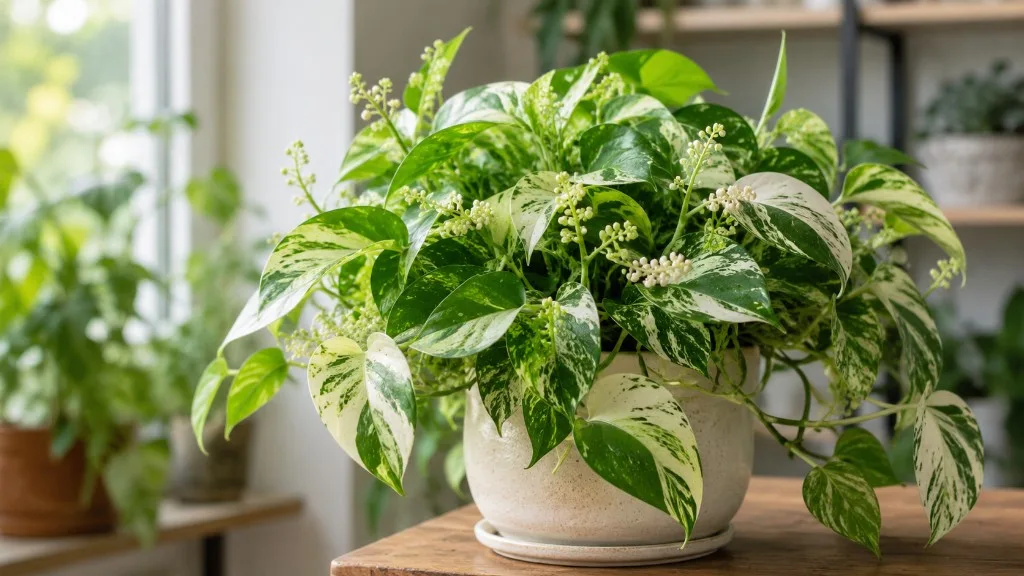
Pearls and Jade Pothos problems
Use the guides below to diagnose and fix common issues on Pearls and Jade Pothos. Each problem page explains why it happens on this species and what to do first.
Or use our problem diagnosis tool to narrow down symptoms.
Common problems on Pearls and Jade Pothos
Brown Tips
LowLikely cause: Low humidity or hard water
Quick fix: Increase humidity; use filtered water
Full fix guide →Leggy Growth
MediumLikely cause: Insufficient light causing green reversion
Quick fix: Move to brighter indirect light
Full fix guide →Root Rot
MediumLikely cause: Consistently wet soil
Quick fix: Repot in fresh draining mix
Full fix guide →Yellow Leaves
MediumLikely cause: Overwatering - primary risk for slow growers
Quick fix: Allow top 3–5 cm to dry; reduce watering frequency
Full fix guide →Aphids
MediumLikely cause: Aphids on Pearls and Jade Pothos cluster on tender new variegated leaves and vine tips, leaving sticky honeydew that dulls white-grey marbling. First step: isolate the plant and rinse colonies off wit
Quick fix: See plant-specific guide for step-by-step fixes.
Full fix guide →Drooping Leaves
MediumLikely cause: Drooping on Pearls and Jade Pothos shows as downward-hanging teardrop blades and soft petioles-often one long trailing section first. Dry soil perks leaves up after a soak; limp leaves on wet soil mea
Quick fix: See plant-specific guide for step-by-step fixes.
Full fix guide →Fungus Gnats
MediumLikely cause: Fungus gnats on Pearls and Jade Pothos mean the top 2 inches of mix stay wet too long-common when this slow, compact variegated cultivar meets frequent watering or low light. First step: stop watering
Quick fix: See plant-specific guide for step-by-step fixes.
Full fix guide →Low Humidity
MediumLikely cause: Dry winter air and heat vents crisp the small variegated leaves of Pearls and Jade Pothos faster than on larger pothos. First step: move the plant off the vent and check a hygrometer-rule out underwat
Quick fix: See plant-specific guide for step-by-step fixes.
Full fix guide →Mealybugs
MediumLikely cause: Mealybugs on Pearls and Jade Pothos show up as white cottony clusters in leaf axils and along trailing stems. First step: move the plant away from others and dab every visible bug with 70% isopropyl a
Quick fix: See plant-specific guide for step-by-step fixes.
Full fix guide →Mold on Soil
MediumLikely cause: Fluffy white or gray mold on Pearls and Jade Pothos soil is usually harmless surface fungus feeding on organic mix-but it signals the top layer has stayed damp too long. Scrape off the top 2–3 cm, let
Quick fix: See plant-specific guide for step-by-step fixes.
Full fix guide →Not Enough Light
MediumLikely cause: Not enough light on Pearls and Jade Pothos shows up as fading white marbling, long bare vines, and soil that stays wet too long. Move the plant within 1–2 m of an east- or west-facing window for brigh
Quick fix: See plant-specific guide for step-by-step fixes.
Full fix guide →Overwatering
MediumLikely cause: Overwatering is the primary risk on Pearls and Jade Pothos-a slow variegated cultivar that uses water slowly. Stop watering when the top 3–5 cm is still damp, improve bright indirect light, and inspec
Quick fix: See plant-specific guide for step-by-step fixes.
Full fix guide →Slow Growth
MediumLikely cause: Some slow pace is normal on Pearls and Jade Pothos-this compact variegated cultivar grows slower than golden pothos. Worry when no new marbled leaves appear for eight or more weeks in spring or summer
Quick fix: See plant-specific guide for step-by-step fixes.
Full fix guide →Spider Mites
MediumLikely cause: Spider mites on Pearls and Jade Pothos cause pale stippling and fine webbing on small variegated leaves, especially in dry winter air near windows. First step: isolate the plant and rinse leaf undersi
Quick fix: See plant-specific guide for step-by-step fixes.
Full fix guide →Underwatering
MediumLikely cause: Underwatering on Pearls and Jade Pothos shows as limp vines, a very light pot, and bone-dry mix 3–5 cm down. Water deeply until excess drains, then resume waiting until that depth dries again-do not k
Quick fix: See plant-specific guide for step-by-step fixes.
Full fix guide →Wilting
MediumLikely cause: Wilting on Pearls and Jade Pothos means roots are failing to move water-either from underwatering (light dry pot) or overwatering and root rot (heavy wet pot). Lift the pot and press your finger 3–5 c
Quick fix: See plant-specific guide for step-by-step fixes.
Full fix guide →