Root Rot on Pencil Cactus: Stem-Base Rescue
Quick answer
Root rot on Pencil Cactus starts underground as wet mix suffocates roots, then climbs into the pencil-thick stem base. First step: stop all watering and squeeze-test the lowest inch of stem — soft or translucent tissue on a heavy wet pot means unpot the same day, wearing gloves against the irritant latex sap.
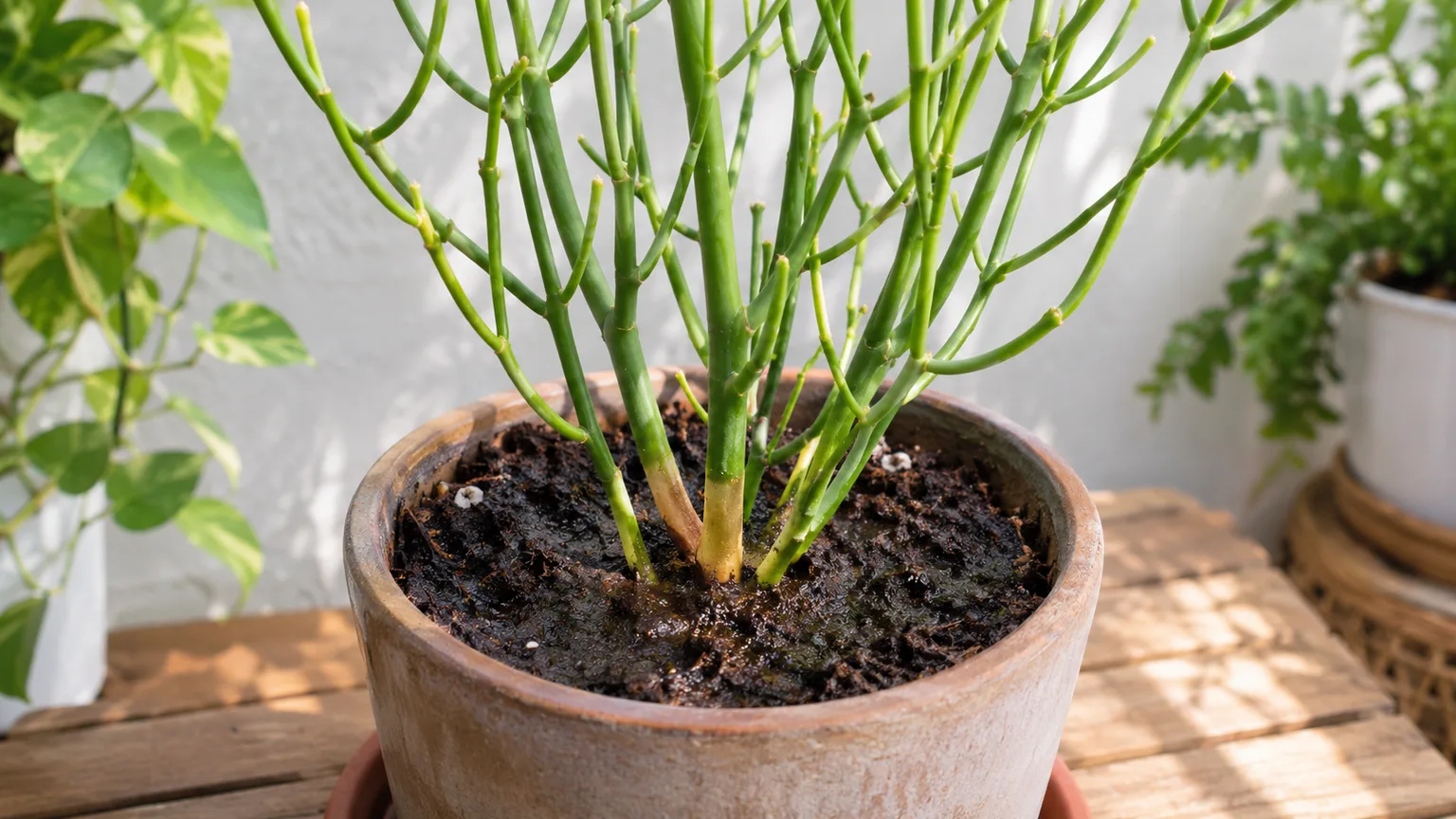
Root Rot on Pencil Cactus: Causes, Checks & Fixes
This guide covers root rot on Pencil Cactus. See also the general Root Rot guide, watering, and light pages for this plant.
Root Rot on Pencil Cactus: Causes, Checks & Fixes
Quick answer
Root rot on Pencil Cactus (Euphorbia tirucalli) is a stem-base and root-crown failure caused by chronic wet mix, not a leaf disease. This succulent stores water in its pencil-thick green stems, so the leaves can look plump and fine while the roots are already dying underground. The Missouri Botanical Garden describes pencil cactus as intolerant of moist, poorly-drained soils and advises allowing soils to dry between waterings.
For how saturated mix kills roots on any houseplant, see our root rot guide. On Pencil Cactus, the tell is a heavy wet pot, a sour smell from the drainage holes, and — most critically — a soft, mushy, or translucent lowest inch of stem while the upper pencil branches still look green.
First step: stop all watering immediately. Then, wearing gloves, squeeze-test the lowest inch of stem above the soil line. Soft tissue on wet mix means unpot and inspect the roots the same day. Do not fertilize, mist, or repot into more wet soil first.
Sap caution: every cut or squeeze on this plant can release caustic milky latex. The ASPCA lists Euphorbia tirucalli as toxic to dogs, cats, and horses with irritant sap, and horticultural guides advise gloves plus eye protection for any pruning or repotting work (Healthy Houseplants care guide). Keep sap off skin, eyes, and mouth, and keep the plant away from pets and children during surgery.
When to use this page vs other Pencil Cactus guides
| Pattern | Read next |
|---|---|
| Heavy wet pot, stems still firm, no sour smell | Dry-down pause per the watering guide — rot may not have set in yet |
| Soft stem base + wet soil + brown slimy roots (this page) | Stay here for unpotting and salvage |
| Wrinkled thin stems, light dusty-dry pot | Underwatering — soak when the full root zone is dry, see the watering guide |
| Pale stretched stems, firm base, no sour smell | Low light — increase exposure gradually per the light guide |
| Fungus gnats or surface mold on persistently wet mix | Moisture alarm — fix drainage per the soil guide before rot advances |
| Whole plant collapsing on wet soil | Advanced rot — start stem triage below |
What root rot looks like on Pencil Cactus
Pencil Cactus photosynthesizes through its stems, not broad leaves. That changes the symptom picture: there is no big yellowing leaf canopy to warn you early. Decay starts at the root crown and climbs the lowest stem segment while the upper branches keep their green color for weeks.
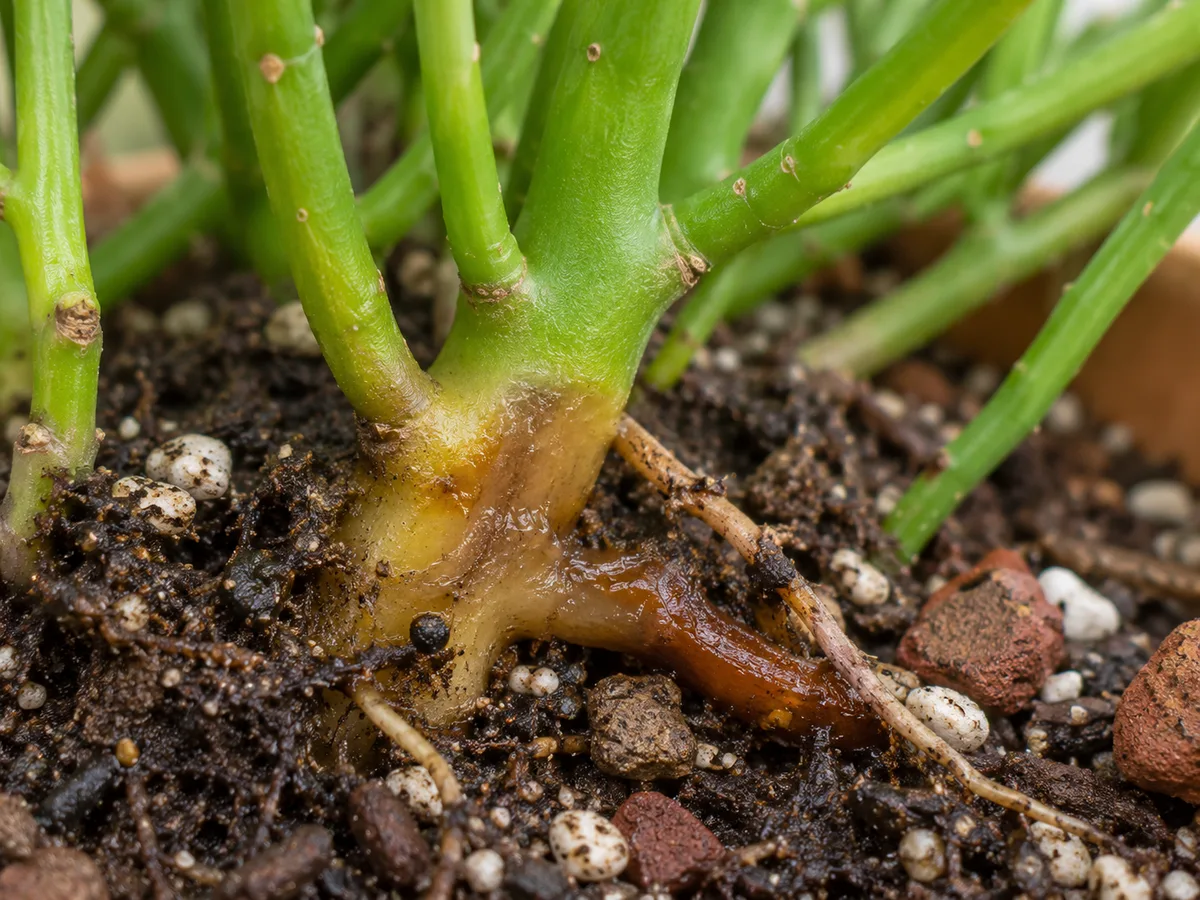
Root rot can soften the lower stem and roots while the upper pencil-like branches stay green.
Early signs (roots failing, stems still mostly firm)
- Heavy pot days after watering; gritty mix never fully dries through the root ball
- Sour or rotten smell from the drainage holes when you lift or tilt the pot
- Lowest inch of stem slightly soft when pressed through gloves, or turning yellow-brown at the soil line
- Small stem segments dropping with light touch while still looking green
- Stalled new tip growth for a month or more in warm bright weather
- Unpotting reveals brown, mushy, or hollow roots while most stem tissue still feels solid
Advanced signs (rot climbing the stems)
- Mushy, translucent, or black stem base spreading upward from the soil line
- Wilt paradox — shriveled upper pencil stems despite wet soil, because dead roots cannot move water
- Several stems collapsing inward as the shared root crown fails
- Foul-smelling wet mix with stems detaching at the base
A wrinkled but firm pencil stem on a light, dusty-dry pot is thirst, not rot. Root rot adds wet mix plus a soft stem base plus sour smell to the picture.
Sap-safe stem-base squeeze test
This plant-only check would be nonsense on a fern or pothos. Pencil Cactus stems are the water tank, the photosynthetic surface, and the rot ladder all at once — and every press risks a latex exposure.
- Gear up first. Nitrile gloves and glasses. Lay newspaper under the pot; have paper towels ready to blot any white sap immediately.
- Lift for weight. A pot that still feels heavy a week after watering on gritty mix means the lower root zone never dried.
- Sniff the drainage holes. Sour or swampy odor means anaerobic decay, not a surface issue.
- Press the lowest inch of each main stem gently through gloves. Healthy tissue feels firm like a pencil eraser; rot feels soft, waterlogged, or hollow.
- Check branch junctions. Rot often pools where low branches meet the main stem and stay damp longest.
- Run a dry wooden skewer to the bottom of the pot. If it exits cool and stained on a heavy pot, the core is still wet — trust the skewer over the dry-looking surface.
Do not rinse sap with bare hands or wipe your face mid-check. Wash gloves, tools, and hands after, and keep pets out of the room until the work area is clean.
Why Pencil Cactus gets root rot
Euphorbia tirucalli evolved on dry rocky hillsides with fast-draining mineral soil and long dry intervals. Indoors, rot happens when the root zone stays saturated until tissue breaks down from the roots upward. Waterlogged soil deprives roots of oxygen and kills them, and weakened tissue invites soil-borne decay organisms.
Calendar watering on a succulent. Watering every week ignores how slowly this plant uses water, especially in dim rooms or large pots. Specialty growers warn that too much water causes root rot and overwatering is the main cause of failure. Match soaks to full dry-down, not weekdays — the full rhythm is in the watering guide.
Winter rest mismatch. The plant slows sharply in cool short-day months, and the Missouri Botanical Garden advises reduced watering from fall to late winter. A summer rhythm in a cool November room keeps roots wet while uptake has already dropped.
Dense mix and oversized pots. Extra peat-heavy soil around a modest succulent root ball holds moisture at the stem base where rot starts. Pencil Cactus needs the gritty mineral mix described in the soil guide — roughly mineral-dominated, draining in seconds — in a pot sized to the roots with open drainage holes.
Standing runoff. Saucers and cachepots that hold water after each soak create a water table at the bottom of the root ball. Empty them within 30 minutes of every watering.
How to confirm the cause
Work through these checks in order. Root rot is confirmed by mushy roots plus a soft stem base in wet mix — not by slow growth alone.
- Stop watering. Every additional soak spreads decay through stored stem tissue.
- Lift the pot. Heavy days after watering means saturation; learn your dry weight.
- Smell the drainage holes. Sour or rotten odor supports anaerobic root decay.
- Skewer the full root zone. Wet, cool, stained probe on a heavy pot confirms the core never dried.
- Squeeze-test the stem base through gloves. Soft, translucent, or hollow on wet mix confirms rot has climbed from the roots.
- Unpot and inspect roots. Healthy pencil cactus roots are pale and firm; rotted tissue is brown, black, mushy, or slips off easily.
- Compare against thirst. Wrinkled firm stems, a light pot, and dusty dry mix mean underwatering — soak and resume the watering guide rhythm instead of surgery.
If mix is wet, roots are mushy, and the lowest stem softens, you have confirmed root rot. No fungicide replaces removing wet soil and decayed tissue.
First fix for Pencil Cactus
Stop all watering immediately. Move the pot to bright indirect light with good airflow — do not blast a stressed plant with harsh midday sun through glass.
Then unpot the same day if any stem base is soft or smells sour, wearing gloves and eye protection throughout:
- Knock the plant out gently and shake off all wet mix. Discard foul soil entirely.
- With a sterilized blade, cut away every mushy root and any soft black stem tissue until only firm pale tissue remains.
- Blot latex sap with paper towels; do not touch your face until gloves are off and hands are washed.
- Let cut surfaces air-dry uncovered in bright indirect light for 2–3 days until wounds callus — succulent cuts planted wet re-rot.
- Repot remaining firm tissue into dry gritty succulent mix in a pot sized to the trimmed roots, not the original oversized container. See repotting.
- Wait one week, then give a moderate edge soak and return to strict soak-and-dry.
That single sequence — stop water, remove decay, callus, dry repot — is the rescue. Editorial care references describe the same core loop: remove the plant, cut away rotten roots and stems, let cuts dry, and repot into fresh dry gritty compost. Do not stack fertilizer, misting, or pesticide on the same day.
Pencil-stem cutting salvage when the base is gone
When the root crown is hollow but upper pencil branches are still firm and green, beheading firm stems beats saving the base. This succulent salvage path does not apply to leafy tropicals.
- Identify the highest firm green tissue on each affected stem — press along the segment; rot feels soft under the surface.
- Cut at least an inch above visibly decayed tissue with a sterile knife, wearing gloves and glasses.
- Blot sap, then lay firm cuttings on dry newspaper in bright indirect light for 5–7 days until cut faces are fully callused and dry.
- Plant callused cuttings upright in dry gritty mix — rooting detail is in the propagation guide.
- Do not water for the first week; then give a light edge soak only when the mix is fully dry throughout.
- Discard mushy lower sections and contaminated soil — do not compost wet rot tissue indoors.
One healthy 10–15 cm firm stem can root into a new plant over a season. A fully hollowed crown rarely recovers, and cuttings are the realistic backup.
Step-by-step recovery
Weeks 1–2: Stabilize without water
Keep the plant in bright light, not deep shade. Do not water — the firm stems are the stored water supply. Some wrinkling may appear; judge by whether soft spots stop spreading.
Weeks 3–4: First cautious drink
If the mix is completely dry throughout the pot, give a light soak and empty the saucer immediately. Specialty guidance for this species spaces water every 2–3 weeks in spring and summer and nearly stops in cool winter conditions — stay at the dry end of that range while roots are weak.
Months 2–3: Watch for new tip growth
Tiny fresh green tips on pencil branches are the best sign rot has stopped. A firm stem base with no new soft spots is positive even when lower segments look scarred.
Month 3+: Resume minimal care
Resume dilute feeding only after new tip growth looks normal for two weeks and every stem base stays firm. Follow the watering guide dry-down rhythm strictly — one wet spell can restart rot on weakened roots.
Recovery timeline
| Stage | What to expect | Positive sign | Warning sign |
|---|---|---|---|
| Days 1–14 | Plant looks unchanged or slightly more wrinkled | Stem bases stay firm; soft spots do not spread | Sour smell returns; bases soften further |
| Weeks 3–4 | First dry-down cycle completes | Mix dries evenly; no new dark tissue | Pot stays heavy; mix never fully dries |
| Months 2–3 | Possible new tip flush on branches | Firm stems plus fresh green tips | Additional stem drop on wet-feeling mix |
| Month 3+ | Gradual fill-in if salvage succeeded | Multiple firm stems producing new tips | Hollow base after repotting |
Realistic expectation: mild cases caught while most roots remain firm often stabilize within one to three months. Severe crown loss usually means cutting propagation, not a quick return to the original shape.
Lookalike symptoms
| What you see | Likely cause | Key check | First action |
|---|---|---|---|
| Soft stem base, wet soil, mushy roots | Root rot | Lowest inch gives under gloved pressure | Stop water, trim, dry repot |
| Heavy wet pot, firm stem bases | Early overwatering | Roots still firm on unpotting | Dry-down pause per the watering guide |
| Wrinkled firm stems, light pot, dry mix | Underwatering | Stems firm; roots pale and dry | Soak when skewer reads dry |
| Pale stretched stems, firm base | Low light | No sour smell | Increase light per the light guide |
| Limp stems on wet mix | Root uptake failure | Press base; sniff holes | Stop water; unpot |
Root rot specifically means mushy roots plus a soft stem base in wet mix. Firm stems on dusty dry soil point elsewhere even when growth looks stalled.
Mistakes to avoid
- Keep watering limp stems when soil is already wet. Wilting on saturated mix usually means rotting roots cannot take up water — not thirst.
- Wait for the whole plant to collapse before unpotting. Green upper branches hide base failure; test the lowest inch of every main stem.
- Repot into standard potting soil. Moisture-retentive peat repeats the conditions that caused rot — use the gritty blend in the soil guide.
- Repot into a larger container. A bigger wet zone makes recovery harder — size to trimmed roots.
- Handle cuts barehanded. The milky latex irritates skin and eyes; gloves and glasses are non-negotiable.
- Fertilize a stressed plant before bases stay firm for two weeks.
- Water immediately after repotting. Fresh wounds on trimmed roots and stems need callus time in dry mix.
- Assume fungicide replaces surgery. Wet soil and mushy tissue must be removed physically.
Pencil Cactus care cross-check
Root rot is almost always a stacking failure of water, soil, and pot choice — not bad luck.
Watering. Confirm the full root zone is dry before soaking — a dry surface on gritty mix lies easily. Full rhythm details are in the watering guide.
Soil. Use coarse mineral-dominated succulent mix that drains in seconds. Dense peat holds moisture around the stem base for days — see the soil guide.
Light. Bright light helps mix dry predictably. Dim corners slow water use — stretch intervals accordingly.
Pot and drainage. Open drainage holes, a right-sized terracotta pot, and empty saucers within 30 minutes of every watering. Pencil cactus is intolerant of moist, poorly-drained soils, so drainage is non-negotiable.
Season. Reduce watering when growth slows in cool short-day months; for this species, winter watering drops to nearly nothing in cool rooms.
How to prevent root rot next time
- Water only when a dry skewer confirms the full root zone is dry — not on a calendar.
- Use fast-draining gritty succulent mix in a pot with open drainage holes.
- Size pots to the root ball; avoid large decorative containers that hold excess soil moisture.
- Check the lowest inch of every main stem whenever you water.
- Learn dry pot weight by lifting weekly.
- Reduce watering frequency sharply in winter when rooms cool and growth slows.
- Empty saucers and cachepots after every soak.
When to worry
Treat as urgent when multiple stems soften at once, the mix smells sour, or brown-black tissue climbs above the soil line with no firm tissue left at the crown. Same-day trimming and dry repotting gives the best chance.
Salvage is unlikely when every stem base is hollow and mushy. Before discarding the plant, take cuttings from any firm upper stem — callused pencil cuttings root reliably in dry gritty mix.
Mild cases caught while stem bases are still mostly firm recover well if you act before decay reaches the stem core. If rot has already hollowed the shared crown, stem-cutting propagation is more realistic than saving the original root ball.
Related Pencil Cactus guides
- Overview — whole-plant context and placement
- Watering — soak-and-dry rhythm after recovery
- Soil — gritty mix that dries fast
- Light — bright exposure that keeps dry-down predictable
- Repotting — downsizing after root trim
- Propagation — stem-cutting salvage protocol
- Fertilizer — feeding only after firm new growth returns
- Problems hub — full symptom index
Conclusion
Root rot on Pencil Cactus is a stem-base and root-crown problem hidden by green upper branches that keep photosynthesizing while the base fails. Stop water, glove up against the latex sap, test the lowest inch of every stem, and unpot when tissue softens on wet mix. Firm stems, dry gritty soil, and fresh tip growth are the recovery signals; scarred lower segments will not revert to perfect green, and that is normal once the root zone stabilizes.
Related tool
Use the Root Rot Risk Checker to narrow causes for root rot on this plant before changing multiple variables at once.