Brown Tips on Pencil Cactus: Causes, Checks & Fixes
Quick answer
Brown tips on pencil cactus are most often underwatering, fertilizer salt burn, sudden sun scorch, or cold damage on the thin green stems. First step: give the pot one deep watering until water drains freely, then let it dry completely before watering again.
Brown Tips on Pencil Cactus: Causes, Checks & Fixes
This guide covers brown tips on Pencil Cactus. See also the general Brown Tips guide, watering, and light pages for this plant.
Brown Tips on Pencil Cactus: Causes, Checks & Fixes
Quick answer
On pencil cactus, brown tips appear on the thin green stems, not on ordinary leaves — this plant sheds its tiny leaves early and photosynthesizes through its branches. The most common causes are a long dry spell, fertilizer salts building up in the mix, a sudden jump into harsh sun, or a chill below about 50°F (10°C). For how tip browning works on houseplants in general, see our brown tips guide. On pencil cactus, the pattern usually shows up as dry, crispy stem ends on otherwise firm branches.
First fix: give the pot one deep watering until water runs freely from the drainage holes, then let the entire pot dry completely before watering again. This single step both rehydrates a thirsty plant and leaches mild salt buildup. Do not fertilize, repot, move, or prune until you see how the plant responds over the next one to two weeks.
What brown tips look like on Pencil Cactus
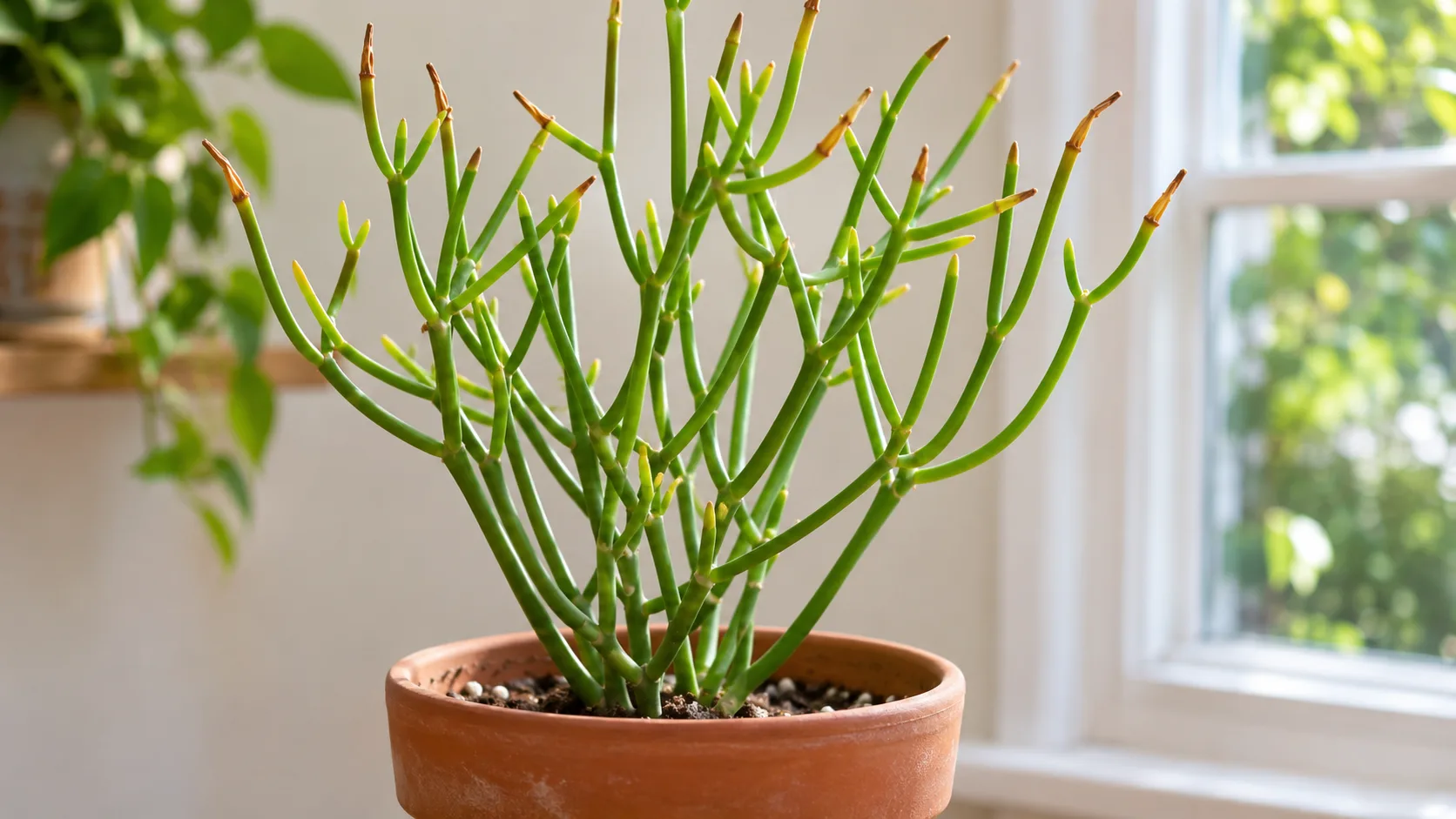
Because Euphorbia tirucalli does its growing through pencil-thin stems, “brown tips” here means the last half-inch or so of a branch turning tan, rust-brown, or grey and feeling dry and papery. The rest of the branch usually stays green and firm. You may see this on many branch ends at once after a missed watering cycle, or on just the sun-facing or draft-facing side after a light or temperature change.
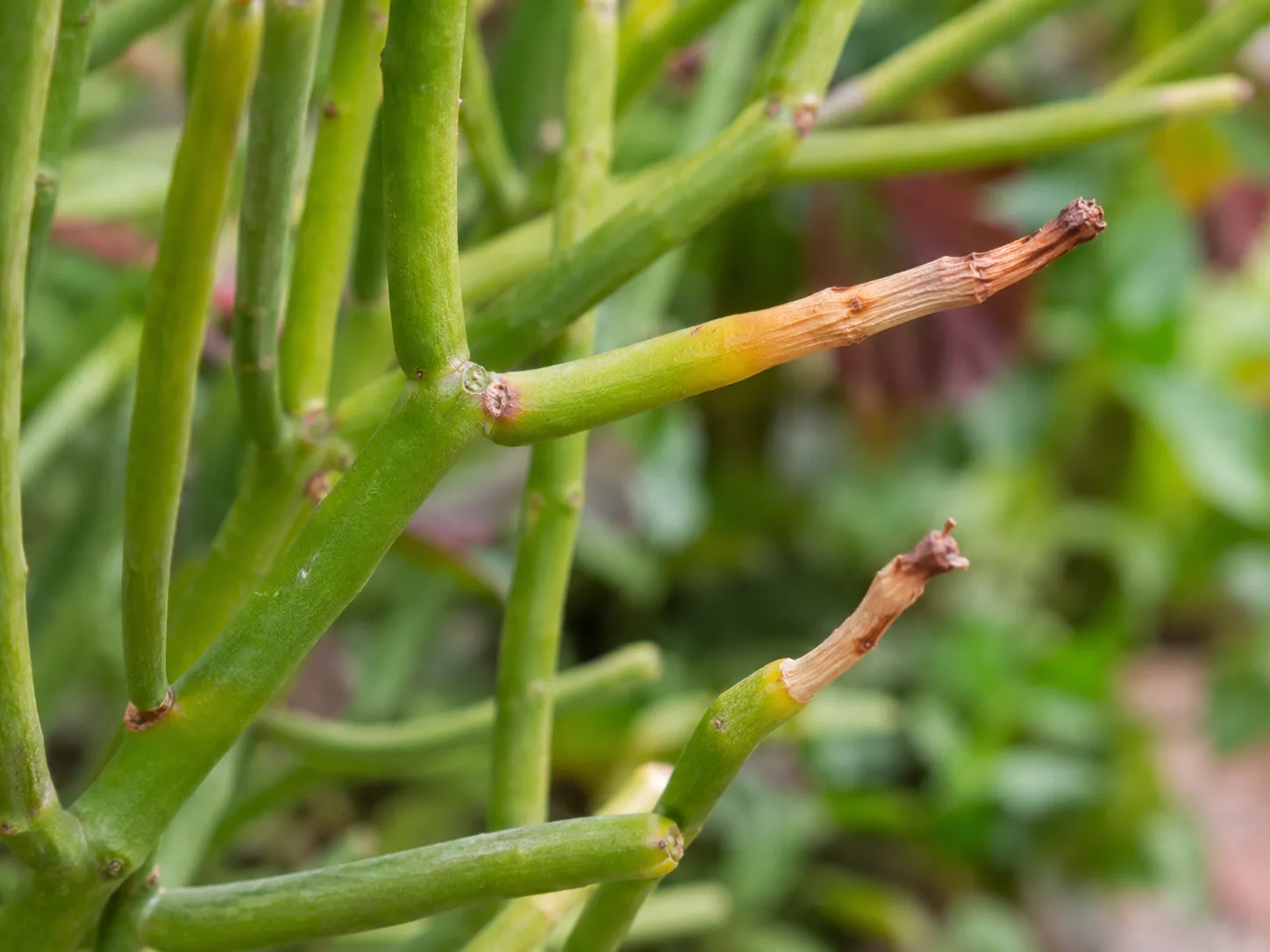
Dry, papery brown ends can develop while the pencil cactus stems behind them remain green and firm.
Two normal things get mistaken for damage. First, the small true leaves along the stems yellow and drop naturally — that is not tip browning, and a leafless pencil cactus in winter is normal. Second, on Firesticks-type cultivars, strong sun plus cool nights turns stem tips red, orange, or gold. That sunset coloring is smooth, vivid, and firm; damage is dull brown, dry, and crispy. If the color is red-orange and the stem feels solid, the plant is showing off, not suffering.
True tip damage keeps a consistent signature: the browned end stops growing, feels hollow or brittle, and never re-greens. New healthy growth emerges behind or beside it once conditions improve.
Why pencil cactus tips turn brown
Prolonged dryness. The thin branches store far less water than a barrel cactus or echeveria rosette, so a plant left dry for many weeks starts sacrificing its outermost tissue. Severe underwatering shows as shriveled, wrinkled stems with brown, crispy tips developing at the branch ends. This is the most common cause indoors, especially in winter when growers overcorrect and stop watering entirely for months.
Fertilizer and salt burn. Pencil cactus is a light feeder that needs almost no fertilizer, and excess salts concentrate at the stem tips where water exits the plant. Over-fertilization shows up as weak growth, a white mineral crust on the soil surface, and in severe cases, browning or burning at the stem tips from salt buildup. Hard tap water adds to the same crust over time.
Sudden sun scorch. This species wants strong light, but branches grown in dim conditions burn when slammed into harsh direct sun. Sunburned tissue develops brown spots or patches that turn dry and crispy on the exposed side. The classic trigger is moving the plant outdoors for summer or pressing it against hot south glass without acclimation.
Cold drafts and chill. Pencil cactus has essentially no cold tolerance. Exposure below about 50°F (10°C) damages stem tissue, and a cool draft from a window or air conditioner can brown the nearest branch tips even when the room feels comfortable to you. Growers in the northern hemisphere see this most in late fall, when the plant sits against cold glass.
Pests, rarely. Mealybugs and spider mites occasionally stipple or discolor stems, but they cause sticky residue, webbing, or speckling rather than clean crispy tips. Rule out the four causes above before assuming insects.
How to confirm the cause
Work through these checks in order before changing anything beyond the first deep watering:
- Soil moisture, full depth. Push a finger or wooden skewer to the bottom of the pot. Bone-dry all the way down with crispy tips fits underwatering; the plant prefers a strict soak-and-dry routine with complete drying between drinks. Wet or sour-smelling soil with browning fits rot instead — see root rot and skip to the emergency section.
- Stem feel. Squeeze several branches gently. Firm with dry ends means tip stress. Soft, mushy, or translucent sections — especially near the base — mean rot, and tip browning is the least of the problem.
- Salt crust. Look for a white crust on the soil surface or pot rim and recall feeding over the last few months. Feeding more than once or twice in the growing season, full-strength doses, or winter feeding all implicate salt burn.
- Light timeline. Did browning appear within days of moving the plant to stronger sun? One-sided browning on the sun-facing side after a move confirms scorch.
- Temperature timeline. Was the plant near an open window, a cold pane, or an air-conditioner vent when nights turned cool? Draft-side browning after a cold snap confirms chill damage.
- Pest inspection. Check stem joints and crevices for cottony clusters, fine webbing, or sticky residue. No residue and no visible insects means pests are unlikely.
If checks 1–3 point to dryness or salts, the first-fix watering already started the cure. If checks 4–5 match, hold the plant stable and correct the exposure next.
The first fix: one deep watering, then a full dry-down
Water thoroughly until liquid streams from the drainage holes, empty the saucer so the pot never sits in water, then leave the plant alone until the whole pot is dry again — typically every two to three weeks in spring and summer, monthly or less in winter. This is the one action to take on day one.
Why this works for the two most common causes at once: a thirsty plant gets the deep drink its thin stems need, and a salt-stressed plant gets a mild flush that carries surface salts out of the root zone. Watch for one to two weeks. If no new tips brown and fresh pencil growth looks green and firm, you found it. Only then consider secondary steps like trimming dead ends or adjusting light.
Step-by-step recovery
After the first watering stabilizes the plant:
- Flush confirmed salt buildup. If you found a white crust or a heavy feeding history, run two to three pot volumes of plain water through the mix a week after the first watering, discarding all drainage. Then pause all fertilizer for at least six to eight weeks.
- Trim only dead ends, with sap protection. Snip fully brown, brittle tips back to healthy green tissue using clean scissors. Wear gloves and eye protection — every cut releases milky latex (details below). Leave partly green stems alone; they still feed the plant.
- Correct the exposure that matches your diagnosis. Scorch: pull the plant a few feet back from hot glass or add a sheer curtain, then re-acclimate gradually. Chill: move it away from the cold pane or vent into stable warmth above 50°F.
- Check the mix if problems recur. Soil that stays wet for days after watering needs more grit. A gritty pencil cactus soil with roughly half mineral grit in a pot with drainage holes prevents both rot and salt accumulation.
Do not stack repotting, spraying, and heavy pruning in the same week. Pencil cactus heals slowly, and each intervention costs the plant latex and energy.
Sap safety: the pencil cactus rule no other plant needs
Trimming brown tips on this species comes with a hazard most houseplants lack. Every cut or snapped branch exudes a milky latex, and the latex is the poisonous part of Euphorbia tirucalli — a strong irritant to skin, eyes, and mucous membranes. Wear gloves and eye protection for any pruning, keep the plant away from children and pets during the work, and rinse skin with running water immediately after contact. Eye exposure needs immediate flushing and medical attention.
Practical consequences: never snap off dead tips with bare fingers, never rub your eyes mid-prune, and lay newspaper under the work area so dripping latex does not land on furniture or other plants. Wipe scissors clean afterward, since dried sap can irritate the next person who handles them. This precaution also applies to the pencil cactus pruning routine — brown-tip cleanup and shape pruning share the same safety protocol.
Recovery timeline
Browned tips never re-green, so judge progress by what is new, not what is old:
- Days 1–7: No new tips browning; stems stay firm; soil dries normally between waterings.
- Weeks 2–4: Fresh pencil growth emerges green and firm at branch tips or nodes in warm weather.
- Month 2+: New branching looks compact with healthy color; on Firesticks forms, vivid stress coloring returns with strong light.
If browning keeps spreading to new tips after two corrected watering cycles, reassess: suspect hidden salt load in old mix, an ongoing cold draft, or early base rot rather than simple dryness.
Lookalike symptoms
Several problems mimic brown tips on pencil cactus. Separating them prevents the wrong fix:
| What you see | Likely cause | Key difference |
|---|---|---|
| Dry crispy brown branch ends, firm stems, dry soil | Underwatering | Whole pot dry; stems wrinkle then crisp — compare underwatering |
| Brown ends plus white soil crust after feeding | Fertilizer or salt burn | Crust on mix or rim; follows feeding — compare fertilizer burn |
| Brown patches on the sun-facing side after a move | Sun scorch | One-sided, fast onset after a light change |
| Brown limp tips after a cold night near glass | Cold damage | Follows chill; tissue may look water-soaked before browning |
| Black soft base, sour soil, collapsing branches | Root or stem rot | Soft and wet, not dry and crispy — see root rot |
| Yellowing whole stems with wet soil | Overwatering | Uniform color change, not tip-limited — see overwatering |
| Sticky residue, webbing, or cottony clusters | Pests | Visible insects or honeydew alongside damage |
Mistakes to avoid
- Watering on a calendar. A fixed weekly drink keeps the lower mix wet and rots roots while salts accumulate. Always confirm the full pot is dry first — the pencil cactus watering rhythm is soak, drain, then wait.
- Feeding a stressed plant. Fertilizer never fixes brown tips; on a light feeder it usually causes them. Hold all feeding until new growth looks clean for several weeks.
- Misting the stems. Pencil cactus thrives in dry air, and misting does nothing for tips while inviting fungal spots in still air. Improve airflow instead of humidity.
- Snapping tips bare-handed. Beyond the sap hazard, rough breaks tear into healthy tissue and leak more latex than a clean scissor cut.
- Repotting on day one. A stressed plant with firm stems and dry soil needs water management, not a new pot. Repot only for confirmed rot, collapsed mix, or a plant falling over — see pencil cactus repotting when it is truly due.
- Chasing red color with more sun too fast. Firesticks color needs strong light, but slamming a shade-grown plant into full sun scorches it. Build up over one to two weeks.
Pencil Cactus care cross-check
Brown tips usually trace back to one of these routine care settings. Compare your setup against the plant’s normal needs:
- Light: Pencil cactus needs four or more hours of direct sunlight indoors to stay compact — review pencil cactus light if growth is pale and stretched as well as brown-tipped.
- Water: Full dry-downs between deep drinks, wider apart in winter — see pencil cactus watering.
- Soil: Very gritty, fast-draining mix in a pot with holes; dense peat-heavy mix stays wet and concentrates salts — see pencil cactus soil.
- Feeding: At most a half-strength cactus feed once or twice in spring and summer, never in winter — see pencil cactus fertilizer.
- Warmth: Stable indoor warmth above 50°F, away from cold panes and vents.
The pencil cactus overview collects these baselines in one place, and the pencil cactus problems hub lists every issue tracked for this species when symptoms overlap.
How to prevent it next time
- Water by dryness, not by date. Lift the pot — a dry pot feels strikingly light — and confirm with a skewer before each drink.
- Feed like a minimalist. Skip fertilizer entirely in fall and winter; one or two half-strength feeds in the growing season is plenty for this species.
- Flush annually. Once a year, run extra plain water through the pot to wash out accumulated salts, especially with hard tap water.
- Acclimate every light upgrade. Move toward stronger sun in steps over one to two weeks, particularly for spring moves outdoors.
- Guard against cold. Bring the plant away from glass before the first cold nights, and never leave it where temperatures dip near 50°F.
- Repot on schedule. Every two to three years, refresh the mix before it compacts and traps salts around the roots.
When to worry
Tip browning alone is cosmetic and recoverable. Escalate fast if:
- Stem bases blacken and soften, or branches collapse — likely advancing rot.
- Browning races across many branches within days despite corrected watering.
- Soil smells sour or stays wet for more than a week after watering.
- All new growth stalls for six weeks or more in warm, bright conditions.
For firm stems with stable, dry tips, patience and corrected watering are enough. Pencil cactus replaces branch tips steadily once its dry-down rhythm, light, and warmth match its arid habits.
When to use this page vs other Pencil Cactus guides
- Pencil Cactus watering guide — Use for routine moisture checks before assuming brown tips is the main issue.
- Pencil Cactus light guide — Use when browning follows a window move or seasonal light drop.
- Pencil Cactus soil guide — Use when the mix stays wet for days or shows a salt crust.
- Pencil Cactus fertilizer guide — Use when browning follows feeding or you suspect salt burn.
- Pencil Cactus problems hub — Browse all common issues on this species.