Brown Tips on Peperomia: Causes, Checks & Fixes
Quick answer
Brown tips on Peperomia usually trace to fluoride or minerals in tap water, fertilizer salt buildup, very dry winter air, or direct sun on variegated leaves - not a single generic stress. First step: check whether tips are uniform across the plant, look for white salt crust on the soil, and note your water source before changing fertilizer or humidity.
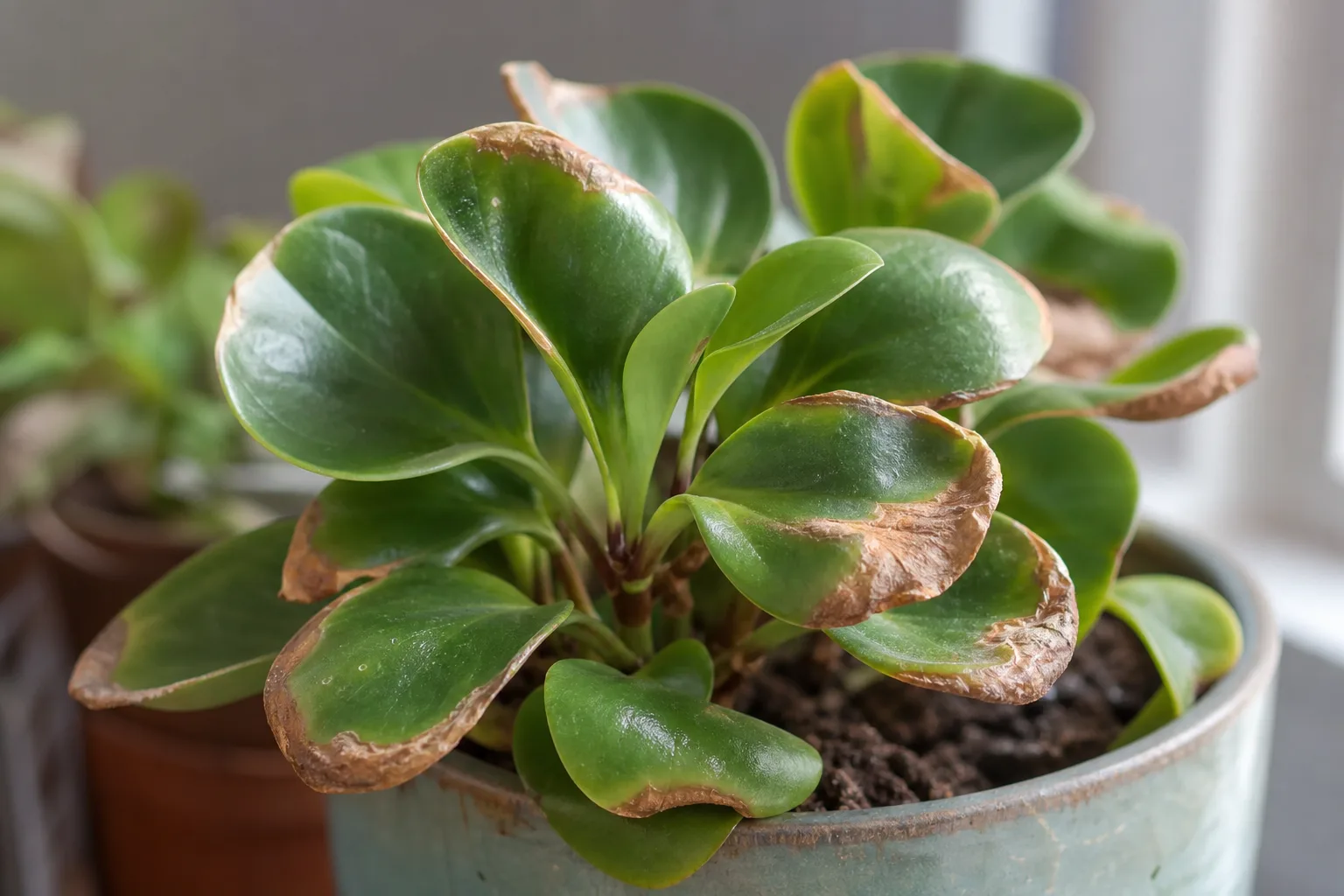
Brown Tips on Peperomia: Causes, Checks & Fixes
This guide covers brown tips on Peperomia. See also the general Brown Tips guide, watering, and light pages for this plant.
Brown Tips on Peperomia: Causes, Checks & Fixes
Quick answer
Brown tips on Peperomia (Peperomia spp.) are almost always environmental edge burn, not a mysterious disease. The genus stores water in semi-succulent leaves and grows shallow epiphytic roots - so small shifts in water chemistry, salt load, humidity, or light show up at leaf margins and tips before the whole plant collapses.
First step: look at the pattern and your water routine before you fertilize, mist, or repot.
- Even brown tips on many leaves over weeks, especially after consistent tap watering → suspect fluoride and minerals in tap water (RHS)
- Brown margins + white crust on soil after feeding → suspect fertilizer salt buildup (University of Maryland Extension)
- Thin-leaved types crisping in heated winter rooms → suspect low humidity or underwatering
- Bleached or brown patches on variegated leaves near a window → suspect direct sun scorch (NC State Extension)
Make one correction at a time - switch water source, flush salts, adjust humidity, or relocate - then wait two to three weeks. Browned tissue will not turn green again; success means clean new leaves.
What brown tips look like on Peperomia
On Peperomia, tip and margin damage is usually dry, papery, and tan to dark brown - not wet, mushy, or spreading from the stem base. Because species leaf thickness varies, the same cause can look slightly different:
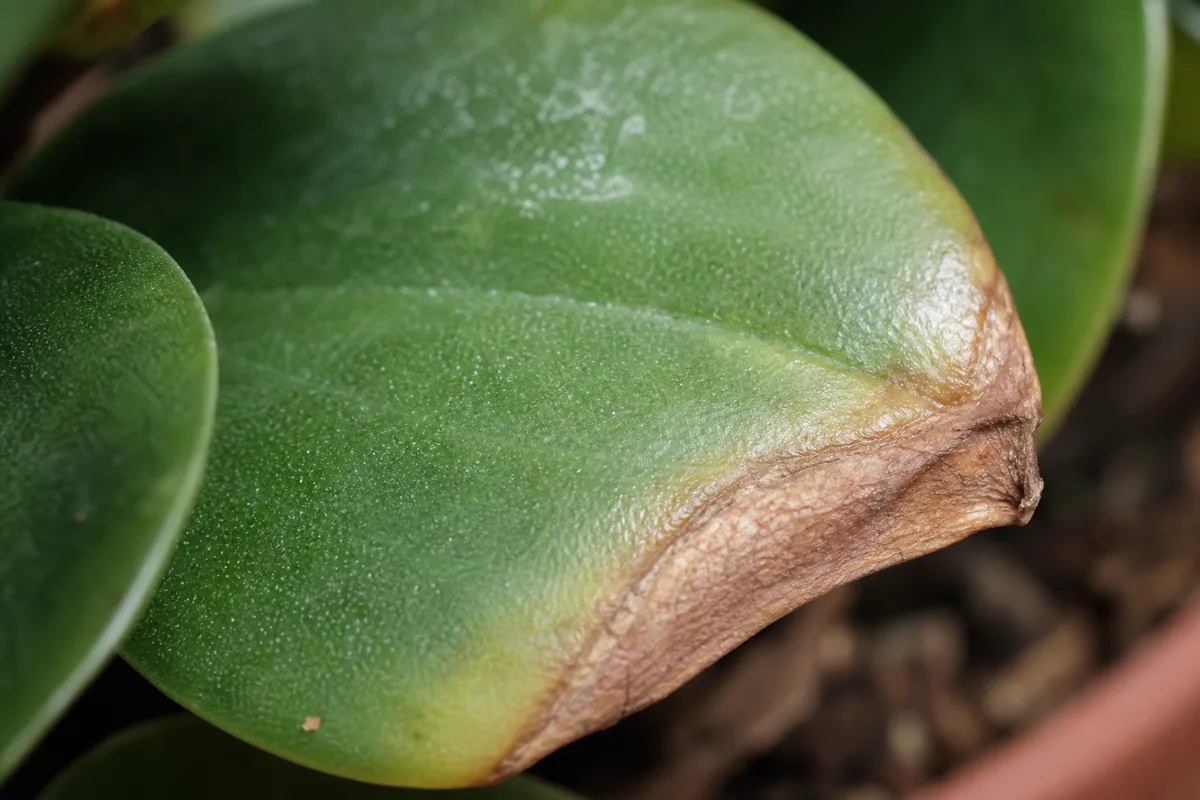
Brown Tips symptoms on Peperomia - compare with healthy tissue on the same plant.
Thick-leaved P. obtusifolia (baby rubber plant): Tips brown evenly and feel crisp. The rest of the glossy leaf often stays firm. Damage may appear on older leaves first while new growth at stem tips stays green - classic tap-water or salt margin burn on a drought-tolerant type.
Thin-leaved P. argyreia (watermelon peperomia) and P. caperata (ripple peperomia): Tips and sometimes entire leaf edges crisp faster. Leaves may cup or feel thinner before tips brown. These types flag dry air and underwatering sooner than obtusifolia.
Variegated cultivars: Cream or pale sections often scorch first. Brown patches on the pale zones with firm green tissue elsewhere point to direct sun, not fluoride alone.
Brown tips vs. other edge damage
| Pattern | What you see | Most likely cause | Quick check |
|---|---|---|---|
| Uniform dry tips | Tan tips on multiple leaves; tissue papery | Tap-water fluoride/minerals | Rainwater vs. tap history |
| Brown margins + salt crust | Edge burn; white deposits on soil | Fertilizer salt buildup | Feed frequency; crust on rim |
| Crisp tips + light pot | Dry feel; soil pulls from pot edge | Underwatering | Top 2–5 cm dry throughout |
| Brown patches on pale zones | Bleached then scorched sections | Direct afternoon sun | Window exposure |
| Fine speckling + webbing | Stipples before tip browning | Spider mites | Magnify leaf undersides |
| Soft yellow then brown | Limp leaves; wet soil | Overwatering / root stress | Pot heavy; sour smell |
This page focuses on tip and margin burn. Soft yellowing with wet soil is a watering-root problem - see yellow leaves and overwatering. Chronic dry-air stress without tip-only pattern overlaps with low humidity.
Why Peperomia gets brown tips - ranked causes
1. Fluoride and minerals in tap water (very common indoors)
Peperomias are sensitive to fluoride in tap water, which can cause leaf tips to turn brown. Many municipal supplies also carry chlorine and dissolved minerals that accumulate slowly in small pots with shallow roots. The damage is gradual: tips on several leaves brown over weeks while the plant otherwise looks stable.
This cause fits Peperomia because epiphytic roots evolved for rainforest leaf-litter water, not treated tap. There is no large root mass to dilute minerals. Clemson HGIC notes that many peperomias have thick, fleshy leaves - but thin-leaved office favorites still take up fluoride through roots and show it at the leaf extremities first.
2. Fertilizer salt buildup in small pots
Peperomia is a light feeder in a small root zone. Excess fertilizer, frequent full-strength feeds, or winter feeding when growth stalls leaves soluble salts in the mix. University of Maryland Extension describes typical symptoms as browning or dieback of leaf tips and margins, sometimes with a white crust on the soil surface - especially when pots are bottom-watered or salts cannot flush out.
Salt burn often follows a feed spike or months of quarter-strength feeding without occasional plain-water flushing. Margins crisp even when soil moisture feels correct.
3. Very low humidity - especially on thin-leaved species
Peperomias tolerate average home humidity better than ferns, but tropical species prefer humid air when possible. Winter heating can drop indoor humidity below 30%, when NC State Extension lists medium to low relative humidity as acceptable but not ideal for all types. Thin-leaved P. argyreia and P. caperata lose leaf-edge moisture faster than thick P. obtusifolia.
Very dry air also invites spider mites - Clemson HGIC lists spider mites among the most frequent peperomia pests. Mite stippling can precede tip browning on stressed plants.
4. Direct sun scorch on variegated and rippled leaves
Peperomia wants bright indirect light. Direct sun in summer can scorch the foliage, and NC State Extension states that sunlight too strong or direct will burn leaves - especially on variegated cultivars where pale tissue has less chlorophyll protection. Scorch shows as brown or bleached patches, often on the window-facing side, not always tip-only.
5. Underwatering crisp margins on thin-leaved types
Thick-leaved obtusifolia tolerates drought, but watermelon and ripple peperomias show stress faster when soil stays dry too long. Crisp brown tips with a light pot and dry mix through the top 2–5 cm (1–2 inches) point to thirst, not fluoride. See the watering guide for species-specific dry-down timing.
How to confirm the cause - numbered checklist
Work through these in order. Stop when one branch clearly fits.
- Water source - Have you used straight tap water for months? Any recent switch to rainwater or filtered water? Uniform tip burn across species in the same room supports fluoride/minerals.
- Salt crust check - White or yellowish deposits on soil surface or pot rim? Brown margins with crust after feeding support salt toxicity - not a nutrient deficiency.
- Soil moisture at depth - Insert a finger or skewer 2–5 cm into the mix. Bone dry and light pot → underwatering branch. Damp at depth with only edge burn → less likely thirst; consider salts or tap water.
- Humidity context - Heated winter room, radiator nearby, or humidity meter below 30%? Thin-leaved types crisping on multiple plants support dry air - see low humidity.
- Light exposure - Within 30 cm (12 inches) of south or west glass? Afternoon sun on variegated leaves? Patchy bleached-then-brown damage on window side supports scorch - see light guide.
- Leaf underside inspection - Fine dots, webbing, or stippling under magnification? Active pests → treat mites before blaming water alone.
- Species thickness - Watermelon or ripple peperomia with tips only, obtusifolia unaffected in same room? Weight humidity and watering over fluoride for thin leaves first.
- Newest growth - Clean green center leaves while older tips are brown? Cause may be historical (old tap water or past overfeeding) - fix the source and watch new leaves only.
First fixes by confirmed cause
Make one primary correction, then wait two to three weeks before stacking more treatments.
| Confirmed cause | First fix |
|---|---|
| Tap-water fluoride/minerals | Switch to rainwater, distilled, or filtered water at room temperature for the next month (RHS). Do not fertilize until new growth looks clean. |
| Salt buildup | Flush the pot: run plain water through at 2–3× pot volume until it drains freely; empty saucer; repeat twice over one week (University of Maryland Extension). Pause fertilizer 6–8 weeks - see fertilizer guide. |
| Low humidity | Run a humidifier nearby or use a pebble tray with the pot elevated above water (RHS). Target 40–50% if possible. Do not rely on misting alone - wet foliage with poor airflow can spot leaves. |
| Sun scorch | Move 30–90 cm (1–3 feet) back from harsh afternoon sun or filter with a sheer curtain. Acclimate over one to two weeks. |
| Underwatering | One thorough soak until runoff, then drain; reset checks per watering guide. |
| Spider mites | Isolate, rinse undersides, confirm activity; follow spider mite page before oil sprays on stressed plants. |
The most costly mistake on Peperomia brown tips is feeding a salt-burned plant because pale margins “look hungry,” or misting repeatedly instead of fixing water chemistry. Both worsen edge burn on shallow roots.
Recovery timeline for Peperomia
Browned tips and margins do not revert to green. Dead leaf tissue stays cosmetic until you trim it or the leaf is shed naturally.
| Cause fixed | What to expect |
|---|---|
| Tap water → rainwater | New leaves emerge clean within 2–3 weeks in warm, bright conditions. Old tips stay brown. |
| Salt flush + feed pause | Margin spread stops within 1–2 weeks; next flush of growth should lack crisp edges after 3–4 weeks. |
| Humidity improved | Thin-leaved types firm up first; tip burn on new growth stops within 2–3 weeks. |
| Sun moved | No new scorch on fresh leaves within 1–2 weeks; old patches permanent. |
| Underwatering corrected | Turgor returns within hours to 2 days after soak; crisp tips on old leaves may remain. |
Judge success only by new growth - not by old damaged tips re-greening. If tips keep browning on fresh leaves after one fix, move to the next most likely branch on the checklist rather than doubling fertilizer or water volume.
What not to do
Do not fertilize a Peperomia with brown margins until you have ruled out salt buildup and flushed if needed. Fertilizer salts accumulate as harmful crust in small pots - more food deepens burn.
Do not assume brown tips always mean “more water.” Crisp tips with wet, heavy soil point to root stress or salts, not thirst - adding water worsens overwatering scenarios.
Do not use misting as your primary humidity fix. Brief surface moisture does not sustain 40–50% room humidity and can encourage fungal spotting with poor airflow.
Do not stack Peperomia repotting guide, heavy pruning, pesticide, and fertilizer on the same day. Fix water quality or salts first.
Do not trim every leaf at once for aesthetics - remove only heavily browned tips if the plant is still recovering; leaves with partial green tissue still photosynthesize.
How to prevent brown tips on Peperomia
Build prevention around Peperomia’s semi-succulent biology and shallow roots:
- Water quality: Use rainwater or filtered water if tips persist on tap - RHS recommends rainwater or filtered water whenever possible
- Feeding discipline: Quarter- to half-strength fertilizer monthly in active growth only; pause in winter - Clemson HGIC directs low-strength occasional feeding in spring and summer
- Salt flushing: Run plain water through the pot every 4–6 weeks in summer if you fertilize regularly
- Species-aware watering: Let thick obtusifolia dry more thoroughly; check thin argyreia and caperata sooner - details in the watering guide
- Light placement: Bright indirect only; filter afternoon sun on variegated leaves - light guide
- Winter humidity: Humidifier or pebble tray when heating drops air below 30%; watch for mites on thin-leaved types
- Pot and mix: Fast-draining soil in a pot with a drainage hole; refresh compacted mix every 2–3 years to avoid salt-laden stale peat - soil guide
Weekly checks while tips are small - water source, crust on soil, pot weight, window exposure - catch edge burn before it covers whole leaves.
Lookalike symptoms on Peperomia
Brown tips overlap with several Peperomia problem pages:
- Low humidity - General dry-air stress; may affect leaf feel and mites before uniform tip burn; broader than fluoride-only pattern
- Underwatering - Crisp edges with very dry soil and light pot; whole leaf may dull before tips alone
- Yellow leaves - Soft yellowing with wet soil is root stress, not dry tip burn
- Spider mites - Stippling and webbing; tips brown after sustained infestation
- Overwatering - Soft limp leaves with wet soil; brown may follow yellow, not papery tips on firm leaves
If tips are papery on firm leaves with stable soil moisture, prioritize water chemistry and salts before repotting or feeding.
Peperomia care cross-check
Stable Peperomia resists tip burn when four factors align:
| Factor | Tip-burn risk when wrong |
|---|---|
| Water chemistry | Chronic tap water on fluoride-sensitive genus |
| Salts | Overfeeding or no flush in small pots |
| Humidity | Below 30% on thin-leaved species |
| Light | Direct afternoon sun on variegated tissue |
Cross-link your routine: the overview hub summarizes species differences; watering covers dry-down by leaf thickness; fertilizer explains light feeding and flush timing; light covers scorch prevention.
Conclusion
Brown tips on Peperomia are a water-chemistry and edge-stress problem disguised as a leaf problem. Semi-succulent leaves store moisture, but shallow epiphytic roots cannot dilute fluoride, chlorine, or fertilizer salts the way a large outdoor shrub can. Before you feed, mist, or repot, read the pattern: uniform tips suggest tap water; margins plus crust suggest salts; patchy pale-zone burn suggests sun; crisp tips on a light pot suggest thirst. Switch water, flush salts, raise humidity, or adjust light - one fix at a time - then judge recovery by clean new growth in two to three weeks. Old brown tips stay cosmetic unless you trim them; the plant is winning when the center pushes green leaves without fresh burn.
When to use this page vs other Peperomia guides
- Peperomia watering guide - Use for routine moisture checks before assuming brown tips is the main issue.
- Peperomia problems hub - Browse all 5 common issues on this species.
- Yellow Leaves on Peperomia - Different entry point when symptoms overlap with brown tips.