Not Enough Light on Philodendron Imperial Green: Causes
Quick answer
Not enough light on Philodendron Imperial Green causes long petioles, small new paddle leaves, slow growth, and a leaning rosette. First step: move to medium-bright indirect light within a few feet of the brightest window, filtered from harsh direct sun.
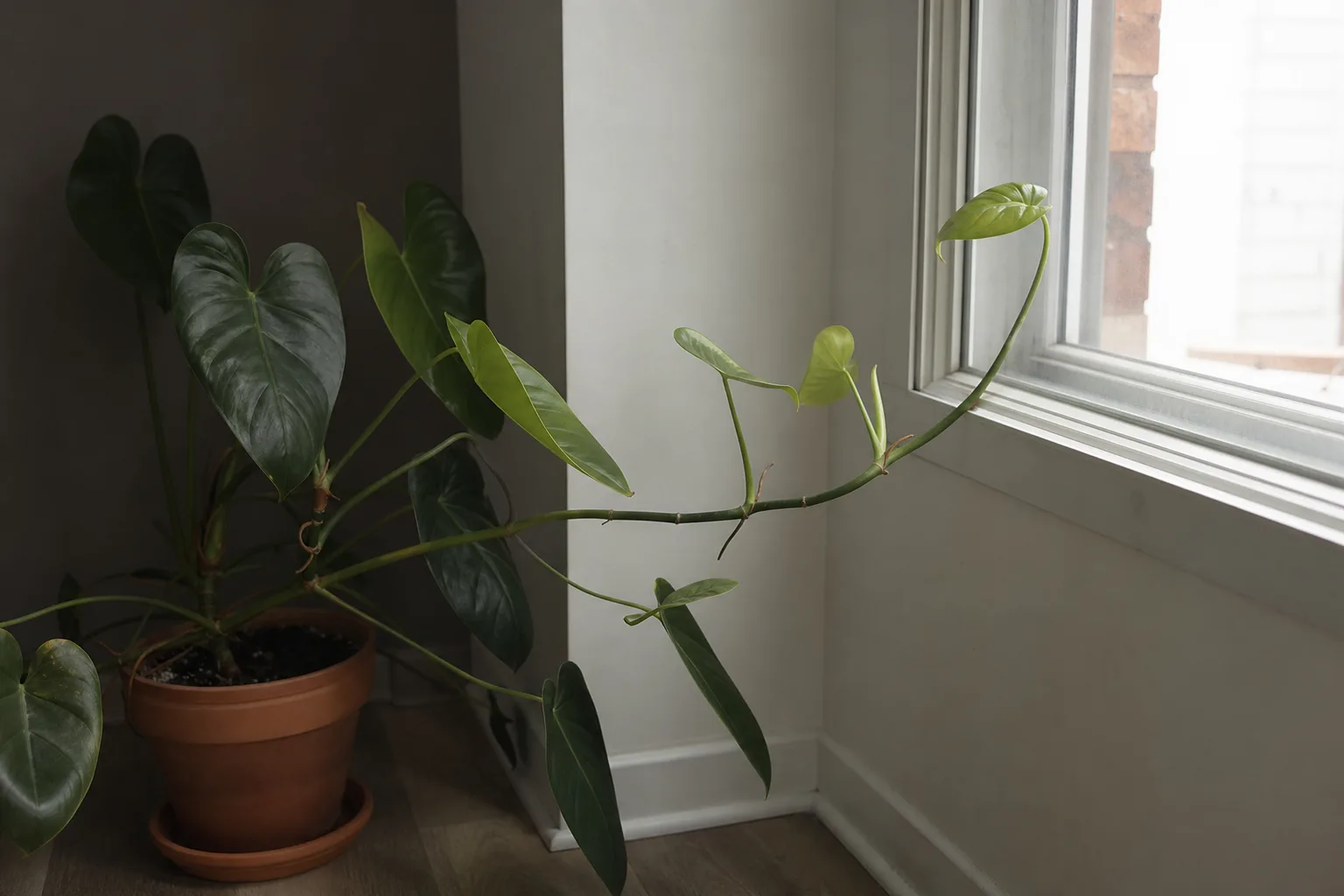
Not Enough Light on Philodendron Imperial Green: Causes, Checks & Fixes
This guide covers not enough light on Philodendron Imperial Green. See also the general Not Enough Light guide, watering, and light pages for this plant.
Not Enough Light on Philodendron Imperial Green: Causes, Checks & Fixes
Quick answer
Not enough light on Philodendron Imperial Green (Philodendron erubescens ‘Imperial Green’) causes long petioles, small new paddle leaves, slow growth, and a rosette that leans toward the brightest window. First step: move the pot to medium-bright indirect light within a few feet of the brightest window, filtered from harsh direct sun.
Imperial Green is often sold as an office plant that tolerates lower light. That is true for survival, not for the compact glossy rosette you bought. In dim conditions the self-heading habit breaks down: the plant stretches, grows slowly, and stays wet longer between waterings-inviting root problems that further weaken the specimen.
Scope note: This page is the placement, confirmation, and light-upgrade guide. For stretched crown shape, pruning decisions, and petiole-length comparisons, see Leggy Growth on Philodendron Imperial Green. For proactive window-by-direction placement and grow-light specs, see Philodendron Imperial Green Light Needs.
Why Philodendron Imperial Green suffers in low light
Photosynthesis drives leaf size and growth rate. Illinois Extension explains that insufficient light weakens plants, producing pale, small, or sparse foliage. Imperial Green’s large paddle leaves require steady indirect light to maintain their architectural scale.
Philodendron erubescens is listed for partial shade and dappled sunlight indoors, with a clear warning to avoid direct sunlight on unacclimated foliage. UF/IFAS groups Imperial-type hybrids under medium to bright indirect light, noting they accept lower indirect light if watering is adjusted-but that tolerance band is survival, not the tight rosette the cultivar was bred for.
Imperial Green is a self-heading hybrid with short internodes and a dense crown, not a trailing vine that can limp along on reflected hallway brightness. On a self-heading plant, stretch shows up as longer petioles and a looser upright silhouette rather than bare gaps along a climbing stem-so low light reads as “leggy” faster than on heartleaf types, even though the mechanism is the same etiolation response.
Low light also slows water use. Missouri Botanical Garden notes that overwatering risk rises when plants in dim corners receive water on a bright-room schedule. Wet soil plus weak growth is a common low-light failure loop-see Overwatering on Philodendron Imperial Green when mix stays damp for many days.
Winter day length reduces effective light. Penn State Extension advises reassessing placement when houseplants come indoors for the season-a summer position may become too dim by November.
Common placement mistakes:
- Across the room from a window - Light intensity drops sharply with distance from the glass. A bright-looking office can still be low light at a credenza two meters from north glass.
- Heavy sheers, tinted glass, or deep interior placement - Cuts the brightness that reaches the crown.
- Assuming “low light tolerant” means dim corners are ideal - Imperial Green may keep existing leaves while new growth shrinks and petioles lengthen over 8–12 weeks.
What not enough light looks like on Philodendron Imperial Green
Watch rosette structure and new leaf size together, not one older paddle leaf in isolation.
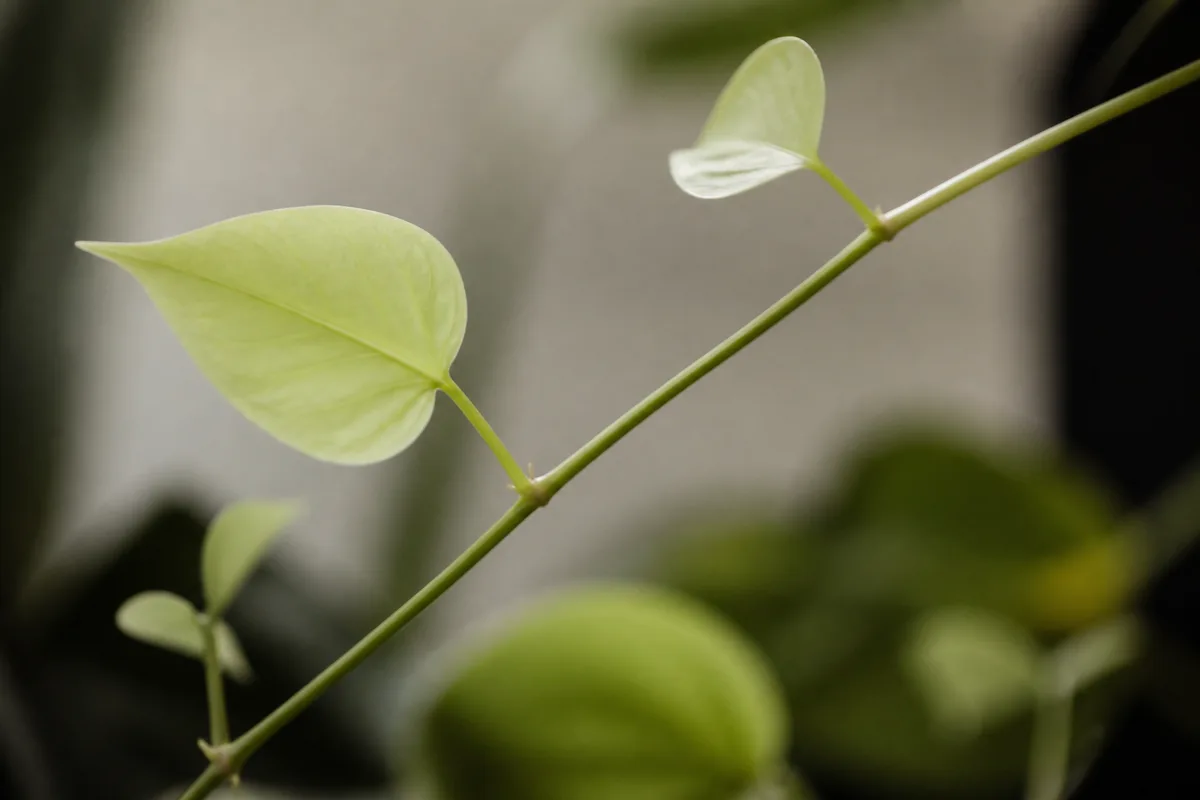
Not Enough Light symptoms on Philodendron Imperial Green - compare with healthy tissue on the same plant.
Typical low-light signs:
- Rosette leans toward windows or the brightest fixture
- Longer petioles than nursery specimens, especially on the two newest leaves
- New paddle leaves noticeably smaller than mature crown leaves
- Slow or absent new growth during spring and summer
- Dull or pale green color on newest foliage
- Soil stays wet longer than every 10–14 days without the top 3–5 cm drying
- Lower yellow leaves if overwatering overlaps in the same dim spot
Healthy Imperial Green for comparison:
- Glossy deep green paddle leaves on relatively short stiff petioles in an even upright rosette
- New leaves emerging at a scale close to the leaves just below them
- Pot weight drops predictably between waterings when you allow the top 3–5 cm to dry
How to confirm the cause
Work through these checks before you fertilize, repot, or add water:
- Light at crown level - At midday, hold your hand where the foliage sits. A soft, defined shadow means moderate indirect light. Barely visible shadow means the spot is too dim for compact Imperial Green growth.
- Newest leaf test - Compare the last two or three emerging leaves to mature crown leaves. Smaller blades with longer petioles on each new leaf point to light as the limiting factor.
- Shadow test - A soft diffuse shadow behind the plant at midday suggests adequate indirect light for this species.
- Watering cadence - Push your finger 3–5 cm into the mix. If it feels wet days after watering while growth is slow, low light may be slowing uptake-not necessarily a single overwatering event.
- Season - Account for shorter winter days before diagnosing; stretching during active summer growth is not normal dormancy.
If stretch, small new leaves, and slow dry-down cluster together, you have a confirmed light problem-not a nutrient deficiency.
Lookalike symptoms to rule out
| What you see | Likely cause | How to tell it apart from low light |
|---|---|---|
| Long petioles, small new leaves, lean toward window | Not enough light (etiolation) | Improves within weeks after a real light upgrade; new leaves emerge larger on shorter petioles |
| Yellow lower leaves, sour soil smell, soft crown | Overwatering / root stress in dim corner | Often pairs with low light because the plant cannot use water quickly-fix light and dry-down together; see Root Rot on Philodendron Imperial Green if stems collapse |
| No new leaves, cool room, winter only | Normal seasonal slowdown | No progressive petiole elongation through spring and summer; growth resumes when days lengthen without a placement change |
| Pale new leaves on recently repotted plant | Uncommon nutrient issue | Recently refreshed mix with slow growth only-stretch and lean still point to light first |
| Sparse crown, long petioles, wet soil for weeks | Low light + overwatering overlap | Most common failure loop in offices; see Slow Growth on Philodendron Imperial Green when light is adequate but the plant still stalls |
Nutrient deficiency is uncommon in recently repotted plants. Root rot causes yellowing and soft crowns with sour soil, not just slow growth alone. Dormancy in winter is normal; stretching in summer is not.
First fix for Philodendron Imperial Green
Move the pot to medium-bright indirect light within 2–4 feet (60–120 cm) of the brightest window.
- East-facing windows are ideal; north can work if the crown sits close to glass.
- South or west windows need several feet of distance or a sheer curtain to avoid scorching glossy paddle leaves-NC State is explicit that direct sunlight should be avoided on unacclimated foliage.
- If the plant lived in deep shade for months, acclimate over 7–14 days rather than jumping to unfiltered south glass in one afternoon. Days 1–3: bright ambient light without hot direct sun on blades. Days 4–7: move one step closer if no bleaching appears. Days 8–14: settle at the final distance. Full staged protocol is in the Imperial Green light guide.
Do not fertilize, repot, or soak the soil on day one. If the mix is wet, skip watering until the top 3–5 cm dries-brighter light will help the root zone recover faster once moisture is in balance. See Imperial Green watering for rhythm tied to light level.
Step-by-step recovery
After the plant has brighter indirect light:
- Hold other changes for two to three weeks - Let new crown growth tell you whether the spot is adequate before pruning or feeding.
- Wait for one firm new leaf - The first emerging leaf after the move is your proof. Larger blade and shorter petiole than the leaf before it means you are on track.
- Rotate the pot weekly - Prevents one-sided lean and keeps spacing even across the rosette.
- Recalibrate watering - Brighter light dries soil faster. Check the top 3–5 cm before every drink instead of following an old calendar rhythm from the dim corner.
- Add a grow light if windows are insufficient - A full-spectrum LED 30–45 cm (12–18 in) above the crown for 10–12 hours daily on a timer can support Imperial Green in interior offices. Indoor plants stretch when light is inadequate; artificial light replaces what the window cannot supply. Fixture distance and hour adjustments are detailed in the light guide.
- Optional cosmetic prune - Once at least two healthier new leaves emerge, remove one or two of the worst stretched outer leaves for shape. Old elongated petioles will not shorten-judge recovery by new growth only. Pruning technique is in the Imperial Green pruning guide.
Do not add a moss pole-Imperial Green is self-heading and does not climb. Leggy spacing here is etiolation toward brighter light, not a search for vertical support.
Recovery timeline
Noticeable improvement in new leaf size within four to eight weeks during the growing season-not on old leaves already formed. Stretched petioles and smaller blades already on the plant will not reshape; judge success by the next two or three new leaves.
Full rosette correction may take one growing season. Winter moves respond slowly until spring.
If six to eight weeks pass with no improvement on new foliage, the spot is still too dim-move closer to the window or add a grow light rather than reaching for fertilizer.
What not to do
- Do not compensate with extra fertilizer or water in a dark corner.
- Do not place in direct hot afternoon sun immediately from deep shade-acclimate in steps.
- Do not assume a moss pole helps-this plant does not climb.
- Do not ignore wet soil while chasing brighter windows-fix light and dry-down together.
How to prevent low-light problems next time
Choose placement before pot decor. Medium to bright indirect light is the baseline for compact form-not just where the plant looks best in the room layout.
- Keep the crown within a few feet of window glass or supplement with a grow light in north-facing and interior rooms.
- Rotate weekly during active growth.
- Match watering to slower drying in dimmer months-see the watering guide.
- Avoid relying on “low light tolerant” labels as permission to keep the plant in dark corners.
Visual guides to common problems show how environment drives most indoor plant stress.
When to worry
Low light alone is gradual. Escalate when dim placement pairs with wet soil, yellowing, and crown softening-inspect roots if improvement stalls after a real light upgrade. Keep away from pets-philodendron is toxic to cats and dogs if chewed.
Related Imperial Green guides
- Philodendron Imperial Green overview
- Philodendron Imperial Green light
- Leggy growth on Philodendron Imperial Green
- Philodendron Imperial Green watering
- Overwatering on Philodendron Imperial Green
- Root rot on Philodendron Imperial Green
- Slow growth on Philodendron Imperial Green
Conclusion
Not enough light on Philodendron Imperial Green turns a statement plant into a stretched survivor. Move to medium-bright indirect light, acclimate if the plant came from deep shade, recalibrate watering, and judge recovery by larger new glossy leaves on shorter petioles-not by more fertilizer in a dark corner.