Not Enough Light on Philodendron Melanochrysum: Causes
Quick answer
Not enough light on Philodendron melanochrysum shows as small new leaves, long thin petioles, slow unfurling, and a vine that reaches toward windows. First step: move the plant within 1–2 metres of a bright filtered window or add a full-spectrum grow light for 10–12 hours daily.
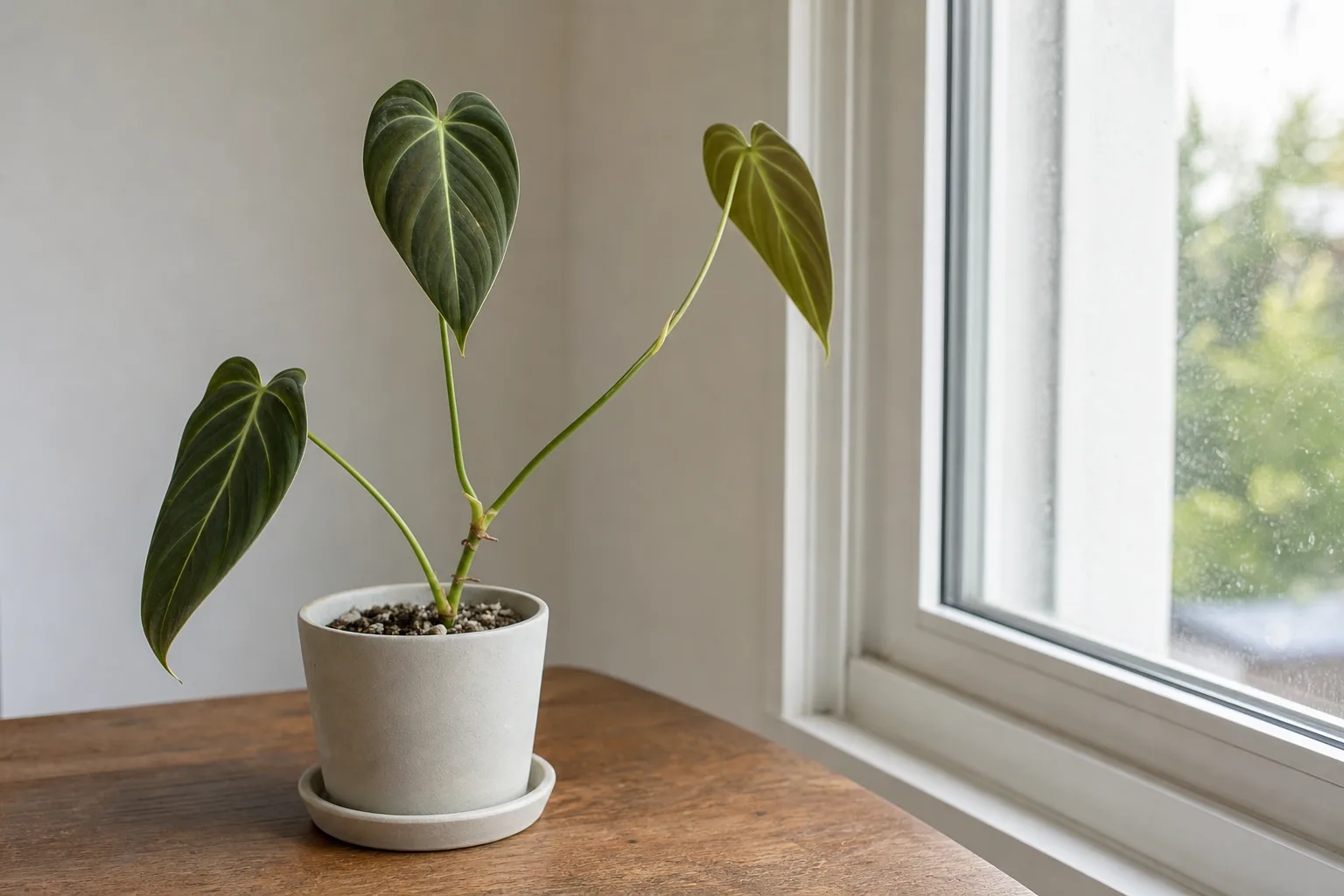
Not Enough Light on Philodendron Melanochrysum: Causes, Checks & Fixes
This guide covers not enough light on Philodendron Melanochrysum. See also the general Not Enough Light guide, watering, and light pages for this plant.
Not Enough Light on Philodendron Melanochrysum: Causes, Checks & Fixes
Quick answer
Not enough light on Philodendron melanochrysum shows as small new leaves, long thin petioles, slow unfurling, and a vine that reaches toward windows. First step: move the plant within 1–2 metres of a bright filtered window or add a full-spectrum grow light for 10–12 hours daily.
Scope note: This page is the problem-intent triage slug for low-light etiolation and juvenile leaf-size stall - confirmation checks, first fix, and recovery timeline. Window-by-window placement, grow-light setup, acclimation ramps, and seasonal adjustments live on the Melanochrysum light guide. If internodes are already very long with naked stem between leaves, also read leggy growth for support-and-prune recovery after you brighten placement.
P. melanochrysum is a forest understory climber that still needs strong ambient light to produce large velvet leaves indoors. It is not a low-light tolerant species like heartleaf philodendron. When photons are scarce, the vine survives by stretching and shrinking - leaving you with a healthy-looking but juvenile plant far from the dramatic foliage you bought it for.
Not enough light vs. light guide vs. leggy growth - which page to use
Melanochrysum light problems overlap across several cluster pages. Your primary symptom determines where to start:
| Your main complaint | Start here | Why |
|---|---|---|
| Small new leaves, slow unfurl, vine leaning toward glass | This guide (not enough light) | Progressive shrinkage and photon-seeking lean are the defining low-light patterns |
| Window placement, grow-light hours, acclimation, scorch warnings | Light guide | Ongoing brightness requirements and fixture setup |
| Very long naked internodes after months in dim culture | Leggy growth | Stretch recovery, pruning, and pole retraining after you fix brightness |
| Growth flat but stems not stretching aggressively | Slow growth | Stall without strong directional lean |
| Wet soil, yellow lower leaves in a dim corner | Yellow leaves | Low-light plus overwatering overlap |
Many melanochrysum vines show both small juvenile tips and long internodes. If shrinking new leaves and window lean are your clearest signals, stay on this page for the pole-vs-light differential and wet-soil cross-check. If bare stem sections dominate after you already moved to brighter light, continue on leggy growth.
Why Philodendron melanochrysum gets not enough light
The most common cause is placement based on room brightness rather than plant-facing exposure. A melanochrysum on a shelf five metres from a south window may live in a well-lit room but receive very few useful photons at the leaf surface.
Iowa State Extension notes that most philodendrons prefer moderate to indirect light indoors, and collector velvet species like melanochrysum sit at the brighter end of that range. RHS guidance is explicit: without sufficient light, philodendrons become leggy and produce fewer, smaller leaves. On melanochrysum, that translates to thin vines, delayed unfurling, and leaves that never reach mature dimensions even with a moss pole.
Winter shortens effective day length and pushes growers to slide plants away from cold window glass - a reasonable move that often lands the vine in a dim corner. Heavy curtains, frosted bathroom glass, and overhead shelves that shade the canopy also cut light without obvious warning signs until new growth shrinks.
Low light slows photosynthesis and water uptake. The same watering rhythm that worked in summer can leave mix damp longer in a dim spot, compounding stress. That is why not-enough-light on this aroid should always be checked alongside pot weight and soil moisture - see yellow leaves when lower foliage yellows while the pot stays wet.
What not enough light looks like on Philodendron melanochrysum
Watch for these patterns on this species:
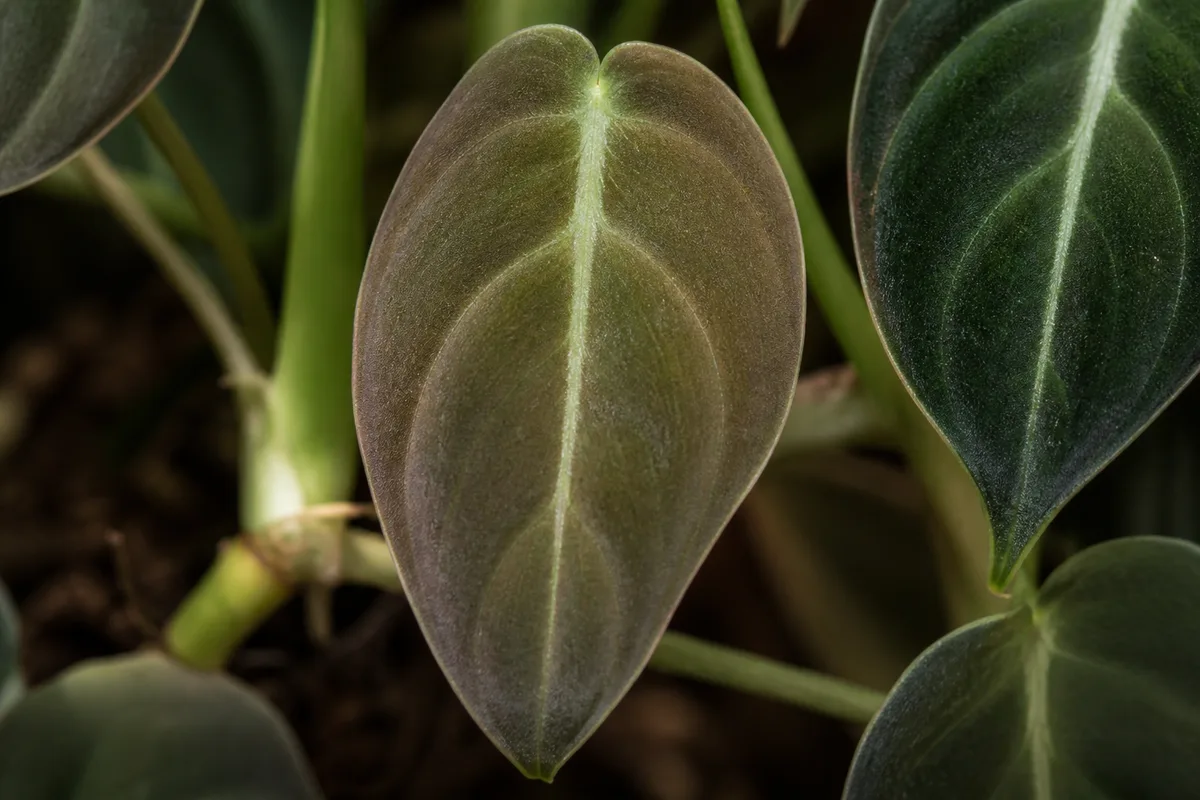
Not Enough Light symptoms on Philodendron Melanochrysum - compare with healthy tissue on the same plant.
- New leaves significantly smaller than older ones on the same stem
- Long, thin petioles and visibly lengthened internodes between leaves
- Vine leaning hard toward windows or grow lights
- Dark green but undersized juvenile foliage at the growing tip
- Slow cataphyll opening compared to earlier growth cycles
- Lower leaves yellowing while the pot stays wet - a low-light plus overwatering overlap
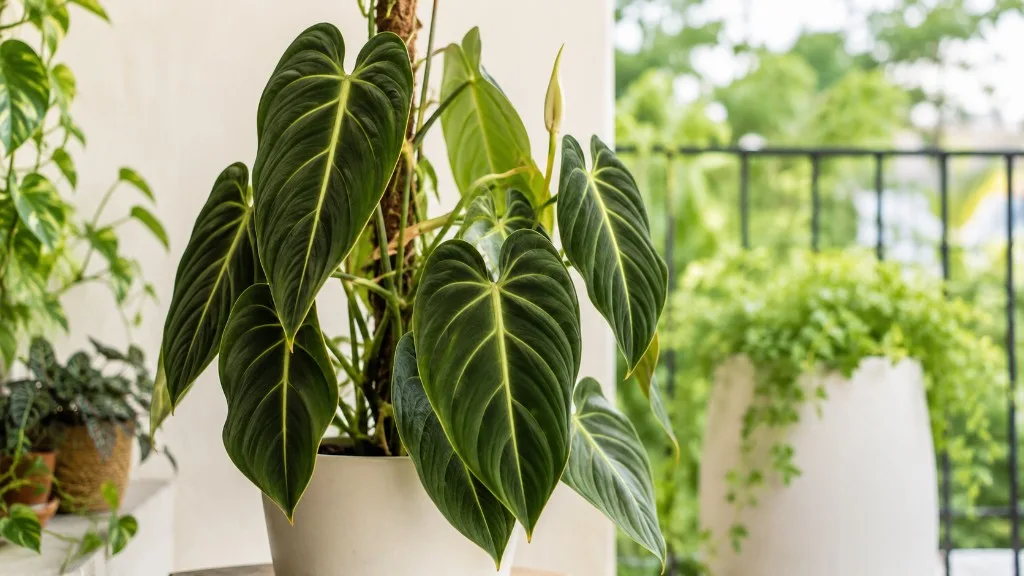
Melanochrysum should develop larger leaves as it climbs a support with attached aerial roots. If leaf size plateaus at juvenile dimensions despite humidity and a moist pole, light is the usual limiting factor - but pole attachment must be ruled out first (table below).
Visual confirmation cues
Use these field checks when photographing your own plant for comparison:
- Lean shot: Frame the whole vine from the side so the window or grow light is visible - strong directional lean confirms photon-seeking behavior.
- Leaf-size comparison: Photograph the newest fully opened leaf beside one three to four nodes lower on the same stem; progressive shrinkage is the hallmark low-light pattern on velvet melano.
- Pole tip height: Include the moss pole top in frame; if the active meristem sits below the window sill while older leaves higher on the pole look fine, the growth tip is in shade even though the room feels bright.
Small leaves with a moss pole: light vs support
A supported melanochrysum in a bright room can still show small juvenile hearts when aerial roots are not gripping moist pole fiber. Before you blame light alone, run this differential - adapted from the light guide pole table:
| Observation | Likely primary cause | First fix |
|---|---|---|
| Small leaves + long internodes + dim room feel | Insufficient light | Move toward filtered east; add LED 10–12 h - see light guide |
| Small leaves + short internodes + bright window + bare stake | Missing pole attachment | Install moist textured pole; tuck aerial roots |
| Small juvenile hearts on dangling vine tip | Unsupported juvenile habit + needs pole | Train vine to pole in brighter filtered spot |
| Stuck cataphyll weeks + dry edges | Low humidity ± low light | Humidifier; brighten; see low humidity |
| Pale bleach patches on newest leaf | Too much direct sun (not low light) | Pull back; filter glass - acclimation on light hub |
If window placement and pole moisture both look correct yet leaves stay small for more than two growth cycles, check slow growth and root health before chasing more light.
How to confirm the cause
Do not diagnose from one pale leaf. Use this order:
- Distance to light source - Measure roughly how far the top leaves sit from the window or fixture. Beyond 2 metres from a bright filtered window often means insufficient light for sizing on melanochrysum.
- New vs old leaf size - Compare the newest fully opened leaf to one three to four nodes below on the same vine. Progressive shrinkage confirms light limitation.
- Directional lean - Strong lean toward one exposure means the plant is actively seeking photons.
- Shadow test - At midday, hold your hand between the plant and the window. A sharp, high-contrast shadow on the leaves suggests usable brightness; a faint ghost shadow suggests marginal light.
- Soil dry-down speed - If the chunky mix stays wet more than 10–14 days after a thorough watering in warm weather, growth may be too slow for the current placement - cross-check watering rhythm.
Etiolation vs dormancy vs root-stress slow growth
| Pattern | Light-starved (this page) | Winter dormancy | Root stress / slow growth |
|---|---|---|---|
| Internode length | Lengthening on successive leaves | Stable or slightly shorter | May be normal length; growth stalls |
| Vine lean | Strong toward brightest window | Minimal | Usually upright or wilted |
| New leaf size | Progressively smaller | Similar to prior leaf | Small or absent |
| Soil dry-down | Slow in dim corner | Slow in cool winter | Wet and sour, or very dry |
| Stem firmness | Firm at tip | Firm | Soft base possible |
| Best next read | Light guide | Overview seasonal notes | Slow growth or root rot |
Lookalike symptoms to rule out
Nutrient deficiency can pale leaves but usually does not shorten internodes as dramatically as low light. Root rot causes yellowing and wilting with sour soil and mushy roots - not directional leaning. Spider mites stipple and web leaf undersides in warm dry air. Normal aging drops the lowest leaf while the tip keeps growing; light stress shrinks successive new leaves at the tip. Leggy growth overlaps heavily - treat very long naked stems as a support-and-prune follow-up after you fix brightness.
First fix for Philodendron melanochrysum
Move the plant closer to bright, filtered light the same week you confirm the pattern. An east window, a few feet back from a south or west window with sheer curtain, or a full-spectrum grow light 30–45 cm above the canopy for 10–12 hours daily are the reliable fixes. Full window tables, fixture distance, and timer hours are on the light guide.
Increase light in one step, not five. Do not simultaneously repot, fertilize heavily, and move from a dim room to direct afternoon sun - velvet leaves burn easily. If the plant has been in low light for months, acclimate over 10–14 days by creeping closer to the window or raising grow-light hours gradually.
Reduce watering frequency slightly after the move until you see how fast the mix dries at the new light level. Brighter light increases water use; dim light reduces it - match the rhythm to the new exposure per the watering guide.
Step-by-step recovery
After improving light:
- Secure the vine to a moist moss pole so new leaves emerge closer to the light source, not trailing downward into shade.
- Rotate the pot a quarter turn weekly for even exposure.
- Wipe dust from velvet leaves gently with a dry soft brush - dust blocks light on textured surfaces.
- Watch the next two leaves. Wider blades and shorter petioles mean the correction is working.
- Resume light feeding only after new growth looks normal for the season.
If a grow light is your primary source in winter, keep humidity steady - brighter light without humidity can still tear new velvet leaves. See low humidity if cataphylls stick.
Worked scenario: A supported melanochrysum sat four metres from a west window - one old velvet leaf held, internodes stretched to 12–15 cm, new blades stayed juvenile-sized. Moving the pole to 1.5 metres from a sheer-curtained east window with the moss pole kept moist produced a firm new cataphyll in two weeks and a visibly wider leaf on the third flush. Watering interval dropped from 14 days to 9 days because transpiration increased.
Recovery timeline
Expect one to two growth cycles - often four to eight weeks in warm months - before new leaves clearly exceed the size of the last low-light flush. Internode length tightens more slowly; judge early progress by faster unfurling and darker, firmer new blades rather than instant mature dimensions.
Leaves that opened small under dim conditions will not enlarge retroactively. The vine may look uneven until enough new foliage replaces the juvenile section.
What not to do
- Do not place melanochrysum in direct afternoon sun without acclimation; scorched velvet tissue does not recover cosmetically.
- Do not keep watering on the old dim-room schedule after moving to brighter light - adjust using pot weight.
- Do not fertilize heavily to “make up for” low light; nitrogen cannot replace photons.
- Do not assume a large window across the room supplies enough light at the far wall.
- Do not remove the moss pole while correcting light; climbing support and brightness work together for mature leaf size.
- Do not judge success by older large leaves staying green - watch the tip.
How to prevent not enough light next time
Keep melanochrysum within 1–2 metres of its primary light source year-round. Re-check placement after seasonal furniture moves, holiday decorations, and outdoor tree leaf-out that shades windows. Add a timer-controlled grow light from autumn through early spring if your brightest window falls below roughly six hours of useful indirect light - setup detail on the light guide.
Pair bright filtered exposure with humidity and a moist pole - light unlocks energy, but this species still needs both support and moist air to express mature foliage per the overview.
When to worry
Not enough light is a chronic stressor rather than an overnight killer, but escalate when:
- New growth stops for more than a month in warm conditions
- Multiple lower leaves yellow while soil stays damp and smells sour - see overwatering
- The vine cannot support its weight on the pole and collapses
- After four weeks of corrected light, new leaves are still juvenile-sized
If light is adequate and leaves remain small, inspect roots and humidity next. Light, humidity, and support form a three-way requirement on melanochrysum.
Related Philodendron melanochrysum guides
- Melanochrysum overview - species biology, humidity, and full care map
- Light needs - window placement, grow lights, and acclimation
- Watering - how light changes dry-down speed
- Leggy growth - long internodes after dim culture
- Slow growth - flat growth without aggressive lean
- Yellow leaves - wet soil plus dim corner overlap
- Low humidity - stuck cataphylls in dry air
- Root rot - when low light and wet mix compound
Conclusion
Not enough light on P. melanochrysum limits leaf size and internode length even when humidity and watering look correct. Confirm by comparing shrinking new leaves, directional lean, and slow unfurling against older foliage; rule out missing pole attachment with the differential table. Move to bright filtered light or add a grow light first, adjust watering to match the new dry-down speed, and judge recovery on the next growth cycles - not on leaves that already opened small. For window placement, acclimation, and grow-light hours, continue on the Melanochrysum light guide; for stretched naked stems after brightening, see leggy growth.
Frequently asked questions
How can I confirm not enough light on Philodendron melanochrysum?
Confirm it when new leaves stay noticeably smaller than older ones, petioles lengthen between nodes, and the vine leans toward the brightest side of the room. On melanochrysum, mature-sized velvet foliage will not develop in dim corners even with good humidity and a moss pole - small juvenile leaves at the tip are the confirming pattern. Run the shadow test and new-vs-old leaf comparison before repotting or feeding.
What should I check first for not enough light on Philodendron melanochrysum?
Check how far the top leaves sit from the window or grow light, then compare the newest leaf against two or three older ones on the same vine. Note recent moves away from bright spots or seasonal sun-angle changes. If soil stays wet too long, low light may be slowing water use - check moisture and placement together via the watering guide.
Will damaged Philodendron melanochrysum leaves recover from low light?
Existing small or pale leaves do not enlarge after you improve light. They may harden in place at their current size. Recovery shows up on the next leaves - wider blades, shorter petioles, stronger venation, and faster unfurling once the plant receives adequate bright indirect exposure.
When is not enough light urgent on Philodendron melanochrysum?
Act promptly when new growth stops entirely for more than a month in warm conditions, leaves yellow from the base while the pot stays damp, or the vine becomes too weak to support itself on the moss pole. Low light plus wet soil is a common path to root stress on aroids; fixing placement is time-sensitive if soil odor turns sour.
Is my melano dormant or light-starved?
Winter cool and short days can slow melanochrysum without true etiolation - but dormancy usually keeps internode length stable and does not produce aggressive window lean. Light starvation shows progressive new-leaf shrinkage, directional lean, and slow cataphyll unfurl even in warm rooms. If lean and shrinkage appear in summer, treat as low light, not dormancy. When growth is flat but stems are not stretching, see slow growth.