Overwatering on Philodendron Melanochrysum: Causes, Checks
Quick answer
Overwatering on Philodendron Melanochrysum is usually caused by watering before the top 3–5 cm of chunky mix dries, especially in low light or winter. First step: stop watering, check pot weight and root firmness, and let the mix dry fully before the next drink.
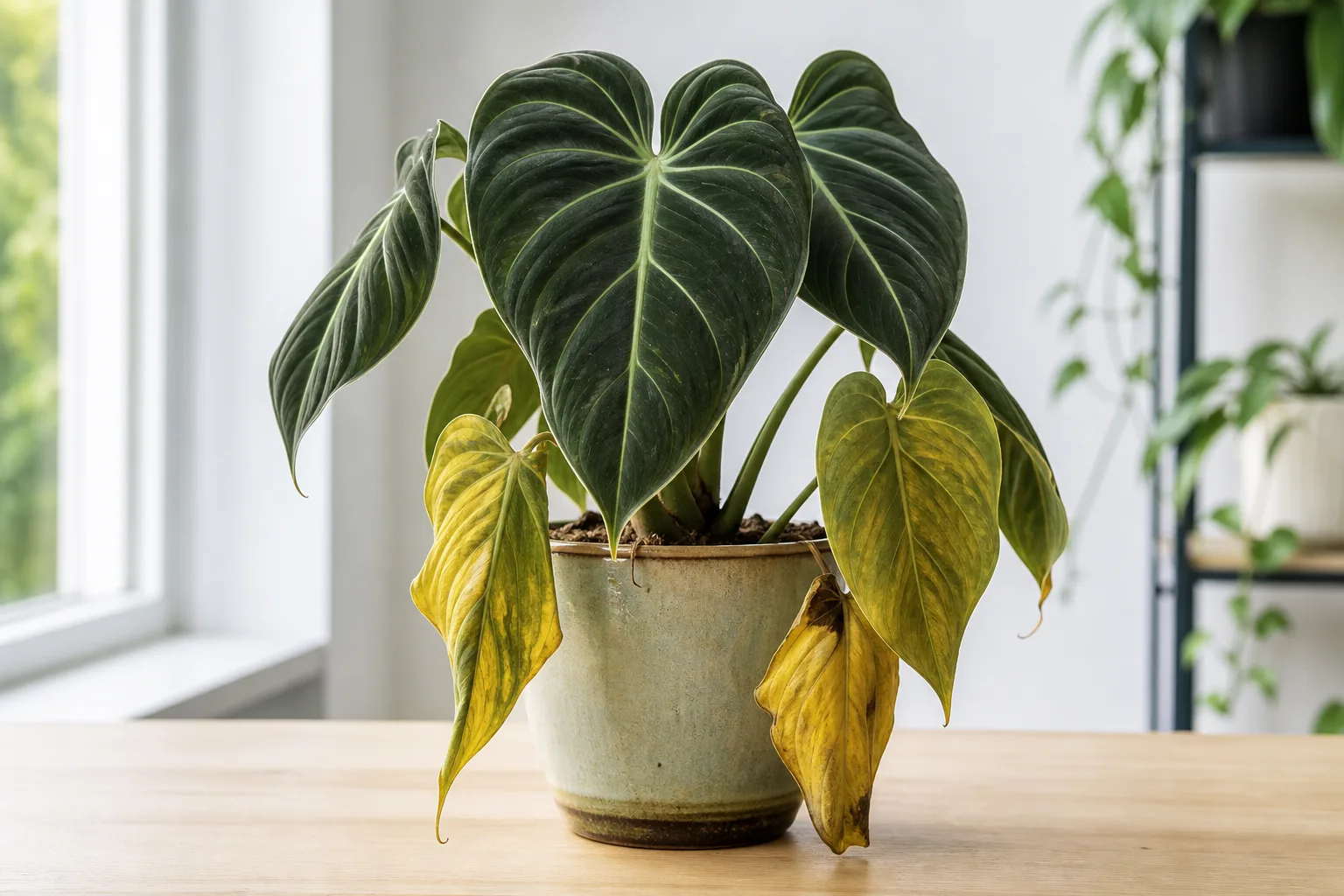
Overwatering on Philodendron Melanochrysum: Causes, Checks & Fixes
This guide covers overwatering on Philodendron Melanochrysum. See also the general Overwatering guide, watering, and light pages for this plant.
Overwatering on Philodendron Melanochrysum: Causes, Checks & Fixes
Quick answer
Use this page for early wet-soil triage on Philodendron melanochrysum - the Colombian velvet climber collectors train on moss poles - before you have confirmed mushy roots or sour decay. If roots are already brown, soft, and slippery, open the root rot guide instead. For routine soak-and-drain rhythm and seasonal cadence, use the watering guide.
Overwatering on Philodendron Melanochrysum is usually caused by watering before the top 3–5 cm of chunky mix dries, especially in low light or winter. First step: stop watering, check pot weight and root firmness, and let the mix dry fully before the next drink.
Philodendron Melanochrysum is a velvet climbing philodendron with large, dark velvety leaves that hold moisture longer than small-leaved houseplants. When roots stay saturated in dense or repeatedly wet mix, oxygen drops in the root zone, fine roots die, and the plant cannot move water upward even though the pot feels heavy. The confusing part is that an overwatered Melano often looks thirsty-leaves droop and yellow while soil is still damp-because damaged roots fail before the mix dries out.
| What you notice | Pot / mix | Stem base | Smell | First move |
|---|---|---|---|---|
| Damp top 3–5 cm, one yellow lowest leaf, firm stem | Heavy but no sour odor | Firm at soil line | Neutral | Dry-back - pause water until top 3–5 cm dries |
| Heavy 5+ days after watering, 2+ yellow lowers, stalled cataphylls | Wet throughout upper mix | Still firm | None yet | Dry-back plus spot-check - probe roots after 7–10 days dry |
| Wilt on wet soil, sour drainage smell, soft stem base | Saturated, water in saucer | Mushy at soil line | Sour | Root rot rescue same day |
| Light pot, dusty dry mix, crispy velvet edges | Dry throughout | Firm | None | Underwatering - not this page |
Symptom photo pending: yellow velvet melanochrysum leaf on dark wet top layer beside a firm healthy leaf; heavy wet pot beside a light dry pot after probe.
Why Philodendron Melanochrysum gets overwatering
Calendar watering and moss-pole confusion
Calendar watering is the most common trigger. Melanochrysum needs evenly moist-not soggy-soil, but that does not mean a fixed weekly schedule. Iowa State Extension advises watering philodendrons when the top of the soil is dry and never letting plants sit in soggy soil. On this species, large mature leaves slow surface drying, so a rhythm that worked in summer can become excessive by winter when growth slows and light drops.
Many growers water the pot because the moss pole looks dry while the top 3–5 cm of mix is still damp-a split the watering guide keeps separate. Pole moisture supports aerial roots; saturated pot mix suffocates basal roots.
Dense mix, oversized pots, and cachepots
Melanochrysum needs a chunky, free-draining aroid blend-potting mix with perlite and orchid bark-not straight peat-heavy bagged soil. RHS guidance for philodendrons is explicit: saturated compost can cause root rot, and oversized pots keep mix wet longer. A collector-grade plant in a decorative cachepot with no drainage, or an outer pot holding runoff, is especially prone to chronic wet feet. See the soil guide for mix ratios and the repotting guide for pot sizing after rescue.
Low light, winter slowdown, and post-shipment quarantine
Low light and cool rooms compound the pattern. Clemson Extension notes that yellowing of lower leaves can be caused by too little light or overwatering-both slow drying on a climbing aroid trained on a moss pole. A Melano in a dim corner, recently shipped, or quarantined away from windows may stay wet for ten days or more after one thorough soak. Winter heating without added humidity can also slow transpiration unevenly along a long vine, so the lower section stays damp while upper leaves look stressed. If light is the limiting factor, cross-check the not enough light guide before you cut watering alone.
Blocked drainage, saucers full of standing water, and watering before checking depth all push trouble forward. NC State Extension on philodendron culture notes that overwatering can cause root rot when soil stays waterlogged-directly relevant when velvet philodendrons are treated like moisture-loving ferns instead of epiphytic climbers.
What overwatering looks like on Philodendron Melanochrysum
Early signs are easy to miss because the dark foliage hides yellowing until several leaves are affected. Watch for these patterns together:
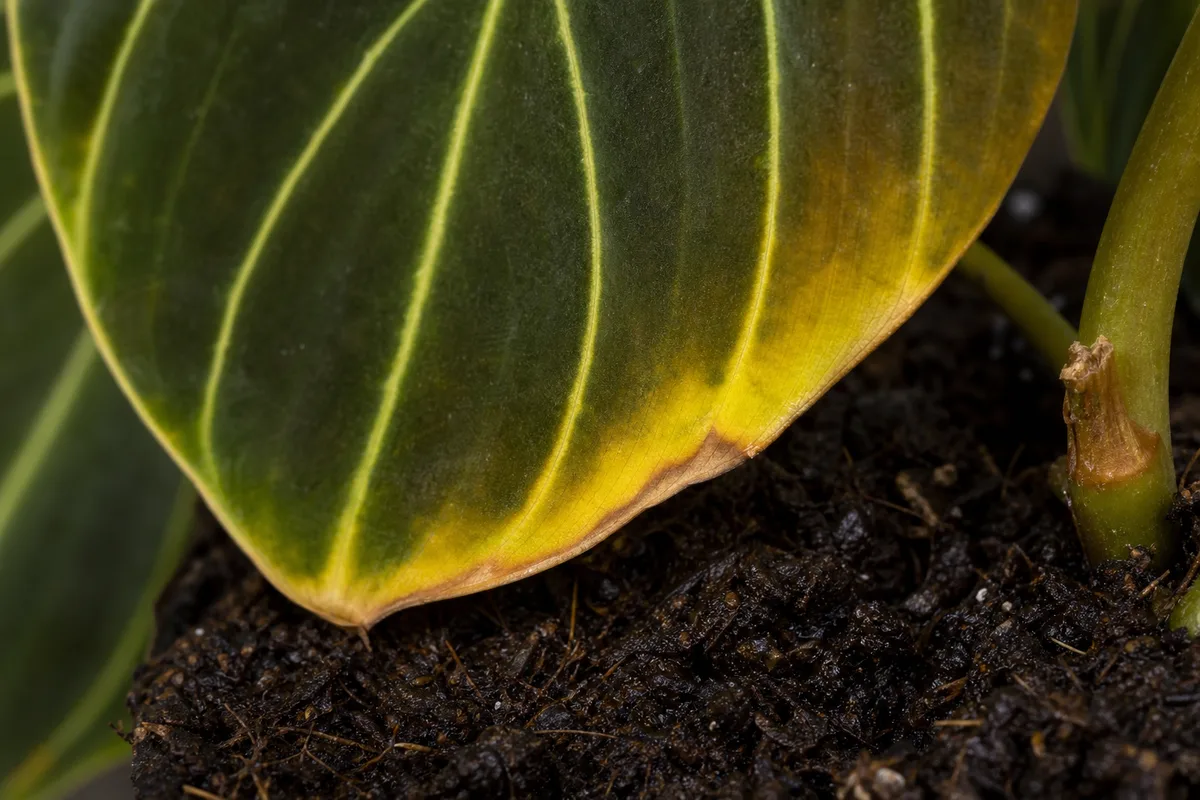
Overwatering symptoms on Philodendron Melanochrysum - compare with healthy tissue on the same plant.
- Mix that stays damp on the surface for more than a few days after watering
- Pot feels heavy when lifted, with water pooling in the saucer
- Lower velvet leaves turning chartreuse or yellow while newer leaves still look dark
- Leaf blades hanging limply despite wet soil-the wilt-with-wet-soil trap that sends many owners back to the watering can
- New leaves stalling, browning at the tip before unfurling, or emerging smaller than prior leaves
- Fungus gnats hovering over constantly moist surface mix
- A sour or swampy smell from the drainage hole
On Melanochrysum, stem softness at the soil line is especially serious. A firm dark leaf can still look acceptable while the node underground has already turned mushy. Aerial roots on a moist moss pole can look healthy while basal roots rot in dense, airless mix at the pot bottom-that is why pot weight, smell, and root texture matter more than leaf color alone on this species.
Symptom photo pending: stem-base firmness check at soil line on melanochrysum vine; firm pale roots vs. mushy brown rot on unpotting.
How to confirm the cause
Do not guess from one yellow leaf on a long vine. Use this inspection order:
- Pot weight and drainage - Lift the pot. If it feels heavy five or more days after watering, or water sits in the saucer, saturation is likely.
- Soil depth check - Push your finger or a skewer into the top 3–5 cm. Cool, clinging mix here means wait-not water.
- Soil smell - A sour odor from the drainage hole strongly suggests anaerobic, decaying root tissue.
- Stem base - Press gently where the vine meets the soil. Firm is good; soft, wet, or collapsing tissue is not.
- Leaf pattern - Yellowing starting on the lowest leaves with wet mix fits overwatering; crispy dry edges with a light pot suggest underwatering instead. Several yellow leaves at once may also need the yellow leaves differential.
- Unpot if needed - Shake off wet mix and compare firm pale roots against brown, slippery sections.
Healthy roots on this aroid are typically pale, firm, and resilient. Rotten roots turn dark, feel squishy, and may fall away when touched. If more than one-third of the root mass is mushy, treat the case as advanced and switch to root rot rescue.
Lookalike symptoms to rule out
| Symptom pattern | Pot weight | Top 3–5 cm | Stem / roots | Likely cause |
|---|---|---|---|---|
| Yellow lowers, wilt on wet soil | Heavy | Damp days after watering | Firm stem; roots still pale | Overwatering (this page) |
| Limp leaves, dusty dry mix | Light | Dry throughout | Firm roots | Underwatering |
| Sour smell, mushy stem base, rapid multi-leaf yellow | Heavy | Wet throughout | Brown slippery roots | Root rot |
| Droopy petioles on wet soil, roots firm | Heavy | Damp | Firm roots, no odor | Wilting branch before another pour |
| One yellow lowest leaf only | Normal | Dry at depth | Firm everywhere | Normal aging or yellow leaves |
| Stippling, fine webbing on leaf undersides | Any | Any | Firm | Spider mites - confirm with a loupe |
Low humidity below 50% can crisp velvet edges without wet soil-see low humidity if edges brown while the probe reads dry.
First fix for Philodendron Melanochrysum
One clear first action: stop watering until the top 3–5 cm is dry throughout. Do not pour off only the saucer and assume the problem is solved. Empty cachepot reservoirs and pull nursery pots out of decorative sleeves when weighing.
Mild dry-back
For damp soil, firm stem base, no sour smell, and at most one yellow lower leaf:
- Let the top 3–5 cm dry completely-often one to two weeks in a badly saturated pot.
- Move one step toward brighter filtered light if the plant has been in a very dim corner.
- Improve airflow around the pot without blasting dry air directly on unfurling cataphylls.
- Resume watering only when the probe reads dry-then soak until runoff and drain fully per the watering guide.
Moderate dry-back plus inspection
If leaves keep declining after seven to ten days of dry-back, or you see two or more yellow lower leaves with a heavy pot but a firm stem:
- Slide the plant out and inspect roots. Firm pale roots support continued dry-back; any mushy tissue means escalate.
- Remove wet, degraded mix gently with your fingers or a soft stream of water.
- Cut away every mushy, brown, or black root back to firm tissue using clean, sharp scissors.
- Sterilize blades between cuts on badly affected plants.
- Lay the trimmed plant in shade for several hours so cut surfaces dry before repotting.
Repot into a clean container with drainage holes, using dry chunky aroid mix from the soil guide. Do not water for five to seven days after repotting if roots were trimmed-a conservative dry spell that lets cut tissue callus. This interval is grower rescue guidance, not a single extension prescription.
Severe - escalate to root rot rescue
For sour smell, spongy stem base, wilt on saturated soil, or more than one-third mushy roots on spot-check:
- Do not wait out another dry-back cycle.
- Follow the root rot guide the same day: unpot, rinse roots, trim soft tissue, repot into fresh airy mix in an appropriately sized pot.
Make one correction at a time. Do not fertilize, move to a new room, and repot into a much larger pot on the same day.
Step-by-step recovery
After the initial dry-back or dry repot:
- Place the plant in bright indirect light with gentle airflow so the mix dries evenly when you resume watering.
- Keep humidity around 60–70% with a humidifier or grouped plants-a practical target for velvet melanochrysum per the overview humidity section-while philodendrons broadly tolerate moderately humid air per RHS. Do not mist so heavily that leaf axils stay wet. High air humidity does not excuse saturated roots; roots still need airflow in the mix.
- When you water again-only after the top 3–5 cm is dry-soak thoroughly until water runs from the drainage hole, then empty the saucer.
- Retie the vine loosely to a moss pole so aerial roots can attach; unsupported sections stress more easily after root damage because the vine cannot redistribute water along a long unsupported run.
- Watch for a new velvet leaf unfurling cleanly over the next four to eight weeks.
- Remove leaves that collapse completely, but leave mostly firm foliage in place until new growth appears.
If the plant has no firm roots left, propagate from a healthy node cutting with an aerial root per the propagation guide rather than trying to save a rotting base.
Recovery timeline
Mild cases with mostly firm roots often stabilize within two to three weeks once watering pauses and the mix dries predictably. Moderate cases with some root pruning may need six to eight weeks before you see confident new leaves. Severely rotted stem bases with little firm tissue left rarely recover fully; honest progress means no spreading softness and at least one healthy node above soil.
Old yellow or limp velvet leaves will not regain their full sheen. Use new dark unfurling leaves, firm roots on reinspection, and a neutral-smelling pot as your recovery markers-not cosmetic recovery on damaged foliage.
If symptoms worsen during dry-back-more yellow leaves, sour smell, stem softening-stop waiting and switch to root rot rescue.
What not to do
- Do not keep watering because leaves look limp while soil is still wet.
- Do not repot into a much larger pot; extra wet soil volume slows drying and raises rot risk.
- Do not fertilize until new growth shows and watering is back on a stable dry-down rhythm.
- Do not leave the plant sitting in a full saucer after watering.
- Do not rely on fungicide alone without fixing drainage and removing mushy tissue.
- Do not assume high humidity excuses saturated roots-roots still need airflow in the mix.
- Do not water the pot because the moss pole looks dry while the top 3–5 cm is still damp.
How to prevent overwatering next time
Match watering to how fast your pot dries, not a calendar. For many indoor Melanochrysum plants in active summer growth, that often means roughly every seven to fourteen days-but always confirm the top 3–5 cm is dry first; treat any fixed interval as plant-hub guidance that shifts in cooler, dimmer winter rooms. Use a pot only slightly larger than the root mass, chunky aroid mix, bright indirect light, and a moss pole so the vine grows evenly.
Pour away excess runoff, reduce frequency sharply when the plant moves to a cooler or dimmer spot, and refresh compacted mix every one to two years so drainage does not silently fail. Weekly glance checks-pot weight, soil smell, firm stem bases-catch trouble while rescue is still straightforward.
Keep Philodendron Melanochrysum away from pets that may chew vines; all parts contain calcium oxalate crystals toxic to cats and dogs if ingested.
When to worry
Treat overwatering as high severity on Philodendron Melanochrysum once roots are involved. Escalate immediately if:
- Stem bases soften and collapse at soil level
- Black tissue spreads upward on the vine
- More than one-third of roots are mushy on inspection
- Several leaves fail within seven to ten days despite dry surface soil
- Soil smells sour even though you have stopped watering
If only a few roots were affected and firm nodes remain above soil, the odds are reasonable. If the base pulls out with no resistance, focus on node cuttings rather than the main vine.
Related Philodendron Melanochrysum guides
- Melanochrysum overview - species hub: light, humidity, climbing habit
- Watering - soak-and-drain rhythm, moss-pole vs. pot dry-down
- Root rot - unpot, trim, and salvage when sour smell appears
- Underwatering - light pot and dry mix lookalike
- Wilting - wet-soil vs. dry-soil collapse fork
- Yellow leaves - when yellowing is aging vs. moisture stress
- Fungus gnats - chronic surface wetness signal
- Soil - chunky aroid mix that dries without starving roots
- Propagation - node rescue when the base is lost
This URL is the early wet-soil triage hub for the melanochrysum cluster. Sibling pages go deeper on one cause; start here when the pot stays heavy and velvet leaves yellow on damp mix before roots turn fully mushy.
FAQs
Why does my Philodendron Melanochrysum wilt when the soil is still wet?
Wilting on wet mix usually means damaged roots cannot move water upward-not that the plant needs another drink. On Melanochrysum, limp velvet leaves with a heavy pot and damp top 3–5 cm are classic overwatering signals. Confirm with pot weight and a probe before adding water; if the stem base feels soft or soil smells sour, escalate to the root rot guide the same day.
What should I check first for overwatering on Philodendron Melanochrysum?
Check pot weight and drainage holes before touching leaves. Then smell the mix near the drainage hole, press the stem base for softness, and finally unpot only if wet soil and declining leaves persist after you stop watering for a week.
Will damaged Philodendron Melanochrysum leaves recover from overwatering?
Yellowed or softened velvet leaves usually do not return to perfect form. Judge recovery by firm roots, no spreading stem softness, and eventually new dark leaves unfurling cleanly from the growing tip.
When is overwatering urgent on Philodendron Melanochrysum?
Treat it as urgent when the stem base feels mushy at soil level, soil smells sour, several leaves collapse at once despite wet mix, or roots are brown and slippery on inspection. Melanochrysum can look stable for days while roots fail underground.
How do I prevent overwatering on Philodendron Melanochrysum next time?
Water only when the top 3–5 cm of chunky aroid mix is dry, use a pot with drainage holes, give bright indirect light so the mix dries predictably, and cut back sharply in autumn and winter. Pair that with a moss pole and 60–70% humidity without letting the root zone stay saturated.
Conclusion
Overwatering on Philodendron Melanochrysum is almost always a drainage and watering-timing problem on a large-leaved velvet climber-not bad luck. Confirm with heavy wet pots, sour smell, and soft roots; act by stopping water, drying the mix, and pruning rot if needed. Mild cases stop at dry-back; sour smell or mushy stem bases mean the root rot guide the same day. Prevent recurrence with the watering guide dry-depth probe, chunky mix from the soil guide, and less frequent drinks in winter. Judge success by firm roots and new dark velvet leaves-and use wilting or propagation siblings if collapse or base loss outpaces dry-back.