Fungus Gnats on Philodendron Melanochrysum: Causes, Checks
Quick answer
Fungus gnats on Philodendron Melanochrysum mean the soil surface stays too wet - larvae breed in moist organic mix while the moss pole may still look fine. First step: let the top 3–5 cm (1–2 inches) of potting mix dry completely between waterings, set a yellow sticky trap at soil level, and apply a Bacillus thuringiensis israelensis (Bti) soil drench weekly for three to four weeks.
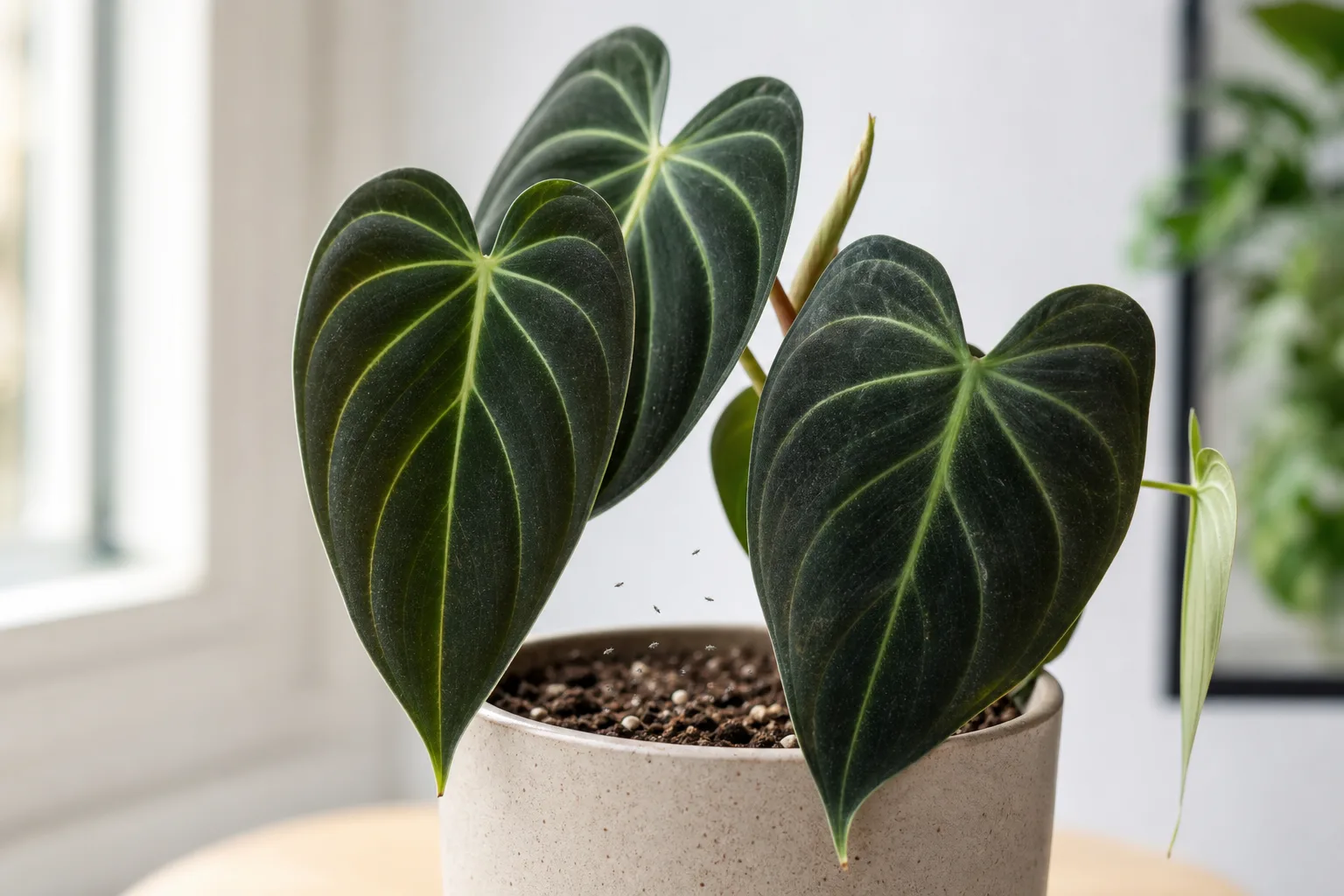
Fungus Gnats on Philodendron Melanochrysum: Causes, Checks & Fixes
This guide covers fungus gnats on Philodendron Melanochrysum. See also the general Fungus Gnats guide, watering, and light pages for this plant.
Fungus Gnats on Philodendron Melanochrysum: Causes, Checks & Fixes
Quick answer
Fungus gnats on Philodendron melanochrysum - the Colombian velvet climber collectors train on moss poles - almost always mean the pot surface stays wet too long, even when ambient humidity is high and the pole looks correctly damp. Adults are tiny dark flies that rise when you water or bump the pot; larvae live in the moist top layer of organic mix.
First step: stop top-watering until the top 3–5 cm (1–2 inches) of mix is completely dry, and place a yellow sticky trap horizontally at the pot rim. Gnats are a moisture signal on this aroid, not a leaf disease. Spraying velvet foliage misses larvae in soil.
Melanochrysum needs high humidity for mature leaves and a moist climbing pole - but those needs are separate from a soggy soil surface. The watering guide calls for a full soak only after the top 3–5 cm dries; chronic surface wetness breaks that rhythm and breeds gnats while the vine still looks fine above soil.
Why Philodendron Melanochrysum gets fungus gnats
Fungus gnat adults are weak fliers that lay eggs in cracks of moist organic growing media. Larvae feed on fungi, algae, decaying matter, and sometimes fine roots in the upper mix. On collector melanochrysum setups, several habits create that habitat even when the grower is attentive:
Moss-pole misting runoff. Water directed down the pole or heavy morning misting often runs along the stem and pools on the pot rim. The surface inch stays wet while the grower believes they are only hydrating aerial roots.
Humidity tents and stacked collector shelves. Multiple pots in a closed tent share warm, still air. Humidity stays at 60–70% for velvet leaves, but air movement between pots drops - so surface mix on every container dries slower than in an open room.
Peat- or bark-heavy aroid mix that ages in place. Fresh chunky mix drains well; after a year indoors, broken-down peat holds moisture at the surface while the root ball still feels appropriate. That pattern also raises mold on soil risk.
Large pots with moderate root mass. Climbing philodendrons are often potted generously for stability on tall poles. Extra wet mix in an oversized pot extends dry-down time and gives larvae more habitat.
Fall nursery introductions and outdoor-summered plants. UC IPM notes fungus gnats commonly arrive on newly purchased houseplants; pots brought inside in autumn frequently carry eggs in contaminated surface mix. One infested nursery melanochrysum can spread adults across every pot on the same cabinet.
Calendar watering because the pole looks dry. Iowa State Extension notes that climbing philodendrons need bright, indirect light and moist but well-drained soil - moisture at the root zone, not a constantly damp surface. Many growers add another pot drink when the moss fiber lightens, without probing the top 3–5 cm first.
High ambient humidity for velvet leaves is not the same as a wet soil surface. Melanochrysum can sit at 60–70% room humidity while the top centimetres of mix still dry when drainage and watering discipline match the watering guide.
What fungus gnats look like on Philodendron Melanochrysum
Adult flies:
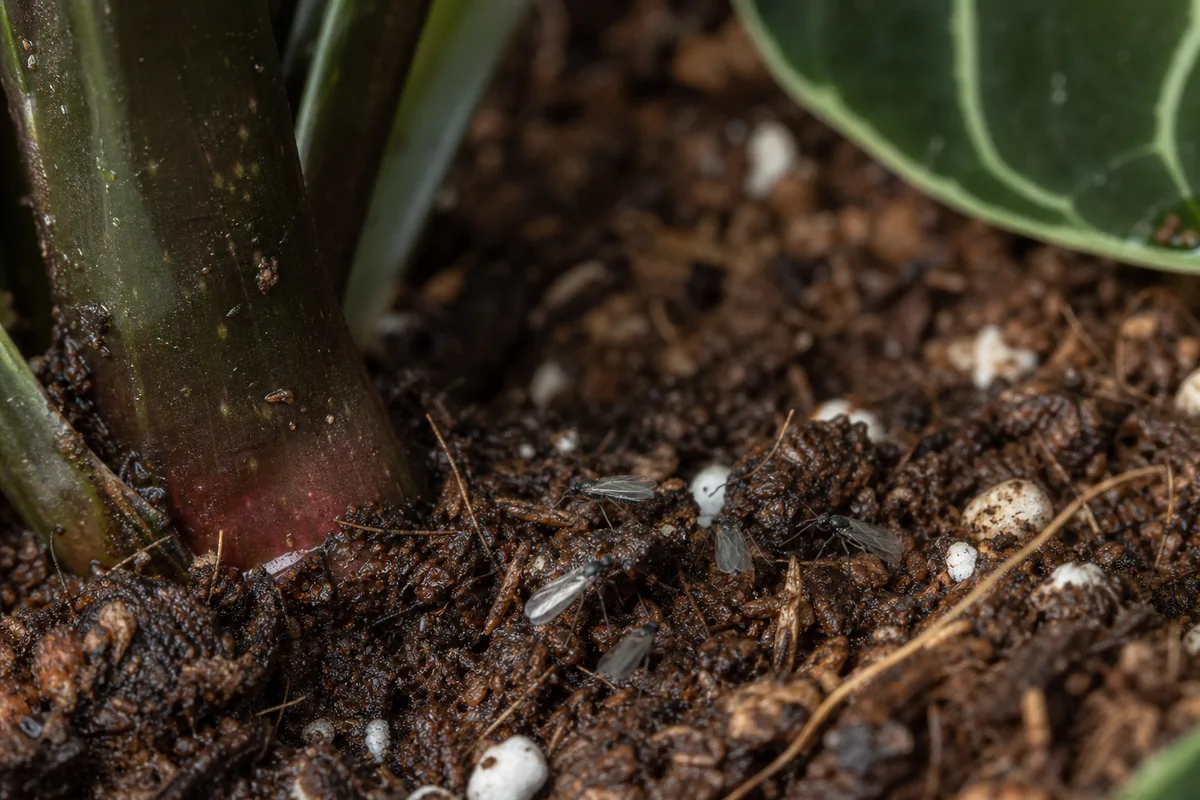
Fungus Gnats symptoms on Philodendron Melanochrysum - compare with healthy tissue on the same plant.
- Tiny dark mosquito-like insects, roughly 1/8 inch long, with long legs
- Rise in a cloud when you water, repot, or bump the pot - not when you shake mature canopy leaves
- Rest on moist soil, pot rim, or the moss pole base after misting
- Do not bite people or pets
Larval stage in soil:
- Translucent wormlike larvae with dark head capsules in the top inch of mix
- Visible when you scrape back wet surface soil, flip a potato test slice, or lift top dressing
- Sometimes green algae or mold film on a constantly wet surface - often appears alongside gnats
What you usually will not see on velvet melanochrysum leaves:
- Chewing holes or stippling from gnat feeding - damage is indirect from larval root stress and chronic wet soil
- Webbing (spider mites)
- White fuzzy clusters (mealybugs)
Plant symptoms when infestation overlaps with overwatering:
- Yellowing lower leaves or stalled cataphylls on the pole while mix stays damp
- Sour or musty smell from anaerobic wet soil - same warning sign as overwatering
- Slow new leaf unfurling even though humidity looks adequate
On a firm-stemmed climber with only moderate fly counts, vines may look normal while gnats annoy you at the soil line. That separation helps confirm a soil pest - but if yellow leaves spread, cross-check root rot before treating flies alone.
How to confirm the cause
Work through these checks in order. Gnats need moisture evidence, not fly sightings alone.
- Soil surface dry-down - After watering, note how many days until the top 3–5 cm (1–2 inches) feel dry at your fingertip. If the answer is never, gnats will persist. Compare against the watering guide dry norm.
- Fly behavior - Tap the pot; fungus gnats rise from soil and resettle near the surface. Fruit flies hover near kitchen compost. Whiteflies puff off foliage when leaves are shaken.
- Sticky trap test - Place a yellow sticky trap horizontally on the pot rim for 48 hours. Multiple small dark captures confirm active adults breeding in that melanochrysum pot.
- Larval scrape - Slide the top quarter-inch of mix aside in one spot; tiny translucent larvae may wriggle in consistently wet organic soil.
- Potato slice test - Colorado State Extension recommends inserting 1/4-inch potato wedges into the surface mix. Check the underside after 48–72 hours for larvae feeding. This confirms larvae in your melanochrysum mix, not random room flies.
- Root-zone audit - If yellow leaves appear, sniff the drainage hole and lift the pot. Heavy cool mix with sour smell points to root rot overlapping gnats - a more urgent problem than fly control alone.
Lookalike symptoms to rule out
| Symptom pattern | Likely cause | Key check |
|---|---|---|
| Tiny flies from soil when watering | Fungus gnats | Wet top 3–5 cm; larvae in mix |
| Small flies near kitchen fruit or compost | Fruit flies | Breeding site away from pots |
| Sturdier flies on algae-heavy wet surface | Shore flies | More common in greenhouse benches |
| Flies from sink or shower drain | Drain flies | Wet organic matter in plumbing |
| White flies puffing off leaves when shaken | Whiteflies | Insects on leaf undersides |
| Silvery scarring on velvet blades | Thrips | No consistent soil flies |
| New leaf tear, no insects, dry soil | Low humidity | Opposite moisture pattern - see low humidity |
| Mold fuzz on soil surface | Saprophytic fungi | Often with gnats; see mold on soil |
First fix for Philodendron Melanochrysum
Let the top 3–5 cm (1–2 inches) of potting mix dry completely, and set one yellow sticky trap at soil level.
That single cultural change disrupts egg-laying and larval habitat while removing breeding females. Minnesota Extension advises letting the top layer dry before the next drink to break the life cycle - melanochrysum tolerates this surface dry-down when the root ball still holds moisture, humidity stays adequate, and the moss pole is misted separately.
Immediate steps after the dry-and-trap start:
- Pause top watering until the upper mix is dry; water deeply only when that layer has dried per the watering guide.
- Empty saucers within 30 minutes of every watering.
- Apply Bti drench if larvae persist - Mississippi State Extension lists Bacillus thuringiensis israelensis drenches for fungus gnat larvae in potting mix. Products such as Mosquito Bits contain Bti; water with Bti tea weekly for three to four weeks because it does not affect eggs or pupae.
- Optional surface barrier - Wisconsin Horticulture suggests a half-inch layer of coarse sand or fine gravel to keep the surface drier and less attractive for egg-laying.
Keep misting the moss pole if needed for aerial roots, but direct that moisture away from flooding the pot rim. Bottom-watering can hydrate roots while the surface stays drier - useful when top watering soaks the whole egg zone every time.
Do not drench with plain water daily trying to flush larvae - that worsens gnat habitat even if the pole still looks thirsty.
Step-by-step recovery
Week 1–2:
- Dry the top 3–5 cm between waterings and deploy sticky traps at soil level beside the moss pole base.
- Apply first Bti soil drench; mark the calendar for weekly repeats.
- Scrape away visible algae or mold on the surface and replace with dry coarse top dressing if needed.
Week 3–4:
- Continue Bti cycles even as adult counts on traps drop - larvae hatch in waves.
- Inspect new melanochrysum leaves for improved unfurling once soil oxygen improves.
- Replace traps when 50–60% covered so you can monitor remaining adults.
Week 5+:
- When traps stay nearly clean for two weeks and surface dry-down is consistent, resume normal melanochrysum watering - still probing the top 3–5 cm first.
- If gnats return immediately, repot into fresh chunky mix per the soil and repotting guides, discarding saturated surface soil.
Most home infestations improve within four to six weeks when dryness, Bti, and traps run together.
Treatment observation (indoor moss-pole melanochrysum)
In a documented indoor case - 6-inch melanochrysum on a moss pole in peat-heavy aroid mix, pole misting pooling on the rim - a horizontal sticky trap caught roughly 40 adults on day 1 after chronic surface wetness. Holding the top 3–5 cm dry between drinks, weekly Bti drenches, and redirecting pole moisture away from the rim dropped counts to about 4 adults by week 4; a new cataphyll unfurled at week 5 once trap captures stayed low and surface dry-down held for 10 consecutive days. Your timeline will vary with light, pot size, and tent humidity, but falling trap counts plus consistent surface dryness are the reliable progress markers.
Recovery timeline
Adult counts on sticky traps often fall within seven to ten days once the surface stays dry. Larval cycles need three to four weekly Bti applications before you should trust the soil is clean. Yellowed lower leaves from wet roots may take four to eight weeks to stabilize as new growth resumes on the pole - old yellow tissue will not re-green.
Gnats can linger in a humid room even after one pot is fixed - check neighbor pots on the same shelf before declaring victory.
What not to do
- Do not spray pyrethrin into the air; Wisconsin Horticulture notes air sprays are ineffective for fungus gnats.
- Do not keep the pot on a constantly full pebble tray while fighting gnats.
- Do not water on a calendar because the moss pole looks dry - check pot mix separately.
- Do not assume gnats mean you must lower humidity to 40%; fix soil surface moisture instead.
- Do not compensate for yellow leaves with extra water while fighting gnats - that deepens overwatering injury.
- Do not repot into peat-heavy mix without perlite and bark - drainage matters on aroids.
- Do not ignore a filled sticky trap; it tells you adults are still laying eggs.
Philodendron Melanochrysum care cross-check during treatment
While correcting gnats, align the rest of care with what melanochrysum needs - pole moisture and pot moisture are separate variables:
| Factor | Gnat-friendly mistake | Melanochrysum target |
|---|---|---|
| Water timing | Calendar watering when pole looks dry | Top 3–5 cm dry before soak - watering guide |
| Moss pole | Misting so runoff floods pot rim | Damp pole fiber; dry soil surface |
| Saucers | Standing water after every drink | Empty within 30 minutes |
| Humidity tent | Stacked pots with no air gap | High humidity for leaves; surface still dries between drinks |
| Mix | Aged peat holding surface moisture | Chunky aroid blend per soil guide |
| Pot size | Oversized pot for pole stability | Sized closer to root mass; one size up at repot only |
| New plants | Placed beside main climber immediately | Quarantine two to three weeks with soil-level trap |
How to prevent fungus gnats next time
Water melanochrysum when the top 3–5 cm of mix is dry, then soak until drainage runs free - same logic as the watering guide, applied strictly to the pot, not the pole. Bright filtered light helps the mix dry predictably between drinks.
Bottom-watering paradox: Bottom-watering can keep roots hydrated while the surface stays drier - but only if you remove the pot from standing water once the surface just moistens and never refill the saucer on autopilot. Refilling whenever the pot feels light, without checking whether the top 3–5 cm has dried, leaves the egg zone soggy and prolongs infestations.
Use pots with drainage holes sized to the root mass. Quarantine fall nursery pots and outdoor-summered plants for two to three weeks before placing them beside your climber. When misting aerial roots, shield the soil surface or top-dress with dry bark. If you use humidity tents, keep pots slightly separated so air moves between them.
Refresh mix when aged peat holds surface moisture for a week indoors - the same degraded structure that breeds gnats also raises root rot risk on velvet climbers.
When to worry - root rot inspection and escalation
Fungus gnats are usually low to medium severity cosmetically, but they flag root-risk moisture on a plant that already dislikes wet feet.
Escalate if:
- Traps catch hundreds of adults per week after four weeks of dry-down and Bti
- Lower leaves yellow and new cataphylls stall while soil smells sour
- Larvae are abundant in the top inch and roots feel soft on inspection
- Gnats appeared right after repotting into dense, moisture-retentive mix
In those cases, unpot, trim any mushy roots, repot into fresh chunky aroid mix per the root rot guide, and continue Bti plus traps. Root rot and gnats often share the same overwatering cause on melanochrysum.
If decline continues after dry-down, Bti drenches, and drainage correction, contact your local cooperative extension office or master gardener helpline before you water again.
Escalation summary: which path to take
- Dry-down only - Few adults when watering, firm stem base, surface damp but no sour smell, yellowing limited to one old lower leaf. Dry the top 3–5 cm; one sticky trap; recheck in 10–14 days.
- Dry-down plus Bti - Traps fill weekly, larvae confirmed on potato slice or top-inch scrape, stem still firm. Dry surface first, then three to four weekly Bti drenches while keeping the top layer dry between drinks.
- Same-week unpot - Soft stem base, sour saturated mix, wilting on wet soil, or multiple yellow leaves spreading up the vine. Inspect roots the same week - follow root rot.
- Collection protocol - Gnats on one melanochrysum in a humid cabinet with other aroids. Isolate the affected pot, dry the top 3–5 cm on every neighbor, and trap each container for two to three weeks.
Permanent takeaway: The long-term fix on collector melanochrysum is not lowering humidity - it is keeping pole moisture and pot surface dryness on separate schedules. Velvet leaves and aerial roots drink from humid air and damp moss; eggs hatch in wet organic mix at the rim. Hold that split and gnats usually stay gone.
Pet safety note
Philodendron species contain insoluble calcium oxalate crystals toxic to cats and dogs if chewed - oral irritation, drooling, and vomiting are common signs. Gnats themselves are not a pet hazard, but keep sticky traps and soil drenches out of reach of curious animals. Bti drenches are low-risk around pets when used on the label, but discourage soil chewing. Contact your veterinarian or ASPCA Poison Control at (888) 426-4435 if ingestion symptoms appear.
Related Philodendron Melanochrysum problems
- Melanochrysum overview - species hub: light, water, humidity, soil
- Watering - top 3–5 cm dry-down, moss-pole rhythm, seasonal adjustments
- Overwatering - wet-soil signs when gnats are a moisture alarm
- Root rot - mushy roots and same-week unpot escalation
- Mold on soil - surface fungi on persistently damp peat
- Soil - chunky aroid mix ratios
- Repotting - when to refresh degraded mix after gnat recurrence
This URL is the fungus-gnat and wet-surface hub for the melanochrysum cluster. Sibling pages go deeper on one cause; start here when tiny flies rise from a damp moss-pole pot in a humid room.
FAQs
Are fungus gnats a sign my Philodendron Melanochrysum roots are about to rot?
Gnats alone rarely kill a mature melanochrysum, but they flag the same chronically wet surface mix that leads to root rot on velvet climbers. If traps are heavy and the top 3–5 cm never dries, sniff the drainage hole and check root firmness - sour smell or mushy tissue means escalate to the root rot guide, not fly control alone.
Can I keep misting my moss pole while fighting gnats without flooding the pot?
Yes - aerial roots on the pole need moisture separate from the pot surface. Mist or pour slowly down the pole in the morning so runoff does not pool on the rim, or shield the soil with a dry bark top-dressing. The mistake is watering the pot because the pole looks dry while the top mix is still damp.
Will fungus gnats kill Philodendron Melanochrysum?
Adults are usually a nuisance, but larvae in soggy mix can chew fine feeder roots and slow new leaf unfurling on the pole. Heavy infestations on recently repotted climbers are riskier because tender roots have less reserve. Fix surface dryness and run Bti before assuming the plant is doomed.
When are fungus gnats urgent on a humidity-tent melanochrysum setup?
Treat as urgent when stacked pots in a tent share damp surfaces, traps fill within days on multiple plants, and lower leaves yellow while soil smells sour. Tent air can keep humidity high without helping the mix dry - isolate the worst pot, dry every surface inch, and inspect roots if cataphylls stall.
How do I prevent fungus gnats after bringing home a fall nursery melanochrysum?
Quarantine the new pot two to three weeks with a sticky trap at soil level before placing it beside your main climber. Nursery peat-heavy mix and outdoor-summered plants often arrive with eggs already in the surface layer. Let the top 3–5 cm dry per the watering guide and refresh degraded mix when it holds moisture for a week indoors.
When to use this page vs other Philodendron Melanochrysum guides
- Philodendron Melanochrysum watering guide - Use for routine moisture checks before assuming fungus gnats is the main issue.
- Philodendron Melanochrysum problems hub - Browse all 10 common issues on this species.
- Root Rot on Philodendron Melanochrysum - Different entry point when symptoms overlap with fungus gnats.
- Slow Growth on Philodendron Melanochrysum - Different entry point when symptoms overlap with fungus gnats.