Poor Root Growth on Heartleaf Philodendron: Causes, Checks
Quick answer
Poor root growth on Heartleaf Philodendron usually means roots are not extending into the mix—often from wet compacted soil in dim light, an oversized pot, or a dense root mat—not a fertilizer shortage. First step: slide the plant partly from the pot and inspect root color, firmness, and how much of the mix the roots actually fill before repotting or feeding.
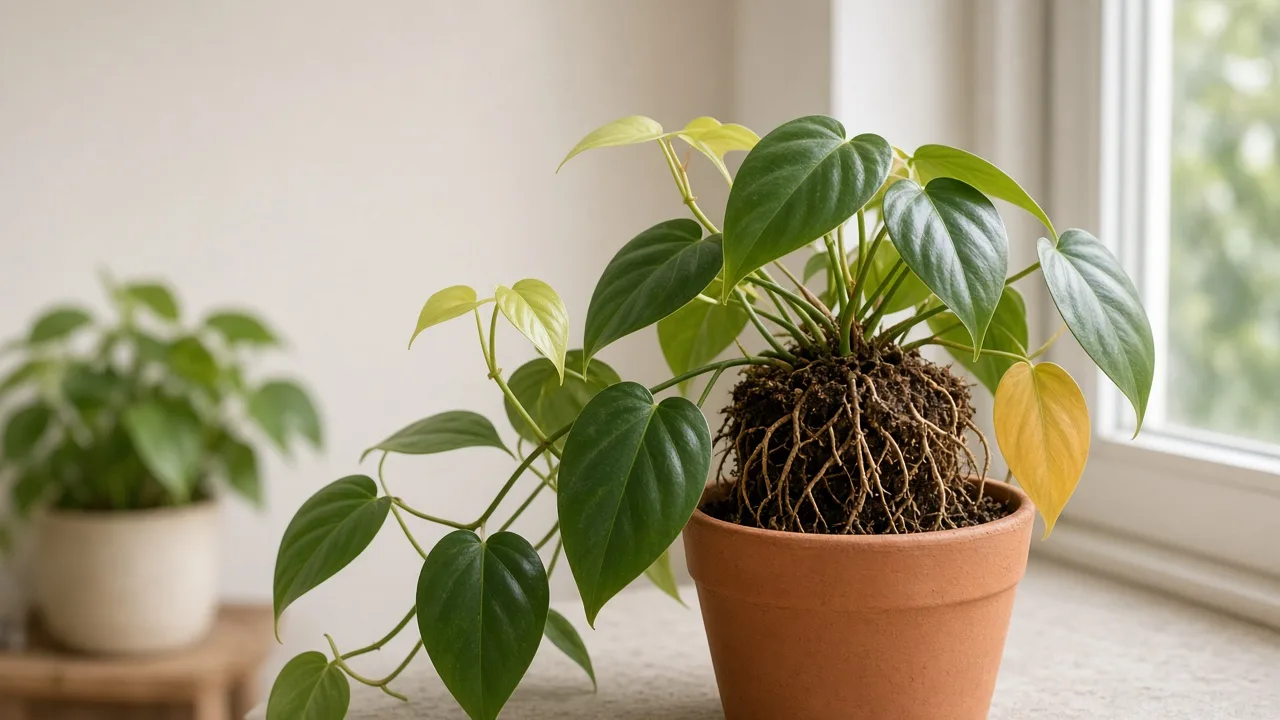
Poor Root Growth on Heartleaf Philodendron: Causes, Checks & Fixes
This guide covers poor root growth on Heartleaf Philodendron. See also the general Poor Root Growth guide, watering, and light pages for this plant.
Poor Root Growth on Heartleaf Philodendron: Causes, Checks & Fixes
Quick answer
Poor root growth on Heartleaf Philodendron means the root system stays small, weak, or fails to expand into fresh mix—even when trailing vines still carry older glossy heart-shaped leaves. On Philodendron hederaceum—the species behind retail names like sweetheart plant and philodendron scandens—this stall usually traces to wet compacted mix in weak light, an oversized pot, or a dense root mat, not a missing fertilizer dose.
First step: slide the plant partly from the pot and inspect root color, firmness, and how much of the mix the roots actually occupy. Do not repot, fertilize, or water more until you know whether roots are firm and pale with active tips, brown and mushy, or circling a pot with almost no soil left.
For how chronic wet mix limits root oxygen in general, see our poor root growth overview. On Heartleaf Philodendron, the pattern usually shows up as thin trailing vines with small new leaves while the pot stays damp for days in a dim corner. This page focuses on root extension failure and binding; our root rot guide covers mushy decay rescue when wet soil has already turned roots slippery and nodes soft.
What poor root growth looks like on Heartleaf Philodendron
Above-ground signs
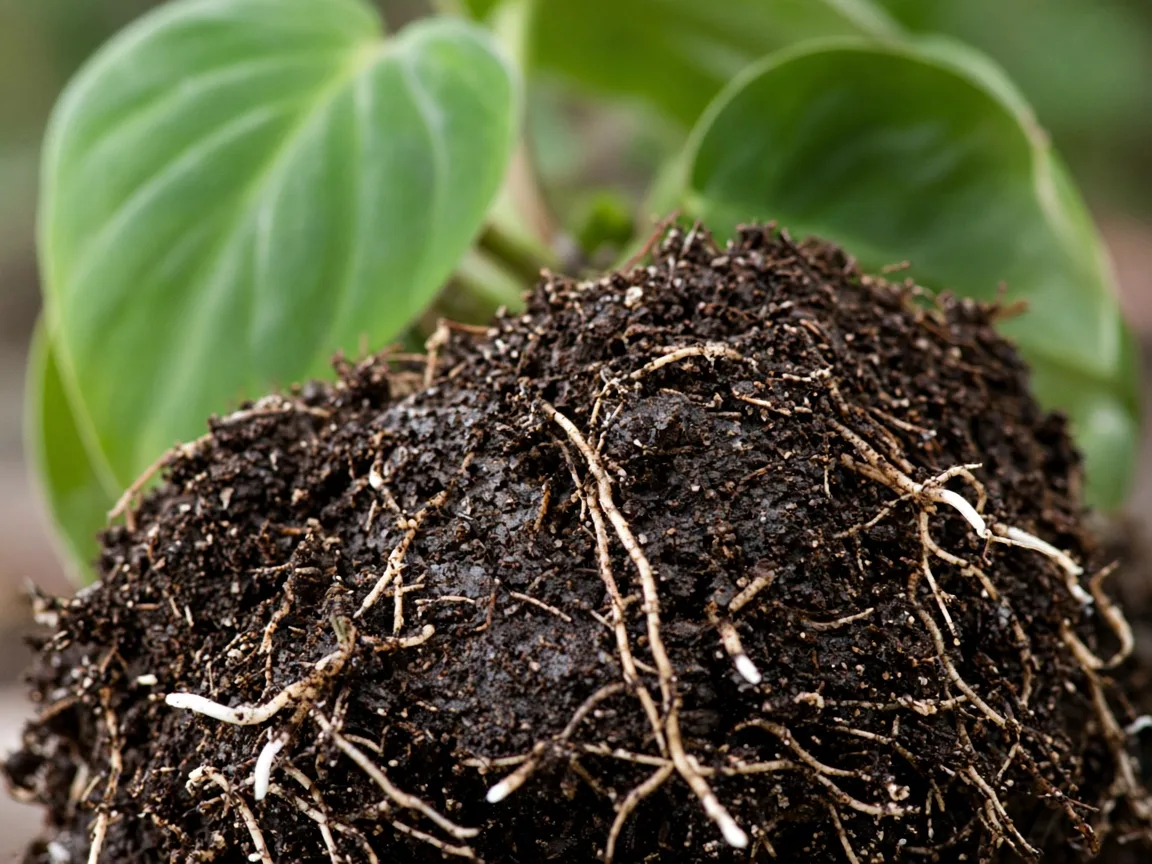
Poor root growth on Heartleaf Philodendron—sparse wiry roots with compacted damp mix and few white active tips.
The pattern is subtle at first. Long trailing vines may keep older heart-shaped leaves while new growth slows or stops entirely. New leaves that do appear are often smaller than earlier ones and may open with a bronze tinge before fading to the usual glossy green—a sign the plant lacks the light and root energy to sustain its normal fast summer push.
Stems can feel thin and flexible rather than firm. You may see yellow leaves scattered along vines even when the surface mix feels damp—the wilt-on-wet-mix paradox: damaged roots cannot move water upward, so trailing leaves look thirsty while the soil stays moist. In advanced cases, the pot feels oddly light soon after watering, or water runs straight through without the mix holding moisture—both point to too few healthy roots for the container size.
Below-ground signs
Healthy Heartleaf Philodendron roots should be firm, pale, or white with active tips. Poor growth shows as short, wiry roots that barely reach the pot walls, brown or blackened sections, or a dense root mat with almost no soil between strands. A sour smell from the drain hole suggests decay rather than simple stunting—escalate to root rot triage if tissue is mushy.
Why Heartleaf Philodendron gets poor root growth
Use this cause matrix to separate stall drivers from rot escalation. Each row points to a different first fix.
| Cause | What you usually see | Why it hits P. hederaceum |
|---|---|---|
| Wet compacted mix in dim light | Top mix damp for days; sparse wiry roots; small new leaves | Tolerates low light but uses little water there; fine roots lose oxygen in stale wet peat |
| Oversized pot stall | Small root ball in a large pot; outer mix stays wet; no new white tips | Unused wet soil around sparse roots stays anaerobic—roots never grow into it |
| Root binding | Dense circling mat; water runs through fast; pot light soon after watering | Fast-growing trailing vine outgrows the same pot; little soil left to hold moisture or support new tips |
| Post-repot shock | Growth pause 2–4 weeks after repotting; roots firm when checked | Disturbed roots pause extension while the plant stabilizes |
| Winter dormancy | Slower pushes in cool months; firm stems; mix dries between drinks | Reduced watering from fall through late winter is normal—not pathology when nodes stay firm |
Low light tolerance and slow water use
Heartleaf Philodendron is famous for surviving dim rooms, but survival is not active root growth. In low light the plant photosynthesizes slowly and uses water slowly too. When mix stays wet for days, fine roots lose oxygen and stop developing. Root rot can occur in overly moist soils—poor extension is often the early stage before mushy decay spreads. See not enough light when vines stretch with long gaps between nodes.
Adventitious roots on vines vs. a stalled soil root ball
Unlike many houseplants, Heartleaf Philodendron produces slender green stems with adventitious roots along trailing vines. Aerial bumps may look healthy while the soil root ball stays sparse—a misleading sign that the plant is “rooting fine.” Those surface roots only help when humidity is high or they reach moist moss; they do not replace a functioning underground root mass in a dry hanging basket.
Wet compacted mix and oversized pots
Compacted, peat-heavy soil compresses after repeated watering, squeezing out air pockets roots need to expand. Without perlite or bark per our soil guide, the center of the root ball can stay wet while the top feels merely damp. An oversized pot makes this worse: the RHS warns that if the pot is much bigger than the rootball, compost stays wet longer and roots can rot. Do not upsize hoping to “give roots room” when the current mass is sparse—that deepens the stall. See pot too large when the container dwarfs the root mass.
Root binding without new extension
Heartleaf Philodendron trails for years in the same pot, but when roots circle into a solid mat, new root tips cannot form and top growth stalls despite faithful watering. Water may pass through the pot too quickly without wetting the center—a classic pot-bound pattern. Repotting signs from the species profile include roots circling the base or emerging from drainage holes and soil drying out the day after watering.
How to confirm the cause
Work through these checks in order before changing multiple variables:
- Moisture pattern - Has the top 2–3 cm stayed wet for five or more days in your normal light?
- Light level - Is the plant more than a few feet from a bright window, or under a weak grow light? See leggy growth when internodes stretch.
- Pot size vs. roots - Is the container much wider than the root ball, or packed so tight that soil is scarce?
- Root inspection - Slide the plant out. Compare firm pale roots with mushy brown tissue.
- Smell and drainage - Sour odor or blocked holes support rot over simple binding.
- Recent changes - Repotting within the last month, fertilizer spikes, or a move to a colder room can mimic poor roots temporarily.
Compare poor root growth with lookalikes
| Signal | Poor root growth | Root rot | Root binding | Slow growth | Underwatering |
|---|---|---|---|---|---|
| Root texture | Firm but sparse, short, or circling | Brown, mushy, slippery | Dense mat, little soil | Firm when checked | Firm, pale; mix bone dry |
| Soil smell | Neutral or musty | Sour or swampy | Neutral | Neutral | Dusty dry |
| Pot weight | Light soon after water, or heavy with damp unused mix | Heavy days after watering | Light; water runs through | Moderate | Very light |
| Leaf pattern | Small new hearts; yellow on damp mix | Dull, limp on wet mix | Stalled vines, older leaves hold | Leggy stretch, occasional new leaves | Crispy edges, inward curl |
| First move | Match pot to roots; airy mix; brighter light | Stop water; trim mush; dry repot | Loosen mat; one size up | Upgrade light | Thorough soak once |
Underwatering shows a very light pot, crispy leaf edges, and firm white roots—the opposite of chronic wet mix with limp vines. For chronic wet mix before roots fail, see overwatering. For top-growth stall overlap, see slow growth and no new growth.
First fix for Heartleaf Philodendron
Gently unpot and inspect the root ball—then match your next step to what you find.
If roots are firm but sparse in compacted, sour-smelling mix: repot into fresh standard potting mix with 25–30% perlite in a clean pot only slightly larger than the root mass—or the same size if an oversized pot caused the stall. If roots are brown and mushy: trim decay back to firm tissue before repotting, then follow our root rot protocol for the dry-week recovery sequence. If roots circle densely with little soil: move up one pot size with fresh airy mix and loosen the outer mat by hand.
Do not fertilize, prune heavily, or move to direct sun on the same day. Fix the root environment first.
Step-by-step recovery
- Unpot on a towel; rinse old mix away to see the full root system.
- Trim brown, black, or mushy roots with sterilized scissors until only firm tissue remains.
- Choose a pot with open drainage sized to the remaining roots—not dramatically larger.
- Fill with fresh perlite-enhanced mix per our soil guide; plant at the same depth as before.
- Water once lightly so mix settles, then empty saucers completely.
- Place in medium to bright indirect light so the pot dries predictably between drinks.
- Hold fertilizer until new leaves unfurl with normal size and gloss.
- Resume watering only when the top 2–3 cm of mix is dry per our watering guide.
If more than half the root mass was removed, take healthy stem cuttings with nodes as backup. Heartleaf Philodendron propagates readily from stem cuttings in water or moist soil—see our propagation guide for node selection. Full repotting technique lives on our repotting guide.
Recovery timeline
Mild stunting with mostly firm roots may show new white tips within two to four weeks after repotting into airy mix and brighter light. The next unfurling heart-shaped leaf tells you whether light is adequate—mostly small pale new growth means move closer to the window, not add fertilizer.
Severe rot with soft nodes can take six weeks or longer to stabilize, and may require propagation rather than saving every vine. Judge progress by new root tips and firm stems, not by old yellow leaves re-greening.
Lookalike symptoms
- Simple slow growth - Heartleaf Philodendron naturally slows in winter; occasional new leaves in spring are normal. See slow growth when the whole vine stalls without a below-soil check.
- Underwatering - Dry pot, crispy tips, firm roots; not sour wet mix. See underwatering.
- Low light alone - Leggy vines with long gaps between leaves but intact roots when checked.
- Transplant shock - Temporary wilt after repotting; roots firm when inspected a week later.
- Root rot (advanced) - Mushy nodes and sour smell; poor root growth is often the early stage of the same wet-soil problem. Escalate to root rot when tissue is slippery.
- Poor drainage - Chronic bottom wetness from blocked holes or heavy mix; see poor drainage when water pools in saucers.
Mistakes to avoid
Do not water more when vines look limp without checking roots first—that deepens anaerobic conditions and can push sparse roots into rot. Do not repot into garden soil or a pot several sizes larger. Do not fertilize stressed roots hoping to strengthen them; salts can burn tissue that is already struggling. Do not leave saucers full after watering—the RHS advises never leaving philodendrons standing in water.
Wear gloves when handling cut tissue—Heartleaf Philodendron contains insoluble calcium oxalate crystals toxic to cats and dogs. Contact your veterinarian or ASPCA Poison Control at (888) 426-4435 if ingestion is suspected.
How to prevent poor root growth next time
Match watering to how fast your pot dries in your light, not a calendar. Water when the top 2–3 cm of mix is dry—roughly every 7–10 days in summer and every 14–21 days in winter in bright indirect light for most homes, always confirming with a finger check per our watering guide. Use 25–30% perlite in the mix, keep drainage holes clear, and repot every one to two years when roots circle the pot or the mix breaks down. Move dim, chronically wet plants to brighter spots before increasing water frequency.
Fungus gnats hovering over the surface often signal chronic wet mix that limits new root tips—see our fungus gnats guide if flies persist after you fix dry-down rhythm.
When to worry
Escalate immediately if nodes soften, stems blacken from soil upward, or several leaves collapse within days of staying wet—that is root rot, not binding alone. Early stunting with firm nodes still allows repot rescue. Take node cuttings before rot reaches every vine if the base is failing.
Heartleaf Philodendron care cross-check
Poor roots rarely exist in isolation. Before you repot again, confirm:
- Light - Medium to bright indirect light so the mix dries predictably; dim corners prolong wet-soil stall. See light guide and not enough light.
- Mix - Chunky aroid blend with perlite and bark; compacted peat suffocates fine roots. See soil guide.
- Pot size - Match the container to actual root mass, not trailing vine length.
- Water rhythm - Top 2–3 cm dry before the next drink; saucers emptied after every watering.
When to use this page vs other Heartleaf Philodendron guides
| Your main question | Start here | Use a sibling page instead |
|---|---|---|
| Roots are sparse or not extending, but mostly firm | This page | — |
| Roots are brown, mushy, sour-smelling | Root rot | This page for early stall only |
| Mix stays wet but roots still firm | Overwatering | This page when extension has already stopped |
| Vines stretch with long internodes | Leggy growth | This page when you have checked below soil |
| No new leaves for months, roots look fine | No new growth | This page when unpotting shows a thin root mat |
Related Heartleaf Philodendron guides
- Heartleaf Philodendron overview - Species context, growth habit, and daily care
- All philodendron problems - Full problem hub for this plant
- Root rot - Mushy decay rescue when wet soil has already failed roots
- Overwatering - Chronic wet mix before roots stop extending
- Slow growth - Top-growth stall when roots are still firm
- Underwatering - Dry root ball lookalike
- Watering - Dry-down rhythm and seasonal adjustment
- Repotting - Pot sizing, binding relief, and technique
- Propagation - Salvage node cuttings when base roots fail
Conclusion
Poor root growth on Heartleaf Philodendron—Philodendron hederaceum—usually begins with a root zone that cannot breathe: wet compacted mix in light too weak for this fast trailing aroid to use water quickly, an oversized pot leaving anaerobic soil around sparse roots, or a dense binding mat with no room for new white tips. Confirm by inspecting roots, refresh airy mix when needed, and water only after the top 2–3 cm dries. When tissue turns mushy, escalate to root rot rescue rather than waiting. Prevent recurrence with drainage, medium to bright indirect light, and pots sized to actual root mass—not leaf size alone.
Related tool
Use the Plant Problem Diagnosis Tool to narrow causes for poor root growth on this plant before changing multiple variables at once.