Underwatering on Staghorn Fern: Causes, Checks & Fixes
Quick answer
Underwatering on Staghorn Fern shows as wilting antler fronds and a very lightweight mount. Soak the root mass for 20–30 minutes, drain face-up until dripping stops, then resume weight-based soaking-not constant misting alone.
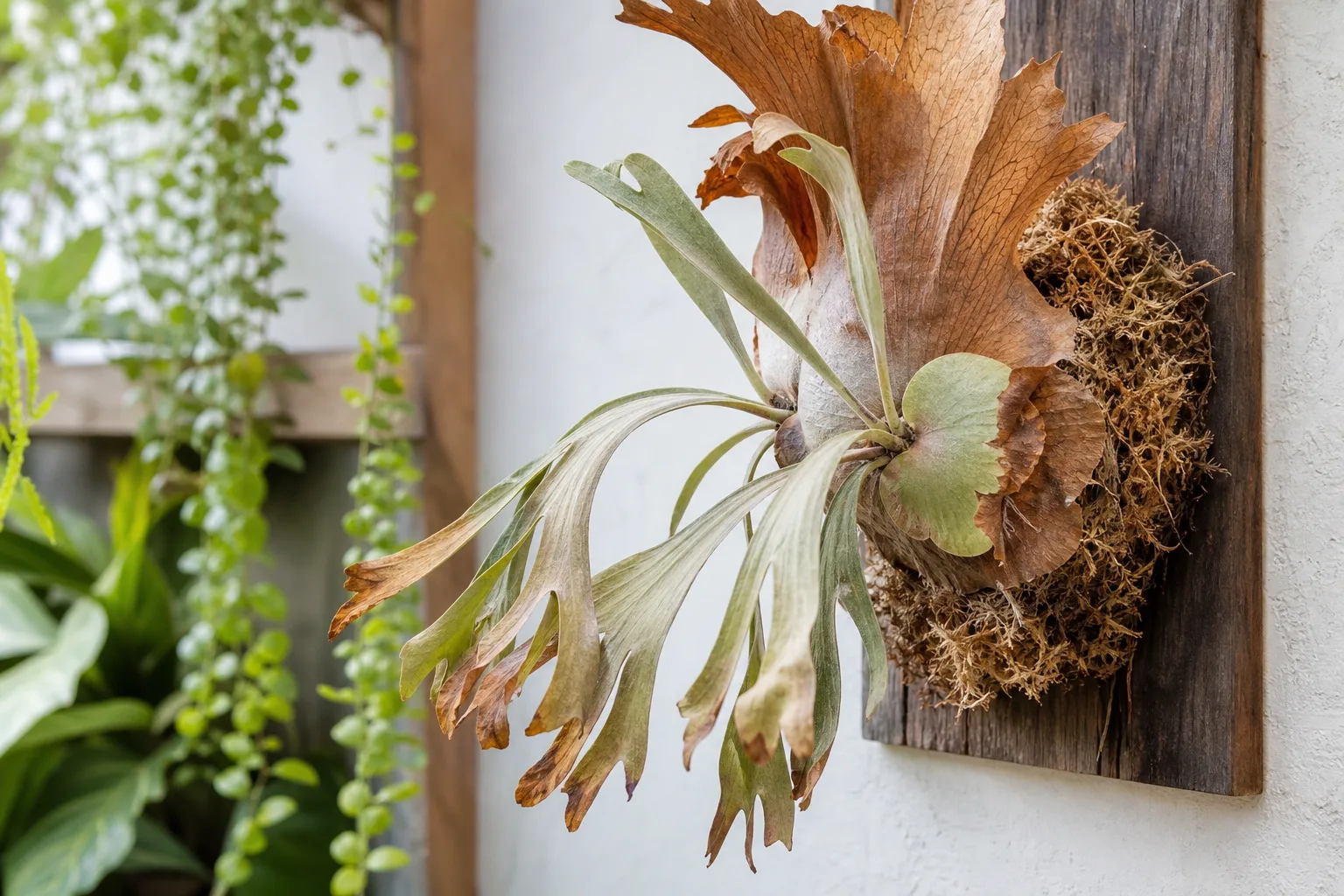
Underwatering on Staghorn Fern: Causes, Checks & Fixes
This guide covers underwatering on Staghorn Fern. See also the general Underwatering guide, watering, and light pages for this plant.
Underwatering on Staghorn Fern: Causes, Checks & Fixes
Quick answer
Underwatering on Staghorn Fern (Platycerium bifurcatum) means the sphagnum moss and root zone behind the shield frond dried out too long-not that you skipped one calendar watering on an otherwise hydrated mount. These epiphytic ferns on open boards lose moisture two to three times faster than roots in a conventional pot because thin moss pads are exposed to air on every side.
The signature pattern: limp gray-green antler fronds on a feather-light mount with dry moss at the crown. An underwatered staghorn recovers when you soak thoroughly-the opposite of overwatering, where wet moss and wilt coexist because roots have failed.
First step: soak the root mass, not the frond tips. Remove the mount, submerge or drench the moss behind the shield for 20–30 minutes, drain face-up until dripping stops, then rehang. This page covers confirmed drought rescue-weight test, perk-after-soak confirmation, and hydrophobic moss recovery. If fronds droop but you have not yet ruled out wet moss or rot, start with drooping leaves triage first.
Routing callout: For full soak-and-dry technique, weight-test calibration, and seasonal scheduling, see the Staghorn Fern watering guide. If moss is heavy, sour-smelling, or black at antler bases, switch to overwatering or root rot rescue instead of soaking again.
What underwatering looks like on Staghorn Fern
Underwatered mounts tell a clearer story on antler (fertile) fronds than on shield tissue:
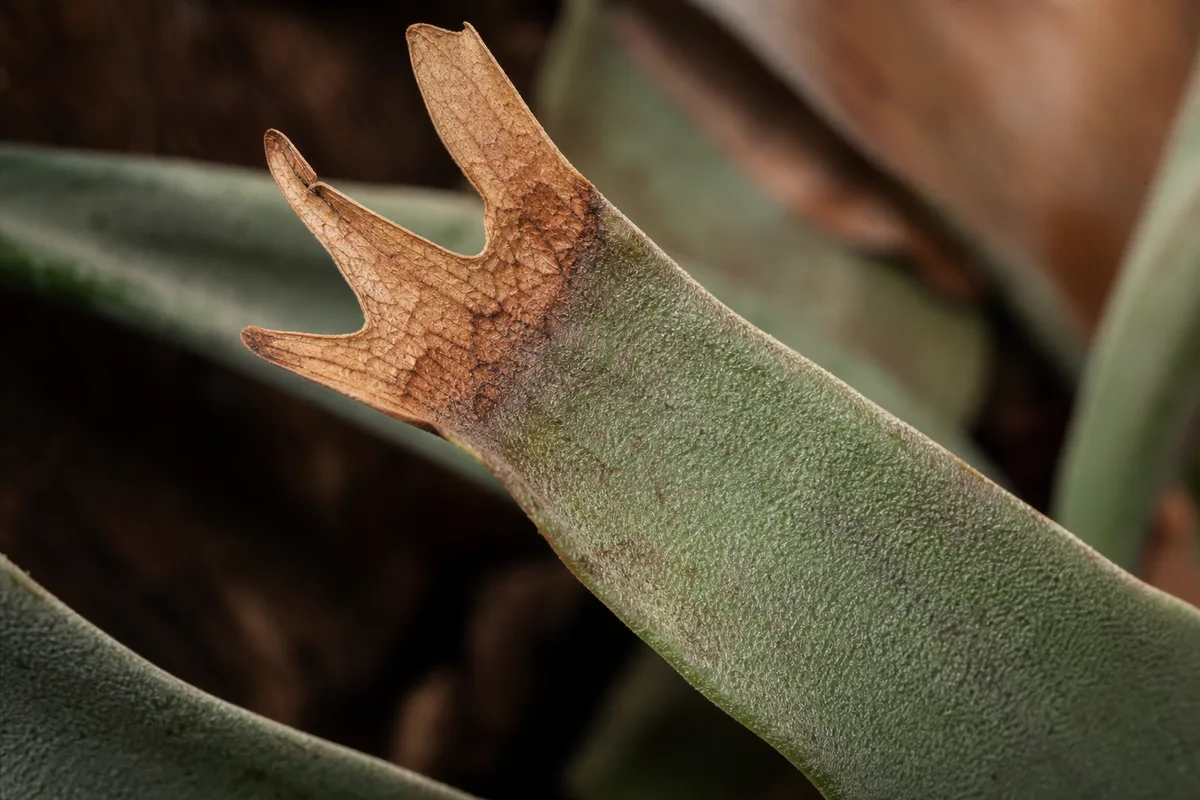
Underwatering symptoms on Staghorn Fern - compare with healthy tissue on the same plant.
- Wilting or limp antler fronds that feel soft and dull gray-green instead of firm and bright
- Crispy brown tips progressing down frond edges when dry spells repeat
- Very lightweight mount-dramatically lighter than your post-soak reference weight
- Moss pulling away from the board or feeling dusty, cool, and hydrophobic
- Slowed new growth during active season despite adequate light
- No foul smell and no black wet tissue at antler bases-those point to overwatering instead
Limp antler fronds and lightweight mount
Healthy antler fronds arch outward with springy tissue. When roots cannot supply water, turgor drops first in the forked fertile fronds-the parts most people call “leaves.” The mount feels nearly weightless in your hands compared to how it felt right after a proper soak and drain cycle. Press moss near the shield base: the surface and first inch feel fully dry, not merely cool on the crust.
A single dry episode often produces obvious wilt within days. Repeated drought stresses fine roots and makes recovery uneven-antler tips may brown while the crown stays firm.
Crispy antler tips vs. normal shield browning
Do not confuse two very different browning patterns. Natural shield frond aging produces dry, papery tan to caramel tissue clasping the mount-firm like aged parchment, with no smell. Wisconsin Horticulture Extension advises that tan or brown basal fronds should not be removed even if they look dead until they fall off naturally.
Underwatering damage appears on green antler fronds: limp tissue, gray-green dull color, and crispy brown edges that progress inward when dry cycles repeat. Shield fronds may look normal while antlers wilt-that is still drought if the mount is light and moss is dry throughout.
| Trait | Normal shield aging | Underwatering on antler fronds |
|---|---|---|
| Location | Flat shields at mount base | Forked fertile fronds above crown |
| Texture | Dry, papery, firm | Limp, soft, then crispy at tips |
| Color | Tan, caramel, light brown | Gray-green limp; brown crispy edges |
| Mount weight | Any | Feather-light |
| Recovery | No action needed | Perks after thorough soak |
Why Staghorn Fern gets underwatered
Mounted culture should alternate deep soak with real dry-down. Several indoor setups skip the soak half of that rhythm:
Fear of rot after an overwatering scare. Growers who lost a staghorn to soggy moss sometimes under-correct-misting frond surfaces or skipping soaks for weeks. Epiphytic roots still need periodic saturation; roots must never be allowed to dry out completely, even though they should dry nearly through between drinks.
Bright windows, heating vents, and travel neglect. A mount near a sunny south window or HVAC vent can dry in four to six days in summer-two to three times faster than the same plant in a humid bathroom with bright indirect light. Forgotten soaks during travel leave moss dust-dry while antler fronds still look slightly green on the surface.
Misting without soak-and-dry. Daily mist raises humidity for minutes and wets outer moss crust. It does not reliably hydrate the root mass tucked several inches behind the shield. A staghorn can get sprayed regularly yet still dehydrate if the moss core never receives a deep soak. See the watering guide for when mist supplements humidity only.
Winter calendar neglect. Reducing winter frequency is correct-many indoor mounts need water every 14–21 days in cool dim rooms-but skipping soaks entirely for months still desiccates fine roots. Allow roots to dry slightly between waterings while never leaving the crown bone dry for weeks.
Potted staghorn underwatering
Some staghorns still live in baskets or pots. Without open-air drying, mix holds moisture longer-underwatering is less common but still happens when growers treat a potted epiphyte like a drought-tolerant succulent. Confirm dryness throughout the root ball, not just the surface crust. Light pot weight, limp antler fronds, and mix pulled away from the pot wall point to thirst. Soak from below or submerge the root ball until fully saturated, then drain. Remounting onto open board with long-fiber sphagnum often prevents repeat dry-out if the pot dries unevenly.
How to confirm the cause
Work through this checklist before remounting or trimming:
- Mount weight - Lift the board. Feather-light compared to your post-soak reference strongly suggests underwatering-not a mount that still feels heavy.
- Moss finger test - Press near the shield base. Dry, dusty moss throughout the first inch on a light mount confirms drought.
- Antler base inspection - Green antler tissue firm at the moss line with limp fronds above points to thirst. Black wet tissue on a heavy mount points to overwatering instead.
- Perk-after-soak test - Soak 20–30 minutes, drain fully, check in a few hours. Fronds that firm up confirm underwatering. No improvement on a heavy wet mount means stop soaking and investigate rot.
- Smell check - No sour or stagnant odor from the crown. Foul smell means wetness problem, not drought.
- Shield vs. antler pattern - Papery brown shields alone are normal. Limp green antlers on dry moss are the drought signal.
| Pattern | Mount weight | Moss at crown | Antler fronds | Likely cause |
|---|---|---|---|---|
| Confirmed underwatering | Feather-light | Dry, dusty | Limp; perk after soak | Soak per steps below |
| Overwatering | Heavy for days | Wet, cool | Limp on wet moss; black bases | Overwatering rescue |
| Natural shield aging | Any | Dry at base | Green antlers; papery brown shields | No action-see overview |
| Advanced rot | Heavy; sour smell | Mush throughout | Spreading black mush | Root rot rescue |
First fix for Staghorn Fern
Immerse the root mass-not antler fronds-in room-temperature water for 20–30 minutes, then drain face-up until dripping stops.
That single deep soak is the first correct action for confirmed drought on a mounted plant. Remove the board from the wall, place it moss-side down in a sink or tub so water covers the moss and root zone behind the shield, and wait until the moss darkens evenly and the mount feels uniformly heavy. Antler fronds can stay mostly above the water line if space is tight.
After soaking:
- Drain face-up on a rack or dish rack for at least 20–30 minutes-longer for large or thickly mossed mounts.
- Rehang when drip-free-no water running down the wall.
- Do not soak again until the weight test says the mount is nearly dry.
UF/IFAS recommends watering when the growing medium feels dry with the entire root ball and moss soaked thoroughly, then drained fully before the next cycle.
Hydrophobic moss: longer submerge or remount
Sometimes moss that went bone-dry repels water-the surface wets while the core stays dry. If bubbles stop quickly and the mount still feels unevenly heavy after a standard soak:
- Submerge longer-up to 45–60 minutes for a standard indoor mount, watching for even darkening throughout the pad.
- Shower-drench at multiple angles if the mount is too large for your sink; rotate so water reaches dry pockets in thick moss.
- Remount with fresh pre-moistened long-fiber sphagnum if repeated soaks fail to rehydrate the center. Follow the remounting guide for moss density-thinner airier pads hydrate more reliably than dense wads indoors.
Do not fix hydrophobic moss with daily misting or tiny splashes. One full soak-or a remount if the pad has collapsed-is the correct response.
Recovery timeline
Mild underwatering on a firm crown with healthy roots usually shows visible perk within a few hours to the same day after a thorough soak and drain. Antler fronds regain turgor before new growth appears.
Repeated drought cycles over weeks may leave crispy brown antler tips that will not re-green even after correct watering resumes. Judge recovery by firm tissue at frond bases, resumed new antler emergence, and stable mount weight rhythm-not by old damaged segments reverting.
Moderate cases with hydrophobic moss remount may take two to four weeks before growth rate normalizes. Staghorns grow slowly indoors; a firm shield base with perked antlers is positive even when tips stay brown.
Severe prolonged drought stressing the crown-weeks of bone-dry moss with fully collapsed antlers-may take one to three months for new growth if the crown tissue remains firm. If antler bases turn black or mushy after soaking, escalate to root rot assessment; that pattern is not simple thirst.
Mistakes to avoid
Do not respond to dryness by keeping the mount constantly wet going forward-that swings to overwatering and crown rot.
Do not remove papery brown shield fronds during recovery-they protect roots and regulate moisture at the base.
Do not use ice-cold tap water; let water reach room temperature before soaking tropical roots.
Do not rely on misting alone for wall-mounted plants-treat mist as optional humidity support only during dry spells.
Do not soak again the day after rescue because fronds still look slightly dull-wait for the weight test to pass.
Do not confuse crispy antler tips from repeated drought with rot-black wet mush at the crown on a heavy mount is a different emergency.
How to prevent underwatering next time
Water on weight, not calendar. Soak deeply only when the mount feels nearly lightweight. Starting guides for bright indoor mounts:
| Season / conditions | Typical soak interval (confirm with weight test) |
|---|---|
| Active growth (spring–summer) | About every 7–10 days |
| Shoulder seasons (fall) | About every 10–14 days |
| Slow growth (winter, cooler/dimmer) | About every 14–21 days |
| Hot, bright, or dry placement | As often as every 4–6 days |
| Cool dim room | As infrequently as every 2–3 weeks |
Drain before rehanging - face-up at least 20–30 minutes after every soak.
Track mount weight weekly during your first month with a new mount to calibrate feel.
Add humidity near heating vents or move to a brighter bathroom if antler tips brown despite correct soak timing-moderate humidity helps reduce dry-air stress between soaks.
Adjust moss volume when the mount dries in three to four days every cycle-slightly more long-fiber pad (not denser packing) or better humidity, not more frequent partial watering.
The watering guide covers weight-test calibration, submersion vs. shower soaking, and winter slowdown in detail.
Moss volume and placement when mount dries too fast
If your mount hits feather-light weight in three days every cycle despite reasonable room humidity, suspect placement before blaming the plant. Bright south windows, forced-air vents, and open doorways accelerate dry-down two to three times versus a stable bright-indirect spot. Slightly increasing long-fiber sphagnum volume-without cramming moss into a dense mass-gives roots more reservoir between soaks. A humidifier or bathroom placement with good light reduces tip browning from dry air while the moss core is actually fine.
When to worry
Treat as urgent when antler fronds stay fully limp 24 hours after a thorough soak and drain on a mount that felt correctly heavy post-soak-that may indicate root damage from prior overwatering or repeated drought, not ongoing thirst.
Crisp dead antler sections will not re-green-that is permanent tissue loss, not an emergency if the crown is firm and new growth eventually resumes.
Black or mushy tissue at antler bases after soaking on a previously dry mount suggests rot masked as drought-switch to root rot protocol.
Weeks of dust-dry moss with a collapsing crown and no new antler emergence after correct soak-and-dry rhythm may mean crown stress beyond a single rescue-seek local extension advice if the plant keeps declining despite firm weight management.
Conclusion
Underwatering on Staghorn Fern is a mount-culture gap: the moss core behind the shield dried out while frond surfaces still looked slightly green, or misting replaced deep soaks. Soak the root mass first, confirm perk within hours, distinguish papery brown shields from limp antlers, and return to weight-based scheduling. A firm crown with perked fronds after one soak means you caught it early; 24-hour non-recovery or blackening at the base means look beyond simple thirst.
Related Staghorn Fern guides
- Staghorn Fern watering guide - soak-and-dry method, weight test, drain time, and seasonal schedule
- Overwatering on Staghorn Fern - heavy wet mount vs. feather-light drought
- Drooping leaves on Staghorn Fern - posture triage when cause is not yet confirmed
- Root rot on Staghorn Fern - when black mush or sour smell appears after misdiagnosis
- Staghorn Fern overview - shield and antler biology, light, and culture context
Related tool
Use the Plant Watering Calculator to narrow causes for underwatering on this plant before changing multiple variables at once.