Brown Tips on Staghorn Fern: Causes, Checks & Fixes
Quick answer
Brown tips on Staghorn Fern antler fronds usually mean dry air, inconsistent soaking, fluoride in tap water, or direct sun scorch-not fungus. Lift the mount, check humidity, and switch to filtered water before trimming dead tips or soaking more.
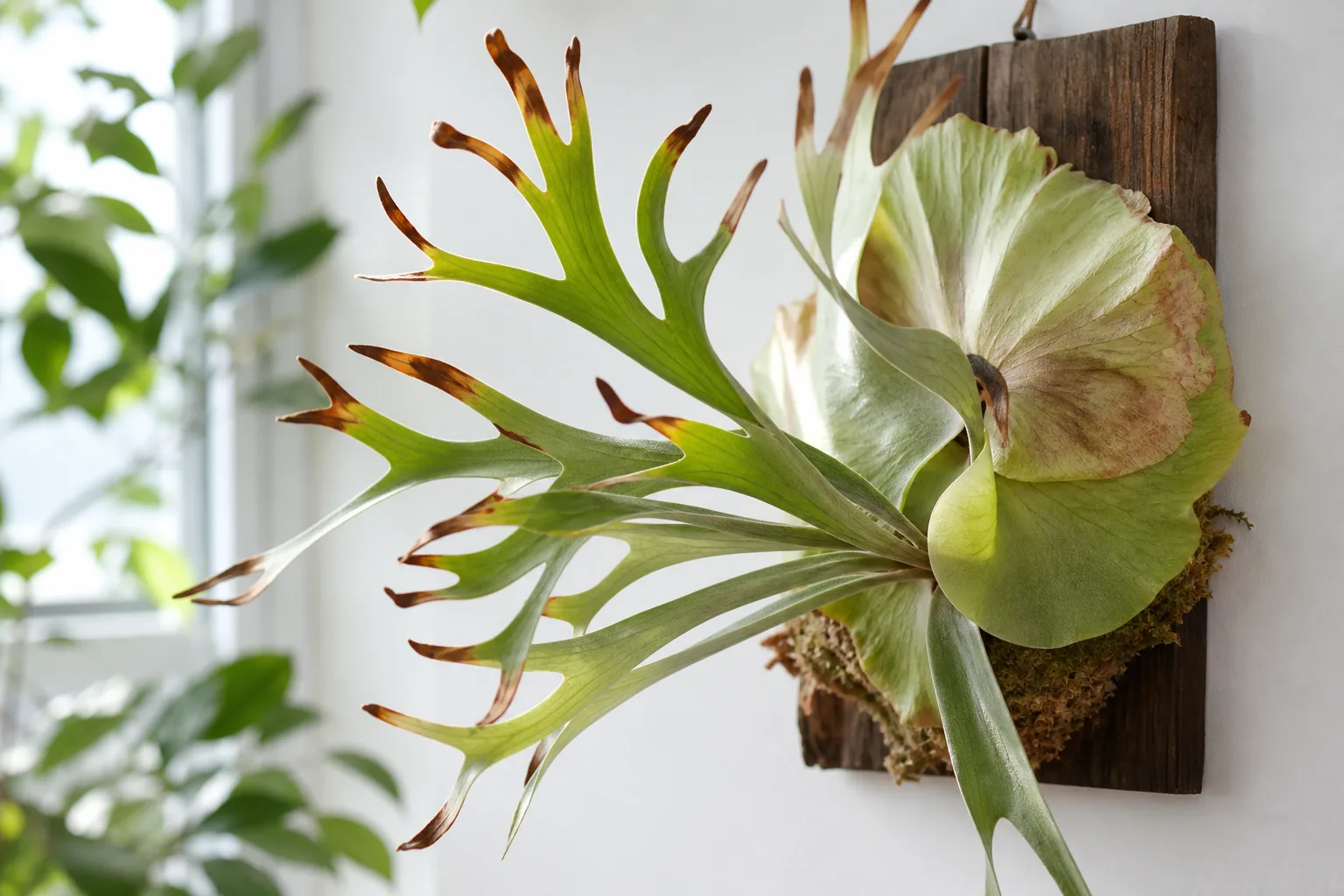
Brown Tips on Staghorn Fern: Causes, Checks & Fixes
This guide covers brown tips on Staghorn Fern. See also the general Brown Tips guide, watering, and light pages for this plant.
Brown Tips on Staghorn Fern: Causes, Checks & Fixes
Quick answer
Brown tips on antler fronds of Staghorn Fern (Platycerium bifurcatum) are almost always environmental stress-not disease. This epiphyte absorbs moisture through fronds and roots on an open mount, so dry air, hard tap water, sun scorch, and inconsistent soak rhythms all show first at the farthest leaf margins.
First step: lift the mount and read the weight. A nearly lightweight board with crispy antlers points to underwatering layered on dry air. A heavy wet mount with brown tips means do not soak more-fix humidity, water quality, or rot routing instead.
Routing callout: If a hygrometer reads below 40%, tips appeared when central heating started, and the mount still feels appropriately moist, dry air is the primary driver-follow the low humidity guide for humidifier workflow and winter recovery. Stay on this page when humidity is adequate but tips brown after tap-water soaks, after a move toward a sunny window, or when soak timing swings between bone dry and soggy.
Brown tips vs. low humidity - which guide to use
Both pages address crispy antler margins, but the first variable you change depends on what you confirm at the mount:
| What you see | Mount weight | Humidity | Start here |
|---|---|---|---|
| Crispy tips all around antler lobes; winter onset | Moderate-moist but not soggy | Below 40–45% | Low humidity guide |
| Tips brown after every soak; white crust on moss | Moderate | Above 50% | This page - tap water / salt focus |
| Sun-facing side tan; shaded side still green | Any | Any | This page - sun scorch; also see light guide |
| Black base spots, sour smell, soft crown | Heavy, waterlogged | Any | Root rot guide - not tip burn |
| Flat papery brown plates at mount base only | Any | Any | Normal shield aging - see overview |
The low-humidity page covers humidifier placement, bathroom moves, and spider-mite checks in dry rooms. This page covers water quality, sun asymmetry, soak rhythm, and the mount-weight paradox so you do not duplicate humidity advice or soak a wet mount because tips look dry.
What brown tips look like on antler fronds
Brown-tip damage concentrates on fertile antler fronds-the forked green “stag horns” that grow outward from the crown. Shield fronds pressed flat to the mount are a different tissue type; papery tan shields at the base are normal aging, not the symptom this page treats.
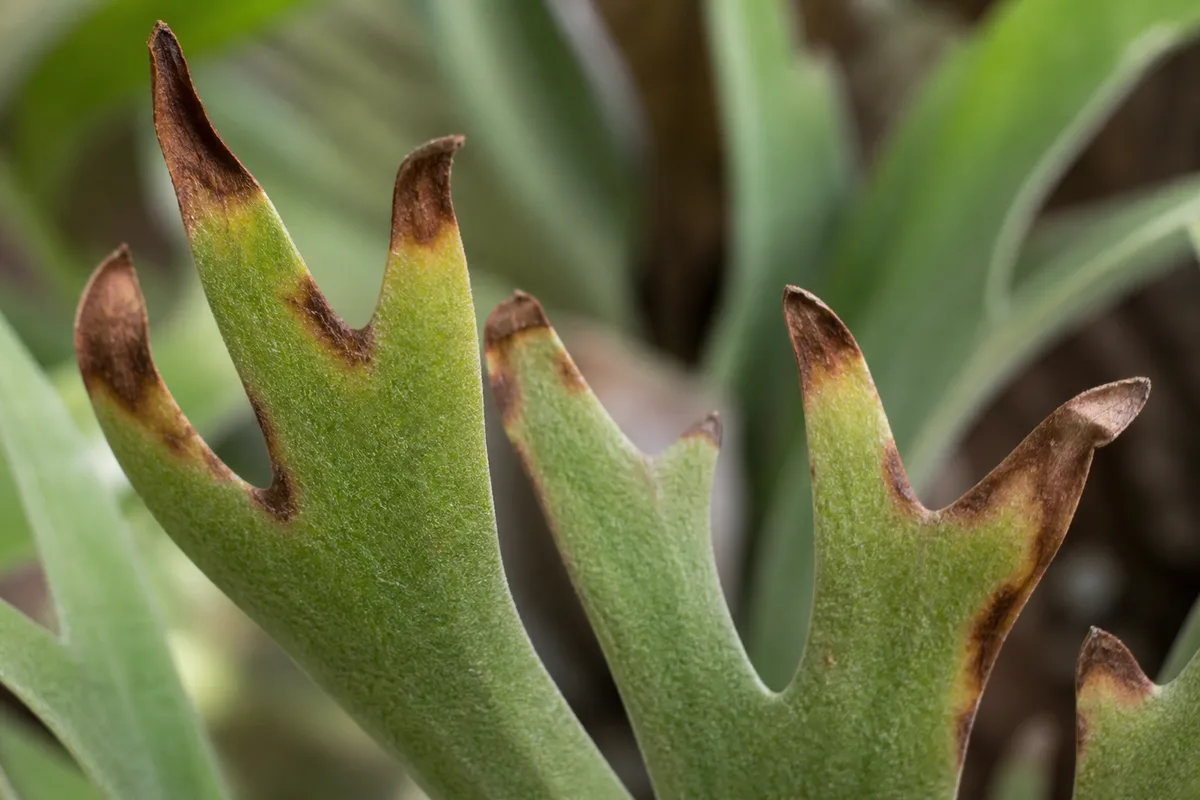
Brown Tips symptoms on Staghorn Fern - compare with healthy tissue on the same plant.
Typical brown-tip patterns:
- Dry, tan-to-dark-brown crispy margins at antler tips and lobe edges, often papery when pinched gently
- All-around edge burn when dry air or underwatering desiccates margins evenly
- One-sided scorch when the sun-facing lobe bleaches or crisps while the shaded side stays green
- Tip burn after feeding or hard-water soaks without a humidity drop-margins may brown on otherwise firm green tissue
- Slow antler production when stress persists through what should be active spring growth
What brown tips do not look like:
- Flat cinnamon-brown shield plates layered at the mount base - normal sterile frond aging
- Grayish-white felt on healthy antlers - natural coating that slows transpiration; do not wipe it off
- Black mush at the crown with foul-smelling moss - rot, not cosmetic burn
- Fine stippling with webbing on antler undersides - spider mites thrive in dry conditions; humidity fixes help but may not clear an established colony alone
Because staghorns grow slowly on mounts, one browned antler tip can look alarming on an otherwise healthy specimen. Read tissue type (antler vs. shield), pattern (all-around vs. sun-side only), and mount weight before trimming anything.
Why Staghorn Fern gets brown tips
P. bifurcatum evolved in rainforest canopy conditions with high humidity, soft rainfall, and dappled light. Indoors, four stressors account for most antler tip burn beyond pure dry-air cases covered on the low-humidity page.
Tap water fluoride and salt buildup
Epiphytic ferns prefer rainwater or filtered water. Hard (alkaline) tap water can brown leaves when used too often; mineral deposits accumulate in sphagnum moss and at frond margins furthest from the vascular supply. Letting tap water sit overnight removes chlorine but not fluoride or dissolved minerals-a common trap when tips keep browning despite adequate humidity.
Inconsistent soak-mount watering
Staghorns need the mount to dry slightly between soakings but not desiccate for weeks. Long dry spells followed by heavy soaking stress frond edges. Calendar soaking without lifting the board misses the rhythm this epiphyte expects-see the watering guide for soak-and-drip technique.
Direct sun scorch
Staghorns tolerate bright indirect light with filtered sun when humidity is high. Harsh midday rays through south or west glass scorch the exposed antler side while shaded tissue stays green-a different pattern from humidity burn, which usually starts at tips all around the frond.
Low humidity and winter heating (cross-reference)
Dry forced-air heat can drop room humidity into the 20–30% range for months. Browning may indicate air that is too dry, especially above heating vents. When that fits your readings, prioritize the low-humidity guide rather than repeating humidifier steps here.
Fertilizer salt stress
Heavy or frequent feeding pushes salts into moss and frond bases. Tip burn after a spring fertilizer application-sometimes with visible crust on moss-overlaps with hard-water damage. Pause feeding until new antlers emerge clean.
How to confirm the cause
Work through these checks in order before changing humidity, soaking, and water source all at once:
- Humidity reading - Place a hygrometer near the mount at frond height. Sustained below 40% during heating season strongly supports dry air; route to the low-humidity guide. Above 50% with ongoing tip burn shifts focus to water quality or light.
- Mount weight - Lift the board. A feather-light mount with crispy antlers suggests underwatering contributing to tip burn. A heavy wet mount with brown tips means do not soak more-investigate overwatering or salt stress instead.
- Sun asymmetry - Are damaged lobes on the window-facing side only? Direct sun scorch fits; move to filtered light per the light guide.
- Water source and timing - Did tips worsen after switching to hard tap water or after fertilizing? Salt and fluoride patterns fit even in humid rooms.
- Frond type - Brown only on upright antlers with firm green shields? Environmental tip burn. Soft blackening at the crown with sour moss points to root rot.
- Season and placement - Winter onset above a vent implicates dry air. Post-move scorch near glass implicates light. Document before/after for the next antler flush.
If humidity is low, fix air first. If humidity is adequate and the mount is appropriately moist, switch water source before adding soaks or trimming aggressively.
First fix to try
If humidity reads above 50% and the mount is not bone dry: switch to rainwater, reverse-osmosis, or filtered water for the next four to six weeks of soaks.
This single change tests fluoride and salt buildup without triggering rot from extra watering. Soak normally when moss approaches dryness-do not increase frequency purely because tips look brown on an already wet mount.
If humidity reads below 45% or tips appeared with winter heat: your first fix is raising ambient moisture, not changing water-go to the low-humidity guide and run a humidifier or bright bathroom placement before altering soak rhythm.
If sun-facing lobes scorched after a recent move toward glass: step the mount back to bright indirect light with shear or distance from the pane. Water quality changes will not fix asymmetric burn.
Do not trim antler tips on day one. Do not remove brown shield fronds. Do not soak a heavy mount because margins look crispy-that deepens overwatering risk while fronds still desiccate in dry air.
Step-by-step recovery
After the first fix matches your confirmed cause:
- Stabilize the primary variable for one week - filtered water only, or humidifier only, or light adjustment only. Changing everything at once hides what worked.
- Resume proper soak rhythm - Immerse the mount for several minutes, then drain fully when moss feels nearly lightweight, not on a calendar alone. Match seasonal pace in the watering guide.
- Flush salt-heavy moss - If white crust or recent overfeeding is present, soak once with filtered water, drain completely, and skip fertilizer until new growth is clean.
- Move off vent lines - Even good humidity fails if a heat blast hits antlers daily. Wall placement is part of care for mounted epiphytes.
- Mist antler fronds lightly on dry mornings only if humidity still dips below 45% after humidifier use-regular misting supplements air moisture but does not replace consistent ambient humidity for large wall mounts.
- Treat spider mites if stippling appears - Rinse antler undersides gently; dry air favors mites. See the spider-mites guide if webbing persists after humidity improves.
- Trim fully dead antler tissue once the next segment shows cleaner margins. Use clean scissors; cosmetic trim is optional and does not speed physiological recovery.
Hold remounting, pup division, and fertilizer until one new antler segment opens without brown edges.
Recovery timeline
Environmental corrections often stop new tip damage within one to two weeks, but existing crispy tissue will not re-green. Judge success by new antler fronds:
- Three to six weeks for a clean new antler segment after stable humidity, water quality, or light-typical in warm active growth
- Longer through winter if heating runs constantly; a mount stressed all season may need until spring flush
- No improvement after six to eight weeks in verified good conditions - reassess root health, light levels, and whether low humidity was undertreated despite adequate readings at desk height but not mount height
Document the date you switched water or raised humidity. Compare the next fertile frond to the damaged one-that before/after pair is the most reliable recovery metric on a slow-growing staghorn.
Lookalike symptoms to rule out
| Symptom pattern | Mount / environment | Likely cause | Where to go |
|---|---|---|---|
| Crispy tips all around; winter; RH below 40% | Moderate weight | Low humidity | Low humidity |
| Crispy tips; mount very light; dusty dry moss | Very light | Underwatering | Underwatering |
| Black base spots, sour smell, soft crown | Heavy, wet | Overwatering / rot | Root rot |
| Sun-side tan; shade-side green | Any | Sun scorch | Light guide |
| Tips after every tap soak; RH above 50% | Moderate | Fluoride / salts | This page - filtered water |
| Papery brown flat shields at base | Any | Normal aging | Overview - do not remove |
Underwatering wilts and crisps antlers but the mount feels very lightweight throughout. A full soak plus humidity support fixes fronds faster than water-quality changes alone.
Overwatering produces black spots at frond bases and sour moss-not isolated dry tips on an otherwise firm crown. More water worsens both crisping and rot when the mount is already heavy.
Sun scorch is asymmetric; humidity burn tends toward even margin crisping on exposed lobes.
Shield frond aging mimics “brown leaves” to beginners but occurs on flat basal plates, not forked antlers.
Mistakes to avoid
Do not remove brown shield fronds-they anchor the plant and protect roots. Only aged shields that detach naturally should fall away.
Do not soak more often because antler tips look brown when the mount is already heavy. Confirm moss dryness first; soggy moss in dry air still produces crispy fronds and invites rot-epiphytic ferns are easily damaged by overwatering.
Do not place the mount in direct sun to “dry out” brown tips-that intensifies scorch unless humidity is very high.
Do not wipe the gray felt from antler fronds-that coating is a drought adaptation, not dust.
Do not rely on once-daily misting alone for a large wall mount in a 25% humidity room when a humidifier is what the low-humidity guide recommends.
Do not assume every brown tip means fungus-staghorns rarely show tip burn from disease when mount culture and airflow are sound.
Staghorn Fern care cross-check
Tip-burn recovery works best when the rest of the stack aligns:
- Light: Bright indirect with filtered sun-not harsh midday beams. Bleached tips after a window move need softer exposure, not more water.
- Temperature: Keep above 55°F with adequate humidity-cold drafts and heat spikes both stress recovering fronds.
- Watering: Soak when moss nears dryness; fronds and moss both absorb during immersion. Frond misting supplements air moisture but does not replace soaking.
- Mount integrity: Ensure wire or fishing line is not cutting new green shields-physical damage mimics tip burn at margins.
How to prevent brown tips next time
Run a humidifier from first heating cycle through spring when dry air is your limiting factor-details in the low-humidity guide. For water-quality prevention, default to rainwater when available or filtered water if municipal supply is hard or heavily treated.
Soak on mount weight, not calendar guilt. Hang away from HVAC vents and drafty doorways. In bright south or west windows, use sheer curtains or several feet of setback to avoid scorch.
Monitor with a hygrometer at mount height, not desk height-air at the ceiling hook is often drier than readings across the room.
Pause fertilizer unless new antlers look healthy; light feeding in warm months is enough for most indoor specimens per the fertilizer guide.
When to worry
Brown tips alone on firm green crown tissue and appropriately moist moss are cosmetic, not an emergency. Escalate when:
- Browning spreads with black mush at the crown and foul odor
- Green shield fronds soften while moss stays wet
- New antlers fail to emerge for an entire warm season despite corrected care
- Spider mite webbing covers multiple fronds despite higher humidity
Those patterns need rot intervention, pest treatment, or extension consultation-not more trimming or blind soaking. Staghorn Fern is non-toxic to cats and dogs, but mount hardware and moss still warrant keeping plants out of reach of aggressive chewers.
Related Staghorn Fern guides
- Staghorn Fern overview - antler vs. shield biology and mount culture basics
- Low humidity - primary resource when dry air drives tip burn
- Watering - soak-and-drip rhythm and seasonal intervals
- Light requirements - window placement and sun scorch prevention
- Root rot - when brown bases mean crown failure, not tips
- Underwatering - light mount with crispy antlers
Conclusion
Brown antler tips on Staghorn Fern reward systematic routing: dry air on a moist mount sends you to the low-humidity workflow; hard tap water, sun scorch, or chaotic soak timing stay on this page. Lift the mount, read humidity at frond height, switch water before you soak a wet board, and judge recovery by the next fertile frond-not by old crispy margins. Patience matches this slow epiphyte; one clean antler segment proves your fix landed.