Root Rot on Staghorn Fern: Causes, Checks & Fixes
Quick answer
Root rot on Staghorn Fern means moss at the crown stayed wet too long and tissue at the growing point is failing-especially on mounts that never fully dry. Stop soaking immediately, peel back crown moss to inspect, trim mushy roots, air-dry the crown, and remount into fresh long-fiber sphagnum and orchid bark. Keep brown shield fronds in place unless tissue is black and mushy.
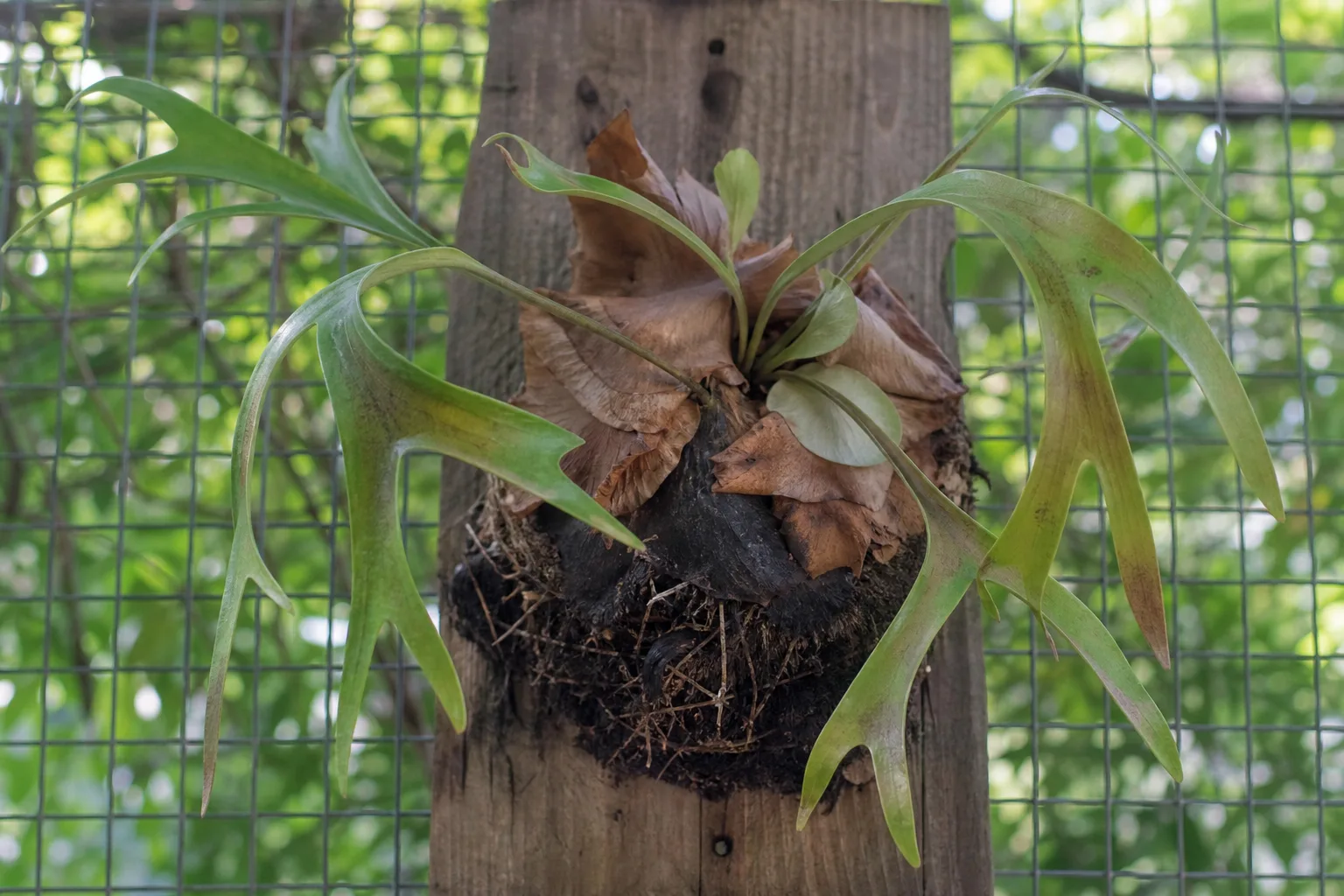
Root Rot on Staghorn Fern: Causes, Checks & Fixes
This guide covers root rot on Staghorn Fern. See also the general Root Rot guide, watering, and light pages for this plant.
Root Rot on Staghorn Fern: Causes, Checks & Fixes
Quick answer
Root rot on Staghorn Fern (Platycerium bifurcatum) is crown and root tissue failure from prolonged wetness-not a random fungal lottery. These litter-trapping epiphytes evolved with burst rain and fast airflow on tree branches. Indoors, moss compressed at the crown, calendar soaking through winter, or rehanging before full drain traps moisture where fine roots need oxygen between drinks.
First step: stop all soaking and inspect the crown today. Peel back moss gently, confirm whether tissue is firm or mushy, and follow the numbered recovery section below if rot is confirmed. This page is the salvage deep-dive-trim, air-dry, remount mix, and pup rescue. If symptoms are early-a heavy mount with firm crown and only surface wet moss-start with the overwatering guide for dry-down triage before crown surgery.
Routing callout: Wilt on wet moss, black antler bases, and sour smell overlap with overwatering, wilting, and drooping leaves. This guide assumes you have confirmed mushy crown tissue or spreading black bases-not a schedule tweak alone. For soak-and-dry prevention rhythm, see the watering guide.
Root rot vs. overwatering - scope for this page
Both problems share wet moss, but the intervention differs.
| Situation | Crown tissue | Moss at base | Your first move |
|---|---|---|---|
| Early overwatering | Firm when pressed | Wet, heavy mount; may be cool but not mushy throughout | Stop soaking; dry mount |
| Confirmed root rot | Soft, denting, or black mush at growing point | Mush throughout crown zone; sour smell after peel-back | Trim, air-dry, full remount (this guide) |
| Underwatering | Firm | Dusty dry throughout; feather-light mount | Soak per watering guide |
| Normal shield aging | Firm | Dry at base | Papery tan-brown shields-leave in place |
Root rot means tissue at the crown or attachment roots has begun to decay. Overwatering caught early reverses with dry-down alone. Once mush penetrates the shield center or blackening climbs antler bases rapidly, you need the salvage protocol below.
What root rot looks like on a mounted Staghorn Fern
Rot on wall mounts usually fails at the crown first, where moss meets the growth point behind the shield frond.
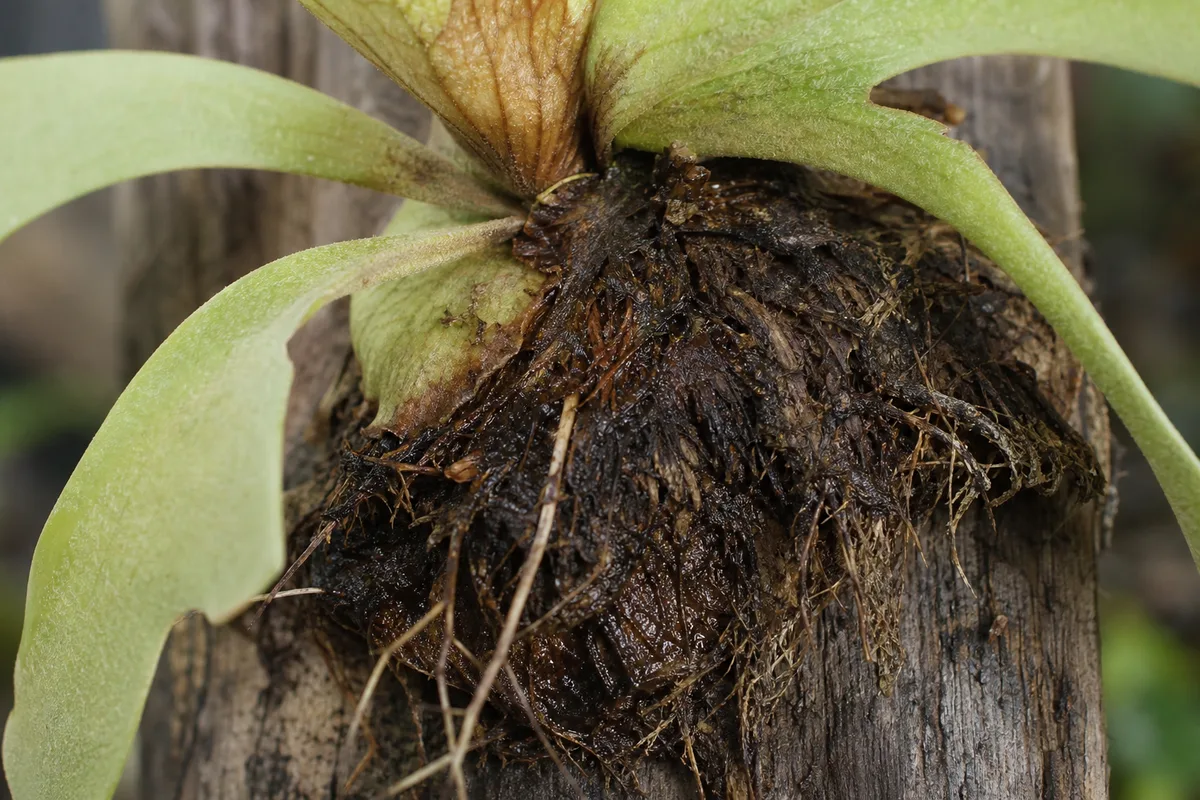
Root Rot symptoms on Staghorn Fern - compare with healthy tissue on the same plant.
- Black or dark wet brown tissue at antler frond bases-not dry papery brown shield aging
- Sour, stagnant, or rotting smell from moss when you lift the mount
- Mushy moss throughout the crown zone when you peel back the outer layer
- Antler fronds wilting while moss stays damp-damaged roots cannot move water despite wet medium
- Mount staying heavy for weeks after the last soak
- Black wet spots on green fronds that do not dry within a day
- Fungus gnats when moss stays persistently wet in dim rooms
The wet paradox
The signature trap: limp antler fronds on a heavy wet mount. Growers soak again, deepening rot. Wilting with moist growing medium often means roots cannot take up water-because they are failing in saturated moss, not because the plant is thirsty.
Crown rot vs. surface soggy moss
Surface soggy moss wets the outer crust while the crown underneath stays firm. Dry-down and moss refresh may suffice-see overwatering.
Crown rot means soft tissue at the growing point, black marks climbing frond bases, and odor that persists after you remove wet outer moss. Peel back one layer at a time. If mush continues into the shield center, you are past a pause-and-wait fix.
Shield frond color - what to leave vs. what signals rot
Natural brown shields are dry, papery, tan to caramel, and firm-normal aging. Wisconsin Horticulture Extension advises that tan or brown basal fronds should not be removed even if they look dead until they fall off naturally.
Rot damage is black or dark wet tissue, softness, and foul smell. Touch and smell before cutting anything during recovery.
Why mounted Staghorns rot
Epiphytic roots are fine and fibrous-adapted to cling to bark, not sit in dense mud. They need alternating moisture and oxygen. Long-fiber sphagnum works on mounts because it holds water inside strands while leaving air spaces between fibers. That balance collapses when moss is packed too thick, kept constantly wet, or mounted in dim rooms with weak airflow.
Compressed moss in low light is the classic indoor failure. The surface may feel merely cool while the crown center goes anaerobic. Staghorn ferns rot easily if overwatered when moss never dries between soaks. Epiphytic roots need oxygen between soakings; when moss stays soggy, roots in waterlogged conditions cannot function normally.
Calendar watering through winter keeps summer soak frequency when growth and evaporation both slow-mounts that dried in five days in July may take eighteen days in January.
Rehanging before full drain pools water in the shield cup against living tissue.
Misting on an already wet mount wets surfaces without fixing core saturation-and can keep moss soggy during recovery when you should be drying the crown.
The shield frond is a moisture reservoir, not decoration. Brown papery shields protect roots and trap nutrients. Removing healthy brown shields during recovery exposes tissue and slows healing.
Lookalike symptoms to rule out
| Pattern | Mount weight | Moss at crown | Antler bases | Shield fronds | Likely cause |
|---|---|---|---|---|---|
| Root rot (this guide) | Heavy; sour smell | Mush throughout crown | Black wet tissue climbing | May be firm brown or black mush | Trim, air-dry, remount |
| Early overwatering | Heavy for days | Wet, cool; crown firm | Early black spots | Papery brown shields firm | Overwatering dry-down |
| Underwatering | Feather-light | Dry, dusty | Firm; limp antlers | Normal brown shields | Soak when dry |
| Normal shield aging | Any | Dry at base | Green antlers above | Dry tan-brown, firm, no smell | No action-overview |
| Low light stress | Variable | Slow to dry | Stunted antlers | Green shields may persist | Light guide + weight test |
How to confirm the cause
Work through this checklist before trimming or remounting:
- Stop soaking - Do not add water while assessing. More moisture deepens decay.
- Mount weight - Lift the board. Still heavy ten or more days after your last soak suggests chronic wetness or rot, not normal retention.
- Smell at the crown - Sour or stagnant odor from moss behind the shield confirms anaerobic conditions.
- Peel-back inspection - Gently lift outer moss at the crown. Brown mushy roots or soft crown tissue confirm rot. Firm tissue with only surface wet moss may be early overwatering instead.
- Antler base check - Black wet tissue where green antlers meet moss on a heavy sour mount confirms advancing rot.
- Crown firmness test - Press gently at the growth point. Firm tissue resists; mush dents under light pressure.
- Underwatering lookalike - Light mount, dusty dry moss throughout, fronds that firm after one thorough soak point to underwatering instead.
- Pup health scan - If the main crown is failing, check rhizome edges for firm offsets with their own shields-salvage may shift to propagation.
First fix: stop soaking and inspect the crown today
Withhold all water and peel back moss at the crown to see what you are dealing with.
Move the mount to bright indirect light with better airflow so existing moisture evaporates faster-without direct sun that scorches antler fronds. Do not soak because antler fronds look wilted when the mount is still heavy. Do not fertilize. Do not remove dry brown shield fronds.
If crown tissue is firm and mush is only in outer moss, you may need only dry-down and moss refresh-return to the overwatering guide. If tissue is mushy at the crown or blackening spreads, continue to step-by-step recovery below.
Step-by-step recovery after confirmed root rot
1. Unmount and strip all wet media
Remove the fern from the wall. Discard every bit of old moss, soggy bark, and slimy material-old media harbors the conditions that caused failure. Do not reuse any wet pad, even if outer fibers look salvageable.
2. Inspect and trim damaged tissue
With clean scissors or a sterile knife, cut away brown, black, or mushy roots and soft blackened tissue at antler bases until you reach firm, pale tissue. Sterilize blades between cuts if you moved through clearly rotted zones. Plants with partial rot may be salvaged by pruning out the rotted part.
Do not remove dry papery brown shield fronds unless they are black, mushy, and foul-smelling. Healthy brown shields protect recovering roots.
Trim blackened antler segments back to firm green tissue if bases are compromised-they will not re-green, but the crown can push new fronds if the growing point survives.
3. Air-dry the crown
Set the trimmed plant in bright indirect light with good airflow. Allow three to five days for moderate rot, or up to one week if the crown was heavily saturated. Tissue should feel firm and dry to the touch-not brittle or shriveled throughout the shield mass.
4. Prepare board and remount mix
Use a rot-resistant board-cedar, redwood, cork, or cypress per UF/IFAS guidance-or replace a soft rotting plaque entirely.
Mix roughly two parts long-fiber sphagnum to one part coarse orchid bark by volume, fluffed airy-not compressed. Pack moss around and below the crown, never on top of the growth point. Thinner pads dry faster than dense wads indoors. Full layering technique lives in the remounting guide.
Secure with fishing line or wire crossed over brown shields, not directly across the fuzzy growth point. Face the bud upward when the board hangs.
5. Recovery watering rhythm
Wait at least seven days after remount before the first soak if crown tissue is still firm. Then resume soak-and-dry per the watering guide: full saturation, 20–30 minute minimum drain face-up, then no water until the mount feels substantially lighter.
During recovery, do not soak weekly on a calendar even if antler fronds look limp-the crown must stay drier than outer moss until new growth appears.
Recovery case example
A typical moderate salvage: peel-back revealed brown mush at the crown after three weeks of winter calendar soaking; grower stopped water, trimmed mushy roots and black antler bases, air-dried four days on a rack, remounted on fresh cedar with a thin moss-bark pad, waited ten days, then gave one light soak with full drain. First firm new antler tip appeared roughly six weeks later-slow but normal for indoor P. bifurcatum.
Potted Staghorn Fern recovery branch
Some staghorns still live in baskets or pots. Without open-air drying, mix holds water two to three times longer than a vertical mount.
- Unpot and shake away all wet mix-discard entirely.
- Trim mushy roots to firm white or tan tissue.
- Air-dry the root ball 24–48 hours in bright indirect light.
- Repot into coarse orchid bark with perlite-open drainage, no dense peat. NC State Extension recommends allowing roots to dry slightly between waterings while never letting them dry out completely.
- Confirm dryness throughout the root ball before soaking again-not just the surface crust.
If a potted setup never dries within ten days indoors, consider remounting onto an open board-the long-term fix for repeat rot in closed containers.
Recovery timeline
Mild crown rot with firm tissue after trim and remount often stabilizes within four to six weeks once soaking stops and the new pad dries predictably. Judge progress by firm crown tissue and stopped spread of black bases, not by old antler fronds re-greening.
Moderate cases needing full remount may take two to four months before new antler tips emerge. Staghorns grow slowly indoors; a firm shield base with no spreading mush is positive even when antlers look sparse.
Severe crown mush throughout the growing point rarely produces a full-looking plant quickly. If tissue keeps softening after dry-down and remount, shift focus to healthy pups at the rhizome edge-see propagation for separation when offsets carry their own shields and roots.
What not to do
Do not keep soaking because antler fronds look wilted when moss is already wet.
Do not remove papery brown shield fronds during recovery-they insulate roots.
Do not fertilize a rotting plant hoping to force new growth.
Do not remount onto the same wet moss pad or rotting board.
Do not pack moss thick and dense against the growth point.
Do not mist heavily on a recovering mount instead of allowing crown dry-down.
Staghorn Fern is non-toxic to cats and dogs, but wash hands after handling mushy tissue.
How to prevent root rot next time
Water on weight, not calendar. Soak deeply only when the mount feels nearly lightweight-typically every 7–10 days in active growth and every 14–21 days in winter for many indoor setups, always confirmed by the weight test in the watering guide.
Allow roots to dry slightly between waterings while never leaving the crown bone dry for weeks. Water when the growing medium feels dry with the entire root ball and moss soaked thoroughly, then drained fully.
Drain before rehanging - face-up at least 20–30 minutes; no water running down the wall.
Use long-fiber sphagnum, not dense peat pads that hold water without airflow.
Remount every two to five years when moss decays or boards soften-stale pads are a common repeat-rot trigger. See the remounting guide for timing and board prep.
Match frequency to light and season-cool dim winter rooms need longer dry-down than bright summer placements.
When to worry (and when pup salvage is the option)
Treat as urgent when blackening spreads up antler bases, the mount smells foul throughout, or moss at the crown is soft and mushy after several days of dry-down.
Discard or pivot to pups when the crown dents under light pressure throughout, mush returns after trim and remount, or the main growing point collapses while firm offsets remain at the rhizome edge. NC State notes that large colonies can be divided-healthy pups are often the realistic salvage path when the central crown is gone.
Chronic wet moss with fungus gnats in dim rooms warrants faster airflow and frequency reduction before crown tissue fails-see fungus gnats.
A firm crown with only outer moss mush after one week of dry-down is not yet hopeless-complete the peel-back checklist before assuming fatality.
Conclusion
Root rot on Staghorn Fern is a mount-culture failure: moss at the crown stayed wet long enough for tissue to decay. Stop soaking first, peel back moss, distinguish papery brown shields from black mush, then trim, air-dry, and remount into a thin airy moss-bark pad if the crown is compromised. Firm tissue after salvage means slow recovery is possible; spreading crown mush means act fast or rescue firm pups. For early wet-moss signs before mush sets in, start with the overwatering guide.
Related Staghorn Fern guides
- Overwatering on Staghorn Fern - early wet-moss triage before crown mush
- Staghorn Fern watering guide - soak-and-dry method, weight test, and seasonal schedule
- Staghorn Fern remounting - board prep, moss density, and growth-point protection
- Staghorn Fern propagation - pup salvage when the main crown fails
- Wilting on Staghorn Fern - wet-paradox context
- Drooping leaves on Staghorn Fern - limp antlers with different causes
- Fungus gnats on Staghorn Fern - chronic wet moss overlap
- Staghorn Fern overview - shield and antler biology
Related tool
Use the Root Rot Risk Checker to narrow causes for root rot on this plant before changing multiple variables at once.