Water Lily Pruning: What and When to Cut
Water Lily Pruning: Leaves, Flowers, and Dormancy
Water Lily Pruning: Leaves, Flowers, and Dormancy
First, cut one fully yellow, collapsed, or rotting pad stalk as close to its base as you can safely reach. Do not begin by shearing across the floating canopy. Water Lily (Nymphaea nouchali) grows new leaves and flowers from a submerged crown, so pruning is mainly careful cleanup of individual leaf stalks and flower stems—not shaping branches or cutting lotus-like aerial foliage.
Reviewed by LeafyPixels Review Board · Author: sai-ananth
Quick answer
Prune Water Lily by tracing each spent flower or failing pad down its flexible stalk and cutting low, close to the crown, without stabbing the crown or disturbing the planted tuber. The RHS recommends removing fading flowers and old yellowing leaves before they sink and decay. Keep healthy green pads because they power active growth; if too many healthy pads crowd the surface, thin selectively and consider whether the basket needs dividing.
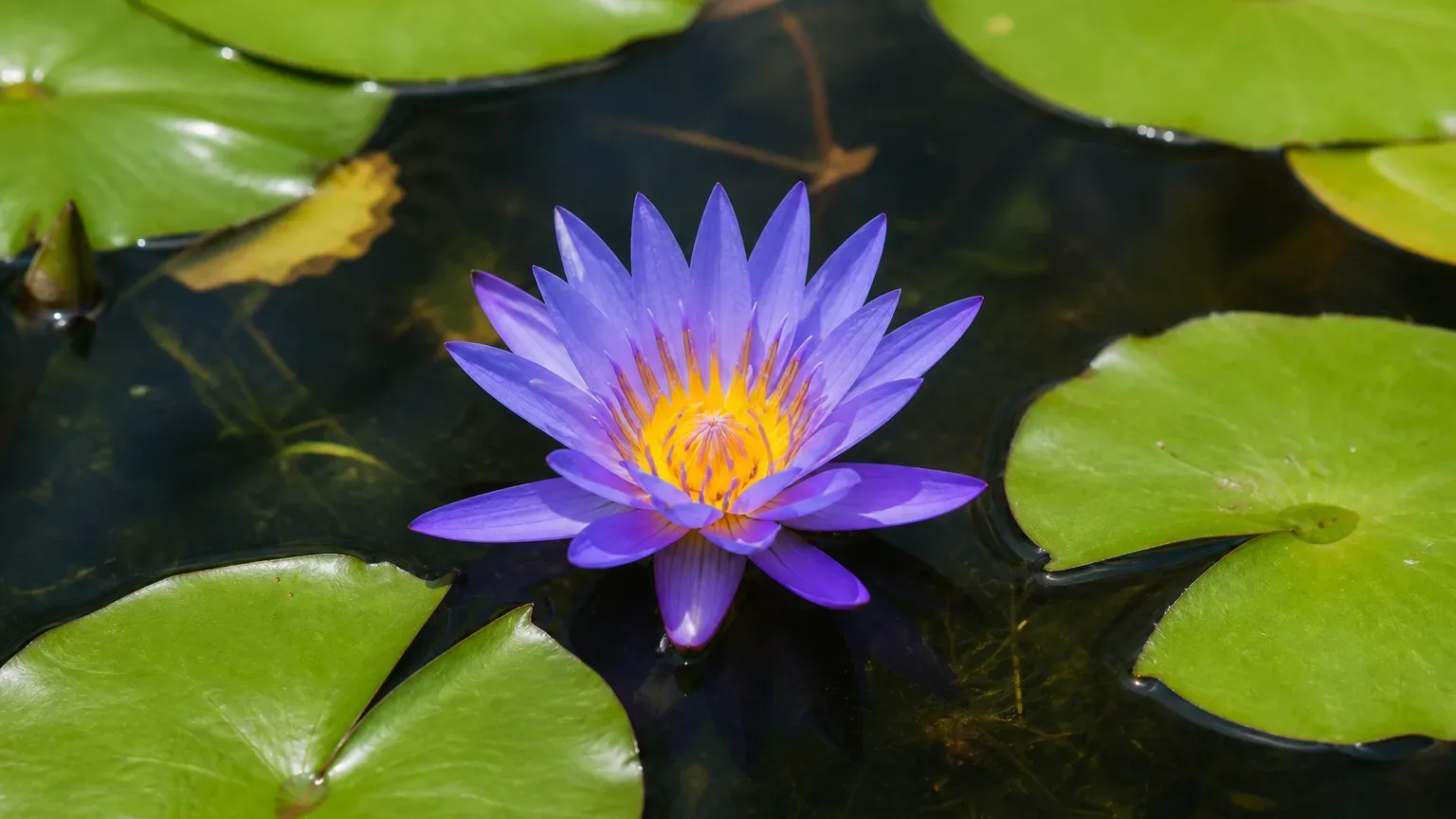
This is a true water lily in the Nymphaeaceae, not a lotus in the genus Nelumbo. Its rounded leaves normally float and its flowers sit on or above the water; the species profile describes N. nouchali as a rhizomatous submerged aquatic perennial. For its broader aquatic growth pattern, start with the Water Lily overview.
What pruning can—and cannot—do
Useful pruning keeps decaying leaves and flowers out of the water, opens crowded surface space, and makes it easier to inspect the crown area. It can remove a torn pad, a flower that has finished, or a soft stalk before that material breaks down. Removing decaying material matters because it can raise nutrient levels, encourage algae, and reduce oxygen available to pond life, according to the RHS pond-care guidance.
Pruning cannot correct a tuber planted too deeply, a shaded position, cold water, crown rot, or a basket packed with old growth. Tropical day-blooming water lilies prefer warm conditions, at least five hours of sun, and fertile loam in a submerged container, while crown rot and leaf spot are among the problems listed by NC State Extension. If new pads are small, repeatedly fail to reach the surface, or stop appearing, check the Water Lily light guide and watering and water-level guide before cutting more.
When to prune Water Lily
During warm active growth
Inspect the plant weekly when warm water and sun are producing pads and flowers. Remove an individual pad when it is mostly yellow, torn beyond useful function, collapsed, slimy, or clearly rotting. Deadhead a flower after it fades and begins to close permanently rather than cutting a bloom that merely closes at its normal time of day.
Routine cleanup can happen whenever spent material is easy to reach safely. Avoid a large reduction immediately after planting or moving the basket deeper; wait until firm new pads lie flat on the surface. The Utah State University Extension planting guidance identifies the rhizome eye or offshoot as the growing point and advises leaving it at the soil surface, which is why blind cutting around the crown is risky.
As weather cools or dormancy begins
Nymphaea nouchali is tropical, so do not copy hardy-water-lily winter advice without accounting for temperature. In frost-free warm climates it may continue growing, though more slowly, and only naturally fading leaves need removal. In cool climates, tropical water lilies need winter water at or above about 10°C (50°F), or the tuber must be lifted and stored frost-free; the RHS tropical overwintering guidance says to remove fading foliage before storing tubers in damp sand.
Do not force dormancy by cutting off a healthy green canopy while water remains warm and the plant is actively growing. Wait for leaves to yellow and decline naturally, then remove them low so dead stalks do not remain in the pond. If cold protection is needed, coordinate pruning with the Water Lily repotting guide rather than repeatedly lifting and lowering the basket.
What to inspect before cutting
Look across the surface first, then trace each candidate stalk toward the basket:
- Pad condition: Keep firm green pads, even if an edge is blemished. Remove pads that are predominantly yellow, soft, detached, or collapsing.
- Flower stage: A spent bloom stays closed, loses color, or starts to sink. A healthy day-blooming flower may close normally and reopen.
- Stalk condition: Remove a soft, blackened, broken, or foul-smelling stalk. A firm flexible stalk supporting a healthy pad stays.
- Crown activity: New rolled leaves and firm shoots indicate active growth. Avoid cutting or pressing the central growing point.
- Crowding pattern: Pads piled above one another can indicate a congested plant, not simply excess foliage. The RHS notes that leaves pushed above the surface rather than floating can signal that a water lily needs dividing.
If the basket smells sour or several stalks turn black at once, pause cosmetic pruning. Those signs point to water or crown trouble that needs diagnosis, not a cleaner silhouette.
Tools and safe access
Use sharp pond scissors, long-handled aquatic pruners, or clean secateurs if you can lift the basket onto a stable working surface. Clean cutting blades before use and between plants; Iowa State Extension provides specific guidance for sanitizing pruning shears. A pond net is useful for retrieving cut material before it drifts or sinks.
Never lean beyond a stable edge to reach a stem. In a deep pond, use a long-handled tool or move the basket to shallower water if this can be done without damaging new shoots. Do not pull stalks by hand: a stalk can tear below the waterline, loosen the tuber, or damage the crown.
How to prune leaves, flowers, and stems
Remove a yellow or damaged pad
- Select one pad that is fully or mostly yellow, collapsed, or rotting.
- Follow its petiole—the long leaf stalk—down toward the basket.
- Hold the stalk lightly so the cut piece cannot sink.
- Cut as low as practical, near the base but clear of the crown.
- Lift the entire pad and stalk from the water.
- Recheck the remaining canopy before making another cut.
A small brown edge does not require removal of an otherwise firm green pad. Trim the whole stalk only when the leaf is no longer contributing much useful green area or is becoming a decay problem.
Deadhead a spent flower
Wait until the bloom has genuinely finished, then follow its peduncle—the flower stem—toward the crown. Cut the spent flower as low on the stem as practical and remove the whole piece from the pond. This follows the RHS recommendation to cut spent flowers low on the stem so they do not sink and rot.
Do not confuse a temporarily closed bloom with a spent one. N. nouchali is a day-blooming tropical water lily, and flower opening changes with daylight and temperature. Watch the same flower over another bright day if its stage is uncertain.
Thin surface growth only when needed
If healthy pads overlap so densely that open water is disappearing, remove the oldest outer pads first. Trace each chosen leaf to its own stalk and cut individually; never mow across the surface. Aim to keep no more than about half the pond surface covered with leaves, a benchmark in the RHS water-lily growing guide.
In a patio tub devoted mainly to one lily, exact coverage will vary with container size and heat, but the principle remains: retain open water and most of the healthy canopy. If new leaves immediately stack on top of one another, division is the durable fix. See Water Lily propagation for tuber or rhizome division rather than using pruning as a substitute.
How much can you safely remove?
There is no reason to impose a tree-pruning percentage on an aquatic water lily. During routine maintenance, remove all truly spent flowers and failing leaves, but preserve the majority of firm green pads. After each few cuts, stop and look again from above.
For crowding, thin in stages rather than stripping the basket in one session. A plant that still has several well-spaced, healthy floating pads can photosynthesize while new leaves rise. A plant reduced to a bare crown has lost useful leaf area and may recover slowly, especially as water cools.
What not to cut
- Do not cut the crown or central growing point. This is where new pads and flowers originate.
- Do not slice blindly into basket soil. The tuber or rhizome and young buds are just below or at the surface.
- Do not remove every green pad for neatness. Water Lily is not improved by being scalped.
- Do not shorten leaf stalks while leaving their pads attached. Remove the whole failing leaf and stalk at the base.
- Do not confuse water-lily maintenance with lotus pruning. Lotus often holds leaves and seed heads well above water on rigid stalks; Nymphaea nouchali usually carries floating pads on flexible petioles.
- Do not prune around an active rot problem and assume it is solved. Soft black stalks, a foul basket, and stopped growth require inspection of the crown and growing conditions.
Aftercare and recovery
Remove every cutting from the water. If pond animals may be hiding on old foliage, leave the material beside the pond for a few hours so they can return before composting it, as advised by the RHS. Return a moved basket to its prior depth and keep the water level steady.
Do not add extra fertilizer simply because you pruned. Continue the normal aquatic feeding plan in the Water Lily fertilizer guide, and keep ordinary soluble fertilizer out of open water. Stable warmth, sun, and depth matter more to recovery than a compensating dose.
During active growth, success looks like firm existing pads, clean cut sites below the surface, and new rolled leaves rising from the crown on the plant’s normal cycle. A cut stalk may soften at its remaining base, but the crown itself should stay firm and odor-free. In cool water or dormancy, do not expect immediate replacement leaves; judge recovery after the water warms.
Signs you cut too much—or missed the real problem
Pause further pruning if remaining green pads rapidly yellow, no new leaf reaches the surface during warm active growth, or the crown area becomes soft and foul-smelling. Check whether the basket was moved too deep, the water cooled, or the plant is shaded. A clean cut cannot compensate for those conditions.
Repeatedly cutting fresh pads because they stand above one another also signals the wrong remedy. Congested water lilies often flower less and need division; the RHS recommends dividing older plants when overgrowth pushes leaves out of the water and reduces flowering. Follow the Water Lily soil guide when resetting divisions in heavy aquatic loam.
Common Water Lily pruning mistakes
- Pulling old stalks instead of cutting them cleanly
- Cutting a flower because it closed for the day
- Leaving severed foliage to sink
- Mistaking the crown for a bundle of expendable stems
- Removing healthy pads to make the pond look bare
- Applying hardy-lily winter instructions to tropical N. nouchali
- Trying to solve basket congestion with endless leaf removal
- Treating Water Lily like lotus because both may be sold under “blue lotus” or “Neel Kamal”
Related Water Lily guides
- Water Lily overview — confirm the floating-leaf habit and whole-plant needs.
- Water Lily light — troubleshoot sparse growth and weak flowering before pruning.
- Water Lily watering — maintain stable submersion and water level after cutting.
- Water Lily propagation — divide a congested tuber or rhizome instead of repeatedly thinning pads.
- Water Lily repotting — reset an overfilled aquatic basket without burying the crown.
- Water Lily fertilizer — feed active growth without adding soluble fertilizer to pond water.
- Water Lily soil — choose dense aquatic loam that stays in the basket.
Conclusion
Water Lily pruning starts with one failing pad, cut low and removed from the water. Continue with spent flowers and genuinely declining stalks, preserve the crown and most healthy floating leaves, and thin only enough to restore open surface space. When pads keep piling up, divide the basket; when foliage fades with cold, match cleanup and overwintering to this tropical species rather than treating it as a hardy lily or a lotus.