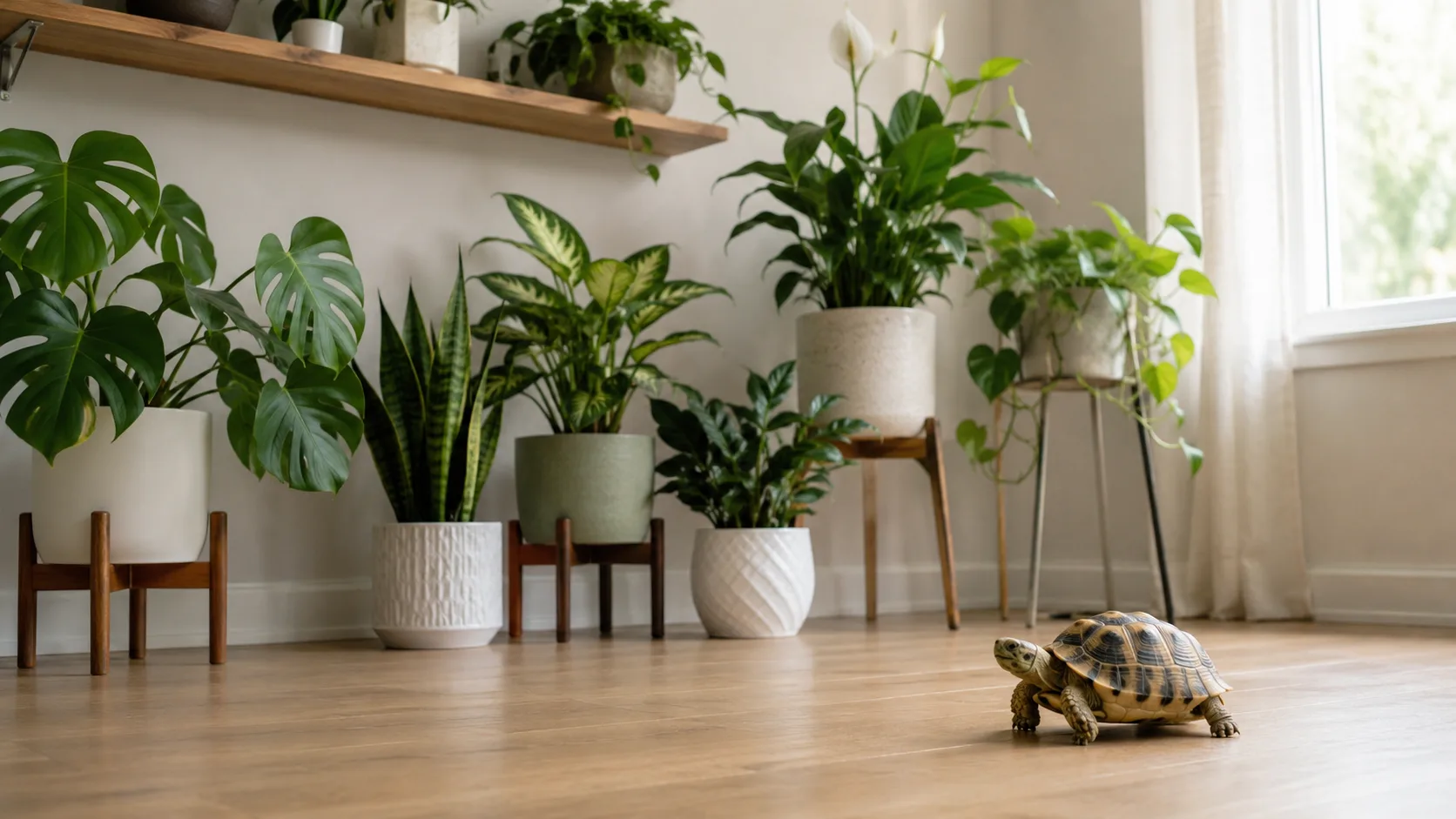
Tortoises do not “nibble once and move on” the way a curious cat might. They graze methodically on anything green within shell range—patio pots, porch planters, dropped cuttings, and houseplants beside an indoor pen. The ASPCA classifies many common ornamentals as toxic to cats, dogs, and/or horses because of insoluble oxalates, saponins, and other compounds. For herbivorous tortoises, those same plants are especially poor choices: repeated ingestion of oxalate-rich foliage can interfere with calcium balance over time, and any oral irritation that reduces eating is a serious concern.
This guide ranks eight frequently kept houseplants that carry ASPCA toxic listings and should be excluded from tortoise-access zones. For verified lower-risk grazing options, see Plants Safe for Tortoises. This page complements—not replaces—species-specific diet plans from a reptile veterinarian.
The eight ornamentals to remove first are pothos, philodendron, peace lily, dieffenbachia, ZZ plant, English ivy, aloe vera, and anthurium.
Why Tortoise Grazing Changes the Stakes
A decorative plant on a patio becomes forage the moment a tortoise roams supervised outdoor time. Low planters sit at perfect grazing height. Trailing pothos stems cross pen boundaries. Pruning debris on a deck looks like salad.
The ASPCA groups pothos, philodendron, peace lily, dieffenbachia, ZZ plant, and anthurium among insoluble calcium oxalate houseplants—compounds that cause oral pain and swelling in mammals. (ASPCA houseplants and pets) Tortoises lack the same clinical sign language as cats, but oral irritation can still suppress appetite—and a tortoise that stops eating needs reptile veterinary attention promptly.
Editor note (patio pens): The most common tortoise exposure we see in home setups is not an indoor houseplant—it is a pothos or philodendron in a porch planter placed six inches from a supervised roaming pen. Moving that one pot outside the shell-radius eliminates more risk than adding a second hide box.
When to Call a Reptile Veterinarian
Contact your reptile veterinarian if a tortoise grazes a known toxic ornamental and shows:
- Refusing food for more than one day (species-dependent urgency)
- Lethargy or prolonged hiding beyond normal routine
- Visible mouth irritation, bubbling, or repeated rubbing
- Diarrhea or noticeably abnormal stool
- Swelling around the head or neck
Save plant material for identification. ASPCA Animal Poison Control at 888-426-4435 can assist with plant ID and compound questions (fee may apply); follow with your reptile vet for species-specific care.
Quick Pick: Remove These First
Start with oxalate aroids: pothos, philodendron, peace lily, dieffenbachia, ZZ plant, anthurium—all ASPCA-listed toxic plants with shared irritant chemistry.
Remove English ivy from patio rails and low baskets; ASPCA lists ivy toxic to cats and dogs with saponin-related GI signs—exclude from tortoise grazing zones.
Relocate aloe vera from sunny patio ledges; ASPCA lists aloe toxic to cats and dogs.
How We Selected These Eight
We required ASPCA toxic listings and LeafyPixels care hubs for identification. We ranked by:
- Grazing reach — trailing or low growth intersecting pens and patios
- Indoor/outdoor prevalence — plants tortoise owners actually keep near roaming areas
- Oxalate and saponin severity — aroids and ivy-family species prioritized
- Conservative reptile safety — when ASPCA confirms toxicity in mammals, tortoises do not get a pass
Wild forage identification is a separate skill set; this page covers ornamentals only.
Toxic Ornamental Comparison Table (Tortoise Access)
Pothos
Safety status: Toxic — ASPCA golden pothos listing. (ASPCA golden pothos)
Grazing risk: Trailing stems at shell height on patios and indoor pens
Pothos is the most common “easy” plant—and the worst neighbor for a tortoise table. Oxalate crystals cause oral irritation in mammals per ASPCA; tortoises should never be offered Araceae houseplants as enrichment.
Safety note: All pothos cultivars share the genus; do not assume variegated forms are safer.
Action: Move pots beyond maximum roaming radius plus trailing stem length.
Useful care guides (for ID):
Philodendron
Safety status: Toxic — ASPCA philodendron listing. (ASPCA philodendron)
Grazing risk: Moss poles and hanging baskets beside outdoor pens
Soft philodendron leaves read as edible to grazing tortoises. Repeated bites accumulate oxalates.
Safety note: Climbing stems root easily in nearby soil—check for volunteer cuttings in pen substrate.
Action: Remove from any supervised outdoor session zone.
Useful care guides (for ID):
Peace Lily
Safety status: Toxic — ASPCA peace lily listing. (ASPCA peace lily)
Grazing risk: Floor pots moved outdoors in summer
Peace lilies tolerate shade patios—exactly where tortoises roam. Not a true lily, but still an oxalate aroid per ASPCA.
Safety note: White spathes drop and persist on decking.
Action: No peace lilies within tortoise roaming areas indoors or out.
Useful care guides (for ID):
Dieffenbachia
Safety status: Toxic — ASPCA dieffenbachia listing. (ASPCA dieffenbachia)
Grazing risk: Broad floor leaves at grazing height
Dieffenbachia causes intense oral irritation in pets per ASPCA. A tortoise that stops eating after sampling needs urgent vet care.
Safety note: Dispose of pruned leaves in sealed bins tortoises cannot tip.
Action: Exclude from pen-adjacent rooms.
Useful care guides (for ID):
ZZ Plant
Safety status: Toxic — ASPCA ZZ plant listing. (ASPCA ZZ plant)
Grazing risk: Low side tables beside indoor tortoise tables
ZZ plant’s waxy leaves still get sampled. ASPCA lists oxalate toxicity.
Safety note: Rhizomes are underground but leaves are the grazing target.
Action: Human-only rooms for ZZ plant storage.
Useful care guides (for ID):
English Ivy
Safety status: Toxic — ASPCA English ivy listing. (ASPCA English ivy)
Grazing risk: Porch rails, ground-cover planters
Ivy trails to grazing height and drops persistent leaves. ASPCA notes saponin-related toxicity.
Safety note: Confirm Hedera helix on plant tags.
Action: Remove ivy from tortoise patio sessions entirely.
Useful care guides (for ID):
Aloe Vera
Safety status: Toxic — ASPCA aloe listing. (ASPCA aloe)
Grazing risk: Sunny patio ledges during outdoor basking
Owners place aloe on sunny decks near tortoise basking zones. ASPCA lists aloe toxic to cats and dogs—keep away from tortoise grazing.
Safety note: Human medicinal use does not translate to tortoise forage.
Action: Separate basking zones from ornamental ledges.
Useful care guides (for ID):
Anthurium
Safety status: Toxic — ASPCA flamingo flower listing includes horses; toxic to cats and dogs. (ASPCA flamingo flower)
Grazing risk: Gift plants temporarily placed on patios
Anthurium’s stiff spathes attract investigation. ASPCA oxalate signs include oral pain and swelling.
Safety note: Often labeled “flamingo lily”—still Anthurium.
Action: Never leave gift plants in roaming areas unsupervised.
Useful care guides (for ID):
Audit Tortoise Access Zones
Measure shell-radius plus neck reach, then check:
- Patio and porch planters
- Indoor pen perimeters
- Dropped leaves and pruning debris
- Temporary gift plants after events
- Neighbor plants leaning through fence gaps
Verified safe grazing belongs on the tortoise-safe list—not on unverified décor.
Common Mistakes
Supervised roaming without scanning the patio first. One pothos pot negates supervision.
Assuming tortoises avoid bitter plants. Grazing behavior varies; do not test toxicity empirically.
Using houseplants as pen “shade décor.” Only verified safe species belong inside pens.
Trusting social-media “tortoise salad” mixes without ASPCA cross-check.
Delaying vet calls when appetite drops after grazing.
Conclusion
Tortoise plant safety means excluding ASPCA-toxic ornamentals from every grazing zone—indoor pens, patios, and supervised outdoor sessions. Pothos and philodendron top the removal list because trailing growth intersects shell paths constantly. Peace lily, dieffenbachia, ZZ plant, anthurium, English ivy, and aloe vera follow as common décor with verified ASPCA toxic listings.
Replace removed plants with verified options from plants safe for tortoises, and contact your reptile veterinarian if grazing occurs and appetite or behavior changes. When in doubt, assume the ornamental is toxic and move it before the next roaming session—not after the first bite.