Hydrangeas Dying or Done Blooming? How to Tell
Learn whether drooping, brown blooms, pale leaves, or brittle stems mean your hydrangea is finished flowering, heat-stressed, thirsty, or in trouble.
The fast triage: look at the whole plant, not one bloom
A hydrangea that suddenly looks lifeless is not automatically dying. A flower head can be finished while the shrub is healthy, and a plant can wilt dramatically during a hot afternoon even when the soil still contains usable moisture. The quickest way to separate normal fading from a real problem is to stop looking at the flower alone and check the plant twice: once in the late afternoon and again the next morning.
If the leaves and flower stems firm up after sunset or look much better before the day heats up, the plant is probably responding to temporary heat and transpiration stress. If it is still limp in the morning, the soil is dry several inches down, or decline is spreading from one branch to the rest of the shrub, you have a care or health problem to solve.
| What you see | More likely explanation | First move |
|---|---|---|
| Drooping only during the hottest hours, then recovery overnight | Temporary heat response | Check soil before watering; improve afternoon protection if it repeats |
| Brown or green flower heads with firm green leaves | Normal bloom aging | Leave them or deadhead lightly after identifying the type |
| Wilted in the morning with dry soil | Drought or root-zone dryness | Water slowly at the soil line and recheck the root zone |
| Wilted with wet soil, pale leaves, or soft stems | Drainage, root, or stem problem | Stop adding water and inspect drainage and tissue |
| Brittle stems, widespread dieback, or no recovery | Severe stress, winter injury, disease, or dead wood | Scratch-test several stems and seek local diagnosis if decline continues |
Recovering by evening usually means a heat response
Hydrangeas have broad, soft leaves that can lose water faster than roots replace it when the sun, heat, or wind peaks. Wilting reduces the leaf area exposed to that demand, so an otherwise healthy shrub may look dramatically floppy for a few hours. The University of Georgia’s CAES Field Report specifically cautions that afternoon wilt in hydrangeas does not always mean the plant needs water, and notes that plants often recover at night and look normal by morning (University of Georgia CAES Field Report).
That does not mean recurring wilt should be ignored. A plant that wilts every afternoon in a hot, exposed location may be telling you that its site is too bright, too dry, too windy, or too small for its root system to keep up. Treat overnight recovery as reassuring evidence, not as proof that the growing conditions are ideal.
Trouble that persists overnight deserves investigation
The warning sign is not simply “droopy.” It is droopy plus a second pattern: dry soil, brown crispy leaf edges, yellowing with wet soil, black or soft stems, spreading spots, or no improvement after the weather cools. A healthy flower can age at the same time that a root problem develops, so do not let the harmless-looking explanation for one symptom hide the more important one.
Use the morning check before reaching for fertilizer, fungicide, or pruners. If the plant looks better in the morning, test the soil before watering; if it looks worse, work through the checks below in order.
What a normal end of bloom looks like
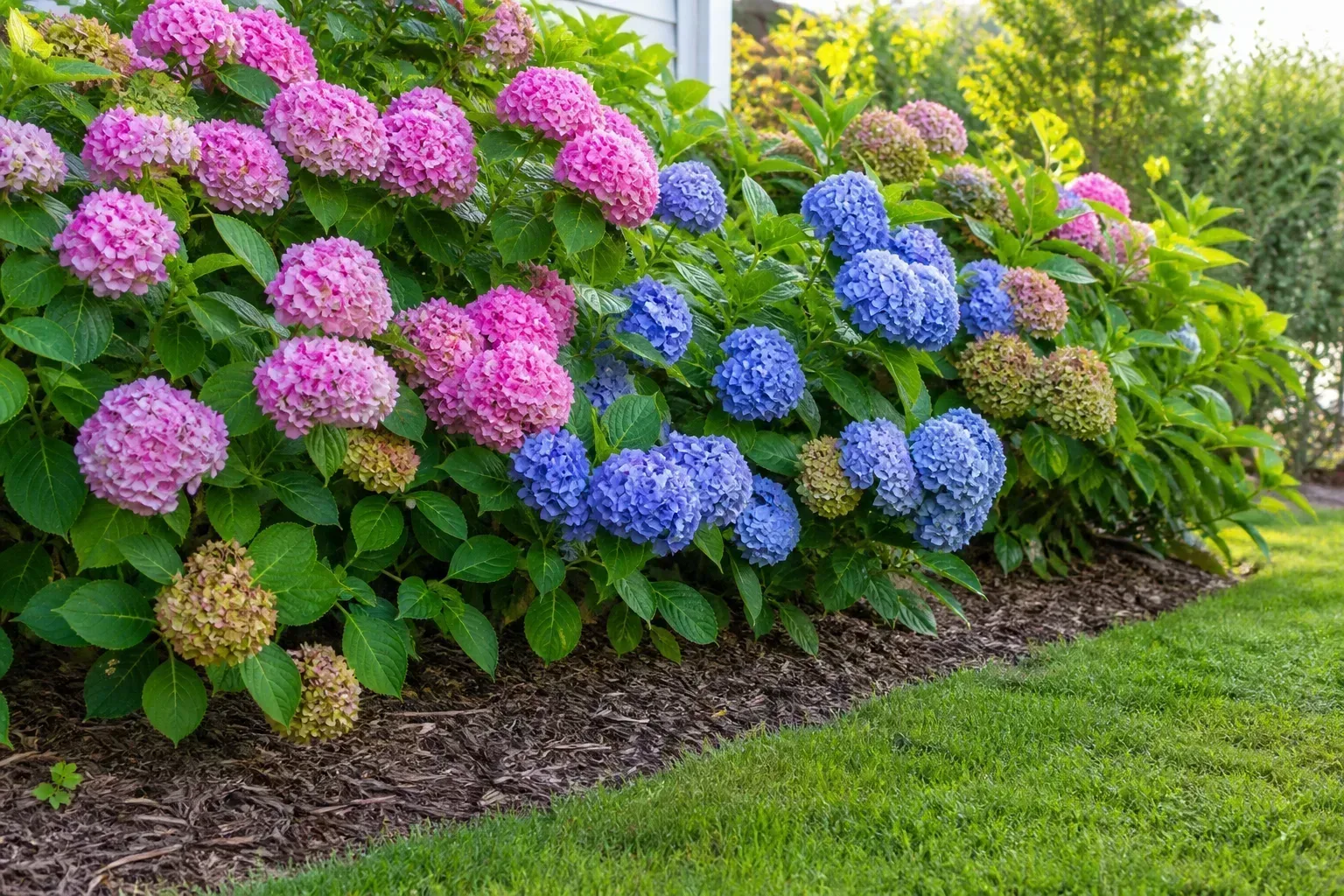
Hydrangea flowers do not always go from colorful to dead in one step. Many heads gradually shift from blue, pink, or white to green, rose, burgundy, tan, or parchment as they age. The flowers become papery and may droop under their own weight, but the leaves remain reasonably firm and green, stems stay flexible or woody rather than soft, and the plant continues producing or holding healthy growth.
White panicles can turn pink or brown as they mature; mopheads may become muted green or dusty rose. The Royal Horticultural Society notes that hydrangea flowers commonly change color as they age, especially in late summer, so color change by itself is weak evidence of a dying plant (RHS growing guide for shrubby hydrangeas).
The more useful distinction is slow, even aging versus sudden tissue damage. A flower head that fades over weeks while the shrub stays vigorous is likely done blooming. A head that browns quickly during a heat wave along with scorched leaves, persistent wilt, or new stem damage points to stress instead.
Do not expect dead petals to turn green again after watering. Water can prevent further dehydration and help living leaves recover, but it cannot reverse tissue that has already dried, browned, or been sun-scalded. Your goal is to protect healthy leaves, buds, roots, and stems—not to restore an old flower head.
Identify your hydrangea before changing care
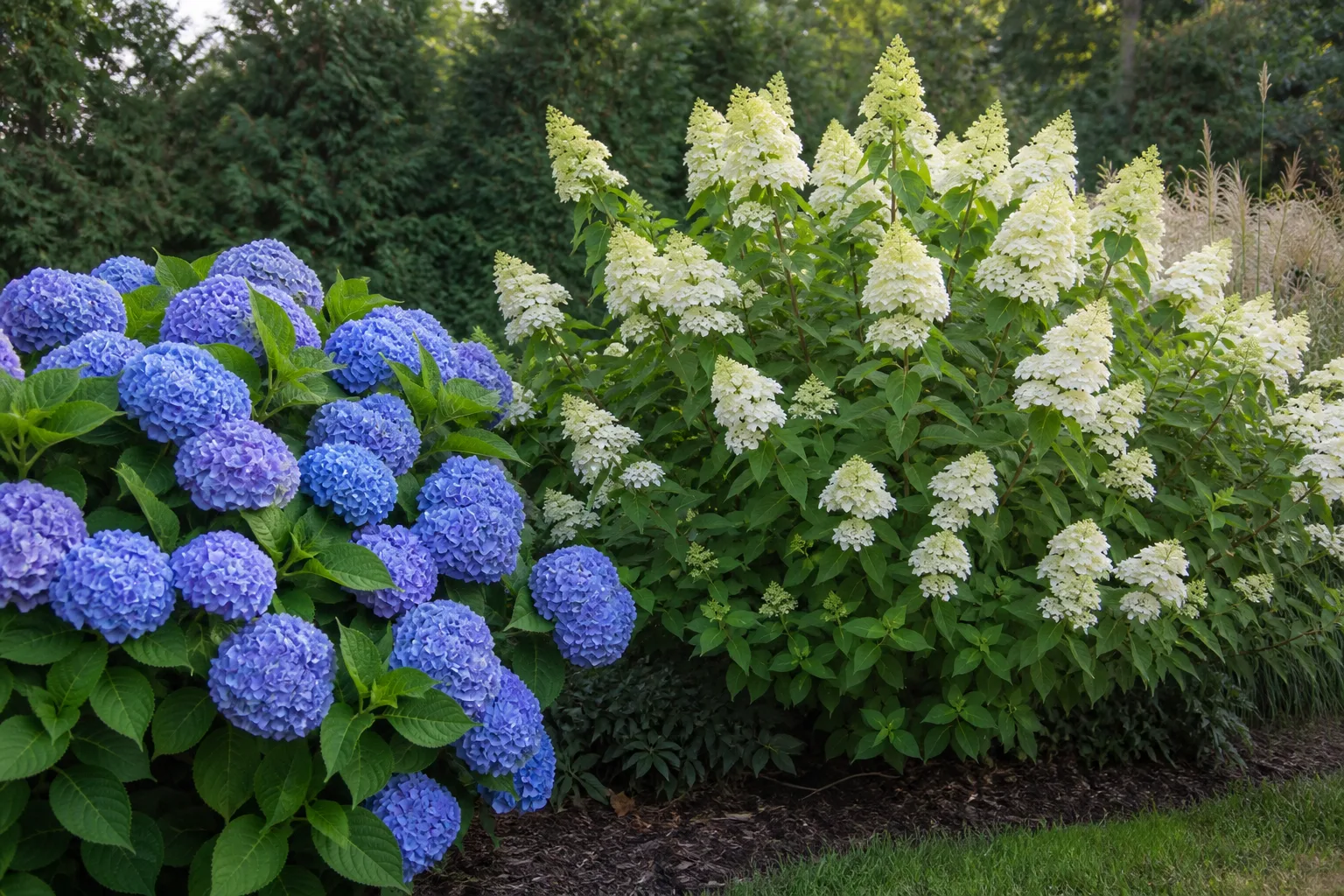
Hydrangea care becomes confusing when a mophead, oakleaf, panicle, and smooth hydrangea are all given the same pruning advice. Start with the plant tag, nursery listing, or purchase record if you have it. If not, use the flower and leaf clues as a working identification, then choose the more conservative option when you are uncertain.
Old-wood types need bud-preserving timing
Bigleaf or French hydrangeas (Hydrangea macrophylla), mountain hydrangeas (H. serrata), oakleaf hydrangeas (H. quercifolia), and climbing hydrangeas (H. anomala) commonly set flowers on stems made during the previous season. Those buds can be present before winter, which is why a late cut can remove next year’s display even when the shrub looks healthy today.
Bigleaf plants usually have broad leaves and round mophead or flat lacecap clusters. Oakleaf leaves resemble oak leaves and its flowers are typically cone-shaped; a climbing hydrangea is a woody vine rather than a freestanding shrub. The University of Illinois Extension explains that old-wood hydrangeas should be pruned soon after flowering because winter or late-season cuts can remove already formed buds (Illinois Extension hydrangea care).
If your old-wood hydrangea has finished flowering and it is already late summer, a faded flower is usually safer to leave than a deep cosmetic cut. This is especially true when you do not know the cultivar or when the plant grows in a cold, windy, or frost-prone site.
New-wood types and rebloomers follow different rules
Panicle hydrangeas (H. paniculata) have long cone-shaped flower clusters, while smooth hydrangeas (H. arborescens) often have rounded white or green-white heads. These groups form flower buds on new growth, so their main structural pruning is generally more flexible and is done in late winter or early spring rather than after summer flowering.
Some bigleaf and mountain cultivars are reblooming, also called remontant. They can flower on old and new wood, so they may produce a later flush after an early display—but that does not make every late-season cut safe. NC State’s Plant Toolbox describes reblooming bigleaf cultivars as capable of flowering later on new growth, while the species itself commonly flowers on the previous year’s growth (NC State Extension Gardener Plant Toolbox).
When the label is missing, treat the plant as an old-wood type until you can identify it. A cautious decision may leave a few dried flower heads in place, but a careless late cut can remove buds that are much harder to replace.
The four checks that separate fading from decline
Soil and roots tell you whether water is actually available
Push a finger or narrow soil probe several inches into the soil near the drip line, not directly against the main stems. Dry, loose soil supports a drought diagnosis; cool, saturated soil after several days without rain raises a drainage or root-health concern. The surface can look damp after a brief shower while the deeper root zone is still dry, so test beyond the mulch and crust.
For a container hydrangea, check the pot’s drainage hole and lift the container if possible. A pot that feels unusually heavy, stays wet for days, or has a blocked hole can produce wilt that looks like thirst because damaged roots cannot take up water normally. In-ground plants can have the same problem in compacted soil, low spots, or places where downspouts keep the root zone saturated.
Leaves, stems, buds, and flowers reveal the pattern
Use the plant’s pattern rather than one dramatic leaf. Dry, crisp brown margins or bleached patches after hot sun suggest heat, drought, or scorch. Soft yellowing with persistently wet soil suggests a different problem, while tan or purple-brown spots that multiply across leaves fit a disease pattern more than ordinary bloom fade.
Stems are equally informative. Green, flexible stems with healthy buds mean the plant has living structure even if some flowers are finished. Dry, brittle tips can reflect winter or drought damage; black, soft, collapsing tissue is more concerning for rot or severe injury. Penn State Extension lists brown or tan leaf spots, flower-bud loss, powdery growth, and other distinct disease patterns for hydrangeas, reinforcing why “it looks sad” is not enough for a diagnosis (Penn State Extension hydrangea diseases).
Look for buds at the ends and along the upper portions of old-wood stems as summer moves toward fall. Those small buds are a reason to stop cutting deeply, not a reason to remove more of the branch because it looks bare.
What to do this week if heat or drought is the cause
If the soil is dry and the plant is still alive, stabilize the root zone before you trim. Do not strip off every brown leaf or cut healthy stems to make a stressed shrub look tidy; green portions of a damaged leaf can still contribute energy while the plant recovers.
Water the root zone slowly and deeply
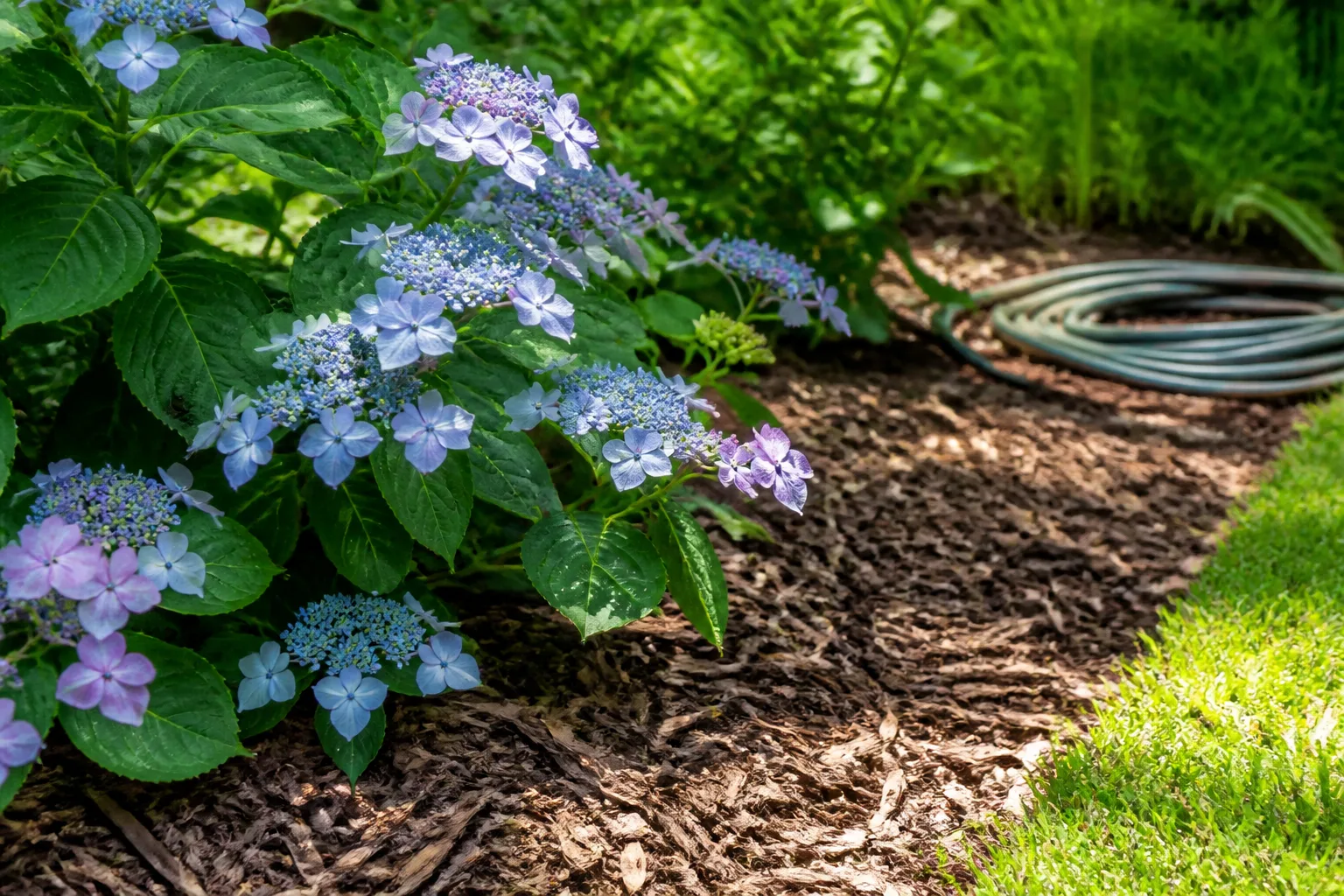
Apply water at the base of the plant and move around the root zone so moisture spreads through the soil rather than forming one wet spot at the crown. A slow hose trickle, soaker hose, or drip line is more useful than a fast splash that runs off compacted ground. Water in the morning when practical, keep foliage as dry as you can, and check the soil again before repeating the treatment.
The RHS recommends deep, thorough watering rather than little-and-often watering during hot weather, along with mulch to reduce moisture stress (RHS advice for hydrangeas in hotter summers). Container plants can dry far faster than shrubs in the ground, so use the moisture in the pot as your guide rather than copying an in-ground schedule.
Avoid watering every afternoon simply because the leaves droop at 4 p.m. If the soil is already moist and the plant recovers by morning, more water may reduce root oxygen and make the long-term problem worse.
Reduce afternoon exposure and mulch without burying the crown
Most hydrangeas perform well with morning sun and afternoon shade or dappled light, although the exact tolerance depends on species, climate, soil moisture, and cultivar. A container can be moved into bright dappled shade during an extreme heat spell; an in-ground shrub may need a temporary shade cloth or a longer-term site change after the season ends.
Spread a few inches of organic mulch over the root zone, keeping it several inches away from stems and the crown. Mulch should slow evaporation and moderate soil temperature, not create a wet collar around the plant. UGA’s bigleaf hydrangea guidance also recommends organic mulch for moisture conservation and warns that late-summer pruning can remove future flowers (UGA Cooperative Extension bigleaf hydrangea guide).
Do not fertilize a severely wilted or browning plant in an attempt to force a rebound. Feeding cannot repair scorched tissue or rotted roots, and a late push of soft growth can be poorly timed for a plant heading toward cold weather.
If the soil is wet but the shrub is still wilted
This is the point where “hydrangeas love water” becomes dangerous advice. A plant with saturated soil can wilt because damaged or oxygen-starved roots are no longer moving water effectively. Penn State’s guidance on root rot in woody ornamentals describes the combination of poor vigor, yellowing, dieback, and dark or decayed roots that can accompany root disease, and emphasizes diagnosis rather than treating every wilt with the same product (Penn State Extension root rot in woody ornamentals).
Stop routine watering while you assess drainage. For a container plant, confirm the drainage hole is open and do not let the pot sit in a saucer of standing water. For an established shrub, look for a low spot, compacted soil, irrigation overspray, or a downspout that keeps the root zone wet; moving water away from the plant may be more useful than adding amendments around the stem.
If you need to inspect a container root ball, healthy roots should be firm rather than slimy. Do not aggressively dig up a large established hydrangea on the basis of one limp afternoon. Persistent morning wilt, declining leaves, repeated stem dieback, and wet soil together justify a closer inspection or a sample sent to a local extension plant clinic.
If the plant is leafy but not flowering
A green hydrangea with few or no flowers is not necessarily dying. The most common explanation depends on its type: an old-wood hydrangea may have lost its flower buds to winter cold or an ill-timed cut, while a new-wood hydrangea may be dealing with insufficient light, excessive nitrogen, severe stress, or a pruning problem that delayed new growth.
Review what happened before you add fertilizer. Did the plant leaf out after a cold snap but fail to open buds? Was a bigleaf, mountain, oakleaf, or climbing hydrangea pruned in fall or winter? Was a nearby tree removed, exposing it to hot afternoon sun, or did another plant grow over it and reduce light? UGA lists winter injury, too much shade, excess nitrogen, and incorrect pruning among causes of poor flowering in bigleaf hydrangeas (UGA bigleaf hydrangea flowering guidance).
Do not assume a high-phosphorus fertilizer is the answer. Test the soil if fertility is genuinely in question, avoid repeated high-nitrogen feeding that encourages leaves over flowers, and match pruning to the plant’s bloom wood. If the shrub is healthy but simply finished with its seasonal display, more fertilizer will not create a second flowering cycle.
Deadhead, leave the blooms, or wait?
Deadheading is optional grooming, not emergency treatment. Remove a spent head when it is clearly finished and you want a tidier shrub, but do not use the flower as an excuse to shorten a long branch or reshape the whole plant. Make the smallest cut that removes the head, ideally just below it or above a healthy leaf pair, and use clean bypass pruners.
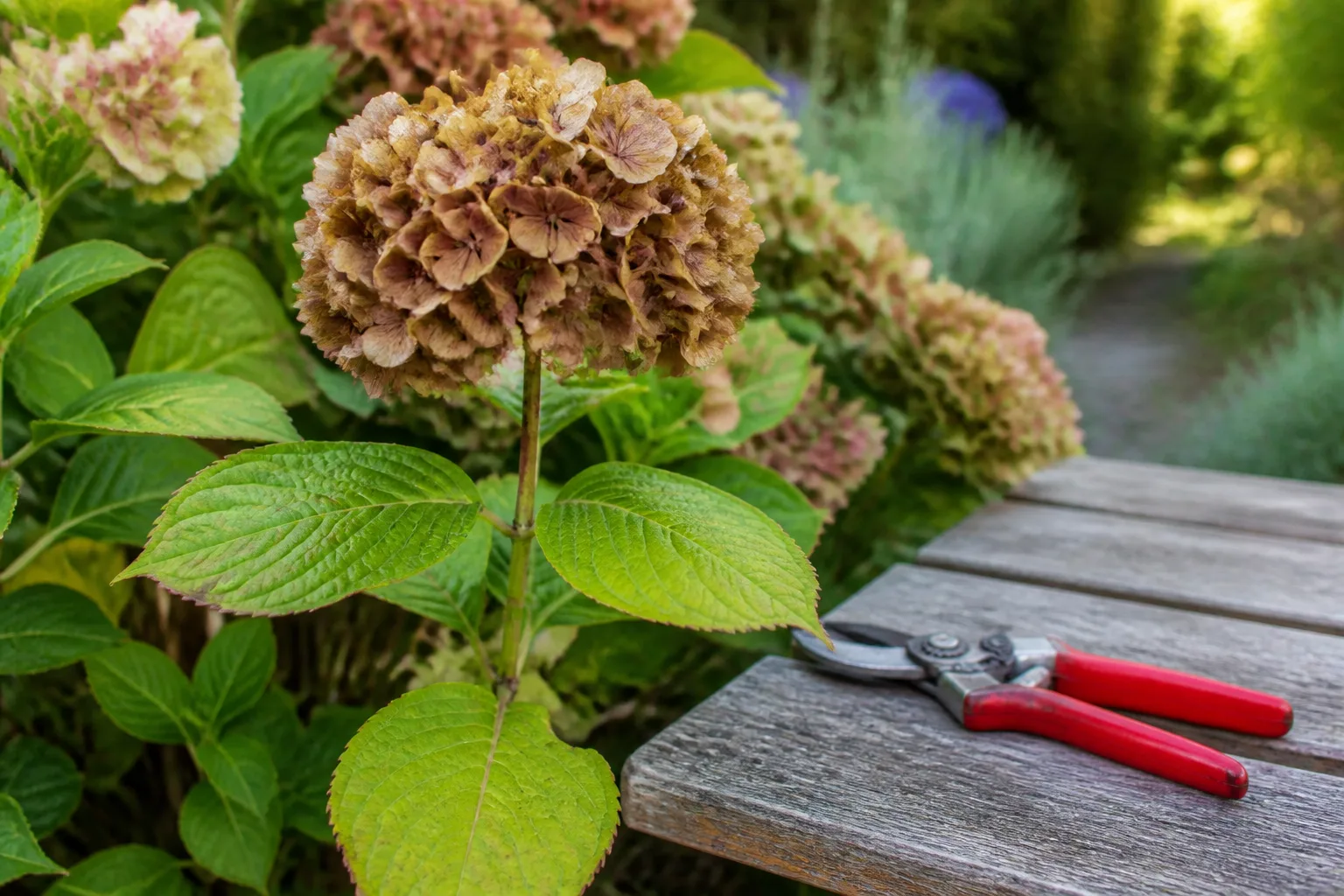
For a known old-wood mophead in a cold or exposed climate, leaving the dried head until late winter or early spring can protect tender buds and avoids a late-season mistake. The RHS recommends leaving mophead flowerheads over winter in many situations, while lacecaps can be cut back after flowering to the second pair of leaves; the appropriate choice depends on the group and local winter conditions (RHS hydrangea pruning guide).
For a panicle or smooth hydrangea, a light summer deadhead is usually a cosmetic choice because the plant flowers on new wood. For a rebloomer, removing a finished early flush may support a cleaner transition to later flowers, but stop making casual cuts once late summer arrives and remember that winter conditions and cultivar determine what returns.
If you cannot identify the hydrangea, if the plant is still stressed, or if the season is already late, leave the flower head. A brown bloom is less costly than removing a living tip that carries next year’s flowers.
Conclusion
To decide whether your hydrangeas are dying or done blooming, check the whole plant and the clock. A shrub that droops only in afternoon heat and recovers overnight may be coping with transpiration; a shrub that remains wilted in the morning, has dry or waterlogged soil, develops crispy leaves, soft stems, spreading spots, or progressive dieback needs a closer diagnosis.
Once you know whether the flower is simply aging and which hydrangea group you have, the next action becomes much clearer. Water dry soil slowly, protect the root zone from extreme heat, keep mulch off the stems, stop adding water to saturated soil, and avoid late pruning on old-wood or unidentified plants. Hydrangeas can look dramatic without being lost, but the reliable path back is careful observation and a targeted fix—not a bigger dose of water, fertilizer, or pruning.